Haymarket Affair (1886): The Chicago Bombing, Trial and Eight-Hour Day
How the eight-hour movement, a deadly bomb and a controversial trial changed labor history.
At a May 4, 1886 Chicago labor rally, a bomb exploded near approaching police and gunfire followed, killing officers and civilians. Eight anarchist activists were convicted in a controversial trial even though the bomb thrower was not identified. Four were executed in 1887; three surviving prisoners were pardoned in 1893. The event became central to international labor memory.
This guide separates the eight-hour-workday campaign, May 3 police shooting, May 4 explosion and subsequent trial.
On this page — 23 topics
What was the Haymarket Affair?
The Haymarket Affair was a series of events in Chicago in May 1886 that became central to the history of the American labor movement. A rally on May 4 was called after police had shot workers near the McCormick plant the previous day. As police advanced to disperse the gathering, someone threw a bomb into their ranks and gunfire followed, killing police officers and civilians. Authorities prosecuted eight men associated with anarchism and labor activism, even though the person who threw the bomb was never conclusively identified. The highly controversial trial, executions and later pardons transformed a local confrontation into an international symbol of workers’ rights and civil liberties.
Why were Chicago workers demanding eight hours?
Industrial laborers commonly worked long days under difficult and sometimes dangerous conditions. A shorter workday was a way to seek more time for families, education and ordinary life, as well as protection against exhaustion. Labor organizations called for coordinated action to make eight hours a standard without assuming that every employer would accept it voluntarily. The Federation of Organized Trades and Labor Unions supported May 1, 1886, as the beginning of a nationwide push for the eight-hour day. Chicago became a major center of the movement because its industrial workforce included large numbers of immigrants and active labor organizations. Not every participant shared the same political views.
What happened on May 1, 1886?
Workers across the United States joined strikes, marches and demonstrations associated with the eight-hour demand on May 1. Chicago saw particularly large mobilization, with unions, socialists, anarchists and other supporters taking part. Some workplaces reached agreements while others faced serious conflict. The date later became internationally important, but it did not immediately establish an eight-hour legal standard for all American workers. The campaign placed questions of wages, working hours and the legitimacy of collective action in the national spotlight. Explaining that wider context is important because the Haymarket rally three days later did not begin as a plan to throw a bomb at police.
What happened at McCormick on May 3?
On May 3, tensions rose at the McCormick Reaper Works, where striking workers and strikebreakers were involved in confrontation. Chicago police fired into a crowd, killing workers and wounding others. Contemporary counts differ in some accounts, but the violence was widely condemned by labor activists. August Spies, an anarchist newspaper editor and organizer, helped promote a protest meeting in response. The McCormick incident is essential to the chronology: the May 4 rally was called to denounce police violence against workers. Without it, an account that begins with the bomb alone can make the gathering appear inexplicable and conceal the conflict over labor rights and policing.
Why was a rally organized at Haymarket Square?
Organizers advertised a meeting near Haymarket Square to protest the events at McCormick and encourage solidarity among workers. The meeting occurred on the evening of May 4, with speeches from prominent labor activists. Contemporary accounts describe an initially peaceful gathering, and attendance decreased as rain approached. The presence of anarchist speakers did not make every person in the crowd a supporter of political violence. Labor organizations included competing ideas about reform, revolution and the use of strikes. The purpose of the advertised rally and the circumstances under which it ended must be distinguished from the unknown motives of whoever threw the explosive device.
Who spoke at the meeting?
August Spies and Samuel Fielden were among the best-known speakers, and Albert Parsons also addressed the gathering. The speeches criticized police conduct and the conditions faced by workers. Reports of their exact wording and tone vary among newspapers and trial records, and later summaries sometimes select only the most inflammatory language. Attendance fluctuated throughout the evening, and not all listeners stayed until the arrival of police. Studying the published handbills, transcripts and accounts of witnesses helps explain the meeting as an organized political protest. It also shows why courts later faced difficult questions about whether speech and association were being treated as evidence of responsibility for a separate violent act.
When was the bomb thrown?
Late on May 4, officers approached the rally and ordered the remaining crowd to disperse. A bomb was thrown toward the police, exploded and caused casualties. Gunfire followed amid confusion, but accounts disagree about the precise sequence and about who fired particular shots. The bomb’s thrower was never reliably established. The incident occurred after a period of speeches rather than at the opening of the meeting. Several police officers died directly or from injuries later, and civilians were also killed. The violent aftermath made headlines and gave authorities grounds for an aggressive campaign against labor radicalism in Chicago.
Who threw the Haymarket bomb?
The identity of the person who threw the bomb remains unresolved. Despite the prosecution of eight men, historians have not established that any of those convicted personally threw it. The central trial theory relied on claims of a broader conspiracy and on speeches, publications and organizing activity rather than a demonstrated connection between each defendant and the device. Several individuals were not at the meeting when it exploded. Claims naming a specific thrower should be treated cautiously unless the supporting evidence is explicit and credible. The uncertainty is one reason the Haymarket trial remains a major case study in the intersection of political belief, criminal responsibility and public fear.
How many people died?
Seven Chicago police officers ultimately died from wounds connected with the bomb and ensuing gunfire, according to major historical summaries, though accounts differ on the immediate death count. Civilians were also killed, with the number uncertain because contemporary sources and later compilations diverge. More people were wounded on both sides. It is inaccurate to describe the blast as having killed all seven police officers instantly or to imply that no workers died. The event involved both a violent attack and the wider gunfire that followed. A precise death toll should identify which category and time period is being counted, rather than repeating an unexplained total.
Why were anarchists blamed?
Chicago had a visible anarchist labor movement whose members criticized concentrated wealth, political authority and police violence. Many newspapers and officials connected the Haymarket bombing to these views before the criminal investigation was complete. The word anarchist became a broad label through which authorities and commentators could express fear of immigrant radicalism. Some activists did promote revolutionary ideas, but political beliefs by themselves do not establish participation in a specific bombing. The prosecution and wider repression occurred in an atmosphere of intense public anger. This context matters when evaluating why eight defendants faced capital charges despite the uncertainty surrounding the actual bomb thrower.
Who were the Haymarket Eight?
The eight defendants were August Spies, Albert Parsons, Adolph Fischer, George Engel, Louis Lingg, Samuel Fielden, Michael Schwab and Oscar Neebe. They were associated to varying degrees with anarchist politics and labor organizing. Their roles in the movement were not identical, nor were all present during the explosion. The trial became a public test of whether radical speech and association could be used to hold people responsible for violence committed by an unidentified actor. Some newspapers presented the men as already guilty, while supporters argued that the proceeding was shaped by prejudice and fear. Identifying the defendants individually avoids treating them as one indistinguishable group.
What happened at the 1886 trial?
The men were tried in Chicago on charges tied to the killing of a police officer. Prosecutors argued that the defendants’ advocacy of violence and participation in radical groups had encouraged or assisted the attack. Critics pointed to questionable evidence, hostility toward the defendants and serious concerns about jury selection. The jury convicted all eight. Seven initially received death sentences, and Oscar Neebe received a prison term. Later legal assessments and political actions cast doubt on the fairness of the proceedings. It is important to distinguish the legal verdict from proof that each accused person personally prepared or threw the bomb, which the prosecution did not establish.
Which men were executed?
August Spies, Albert Parsons, Adolph Fischer and George Engel were executed on November 11, 1887. Louis Lingg died by suicide in his cell shortly before the planned execution. The death sentences of Samuel Fielden and Michael Schwab were commuted to imprisonment, while Oscar Neebe had received a prison term. The executed men became known as the Haymarket Martyrs among labor activists and supporters. Those descriptions reflect the memory of the controversial trial and its effect on labor movements. The tragedy also illustrates how a criminal prosecution can create a lasting political symbol when the underlying evidence and fairness of the proceeding remain strongly contested.
What did Governor John Peter Altgeld do in 1893?
Illinois governor John Peter Altgeld pardoned the surviving three defendants—Samuel Fielden, Michael Schwab and Oscar Neebe—in 1893. His decision was based on serious concerns about the fairness and conduct of the trial. It did not resurrect the executed men or identify the bomb thrower. The pardons were politically controversial because Haymarket remained associated with fears of radicalism and public disorder. They nevertheless became an important marker in reassessing the convictions. The fact that the defendants were pardoned after the event helps explain why many historical accounts treat the trial as a miscarriage of justice rather than an uncomplicated criminal case.
How did newspapers influence the reaction?
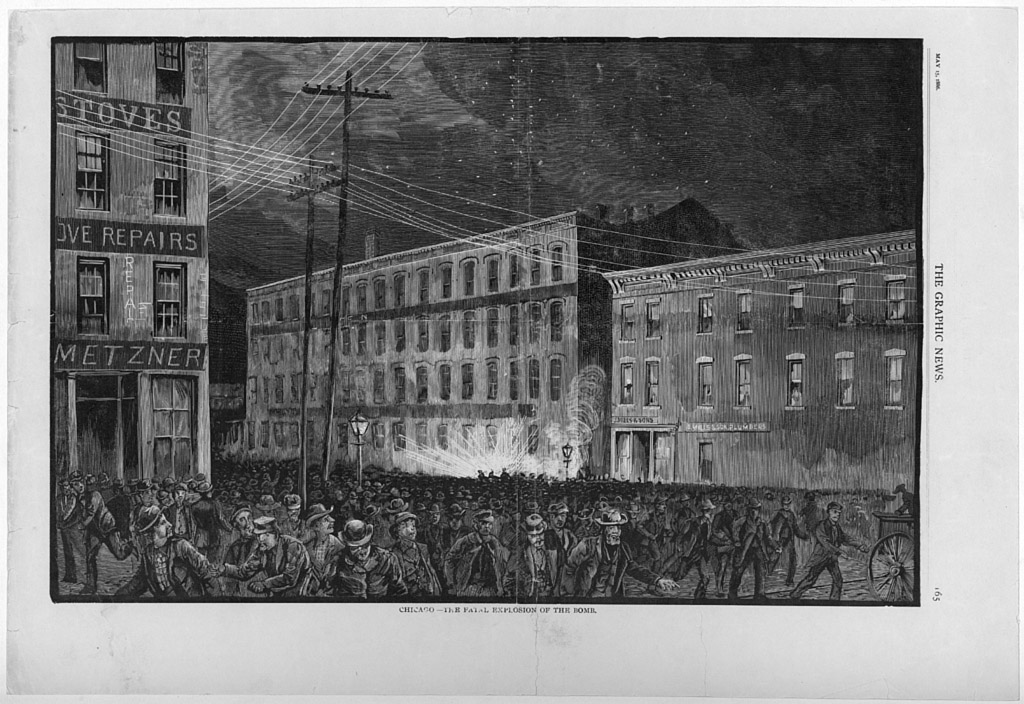
Chicago newspapers reported rapidly and often adopted strong political positions. Some emphasized the bomb and officer deaths, while labor publications focused on the earlier shootings and concerns about civil liberties. Editors’ descriptions of anarchists and immigrants could intensify prejudice. Illustrations of the explosion, including the one accompanying this article, are historical interpretations created for readers and not photographic records of the exact moment. Comparing different newspapers with surviving court documents and police records reveals how an event became a public narrative. The Chicago History Museum’s digitized collection is valuable because it preserves materials from multiple sides of the dispute.
What happened to Chicago’s labor movement?
The bombing, arrests and trial weakened radical organizations and created a climate in which employers and officials could associate labor protest with dangerous extremism. Some unions distanced themselves from anarchist groups, while other activists remembered the convicted men as victims of injustice. The broader demand for an eight-hour day did not disappear. Workers continued organizing through different unions and political movements. The episode therefore had contradictory effects: it frightened some supporters away from collective action and inspired others to strengthen the labor movement. Its long legacy is not limited to a single evening of violence or a list of criminal defendants.
What is the connection with International Workers’ Day?
International labor activists came to commemorate May 1 in connection with the eight-hour movement and the events surrounding Haymarket. The annual observance became known as International Workers’ Day or May Day in many countries. Its connection is with the 1886 labor mobilization and later memory of the defendants, not an assertion that the bomb exploded on May 1. In the United States the federal Labor Day holiday falls in September and developed through a different sequence of organizing and political decisions. Confusing the two observances can obscure both histories. Haymarket nevertheless became an internationally recognized symbol of working-time demands and labor solidarity.
Why is Haymarket considered a civil liberties case?
The case raised questions about the distinction between expressing radical political opinions and participating in a criminal act. Prosecutors relied heavily on the defendants’ writings, speeches and associations, while the bomb thrower was not identified. The trial’s fairness, including jury selection and prejudicial atmosphere, remained under challenge. Historians have therefore studied the incident as an example of how political panic can affect the administration of justice. That perspective does not minimize the death of police officers or justify bombing civilians. It means that responsibility for a violent act must be established by evidence, not simply inferred from unpopular beliefs or membership in a political organization.
Where is the Haymarket Martyrs’ Monument?
The Haymarket Martyrs’ Monument stands in Forest Home Cemetery in Forest Park, Illinois. Dedicated in 1893, it memorializes the men executed after the trial and became a place of remembrance for labor activists. The National Park Service recognizes its historical importance. The monument is different from the public memorial near the original Chicago rally site, and visitors should not assume they are the same location. Its design and later commemorations reflect the growth of an international memory of Haymarket. Examining the monument alongside contemporary newspaper coverage shows how the interpretation of the event changed long after the courts issued their verdicts.
What are the most important primary sources?
The Chicago History Museum’s Haymarket digital collection includes handbills, contemporary photographs, printed materials, trial-related documents and a detailed chronology. The Library of Congress newspaper guide provides links to period reporting, while the National Park Service interprets the Haymarket Martyrs’ Monument. These sources help distinguish the May 3 McCormick shooting from the May 4 bombing and the trial conducted later in 1886. They also illustrate why exact quotes, death counts and claims about the bomb thrower require caution. A documentary approach gives readers more than a sensational description of a single explosive event.
Haymarket chronology
| Date | Event |
|---|---|
| May 1, 1886 | Nationwide demonstrations for eight-hour workday. |
| May 3, 1886 | Police fire on workers at McCormick plant. |
| May 4, 1886 | Haymarket rally ends with bomb and gunfire. |
| 1886 | Eight activists convicted following controversial trial. |
| November 11, 1887 | Four defendants executed. |
| 1893 | Illinois governor pardons three surviving prisoners. |