Exodusters of 1879: Why Black Families Migrated to Kansas
Why thousands of African Americans left the South for Kansas and what they encountered after arriving.
The Exodusters were African Americans who migrated from Southern states to Kansas and other western destinations in the late 1870s, especially during the 1879 Kansas Fever Exodus. They sought safety, land and opportunity after Reconstruction weakened, but travel and settlement often proved expensive and difficult.
This guide explores Benjamin Singleton, Nicodemus, St. Louis relief, homesteading and the broader migration’s causes and effects.
On this page — 22 topics
Who were the Exodusters?
The Exodusters were African Americans who migrated from Southern states, especially Louisiana and Mississippi, toward Kansas and other western destinations during the late 1870s. Their movement became particularly visible in 1879, when thousands left regions where violence, political exclusion and economic dependency constrained life after Reconstruction. The name invoked the biblical Exodus and the hope of reaching a place where families could live with greater independence. The movement was not one officially organized train or federal resettlement program. It consisted of households and groups traveling through different routes, sometimes with little money and incomplete information about conditions ahead. It represents an important chapter of Black migration before the better-known Great Migration of the twentieth century.
Why did people leave the South?
After Reconstruction weakened, Black farmers and workers in parts of the South faced political violence, discriminatory treatment, insecure employment and difficult credit arrangements. The rise of Democratic state governments hostile to Black Republican participation created additional concerns about voting and personal safety. Many families had worked for years without acquiring land and saw little prospect of economic independence. The desire to leave was therefore based on both specific threats and longer-term goals. Some migrants hoped to escape landlords and merchants, while others sought schools, religious freedom or safer communities. The movement should not be described as a spontaneous panic without deliberate planning: letters, church networks and family discussions helped people weigh the risks of leaving familiar places.
Why did Kansas attract migrants?
Kansas held symbolic importance because of its antislavery history, including the conflicts known as Bleeding Kansas and the reputation of abolitionist John Brown. It also offered the possibility of obtaining farmland under federal and state land laws. Stories from earlier Black settlers and land promoters suggested that families might build communities with more autonomy than they had enjoyed in the South. However, available land was not always fertile or free, and living conditions could be harsh. Kansas should not be portrayed as an uncomplicated promised land. The attraction lay in a combination of history, legal possibilities and stories circulating through Black communities. Individual choices varied depending on resources, relatives and information received from those already in the West.
What happened during the 1879 migration?
The year 1879 saw a much-publicized increase in African American migration from the lower Mississippi Valley. Families traveled by steamboat, railroad, wagon and other available means toward Missouri and Kansas. Some arrived with few possessions, expecting assistance that was not always available. The National Park Service describes about 6,000 migrants in the central 1879 exodus from Louisiana, Mississippi and Texas, while larger population changes across the 1870s also reflected earlier migration. These figures refer to different timeframes, so they should not be combined without qualification. The movement drew national press attention and provoked debate over whether Southern violence and unequal opportunities had made life intolerable for Black citizens who were theoretically free.
What was the Kansas Fever Exodus?
The phrase Kansas Fever reflected the excitement and urgency generated by rumors, letters and stories about western opportunities. Some accounts promised inexpensive or available land and greater safety. A number of families expected transportation or support to be provided by federal or charitable organizations, only to discover that travel and resettlement required money they did not possess. Newspapers amplified both hopeful and hostile narratives. The word fever should not be read as evidence that migrants lacked reason or were easily manipulated. The pressures driving departure were real, and decisions often involved difficult choices about selling possessions, separating temporarily from relatives or traveling with children into an unfamiliar region.
Who was Benjamin ‘Pap’ Singleton?
Benjamin “Pap” Singleton was an African American organizer and promoter of migration to Kansas during the 1870s. He encouraged Black communities to establish independent settlements and acquire land away from the power of former slaveholders. His work predated the large 1879 movement and contributed to the broader tradition of organized Black western settlement. Singleton’s colonies and promotional efforts should not be confused with the idea that he personally directed every Exoduster household. Many migrants traveled through other networks or made independent decisions. His importance lies in articulating land ownership and community self-determination as responses to racial inequality in the South. He became a highly visible representative of a movement whose organization was actually decentralized.
What happened in Louisiana after the 1878 elections?
Political changes in Louisiana contributed significantly to the decision to leave. The National Park Service describes how Democratic gains in the 1878 elections followed intimidation, violence and coercion directed at Black voters and Republican supporters. For many families this confirmed that federal constitutional guarantees could not be relied on for local protection. The withdrawal of federal support from contested Southern Republican governments in 1877 had already altered the political landscape. Migration offered one way to respond when remaining in the region seemed to promise little security. The Compromise of 1877 guide explains the broader national political transition, while the Exoduster movement shows how individuals and families responded to its practical consequences.
How did families travel toward Kansas?
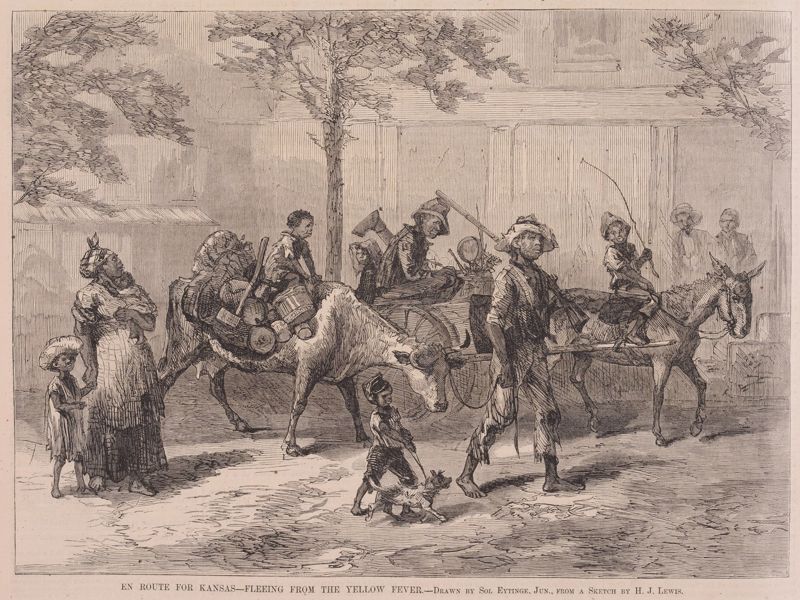
Travel routes varied, but the Mississippi and Missouri Rivers were especially important for people leaving Louisiana and other Southern states. Families boarded steamboats or traveled to river towns where they hoped to continue by rail or boat. Some migrants reached St. Louis and discovered that onward transportation was more difficult or expensive than expected. Others traveled in smaller groups overland. The journey could be exhausting for children, older adults and people carrying limited food. Historical illustrations show carts, luggage and crowded assistance centers, but not every picture documents a particular named family. Understanding transport routes helps explain why stopping places such as St. Louis became important to the movement’s history.
What happened to migrants in St. Louis?
St. Louis became a major transit point, and the arrival of numerous migrants created an urgent need for food, shelter and assistance. The National Park Service reports that roughly 20,000 Exodusters passed through the city during 1879 and 1880, though not all continued to Kansas and this broader figure should be distinguished from narrower counts of the 1879 exodus. Black religious and civic organizations organized relief, including food and clothing. Some steamboat operators refused to provide transportation, leaving families stranded. These events demonstrate that migration required local networks of mutual aid as well as personal determination. They also remind readers that even journeys undertaken to escape racial discrimination encountered new obstacles at intermediate destinations.
Who helped migrants in St. Louis?
The city’s Black community established and supported committees to provide practical aid. Reverend John Turner and other organizers raised money and arranged food, clothing and places to stay. Charlton Tandy helped lead additional relief efforts. Churches played a central role because they offered meeting spaces and connections among families and donors. Their work was not a comprehensive government welfare service; volunteers faced limited resources and a changing number of arrivals. Migrants sometimes had to remain in the city while trying to secure transport farther west. The National Park Service study of Black life in St. Louis documents these efforts and situates them within the city’s wider African American community.
What was Nicodemus, Kansas?
Nicodemus was an African American settlement founded in northwestern Kansas in 1877. It became one of the most important surviving examples of Black homesteading and community building on the Great Plains. Some residents arrived before the height of the Exoduster movement, and later migration brought additional attention to Black western settlements. Families faced difficult farming conditions, limited supplies and the challenge of establishing businesses and schools far from established markets. Nicodemus should not be described as a town founded by all Exodusters together in 1879. Its history belongs to the earlier and broader movement of African Americans seeking land and collective independence in the West.
Did migrants receive free farmland?
Federal homestead legislation could offer eligible settlers opportunities to acquire land by living on and improving a claim, but the process involved rules, costs and considerable risk. Land was not automatically handed to every migrant arriving in Kansas. Settlers needed tools, seed, housing and means of surviving until crops could be harvested. Some land proved less suitable than promoters had promised, and access to transportation or markets could be poor. The possibility of eventual ownership was attractive to people accustomed to sharecropping, but success was never guaranteed. A useful comparison is the sharecropping system, where families usually worked land owned by someone else and often faced merchant debt.
How did drought and farming conditions affect settlement?
Kansas offered substantial agricultural opportunities, but Great Plains weather was demanding. Drought, heat, harsh winters and the difficulty of cultivating unfamiliar soil could threaten new homesteads. Many migrants arrived without enough money to purchase livestock, machinery or durable housing. Communities sometimes depended on charitable support while trying to establish crops and businesses. Some families remained and gradually improved their circumstances, while others moved again when their first settlement proved unsustainable. It would be misleading to measure the entire movement only through people who became successful landowners. The historical record includes hardship, return migration, new urban livelihoods and the gradual development of Black institutions in the West.
Did white Kansans welcome the Exodusters?
Responses varied. Some residents, abolitionist sympathizers and churches welcomed Black settlers or helped provide assistance. Others expressed prejudice or feared economic competition, and some communities had limited capacity or willingness to support new arrivals. Migrants confronted the practical difficulty of finding employment and housing as well as social discrimination. Kansas’s antislavery reputation therefore did not mean that racial equality was guaranteed. The contrast between expectation and reality appears repeatedly in contemporary reports and later histories. A careful account does not replace the danger of the South with a fantasy of a completely prejudice-free West. The movement’s significance lies in the choices migrants made despite the uncertain reception and the effort required to build communities.
How did Southern landowners react?
Many white Southern employers and landowners opposed the migration because it threatened a labor force on which the plantation economy depended. Some local officials and employers attempted to discourage departures, while newspapers blamed promoters or exaggerated claims about conditions in Kansas. Those reactions revealed the tension between formal freedom of movement and economic systems that relied on keeping workers in place. Migrants insisted that they had the right to seek a better life elsewhere. Political disputes over migration also reflected wider struggles about whether the promises of emancipation included the practical freedom to choose one’s residence and employer. Restrictive actions by individual landowners should not be mistaken for a universal national ban on the movement.
Did Congress investigate the Exodus?
A United States Senate committee investigated the movement during 1880, hearing testimony about reasons for migration and conditions in the South. The proceedings became highly partisan, with politicians disagreeing about the extent of violence, the role of migration promoters and the responsibilities of national government. The hearings nevertheless preserved valuable testimony from migrants and officials. They are a reminder that contemporaries recognized the Exoduster movement as a political question rather than simply a series of private relocations. Researchers should examine the testimony critically because witnesses held different interests and did not experience conditions uniformly. The investigation did not produce one simple remedy for the problems that had prompted families to leave.
Was this the same as the Great Migration?
No. The Exoduster movement of the late 1870s preceded the larger Great Migration of African Americans from the South to Northern and Western cities during much of the twentieth century. Both involved escape from discrimination and the search for greater economic opportunity, but the destinations, transport networks and labor markets differed. Many Exodusters sought farmland or small western communities, while later migrants often entered industrial or service employment in expanding urban centers. The two movements belong to a longer history of Black agency and mobility after emancipation. Recognizing their distinctions avoids compressing generations of migration into one continuous event with identical causes and outcomes.
What do historical images reveal?
The nineteenth-century engraving accompanying this guide shows African American migrants traveling with belongings toward Kansas. Such illustrations are useful evidence of how the Exodus was represented to newspaper readers. They cannot establish the identities or routes of every person depicted, and artists sometimes emphasized dramatic scenes. Photographs of early settlements, including Nicodemus, provide complementary evidence about housing and family life. When used with letters, government reports and oral histories, visual sources help reconstruct the movement’s experience. The National Park Service Exodusters history includes images and accounts explaining migration and settlement. Historical artwork should always be identified accurately rather than passed off as a contemporary photograph.
Why are the Exodusters important to American history?
The movement demonstrates that Black Americans responded actively to Reconstruction’s rollback by seeking new communities, land and personal security. Families did not wait passively for national politicians to restore rights that local violence made difficult to exercise. Migration imposed significant costs and offered no guarantee of prosperity, but it asserted a fundamental freedom of movement and the possibility of self-determination. The histories of Nicodemus, St. Louis relief efforts and individual homesteads connect national political decisions to everyday choices. The Exodusters also challenge a narrow geographic understanding of African American history as a story confined to the South and a few Northern cities. Their journeys made the West part of the continuing struggle over freedom and citizenship.
Exodusters movement timeline
| Period | Development |
|---|---|
| 1870s | Earlier Black migration and organized settlement in Kansas. |
| 1877 | Nicodemus founded. |
| 1878 | Political intimidation and Southern elections increase pressure to leave. |
| 1879 | Kansas Fever Exodus draws national attention. |
| 1879–1880 | St. Louis organizations assist migrants; some remain or move onward. |
| 1880 | Congress investigates the causes of the Exodus. |