Black Codes (1865–1866): Southern Laws After Slavery Explained
How Southern laws restricted labor, movement and legal rights after emancipation.
Black Codes were laws passed by Southern governments after the Civil War that attempted to restrict Black freedom through rules affecting employment, vagrancy, courts and family life. Their provisions varied by state, but their discriminatory effects helped lead Congress to enact the Civil Rights Act of 1866 and stronger Reconstruction measures.
The laws were not identical in every state. This guide separates specific legal mechanisms from the broader struggle over freedom.
On this page — 20 topics
What were the Black Codes?
Black Codes were state and local laws adopted in parts of the post-Civil War South that restricted the rights and independence of Black residents. The name is particularly associated with laws introduced in 1865 and 1866 by governments restored under President Andrew Johnson. Their exact provisions varied: some targeted labor contracts and vagrancy, while others affected court testimony, occupations, movement and apprenticeship. They did not simply revive the old slave codes word for word, because slavery had been abolished. Instead, they attempted to preserve forms of racial and economic control within a new legal framework. Historians study them to understand why formal emancipation did not immediately bring equal citizenship, and why Congress moved toward stronger federal civil-rights legislation.
Why were they passed immediately after slavery?
The abolition of slavery threatened the plantation system’s established structure of work, property and authority. Former slaveholders still controlled large areas of land and often retained influence over local courts, police and government. Many wanted to secure a dependable supply of agricultural labor and prevent workers from leaving for better opportunities. Newly freed families, by contrast, sought wages, family autonomy, education and land of their own. The resulting conflict was not only economic: white supremacy shaped assumptions about who could move freely, own weapons, testify or participate in politics. State legislatures enacted laws that appeared to regulate ordinary civic life but applied unequal burdens to African Americans. Those restrictions attracted increasing scrutiny from federal officials and the national press.
Did every Southern state pass the same laws?
No. The details differed among Mississippi, South Carolina and other former Confederate states. Some rules existed in formal statewide statutes; others were enforced through local ordinances, contract practices or the discretion of county officials. Mississippi enacted prominent legislation in late 1865 that addressed employment and vagrancy, while South Carolina restricted certain occupations and other activities. Treating every law as a single uniform code conceals differences that mattered to people trying to navigate the courts. A sound historical account identifies a particular state, year and legal provision before describing its impact. The broader pattern was unmistakable, however: political leaders sought to limit Black independence even after the national government had ended slavery as a legal institution.
What were vagrancy laws?
Vagrancy laws punished behavior described as idleness, wandering, unemployment or a failure to maintain recognized employment. Such laws had older precedents, but discriminatory enforcement made them especially powerful during Reconstruction. Officials might arrest freedpeople for lacking a contract or for being away from a workplace, even if they were seeking better wages or visiting relatives. Fines and other penalties could pressure people to accept employment conditions they did not want. In some jurisdictions fines or criminal convictions also intersected with forced labor arrangements. The crucial point is not that every law explicitly said Black workers must return to a former enslaver. It is that unequal policing could make ordinary exercise of freedom legally risky for people without land or money.
How did labor contracts become a source of control?
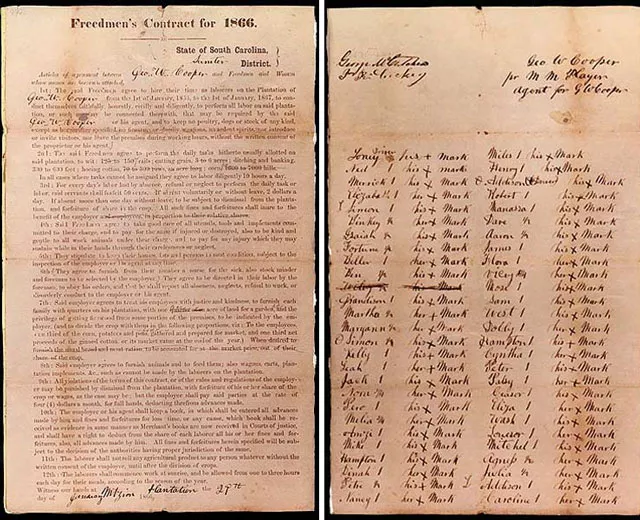
After emancipation, plantation owners and workers negotiated agreements for wages, crop shares, housing and supplies. Written contracts could protect a worker by recording what an employer promised to pay, but they could also impose strict terms on people who had few alternatives. Some Black Codes penalized leaving employment before an agreement expired or limited the ability to move in search of work. Employers controlled land and often influenced local authorities, making negotiation unequal. The historical contract reproduced with this article is an example of the documentary environment, not itself a copy of a Black Code statute. Readers should distinguish the existence of a contract from the question of whether its terms were fair or voluntarily accepted. The later expansion of sharecropping reflected these unresolved labor struggles.
Did the laws affect Black families and children?
Some postwar apprenticeship laws allowed officials to bind children to employers or guardians under conditions that Black parents considered coercive. This could reproduce relationships of dependence and interfere with family reunification after slavery. Many families had already endured separation through sale and forced migration; protecting the right to raise their children was therefore central to the meaning of freedom. In some cases the Freedmen’s Bureau intervened when authorities attempted to place children with former enslavers against parents’ wishes. Outcomes depended on local officials and available federal support. Apprenticeship was not inherently a discriminatory institution, but its application in this political environment could undermine the autonomy of newly free households.
What about the right to testify in court?
Unequal legal standing affected the ability of Black residents to challenge assault, theft, unpaid wages and other harms. Some postwar laws excluded or restricted their testimony in cases involving white people, and many jurisdictions limited jury service. These provisions made even formally recognized rights difficult to enforce. For example, a worker could possess a contract but struggle to prove an employer’s misconduct if the court refused to hear witnesses. The National Archives identifies restrictions on testimony and jury service among the Black Codes’ important features. As with employment rules, details varied by state and local administration. An analysis should examine the law’s wording and its practical application, not assume that every legal dispute was treated identically across the former Confederacy.
Were African Americans allowed to travel freely?
The right to leave a workplace, search for family or establish a home elsewhere became a major point of contention after emancipation. Some laws attempted to regulate movement by requiring proof of employment or punishing people who lacked a recognized occupation. Local officials could also use policing to interfere with travel even without a uniform statewide prohibition. Plantation owners feared losing laborers to towns, farms offering better pay or military-protected districts. Freedpeople asserted the freedom to negotiate and relocate, and many moved in search of family or safety. These conflicts reveal why liberty cannot be measured solely by the end of legal ownership: control over everyday decisions, including where one lives and works, is essential.
How did the Black Codes relate to the Thirteenth Amendment?
The Thirteenth Amendment abolished slavery and involuntary servitude nationwide, subject to its explicit exception for punishment after conviction of a crime. It did not specify every civil right or guarantee voting rights. Southern officials exploited the space between formal abolition and full legal equality by adopting rules that burdened Black workers without openly restoring the ownership of human beings. Congressional Republicans argued that the national government had authority to prevent practices associated with slavery from persisting under different labels. Later federal laws and constitutional amendments addressed citizenship, equal protection and race-based voting discrimination more directly. The codes thus reveal why emancipation required further political and constitutional action.
Did the Black Codes restore slavery?
They did not legally reinstate chattel slavery in the way it existed before the war; the Constitution prohibited that institution. But many codes attempted to force Black labor into dependent relationships and restrict autonomy through criminal, employment and family law. Some arrangements, especially where fines and arrests led to coerced labor, could be deeply oppressive. Describing the system as simply “slavery came back” misses important legal differences, while calling the codes ordinary labor regulation hides their discriminatory purpose and effect. Historians must hold both points together. The laws were part of a broader struggle to determine whether emancipation would deliver genuine economic and civil freedom or leave much of the old hierarchy intact under new rules.
How did freedpeople resist the restrictions?
African Americans organized political meetings, wrote petitions, established churches, searched for sympathetic federal officers and challenged employers over wages and contracts. Families left workplaces where they faced abuse, sometimes at great personal risk. Black conventions argued for equal legal standing and voting rights. Their activity matters because national lawmakers did not act in a vacuum; freedpeople and their allies demanded protections and documented abuses. Resistance could provoke retaliation, and the ability to protest varied depending on local federal troop presence. Surviving petitions and Freedmen’s Bureau complaints offer evidence of how ordinary people understood their newly won freedom. A list of statutes alone cannot reveal how families negotiated and contested those rules.
What was the Freedmen’s Bureau’s role?
Agents of the Freedmen’s Bureau handled complaints about labor disputes, unpaid wages, child apprenticeship and discriminatory treatment. Some challenged restrictive local practices and used federal military support where possible. Others regarded long-term agricultural contracts as a way to stabilize the postwar economy and sometimes pressed freedpeople to accept terms they disliked. The agency’s power and effectiveness were uneven, and it could not rewrite every state law by administrative order. Its files preserve both successes and frustrations. This helps explain why congressional lawmakers became increasingly dissatisfied with relying on agents and soldiers alone. Stronger statutory definitions of citizenship and legal rights promised a more consistent national framework.
Why did the codes influence the Civil Rights Act of 1866?
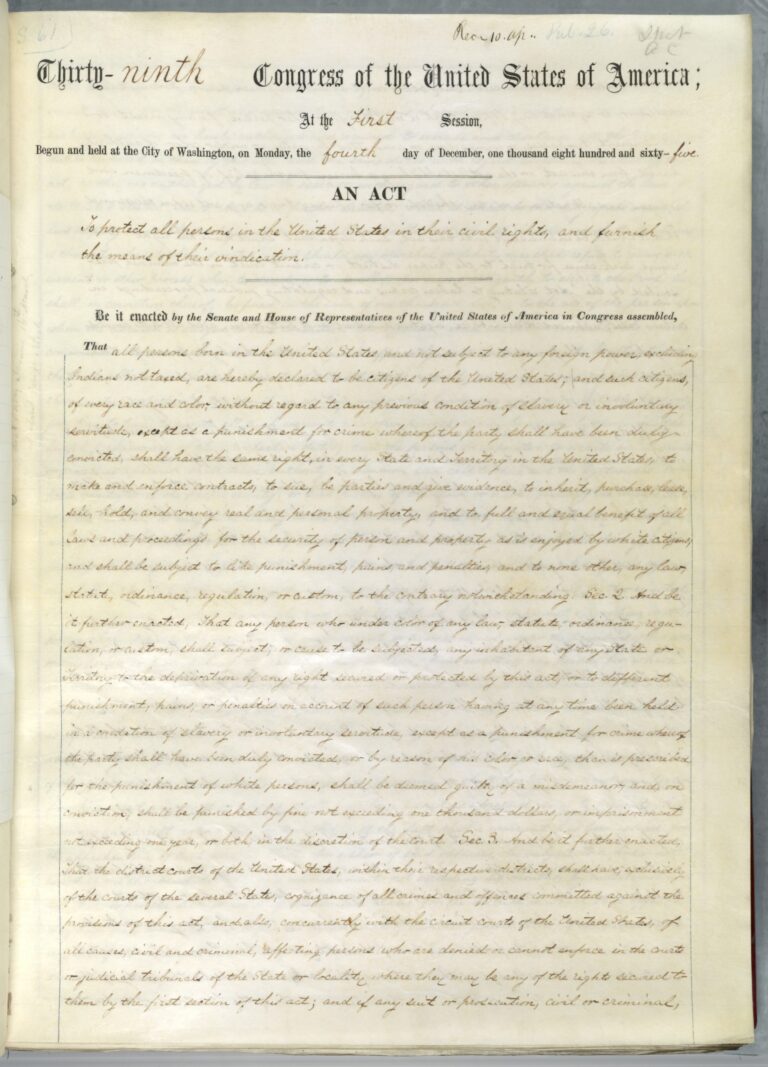
Congressional Republicans viewed Black Codes as evidence that Southern governments might use state law to undermine emancipation. The Civil Rights Act of 1866 asserted national citizenship for many people born in the United States and protected specified civil rights without racial discrimination. It addressed such matters as contracts, property and legal proceedings. President Andrew Johnson vetoed the bill, but Congress overrode him. The act did not automatically eliminate every instance of discriminatory enforcement, and legal challenges continued. Nevertheless, it established a landmark federal response to state restrictions and helped prepare the constitutional debates that led to the Fourteenth Amendment.
What were the Reconstruction Acts of 1867?
Congress also enacted measures placing much of the former Confederacy under military districts and requiring new state constitutions before full representation in Congress could be restored. These Reconstruction Acts arose from broader concerns about unequal laws, political violence and the direction of presidential restoration. They were not limited to repealing Black Codes, but the codes were a powerful example of why congressional leaders believed stronger intervention necessary. The laws opened new opportunities for Black male political participation, even while white resistance continued. Their adoption showed how debates about local employment rules had become an argument over national authority and the legitimacy of restored Southern governments.
Were Black Codes the same as Jim Crow segregation?
No. The Black Codes are primarily associated with the immediate post-emancipation period of 1865–1866, when legislators attempted to regulate freedpeople’s legal position and labor. Jim Crow refers more broadly to the later regime of racial segregation, political disfranchisement and institutional discrimination, especially after Reconstruction weakened. The two systems were connected through persistent white supremacy, but they developed under different federal laws, political conditions and court decisions. Treating them as an identical uninterrupted code obscures important changes during Reconstruction, when African Americans served in elected office and secured constitutional protections. Those achievements were later undermined in many places, but they should not disappear from the historical account.
How did the laws affect the Southern economy?
The codes were part of an effort to stabilize agricultural production while preserving white control over labor and land. Many former slaveholders remained major property owners, while freedpeople generally lacked farms, savings and access to credit. Restrictive labor rules could reduce workers’ bargaining power. However, the later growth of sharecropping and merchant-credit debt cannot be explained by Black Codes alone. Land scarcity, damaged infrastructure, cotton prices and unequal credit markets also shaped decisions. A precise account separates direct legal restrictions from the broader economic conditions in which those laws operated. Both mattered for the difficulty of achieving independence after slavery.
What do the Black Codes teach about Reconstruction?
The Black Codes demonstrate the gap between a legal declaration of freedom and the institutions needed to make freedom effective. Labor rules, family law, policing and courtroom procedures could determine whether a person could move safely, receive wages and defend legal claims. The controversy encouraged Congress to redefine national citizenship and impose conditions on Southern state governments. Historians study state legislation alongside federal correspondence, petitions and individual testimony to establish both intention and impact. Readers should resist broad claims that every state adopted identical provisions, or that these laws alone explain all later racial inequality. Their historical significance rests in showing the early attempt to limit emancipation and the federal response it helped trigger.
Black Codes timeline
| Year | Event |
|---|---|
| 1865 | Reorganization of Southern governments and the end of legal slavery. |
| Late 1865 | Several states enact restrictive laws targeting freedpeople. |
| 1866 | Congress debates and enacts federal civil-rights measures. |
| 1867 | Reconstruction Acts impose new conditions for Southern political restoration. |