Battle of Stones River (1862–1863): Rosecrans, Bragg and Murfreesboro
The Confederate surprise attack, the Union defense and the costly New Year’s battle.
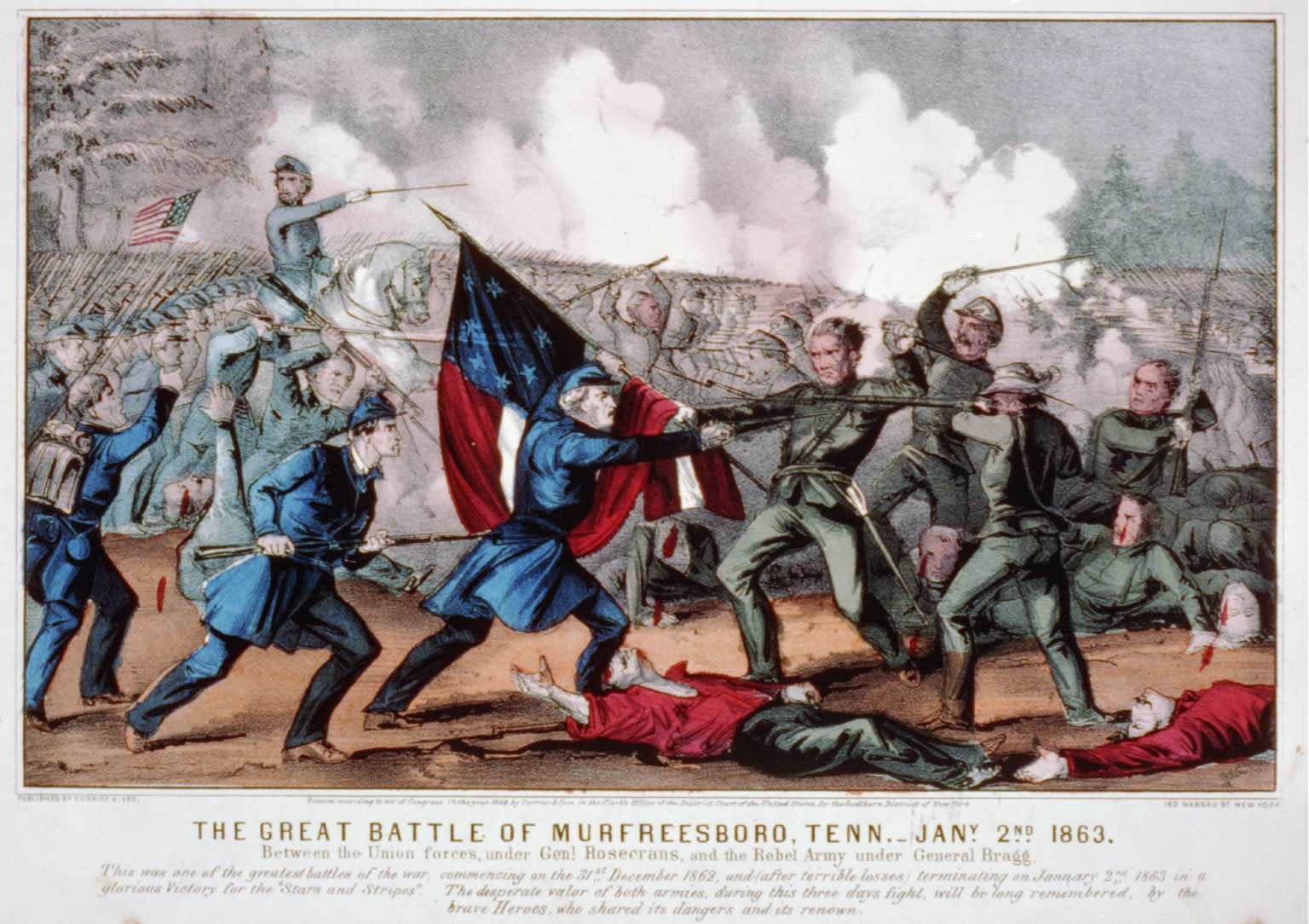
The Battle of Stones River near Murfreesboro, Tennessee, ran from December 31, 1862, to January 2, 1863. Braxton Bragg’s Confederates drove back William Rosecrans’s Union right wing, but federal troops held key positions. A Confederate attack on January 2 failed and Bragg withdrew. The battle was a costly Union victory.
This guide follows the fighting on December 31 and January 2, explains the terrain and separates military results from later claims about the battle.
On this page — 23 topics
When was the Battle of Stones River?
The Battle of Stones River was fought near Murfreesboro, Tennessee, from December 31, 1862, through January 2, 1863, with a lull between major engagements. The principal commanders were Union Major General William S. Rosecrans and Confederate General Braxton Bragg. It was one of the most costly battles of the Civil War relative to the size of the opposing forces. The Confederates achieved important early gains on December 31, but the Union army held its ground and Bragg eventually withdrew. The result gave the United States control over much of Middle Tennessee and strengthened federal morale at a difficult moment.
Why is it also called the Battle of Murfreesboro?
The battlefield lies near the town of Murfreesboro, while Stones River is a nearby river and geographic landmark. Both names appear in historical writings, maps and military records. Such variations are common for Civil War engagements: northern and southern sources often favored different naming conventions, and later historians sometimes adopted the most established label. The battle should not be confused with unrelated actions elsewhere along the river. Readers searching for “Murfreesboro 1862,” “Stones River 1863” or “Battle of Stones River” are generally seeking the same campaign. Using both names helps clarify the chronology across the New Year.
Why were the armies in Middle Tennessee?
After the October 1862 Battle of Perryville in Kentucky, Bragg withdrew south and established his Confederate Army of Tennessee near Murfreesboro. Union forces under Rosecrans remained around Nashville and prepared an advance. Middle Tennessee offered farmland, rail connections and roads essential for supplying troops and controlling the region. Union officials wanted action after frustrating results elsewhere, including Fredericksburg in December. Bragg sought to defend strategically important ground and protect routes toward Chattanooga. Both armies faced difficult winter campaigning conditions, but neither could afford to leave the other unchallenged indefinitely.
Who was William Rosecrans?
William S. Rosecrans commanded the Union Army of the Cumberland. He had taken command after Union disappointment with earlier operations in Kentucky and Tennessee. At Stones River he maintained his army under severe pressure despite the collapse of much of the right flank. His determination helped prevent a rout, and the eventual Confederate withdrawal allowed the battle to be presented as a federal success. Rosecrans would later conduct the Tullahoma Campaign and then lose at Chickamauga in September 1863. His record illustrates how officers’ reputations changed rapidly as strategy, circumstances and political expectations shifted.
Who was Braxton Bragg?
Braxton Bragg led the Confederate Army of Tennessee, which had withdrawn from Kentucky after the Perryville Campaign. He planned to defeat Rosecrans before the Union could gain control of central Tennessee and use it as a platform for further advances. Bragg had capable subordinate commanders, but his relationships with them were often strained. At Stones River his forces gained ground early, and he initially hoped that the Union army would retreat. When Rosecrans held firm and later fighting failed to achieve a decisive victory, Bragg withdrew. The battle’s outcome intensified debates over his leadership without ending his command immediately.
What happened before December 31?
Rosecrans marched south from Nashville after Christmas, moving toward Confederate troops assembled near Murfreesboro. The opposing armies approached each other over difficult roads in winter weather. Skirmishing and reconnaissance shaped the final positions. By the evening of December 30, the main forces faced each other across fields and wooded areas. Both commanders considered attacking, and neither fully anticipated how quickly the battle would become a struggle for survival. The local terrain included cedar forests, limestone outcrops, farm roads and the Nashville Pike, a transportation route that became particularly important during the fighting.
How did the Confederate surprise attack begin?
Before dawn on December 31, Confederate divisions attacked the Union right flank. Many federal soldiers were preparing breakfast or had not yet organized for a major assault. The Confederate advance broke through several positions and forced Union units to retreat toward the Nashville Pike. The fighting spread rapidly across fields, cedar woods and rocky ground. Some Union soldiers attempted to rally at fences, tree lines and artillery positions, but the pressure was intense. The surprise itself was important, yet the battle continued for many hours because federal units recovered enough cohesion to construct a new defensive line.
What was the Slaughter Pen?
The Slaughter Pen was an area of rugged limestone outcrops and cedar woods where Union soldiers fought during the December 31 Confederate advance. The terrain offered cover but also produced deadly close-range engagements and confused movement. Infantrymen attempted to delay the attack long enough for other Union formations to reposition. The name reflects the terrible losses sustained there and was used in later battlefield memory. It should not suggest that every soldier died or that one small location decided the entire battle. The action was part of a wider defensive effort involving scattered troops, artillery and repeated withdrawals.
Why was the Nashville Pike important?
The Nashville Pike was a crucial road connecting Rosecrans’s army with its supply base to the north. If Confederate forces seized it and cut the Union line of retreat and resupply, the federal position could become untenable. During the battle, Union commanders concentrated surviving formations and artillery near this route. The ability to hold it prevented an early Confederate success from becoming a strategic disaster. This is a good example of how a battlefield road can matter more than a visually impressive hill: transportation and supply determine whether an army can continue fighting, evacuate wounded soldiers and survive the next day.
What happened at the Round Forest?
A section of the Union line around the Round Forest near the Nashville and Chattanooga Railroad became a fierce center of resistance. Troops under commanders including Philip Sheridan and other officers fought across nearby positions, but the exact local deployments changed during the day. The Round Forest is often associated with the nickname “Hell’s Half Acre,” reflecting the concentrated violence. Union defenders kept Confederate attacks from breaking through a crucial sector. Later memorials and battlefield interpretation identify the ground, though visitors should recognize that the physical setting has changed since 1862.
Why were Union artillery batteries important?
Federal artillery played a major role in stopping further Confederate advances on December 31. Guns positioned near the Nashville Pike and adjoining open areas created fields of fire that attacking infantry struggled to cross. Artillery could also cover the movement of retreating troops and make new defensive lines more resilient. However, gunners faced serious danger as Confederate soldiers pressed forward, and some batteries lost men, horses or equipment. The battle illustrates the importance of combined infantry and artillery defense rather than a simple contest of muskets. The placement of guns often depended on openings in the rough terrain.
Why did the armies pause on January 1?
New Year’s Day, January 1, 1863, saw less major fighting than the days before and after, although skirmishing and repositioning continued. Both armies needed to reorganize exhausted formations, care for wounded soldiers and prepare for further attacks. Rosecrans refused to abandon his position, while Bragg hoped that renewed pressure might force withdrawal. The pause was a period of military uncertainty rather than a formal truce. Soldiers endured winter conditions with limited food and rest. The date is also significant because the Emancipation Proclamation took effect on the same day, connecting the battle to a transformation in the broader war.
What happened at McFadden’s Ford on January 2?
On January 2, Confederate troops under John C. Breckinridge attacked Union forces across Stones River near McFadden’s Ford. They initially drove federal soldiers back, but the advance exposed them to concentrated Union artillery fire from the opposite bank. The guns inflicted heavy losses, and Union troops counterattacked, forcing the Confederates to withdraw. The action undermined Bragg’s remaining hopes of obtaining a decisive result. It also shows how success in a local infantry charge can become a liability if the attackers cross exposed ground without secure artillery support. The river and its banks shaped the result as much as the troop numbers.
When did Bragg withdraw?
After the severe losses of December 31 and the failure of the January 2 assault, Bragg concluded that he could not maintain the position against Rosecrans’s army. Confederate forces withdrew from Murfreesboro toward Tullahoma during the following days. The Union army remained in control of the battlefield, allowing federal leaders to claim victory. The withdrawal mattered strategically because it reduced Confederate influence in Middle Tennessee and strengthened Union control of the region. Yet the victory did not destroy Bragg’s army, which remained an important opponent in the subsequent campaigns of 1863.
How many casualties occurred?
The National Park Service summarizes the battle as producing approximately 23,000 casualties, with roughly 13,000 Union and 10,000 Confederate losses. Counts depend on the records and categories used, but the total illustrates an extraordinarily costly engagement for both armies. The figure includes killed, wounded and missing or captured soldiers, not battlefield deaths alone. Many survivors carried injuries or trauma for years, and families received imperfect information about loved ones. The cost is one reason Stones River remains important even though it is sometimes overshadowed by Gettysburg or Antietam in popular histories.
Why did the Union victory matter for morale?
The Union had recently suffered a serious defeat at Fredericksburg, and wartime frustration was increasing. Holding the field at Stones River gave federal leaders a much-needed success at the turn of the year. The battle coincided with the Emancipation Proclamation, which made the war’s relationship to slavery increasingly explicit. Rosecrans’s victory encouraged the view that Union armies could regain the initiative in Tennessee. Yet morale did not erase the terrible casualties or guarantee rapid progress. Months of operations still lay ahead before the Union would seize Chattanooga and advance into Georgia.
Was Stones River a turning point?
Stones River strengthened the Union hold on Middle Tennessee, but the idea of one decisive turning point can obscure the war’s long sequence of campaigns. The victory did not immediately end Confederate military power in the West. It did, however, preserve the Union army and establish conditions for the later Tullahoma advance. The battle’s political importance also came from timing: a costly federal success at the beginning of 1863 helped offset defeats elsewhere. Historians evaluate turning points by examining what options a battle opened or closed, not simply by ranking casualty totals.
How did civilians experience the battle?
Local families near Murfreesboro endured soldiers occupying land, destruction of crops and fences, medical emergencies and the burial of the dead. Homes and barns became landmarks in soldiers’ accounts and, in some cases, facilities for wounded men. Military movement altered roads, fields and the landscape long after the fighting ended. The human impact reached beyond uniformed combatants. Enslaved people in Tennessee also confronted changing opportunities and dangers as Union armies advanced. Civilian experiences help explain why a battle should be studied as an event occurring within an inhabited region, not on an empty map designed only for troop movements.
What can visitors see at Stones River?
Stones River National Battlefield preserves significant areas near Murfreesboro, including the Slaughter Pen and positions associated with the Round Forest. The park interprets the battle’s chronology, military landscape and the aftermath of the fighting. The Stones River National Cemetery preserves many Union graves. Visitors can compare period sketches, modern signs and topography, but should not assume that all modern roads and structures match the conditions of 1862. The National Park Service battlefield website provides maps and research material. The battle belongs in the wider story of the Union advance toward Chattanooga.
How does Stones River connect to later campaigns?
After Stones River, Rosecrans’s army remained active in Middle Tennessee and eventually maneuvered against Bragg during the Tullahoma Campaign. The Union then advanced toward Chattanooga, an important rail center. The September 1863 Battle of Chickamauga brought the same principal commanders into another major contest, this time ending in Confederate victory. The November Battles for Chattanooga reversed that setback. Following these linked episodes shows how the western theater evolved across a full year rather than presenting each battle as a disconnected date in a timeline.
Stones River timeline
| Date | Event |
|---|---|
| December 26, 1862 | Rosecrans leaves Nashville toward Murfreesboro. |
| December 30 | Opposing armies occupy nearby positions. |
| December 31 | Confederate surprise attack drives Union right backward. |
| January 1, 1863 | Both armies regroup amid limited fighting. |
| January 2 | Confederate assault near McFadden’s Ford is repulsed. |
| Early January | Bragg withdraws; Union holds the battlefield. |