Battle of Chickamauga (1863): Rosecrans, Bragg and the Union Retreat
Why Bragg defeated Rosecrans, how Longstreet broke through and why Thomas held Horseshoe Ridge.
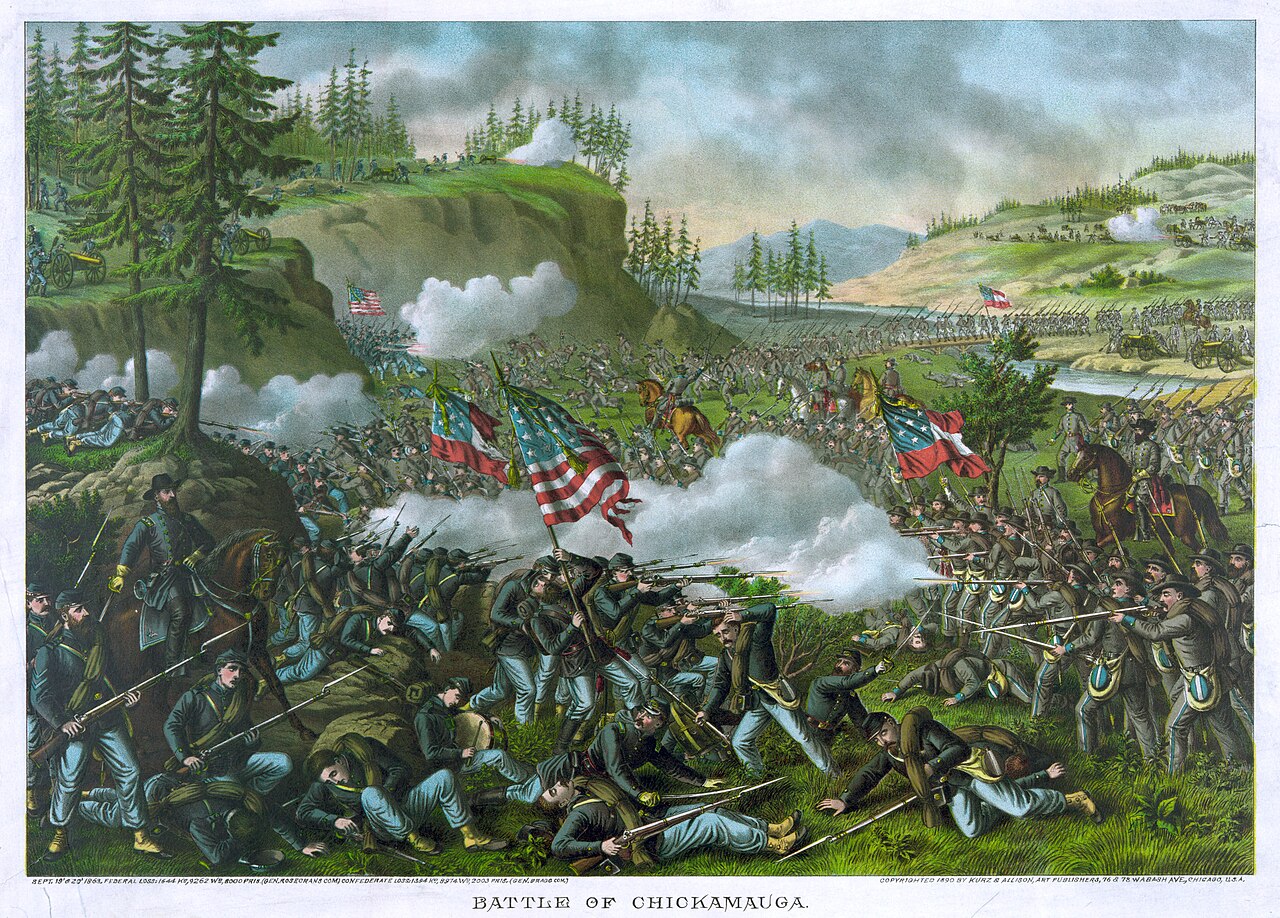
The Battle of Chickamauga, fought September 19–20, 1863, was a Confederate victory in northwestern Georgia. Braxton Bragg’s army defeated William Rosecrans’s Union forces after a breakthrough on September 20. George H. Thomas helped cover the Union withdrawal to Chattanooga, where federal troops remained and later counterattacked.
Follow the battle day by day, including the command error, Horseshoe Ridge and strategic aftermath.
On this page — 23 topics
When was the Battle of Chickamauga?
The Battle of Chickamauga was fought principally on September 19 and 20, 1863, near West Chickamauga Creek in northwestern Georgia. Skirmishing began on September 18 as Confederate forces tried to cross the creek and reach roads leading toward Chattanooga. The battle brought the Union Army of the Cumberland under William S. Rosecrans into conflict with Braxton Bragg’s Confederate Army of Tennessee. It was among the bloodiest battles of the Civil War. Confederate troops won a tactical victory, but the Union army escaped into Chattanooga, where a different phase of the campaign began.
Why was Chattanooga so important?
Chattanooga, Tennessee, was a strategically important transportation center where railroads and routes through mountain gaps connected parts of the upper and lower South. Control of the city offered the Union an approach into Georgia and threatened the Confederate interior. During the summer of 1863, Rosecrans maneuvered against Bragg’s army in Tennessee and pushed it away from Chattanooga. The Union advance created an opportunity, but the army became dispersed among difficult roads and valleys south of the city. Chickamauga arose from the struggle to determine whether the Confederates could counterattack and recover the initiative.
Who was Union General William Rosecrans?
William S. Rosecrans commanded the Union Army of the Cumberland. His earlier Tullahoma Campaign had succeeded in forcing Bragg out of central Tennessee through maneuver rather than a major battle. Near Chickamauga, however, Rosecrans faced incomplete intelligence, separated formations and a Confederate force receiving reinforcements. His decisions during September 20 contributed to a dangerous gap in the Union line, followed by the collapse of the right wing. The outcome damaged his reputation and led to changes in command. A balanced assessment recognizes his earlier operational skill alongside the breakdown of battlefield coordination in Georgia.
Who was Confederate General Braxton Bragg?
Braxton Bragg commanded the Confederate Army of Tennessee, one of the Confederacy’s principal field forces. His relationship with several senior subordinates was difficult, and disagreements over strategy complicated command. Bragg hoped to regain the initiative after losing Chattanooga and to strike Union troops before they could consolidate. At Chickamauga, reinforcements from Virginia increased his strength, including troops associated with James Longstreet. Bragg achieved a major tactical success but failed to destroy Rosecrans’s army before it reached Chattanooga. The battle is therefore both a Confederate victory and a study in the limits of exploiting success.
How did the fighting start on September 18?
On September 18, Confederates attempted to cross West Chickamauga Creek and use routes such as Reed’s Bridge and Alexander’s Bridge. Union cavalry and other soldiers resisted these movements, interrupting plans to gain control of the LaFayette Road. The road was important because it connected Union positions to Chattanooga and could be used to separate parts of Rosecrans’s army. Woods, streams and limited visibility caused confusion over enemy locations. By the evening, troops on both sides were adjusting positions. These initial clashes were not merely minor preliminaries: they shaped where the larger battle would develop.
What happened on September 19?
The first full day involved intense fighting across wooded fields as formations encountered enemies they had not expected to find so close. Attacks and counterattacks developed along multiple sections of the line, with regiments repeatedly losing direction in dense vegetation. Neither side achieved a decisive breakthrough. Both armies suffered severe casualties, and commanders moved units to threatened positions while struggling to understand what was happening elsewhere. Nightfall brought a pause that allowed entrenchment and the arrival of more Confederate troops. The battle’s confusing geography is central to understanding why even experienced generals faced serious difficulties maintaining coherent control.
Why did dense woods affect the battle?
Much of the battlefield was covered by forests, undergrowth and broken terrain that limited the distance officers and soldiers could see. Gunfire, smoke and noise further reduced situational awareness. A division could be in serious danger while neighboring formations remained unaware of the threat. Roads and open fields became important reference points for the movement of brigades. The landscape also made artillery harder to use in some areas. It is misleading to present Chickamauga as two armies arranged in a simple, clear line across a featureless plain. The fighting repeatedly became fragmented and hard to coordinate.
What changed during the night of September 19?
Both sides reorganized, and Confederate reinforcements reached the battlefield. Bragg assigned forces to larger wings under commanders including Leonidas Polk and James Longstreet. On the Union side, Rosecrans and subordinates tried to create a defensive line that would hold routes toward Chattanooga. Movements after dark were difficult, and the commanders carried uncertain assumptions into the following day. Changes in leadership structure did not automatically solve the Confederates’ problems of cooperation. Likewise, Union formations that appeared connected on maps might have become separated by terrain or confused orders before the morning’s fighting resumed.
How did fighting resume on September 20?
Confederate troops attacked the Union left, where George H. Thomas and other commanders resisted repeated pressure. Rosecrans shifted forces in response to reports that positions were threatened. Communication failures and mistaken assessments would become crucial. The Confederate army had organized an attack that ultimately struck where the Union formation became vulnerable, producing a sudden breakthrough. The sequence is best understood by following how orders changed the positions of specific divisions rather than treating the battle as the automatic result of Confederate numerical superiority. Dispositions and timing mattered as much as bravery.
What caused the gap in the Union line?
A mistaken understanding of the Union position led Rosecrans to issue an order that shifted troops and opened a gap in his line. At roughly the same time, Confederates under Longstreet struck that sector. The timing allowed their attack to penetrate deeply and unravel the Union right. Later accounts sometimes describe the order as a single careless mistake that explains everything. The reality involved confusing reports, heavily wooded terrain, prior troop movements and imperfect command relationships. The error was decisive because Confederate units were poised to exploit it, not because one instruction alone determines the outcome of every large battle.
What was Longstreet’s role?
James Longstreet arrived with experienced Confederate troops transferred from Robert E. Lee’s Army of Northern Virginia. At Chickamauga he commanded a wing of Bragg’s army and participated in the September 20 breakthrough that drove much of the Union right from the field. His presence illustrates how Confederate leaders could move forces between theaters using railroads, though such transfers were costly and difficult. Longstreet’s success also intensified later disagreements over Bragg’s leadership and what should have been done after the battle. His reputation at Chickamauga should be assessed separately from his role at Gettysburg in July.
Why did George H. Thomas become famous?
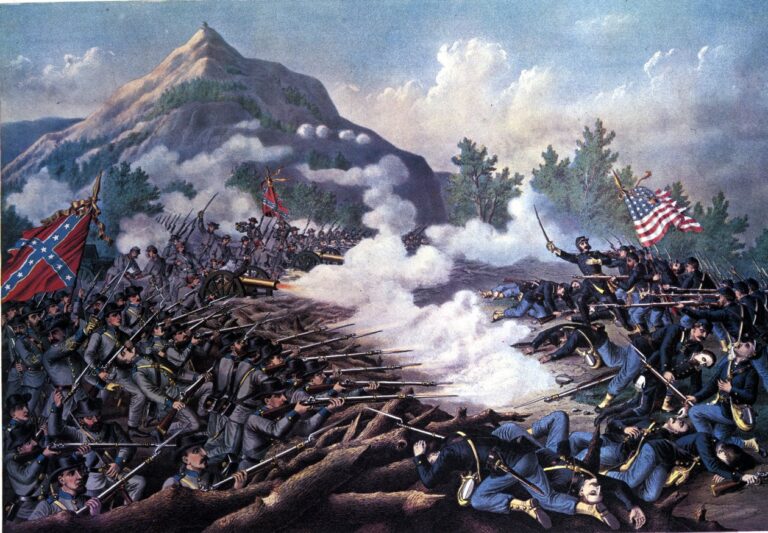
Union General George H. Thomas helped organize a determined defense on and around Snodgrass Hill and Horseshoe Ridge while other Union units retreated. His soldiers resisted repeated Confederate attacks late on September 20, gaining time for elements of the army to escape toward Chattanooga. Thomas became known as the “Rock of Chickamauga” because of this stand. The nickname captures his resolve but can obscure the contributions of other officers and enlisted troops who supported the defense. His actions mattered operationally by preventing a Confederate victory from becoming an even more destructive pursuit of the retreating Union army.
What was Horseshoe Ridge?
Horseshoe Ridge was a cluster of elevated positions near Snodgrass Hill where Union defenders made their final stand. The ground offered some defensive advantages while still exposing troops to determined Confederate attacks. Units gathered from different parts of the army, and coordination became challenging under pressure. The ridge’s name reflects its shape and the configuration of connected heights. The location has been studied carefully by the National Park Service and battlefield historians because it helps explain how the Union retreat could be covered. It is also an important visitor site for understanding the battle’s final hours.
Who won the Battle of Chickamauga?
The Confederates won a tactical victory. Bragg’s forces drove much of the Union army from the battlefield and compelled Rosecrans to withdraw toward Chattanooga. Yet the Union army was not completely destroyed. Thomas’s defense and subsequent movements allowed enough troops to escape for the Union to retain the city. An accurate answer therefore distinguishes battlefield outcome from strategic consequences. The Confederates occupied key ground outside Chattanooga, but they did not secure long-term control of the important city. Federal reinforcements and an improved supply line would soon allow the Union army to strike back.
How many casualties were recorded?
Chickamauga produced tens of thousands of casualties among the opposing armies and is remembered as one of the war’s costliest battles. Estimates often exceed 34,000 combined casualties, but totals vary by source and by which categories are included. Killed, wounded and missing or captured soldiers must not be conflated with deaths. For both armies, the aftermath involved overwhelmed medical facilities, difficult evacuation and anxious families. The scale of suffering is essential to the story, yet assigning an exact figure to every unit without checking the original returns risks creating false precision.
What happened to the Union army afterward?
The defeated Union army retreated to Chattanooga and occupied defensive positions. Confederate forces took control of surrounding heights, including Lookout Mountain and Missionary Ridge, and interfered with Union supply routes. As food and forage shortages worsened, the city’s situation became dangerous. George Thomas replaced Rosecrans in command of the Army of the Cumberland, while Ulysses S. Grant took charge of the larger western theater. The Union then restored supply access and prepared offensive operations. These events connect Chickamauga directly to the November 1863 Battles for Chattanooga.
Did Chickamauga lead to the fall of Chattanooga?
No. Chickamauga allowed the Confederates to pressure Chattanooga, but their victory did not produce the city’s surrender. Federal troops maintained control despite severe shortages and uncertainty. Union engineers and commanders reopened supply lines, and reinforcements arrived from other theaters. In November, Union forces attacked Confederate positions and won a decisive victory at Missionary Ridge. This reversal is one reason Chickamauga is so important historically: its strategic possibilities were not fully realized by Bragg. It demonstrates that the meaning of a battle depends partly on events in the weeks afterward.
What happened to civilians in the area?
The fighting passed through farms, roads and rural communities near West Chickamauga Creek. Families experienced damage to buildings, fences, fields and livestock, while soldiers and wounded men occupied civilian spaces. Medical care and burial operations continued well after the armies moved. The war changed the local landscape in ways not visible in simple campaign maps. Surviving houses, farm names and battlefield archaeology help restore the civilian setting. The burden of disease, displacement and property loss should not be overshadowed by the movement of generals. Historical interpretation now treats the landscape as more than a stage for military decisions.
What did the battle mean for 1864?
Union control of Chattanooga after the November victories made the city a logistical base for William T. Sherman’s Atlanta Campaign in 1864. That is why the struggle around Chickamauga mattered beyond September 1863. The Union could build supply connections and assemble troops for operations into Georgia, while the Confederates were forced to defend farther south. A battle that the Confederates won tactically did not prevent the eventual federal advance. Studying the sequence from Chickamauga to Chattanooga to Atlanta reveals how campaigns connect across months and different commanders.
Where can readers study Chickamauga?
Chickamauga and Chattanooga National Military Park protects important portions of the battlefield and the later campaign sites. The National Park Service battle narrative provides a day-by-day explanation, while historic maps help locate the LaFayette Road, Snodgrass Hill and Horseshoe Ridge. Visitors should compare the wooded battlefield terrain with period accounts rather than assuming every modern road or clearing existed in 1863. Interpretive markers and preserved landscapes make it possible to follow the battle’s changing positions at a scale not apparent in a general Civil War timeline.
Chickamauga campaign timeline
| Date | Event |
|---|---|
| Early September 1863 | Union forces capture Chattanooga; Confederates move to counterattack. |
| September 18 | Clashes at crossings of West Chickamauga Creek. |
| September 19 | Full-scale battle develops across wooded fields. |
| September 20 | Union right collapses; Thomas holds Horseshoe Ridge. |
| Late September–October | Bragg’s forces pressure Chattanooga; Union troops face supply shortages. |
| November 1863 | Union victory in the Battles for Chattanooga. |