Battle of Sailor’s Creek (April 6, 1865): Lee’s Retreat and Ewell’s Surrender
An evidence-based guide to the final weeks of the American Civil War.
On April 6, 1865, Union cavalry and infantry struck retreating Confederate columns at Sailor’s Creek in Virginia. Thousands of Lee’s men were captured, including Richard S. Ewell. The defeat seriously weakened the Army of Northern Virginia three days before Lee surrendered at Appomattox.
Follow the chronology, participants, military decisions and surviving records to understand what occurred and why it mattered.
On this page — 20 topics
Why did the battle happen?
Following the collapse of Confederate positions at Petersburg and the evacuation of Richmond, Robert E. Lee led the Army of Northern Virginia west. His purpose was to find supplies, escape pursuing federal forces and, if possible, unite with another Confederate army. The withdrawal depended on fragile roads and streams of wagons, troops and artillery that could not move at the same speed. Union commanders recognized that a mobile pursuit could break the retreating columns apart before they regrouped. Sailor’s Creek became a particularly vulnerable point where the Confederate army was stretched along the road network.
Where is Sailor’s Creek?
Sailor’s Creek, also commonly called Sayler’s Creek, is in central Virginia, southwest of Richmond. Its branches and surrounding farmland shaped the tactical encounters on April 6. Historical accounts sometimes use different spellings or refer to Hillsman Farm and Lockett Farm, because fighting took place across several nearby locations rather than on a single compact field. Maps of the modern state park can help distinguish the routes used by cavalry, infantry and supply wagons. The locality matters because the creek crossings slowed troops who were already struggling to maintain an orderly retreat.
What was Lee trying to achieve?
Lee had no reason to fight a major set-piece battle at Sailor’s Creek. His immediate hope was to keep the army intact and move it toward food and a defensible route west or southwest. The Confederate forces had been exhausted by the long Petersburg campaign and suffered serious shortages. A retreating army needed to protect its wagon trains while preventing Union cavalry from reaching its front. Lee’s intention was strategic survival, not to secure the fields around the creek for their own sake. That distinction helps explain why the battle was so destructive to his final campaign.
How did Union troops catch the Confederates?
Philip Sheridan’s Union cavalry moved aggressively to cut across Confederate marching routes and strike at exposed gaps. Federal infantry from the II and VI Corps supported the pursuit and engaged retreating Confederate formations. Because the Confederate army was divided into separate segments, Union movements threatened to isolate individual groups. Confederate commanders had to decide whether to fight at creek crossings, continue west or protect the slow wagon train. The combined pressure created a succession of engagements rather than one simple frontal clash. The ability to coordinate mounted troops and infantry was central to the outcome.
What happened at the Hillsman Farm?
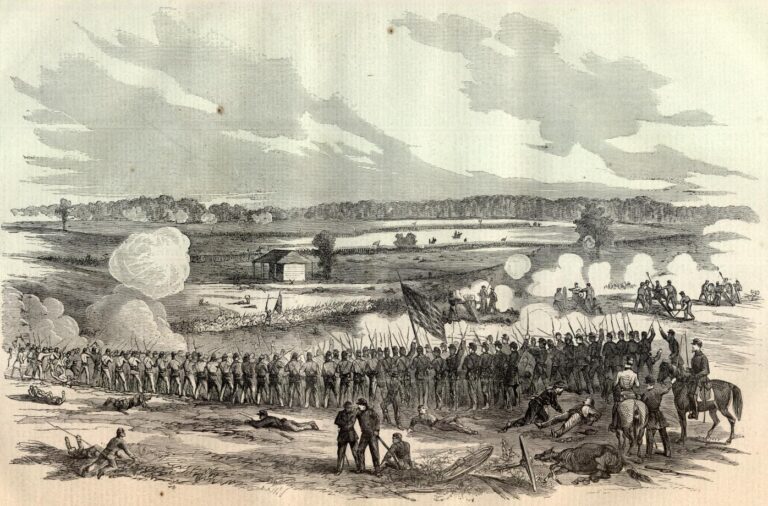
At the Hillsman Farm, federal infantry and Confederate formations fought near Sailor’s Creek as exhausted troops attempted to hold their positions or cross the terrain. Union VI Corps troops advanced against the forces under Richard S. Ewell. Fighting developed in confused circumstances, with limited visibility and difficult terrain adding to the danger. As the Confederate line failed, organized resistance gave way to large-scale surrender. It is important to distinguish this action from the fighting at nearby Lockett Farm, even though both are conventionally grouped under the name Sailor’s Creek.
What happened at the Lockett Farm?
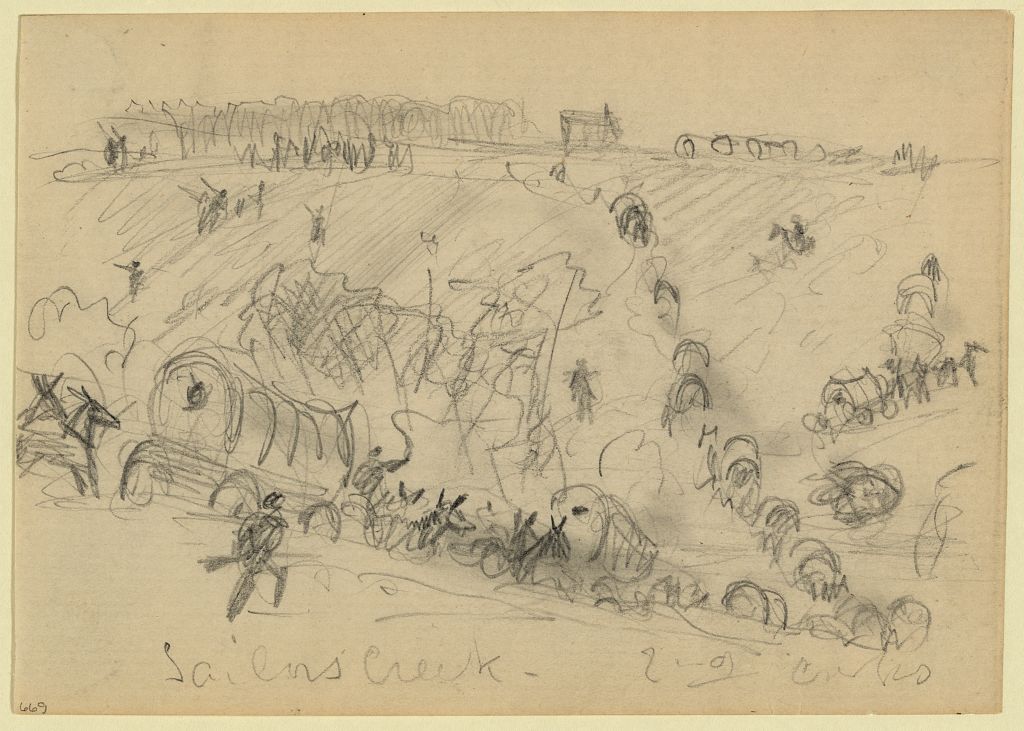
The action at Lockett Farm involved Union attacks on retreating Confederate troops and wagon trains in the same general area. Wagons, teams and soldiers became crowded on roads where movement was already slow. The trains were vital: they carried supplies and equipment needed for the army’s survival. Their vulnerability made a military withdrawal even harder to sustain. Different formations fought at different points along the route, so descriptions of Sailor’s Creek can sometimes compress separate engagements into one dramatic moment. A careful reconstruction follows the positions of each column rather than assuming every participant witnessed the same fighting.
Who commanded the opposing armies?
Robert E. Lee directed the overall Confederate retreat. Richard S. Ewell was among the senior Confederate officers involved in the fighting and was captured. Union commander Philip Sheridan was important to the interception, while II and VI Corps troops provided infantry strength. Their actions formed part of Ulysses S. Grant’s broader strategy to pursue and prevent Lee from escaping. These command relationships matter because the battle was not simply Sheridan fighting Lee alone; multiple corps and detachments worked across an extended front. Senior officers could not always control what was happening to separated columns.
Why was Richard S. Ewell captured?
Richard S. Ewell’s force was cut off and overwhelmed during the fighting near Sailor’s Creek. As the Union attack developed, Confederate units lost room to retreat and lacked the cohesion necessary to break through. Ewell surrendered with numerous soldiers and other officers. His capture was both a practical loss of leadership and a powerful signal that the Army of Northern Virginia was disintegrating. However, it did not mean Lee himself had surrendered that day. Lee continued to command a substantial remainder of his army and would fight further actions before agreeing to terms on April 9.
How many casualties were there?
The National Park Service’s Civil War battle summary provides an estimated total of 8,848 casualties, listing approximately 1,148 Union and 7,700 Confederate casualties. These figures should be treated as estimates and understood in the context of a battle dominated by Confederate captures. Many men who appear in the Confederate figure were prisoners rather than battlefield fatalities. Historical sources can vary in their methods and totals. It is misleading to describe every casualty as killed or to combine different estimates without explaining their basis. The loss of thousands of soldiers was devastating for a retreating force.
Was a quarter of Lee’s army lost?
A common description holds that roughly one-quarter of Lee’s retreating army was destroyed, captured or otherwise lost during the fighting. The proportion varies with the estimate used for the army’s strength and which formations are counted. What matters is the scale of the setback: Lee was losing a major share of the officers and troops he needed to maintain an effective field army. The remaining columns continued west, but they were fewer, weaker and still pressed closely by Union forces. A dramatic percentage should never be presented as an exact headcount drawn from complete contemporary returns.
What did Lee say after the battle?
A famous account attributes to Lee an anguished question about whether his army had dissolved after he saw survivors from the fighting. The remark appears in historical retellings and captures the visible disintegration of the army during the retreat. It should be introduced as a reported statement, not as a stenographic transcript. The more firmly documented reality is the destruction of formations, capture of senior officers and failure of Lee’s planned withdrawal. The human scene conveyed by later accounts is striking, but it is the military evidence that makes Sailor’s Creek significant.
How did the battle affect the road to Appomattox?
Sailor’s Creek left the Confederate army less able to defend its next positions, feed its troops or resist interceptions on the road. The survivors moved toward Farmville and ultimately Appomattox, while Union cavalry and infantry continued to close possible routes. Lee did not immediately negotiate surrender on April 6, but each subsequent day narrowed his options. By April 8 Union forces had taken crucial supplies at Appomattox Station, and on April 9 another attempted breakout failed. Our Appomattox guide explains how the military situation finally resulted in written surrender terms.
Did Sailor’s Creek end the Civil War?
No. The battle was a decisive part of Lee’s final retreat, not the formal end of the war. Fighting continued after April 6, and even the surrender of Lee’s Army of Northern Virginia on April 9 did not end the operations of every Confederate force. Additional armies surrendered in later weeks. Sailor’s Creek matters because it accelerated the defeat of the main Confederate army in Virginia. It demonstrates how a series of linked battlefield and logistical losses made further resistance impossible, rather than one sudden decision ending the conflict everywhere.
How does it connect with Petersburg?
The Petersburg campaign placed persistent pressure on Lee’s defenses and transportation network. When the Confederate positions collapsed, the army was forced into a hurried retreat that it could not adequately supply. Sailor’s Creek was therefore not a separate crisis detached from the previous months of fighting. It reflected the cumulative effects of depleted resources, mounting casualties and the Union’s ability to pursue. Students can understand the connection by following a simple sequence: Petersburg’s fall, the westward retreat, Sailor’s Creek, Appomattox Station and surrender.
Why is Sailor’s Creek historically important?
The battle is important because it shows the operational defeat of Lee’s army before the iconic surrender meeting. A field army survives not only through bravery or capable commanders but also through communications, supply, coherent formations and access to routes of withdrawal. On April 6 those foundations were failing. The capture of senior officers and thousands of soldiers gave the Union a decisive advantage during the final days. Sailor’s Creek also reminds readers that the closing of the war involved fear, exhaustion and combat rather than an orderly procession straight to Appomattox.
What can visitors see at the battlefield?
Sailor’s Creek Battlefield Historical State Park in Virginia protects important parts of the battlefield landscape. Visitors can use interpretive exhibits, roads and trails to understand the distances between the separate combat locations. Landmarks such as the Hillsman House help explain the experience of civilians and soldiers during the battle. Because roads and property boundaries have changed, modern visits benefit from historical maps rather than treating any single view as a complete representation of the 1865 terrain. For broader context, consult the Virginia State Parks information.
What are common misunderstandings?
One mistake is treating the engagement as one compact battle instead of fighting at multiple nearby farms. Another is describing all Confederate casualties as killed when captures account for a large proportion. A third is assuming Lee surrendered immediately after the defeat. He continued the retreat for three more days. Readers should also avoid treating a reported quotation as a precise transcript. Keeping these distinctions clear makes the account more useful than dramatic summaries that omit geography, chronology and the difference between military defeat and formal surrender.
Where should readers go next?
Readers beginning with the entire conflict should consult the American Civil War overview, which explains slavery, secession, major campaigns and the war’s aftermath. Those interested in the final days should follow the fall of Richmond and the Appomattox surrender. Together these articles place the events of April 6 within the wider collapse of Confederate military resistance. For primary-oriented background, consult National Park Service battlefield records rather than using an unsourced number from a timeline infographic.