Battle of Five Forks (1865): Sheridan, Pickett and Petersburg’s Fall
A Union victory at a strategic crossroads destroyed the last practical defense of Petersburg’s supply line.
The Battle of Five Forks occurred near Petersburg, Virginia, on April 1, 1865. Union cavalry under Philip Sheridan held George E. Pickett’s Confederate force while the Union V Corps under Gouverneur K. Warren attacked its flank. The Confederates were defeated, and the South Side Railroad was exposed to Union capture. Lee’s defensive position at Petersburg became untenable, and the Confederates evacuated Petersburg and Richmond the following night.
A source-based guide to the sequence, commanders, decisions and historical consequences.
On this page — 20 topics
What happened at Five Forks?
The Battle of Five Forks was fought on April 1, 1865, at a crossroads west of Petersburg. Union forces commanded by Philip Sheridan and Gouverneur K. Warren attacked a Confederate force under George E. Pickett. Sheridan’s cavalry held the defenders in position while Warren’s infantry struck the Confederate flank.
The attack succeeded, capturing many soldiers and forcing the remaining Confederates to withdraw. The loss of the crossroads exposed the South Side Railroad, a vital supply line for Lee’s army. The victory helped make further defense of Petersburg impossible and set in motion the events that ended with Lee’s surrender at Appomattox.
Why did the Five Forks crossroads matter?
Five Forks was a junction of several roads west of Petersburg. Its strategic importance came from access to the South Side Railroad, which delivered essential supplies to Confederate positions around Petersburg and Richmond. If Union troops gained control of the area, Lee’s remaining communications would be exposed.
The junction itself did not contain the Confederate capital or a large industrial complex. Its value lay in what armies could reach from it. Military maps show how five connecting roads enabled movement toward railroad depots and defensive positions. A victory at a modest rural crossroads could therefore affect the fate of two major cities.
Why was Lee’s army already in trouble?
By spring 1865 the Confederate Army of Northern Virginia had defended Petersburg for more than nine months. Union operations repeatedly extended around its western side and disrupted railroads and roads supplying the defenders. Lee had fewer men to cover a growing perimeter, while provisions and replacements became increasingly scarce.
An unsuccessful Confederate attack at Fort Stedman on March 25 had failed to reverse that pressure. Grant then increased movement against the Confederate right. The defenders at Five Forks were guarding not just an isolated road but one of the last ways Lee could maintain an army around Petersburg.
Who was Philip Sheridan?
Philip H. Sheridan was a Union general who had won major victories during the 1864 Shenandoah Valley Campaign. In March 1865 he joined the operations against Lee with cavalry formations that could move rapidly around the western Confederate flank. His task was to threaten communications and cooperate with Union infantry.
Sheridan was energetic and sometimes impatient with slower command arrangements. At Five Forks he directed the attack and later removed Warren from command even though Warren’s corps played a major role in the victory. Both decisions remain part of debates about leadership and responsibility.
Who was Gouverneur K. Warren?
Gouverneur K. Warren commanded the Union V Corps, an infantry formation assigned to attack the Confederate left at Five Forks. His soldiers had to move through uncertain ground and form for battle before advancing. The attack was delayed while units assembled and clarified the enemy’s position.
Once underway, Warren’s corps helped overwhelm the Confederate defenses. Sheridan nevertheless judged Warren’s performance unsatisfactory and relieved him that evening. Subsequent inquiry and historical debate distinguished the success of the corps from the controversy surrounding its commanding general, showing that a battlefield victory did not prevent conflict between senior officers.
Who was George E. Pickett?
George E. Pickett was a Confederate division commander known chiefly for his association with the disastrous assault at Gettysburg in 1863. In 1865 he led infantry and worked with Confederate cavalry commanded by other officers to protect the Five Forks position. His assignment was to prevent Union movement toward the South Side Railroad.
Pickett’s available force was smaller than the combined Union formations concentrating against him. That disadvantage increased the importance of entrenchments, communication and cavalry screening. His command faced a difficult situation because a breakthrough on the flank might isolate the defenders from Lee’s main army.
What happened before April 1?
The final phase of the Petersburg campaign involved Union movements toward the western roads and railroad connections. On March 31, Confederate forces fought Sheridan’s cavalry around Dinwiddie Court House, creating a dangerous situation for the Union horsemen. Additional federal infantry moved into the area to support them.
By April 1, the Confederates had fallen back to Five Forks and prepared to defend the crossroads. Sheridan saw an opportunity to combine a front pressure by cavalry with a stronger infantry attack against an exposed flank. The success of this coordinated effort would depend on the two arms moving at the right moment.
How did the Union plan to attack?
Sheridan intended his dismounted cavalry to engage the Confederate front while Warren’s V Corps advanced against the left flank of Pickett’s line. This arrangement sought to prevent defenders from shifting freely and to force them to fight from more than one direction. The cavalry also watched roads that might permit escape.
The attack required the infantry to reach the correct position in difficult terrain. Some units moved farther north than intended, disrupting the sequence, but the overall offensive brought strong pressure onto the flank. The plan illustrates how cavalry could do much more than scout or charge with sabers in late Civil War operations.
What did the Confederate defense look like?
Pickett’s soldiers occupied breastworks along the White Oak Road, protecting the front with logs and earth. They expected danger from Sheridan’s cavalry and tried to hold the intersection long enough to keep the railroad approaches safe. The line, however, had an exposed left end vulnerable to infantry moving from the flank.
Strong earthworks protected men against frontal attacks but could not fully solve the problem of being turned. Once Union troops passed around or through the end of the position, defenders could be struck from unfamiliar directions. Pickett lacked the reserves and communication needed to restore the front after the attack gained momentum.
What happened during the late-afternoon attack?
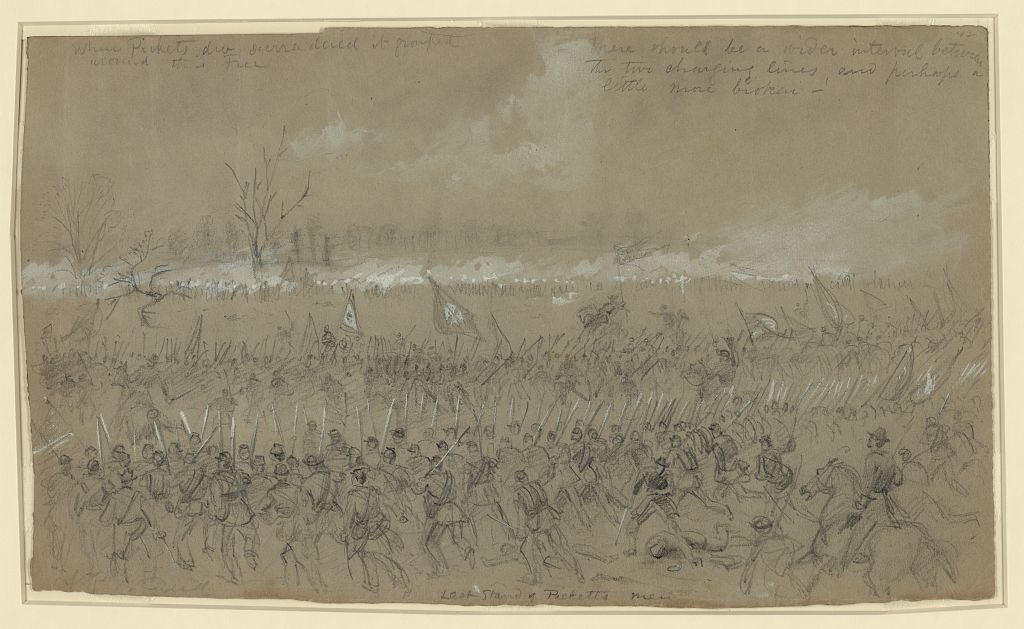
After delays in getting formations into place, Warren’s V Corps advanced during the late afternoon. Some regiments initially moved along an unexpected route, but others struck the Confederate flank and broke into the line. Sheridan’s cavalry maintained pressure across the front while Union forces seized critical ground.
The Confederate defense collapsed, and substantial numbers of men were captured. Remaining cavalry and infantry attempted to withdraw from the area rather than face encirclement. The battle was relatively short compared with the prolonged Petersburg siege, yet its outcome threatened the logistical basis of Confederate resistance.
Was Pickett absent during the attack?
Pickett and several other Confederate officers were away from the immediate front during part of the assault. Historical accounts often mention that he had been dining behind the lines at a gathering sometimes called the shad bake. The distance and difficulty of communication delayed his recognition of the crisis.
The episode became famous because it seems to explain the Confederate defeat through one dramatic lapse. That is too simple. The Union attacked with a strong combined force against a vulnerable flank, and Confederate resources were already limited. Pickett’s absence mattered, but geography and the defenders’ broader strategic position were also crucial.
Why was Warren relieved of command?
Despite the Union victory, Sheridan considered Warren insufficiently prompt and energetic during the operation. He removed Warren from command of the V Corps at the end of the battle. This decision was controversial because Warren’s soldiers had helped deliver the decisive blow to Pickett’s force.
Warren later challenged the judgment, and military historians continue to examine the episode. The controversy illustrates how command relationships can affect reputations independently of battlefield results. Evaluating it requires comparing orders, the timing of troop movements and testimony from officers rather than assuming success proved every decision correct or that removal proved every criticism accurate.
How many casualties were there?
The National Park Service battle database estimates about 3,830 combined casualties, including roughly 830 Union and 3,000 Confederate. These are estimated killed, wounded, captured and missing soldiers, not all deaths. The large Confederate figure reflects substantial numbers taken prisoner after the defenses were overwhelmed.
As with other Civil War engagements, casualty totals can vary by the records and time window included. A clear account should identify whether it refers strictly to the April 1 battle or the surrounding operations. The strategic importance of Five Forks does not depend on exact precision in those estimates, but it does require accuracy about what the figures represent.
Did Five Forks immediately capture the South Side Railroad?
The victory exposed the railroad and made it untenable for Lee to continue defending Petersburg. It did not mean that every rail line and station fell at the exact moment Pickett’s position collapsed. The Union subsequently occupied key routes as the Confederate army withdrew from its stretched defenses.
This distinction is important because military consequences often occur in stages. Five Forks shattered the western defense; Grant ordered attacks against Petersburg’s main line; and Lee recognized he could no longer hold the cities. The sequence explains why the surrender at Appomattox came days later rather than on the evening of April 1.
What happened on April 2 and 3?
After learning of the victory at Five Forks, Grant launched a broad assault on the Petersburg defenses on April 2. Union troops penetrated significant portions of the Confederate line, and Lee informed Confederate leaders that Petersburg and Richmond had to be evacuated. Soldiers and government officials began withdrawing.
On April 3, Union forces entered the two cities. Lee’s army marched west in an attempt to escape and obtain supplies, but Union pursuit eventually blocked the route. The Appomattox surrender on April 9 brought the Army of Northern Virginia’s organized fighting to an end.
Why is Five Forks regarded as decisive?
Five Forks was the military blow that made the existing Confederate defense of Petersburg effectively impossible. Its significance comes from the railroad, the defeat of Pickett’s command and the rapid Union offensive that followed. Lee could not maintain his army behind the old lines after such a loss.
The battle also shows the importance of combined cavalry and infantry attacks in 1865. Rather than simply repeating frontal assaults against elaborate trenches, the Union found and overwhelmed a vulnerable flank. Studied in context, Five Forks is a turning point on the route from Petersburg to Appomattox, not a substitute for the larger campaign.
Battle of Five Forks 1865 timeline
These dates distinguish the main stages of the operation from the consequences that came afterward.
| Date | Event |
|---|---|
| March 25, 1865 | Confederate attack at Fort Stedman fails. |
| March 29–31 | Union cavalry and infantry move around the Confederate western flank. |
| March 31 | Fighting at Dinwiddie Court House creates pressure on Sheridan. |
| April 1, afternoon | Warren’s V Corps and Sheridan’s cavalry attack Five Forks. |
| April 1, evening | Pickett’s defense collapses; Sheridan relieves Warren of command. |
| April 2 | Union forces assault Petersburg’s lines; Lee orders evacuation. |
| April 3 | Richmond and Petersburg fall to Union troops. |
| April 9 | Lee surrenders the Army of Northern Virginia at Appomattox. |
Frequently asked questions
When did it happen? April 1, 1865.
Where did it happen? Dinwiddie County, Virginia.
Who were the main commanders? Sheridan, Warren, Pickett.
What was the outcome? Decisive Union victory. The sections above explain the result in context.
How does it fit into the war? Our Civil War overview provides the wider timeline.
Historical sources and further reading
This guide uses National Park Service research, period images and documented chronology; the distinction between contemporary images and later art is maintained.