Battle of Franklin (1864): Hood’s Assault and Confederate Losses
A mass Confederate attack against prepared Union positions brought devastating losses south of Nashville.
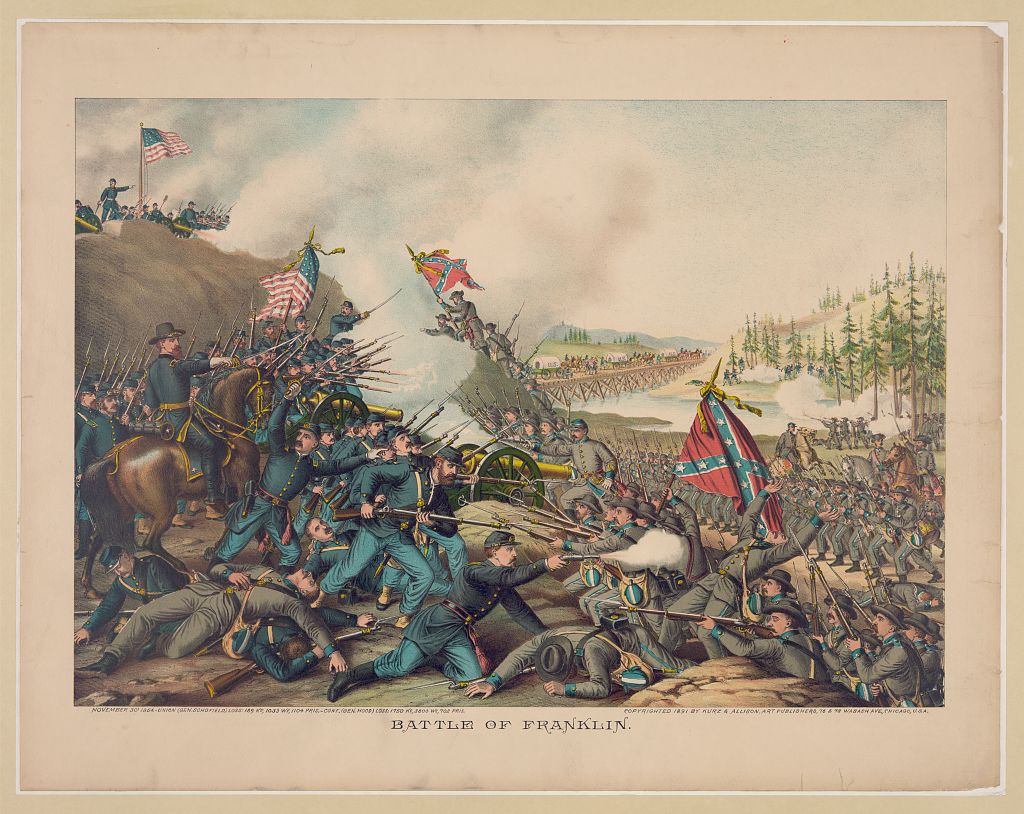
The Battle of Franklin was fought on November 30, 1864, in Franklin, Tennessee. Confederate general John Bell Hood attacked Union soldiers under John M. Schofield, who occupied fortified positions south of town. The Confederate frontal assault made some temporary penetrations but failed to destroy the Union force. Hood’s army suffered severe losses, including several generals; Schofield withdrew to Nashville that night.
A source-based guide to the sequence, commanders, decisions and historical consequences.
On this page — 19 topics
What happened at the Battle of Franklin?
Franklin was a major Civil War battle in Tennessee during Hood’s 1864 campaign against Union forces. John M. Schofield’s troops occupied fortified positions near the town while preparing to move north to Nashville. Hood followed and launched a large frontal attack against those defenses late in the afternoon of November 30.
The attack achieved temporary penetration in places but failed to destroy the Union army. Fighting continued into darkness, leaving many Confederate casualties. Schofield subsequently withdrew toward Nashville as intended. The result severely damaged Hood’s army and helped shape the larger Nashville Campaign, which ended in another Confederate defeat.
Why was Hood marching north?
After the loss of Atlanta, Hood attempted to move against Union lines of communication and draw northern armies away from Georgia. His forces advanced through Tennessee with hopes of achieving a significant battlefield success. The plan relied on striking separated Union commands before they could combine around the defensible city of Nashville.
Schofield was moving his Union force toward Nashville, where George H. Thomas was assembling troops. If Hood could defeat Schofield first, he might improve the odds of a later confrontation with Thomas. That urgency influenced the Confederate commander’s decisions at Franklin, although it did not remove the danger of attacking well-positioned defenders.
What happened at Spring Hill before Franklin?
On November 29, Confederate forces had an opportunity to interrupt Schofield’s line of retreat near Spring Hill. Confused orders, delays and the failure to fully close the road allowed much of the Union army to pass toward Franklin during the night. Historians continue to examine how responsibility for that missed opportunity should be assigned.
The failure placed Hood in a difficult position the next day. Schofield was ahead of him and preparing defenses around Franklin. The Confederate army had to decide whether to attack quickly or continue pursuing toward Nashville. The events at Spring Hill help explain the urgency behind Hood’s decision but do not automatically justify the frontal assault that followed.
Why did Schofield stop at Franklin?
Schofield needed to move his men, wagons and equipment over the Harpeth River while keeping the Confederates from overrunning the column. The river crossings and bridge arrangements required time. He therefore established a defensive perimeter on the southern edge of Franklin, making use of existing positions and rapidly improved fieldworks.
Stopping did not mean Schofield intended to fight Hood indefinitely. His main objective was to protect the withdrawal northward. The temporary nature of the defense is essential to understanding the outcome: Union troops could win the battle by holding long enough to continue their retreat, even without pursuing the defeated attackers afterward.
Who were the main commanders?
John Bell Hood commanded the Confederate Army of Tennessee, while John M. Schofield led Union troops falling back toward Nashville. Schofield’s force included formations under experienced officers responsible for holding different sectors. Hood’s generals commanded the infantry waves assigned to attack the fortified line.
The battle’s outcome depended on far more than decisions made by these two men. Brigades and divisions advanced under difficult conditions, individual commanders attempted to restore broken lines, and reserves were moved to threatened locations. Several Confederate general officers died or were mortally wounded, making the battle particularly destructive for the army’s leadership.
What was the battlefield terrain like?
The approaches south of Franklin included relatively open ground leading toward Union fieldworks. Artillery and rifle fire could cover these exposed areas. Confederate infantry had to cross considerable distances under fire before reaching the defenses. The terrain favored soldiers behind parapets rather than attackers advancing across open fields.
The Harpeth River behind the Union line mattered as well, because it constrained Schofield’s withdrawal until crossings were ready. The road and railroad corridor through town influenced the placement of troops. Understanding this geography helps explain why a Confederate attack could inflict danger locally while remaining very difficult to sustain across the whole defensive front.
How did Hood’s assault begin?
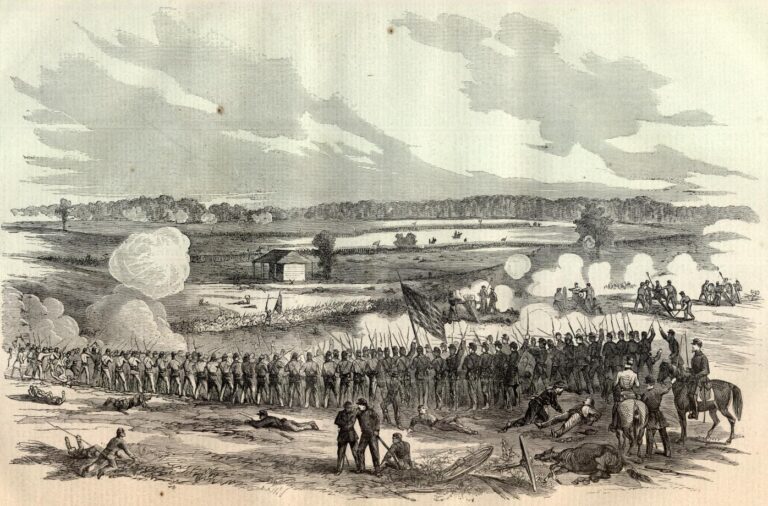
Late on November 30, Confederate infantry advanced toward the Union defenses in a massive frontal assault. The attack began before all possible preparations or reinforcements could be fully coordinated. Hood hoped the pressure would break Schofield’s line and prevent his army from reaching Nashville.
The troops crossed fields exposed to Union fire, and many fell before reaching the works. Some formations reached the defensive line and fought at close range. The attack’s scale made it one of the most dramatic assaults of the western theater, but scale alone could not overcome the advantages of prepared positions and effective defensive fire.
What happened near the Carter House?
The Carter House became associated with severe fighting in the central part of the Union line. Confederate troops achieved a temporary breakthrough in that sector, creating a crisis for the defenders. Union counterattacks and reinforcements restored much of the position amid intense short-range combat.
The house and nearby buildings survive as important sites for studying the battle. Visitors can compare the position of structures with the location of earthworks and the main road. Stories about individual acts of courage are meaningful, but the larger tactical issue was whether the Confederate penetration could be widened and supported. It could not.
Why were the Confederate losses so high?
Hood’s forces advanced against prepared troops across exposed ground, allowing Union defenders to fire effectively before the attackers reached the works. Even those who penetrated parts of the line faced counterattacks and concentrated resistance. The assault continued with enormous human cost but no decisive collapse of Schofield’s army.
The loss of senior officers compounded the damage. The National Park Service’s battle account records six Confederate generals dead or mortally wounded. Men in the ranks suffered even greater losses in absolute terms. The outcome left Hood with a weakened force for the subsequent movement toward Nashville.
How many men were casualties at Franklin?
The National Park Service’s Civil War battle database estimates approximately 9,933 combined casualties, with Confederate losses substantially higher than Union losses. Such totals include killed, wounded, captured and missing personnel, not deaths alone. Exact figures vary among accounts because rolls and estimates were compiled under wartime conditions.
Casualty figures should be compared with care. A number printed on a nineteenth-century memorial lithograph is not automatically the latest scholarly consensus. Historians examine official reports, hospital records and unit histories to reconstruct losses. The broad result is clear: the Confederate army paid a very heavy price for an unsuccessful assault.
Did Schofield remain at Franklin after winning?
No. Schofield withdrew toward Nashville during the night after the fighting, following the strategic purpose of his temporary defense. This sometimes confuses readers who expect the winner of a battle always to occupy the same field the next morning. His army had protected the retreat route and avoided destruction.
Hood remained able to move north, but his force was severely weakened. A Union victory can therefore consist of successfully defending a position long enough to complete a planned withdrawal. The question is not who stayed in town overnight, but whether the commanders achieved their military objectives at acceptable cost.
What happened at Nashville?
After Franklin, Hood moved toward Nashville, where Union general George H. Thomas commanded a larger and better-prepared force. The armies faced one another as Thomas completed arrangements for an attack. On December 15 and 16, Union forces struck Hood’s positions and won a major victory.
The Nashville defeat ended Hood’s attempt to reverse the Union position in Tennessee. Franklin and Nashville should be linked in the chronology because Hood’s losses at the former weakened the army that fought at the latter. Yet they were separate engagements with different tactical situations, and a reader should not combine their casualty totals without explanation.
Was the attack at Franklin a mistake?
Many historians judge Hood’s frontal assault extremely costly and ultimately unsuccessful. Nevertheless, reconstructing his decision requires considering the failed opportunity at Spring Hill, the urgency to strike Schofield before he reached Nashville and Hood’s assessment of the Union position. The attack was not made in a vacuum.
Criticism remains justified by the result, but explanations that rely only on Hood’s temperament miss operational pressures and failures of coordination. Military history is strongest when it distinguishes motive, available intelligence, tactical execution and consequences. Franklin demonstrates how a plausible desire to win quickly could lead to a ruinous battlefield decision.
How did the battle affect local people?
Franklin residents saw their town transformed into a major battlefield, with homes and yards becoming positions for soldiers and places where wounded men were treated. Buildings, fences and fields were damaged. Families faced the sudden arrival of thousands of men requiring medical care and assistance.
The legacy remained visible in burial grounds and preserved sites. The experience of civilians shows why a battle’s consequences extend beyond the moment the armies disengage. Homes that had been ordinary family spaces became part of national military history, and local efforts to preserve them help visitors understand the battle’s human scale.
Why does Franklin remain significant?
Franklin is an example of the growing defensive power of earthworks against mass infantry assaults. The Confederate attack showed determination and temporary tactical success at points, but it failed to destroy an enemy that occupied strong lines. Hood’s army lost soldiers and commanders it urgently needed for the Nashville campaign.
The battle is also important for distinguishing immediate tactical results from the broader campaign. Schofield’s army left Franklin on schedule, while Hood’s army advanced but deteriorated. Studying both facts together explains why the battle is generally considered a Union victory and a serious Confederate defeat.
Battle of Franklin 1864 timeline
These dates distinguish the main stages of the operation; the consequences often continued beyond the moment of battle.
| Date | Event |
|---|---|
| November 29 | Hood pursues Schofield through middle Tennessee. |
| November 30, morning | Union forces establish positions near Franklin. |
| November 30, afternoon | Hood orders a large frontal assault. |
| November 30, evening | Confederate attackers struggle around the central Union works. |
| Night of November 30 | Schofield withdraws toward Nashville. |
| December 15–16 | Hood is defeated again at Nashville. |
Frequently asked questions
When did it happen? November 30, 1864.
Where did it take place? Franklin, Tennessee.
Who commanded the principal forces? Hood, Schofield.
What was the outcome? Union victory. The sections above explain the tactical result and the wider consequences.
How does it fit into the Civil War? For a broader chronology see the American Civil War guide.
Historical sources and further reading
The account uses National Park Service historical interpretation and Library of Congress records. Images are identified as contemporary photographs or later historical representations where applicable.