Woolly Mammoths Were Still Alive After the Great Pyramid Was Built
Woolly mammoths usually belong in our imagination beside Ice Age hunters and frozen Pleistocene landscapes. But a small population survived much later than most people realize.
The fact
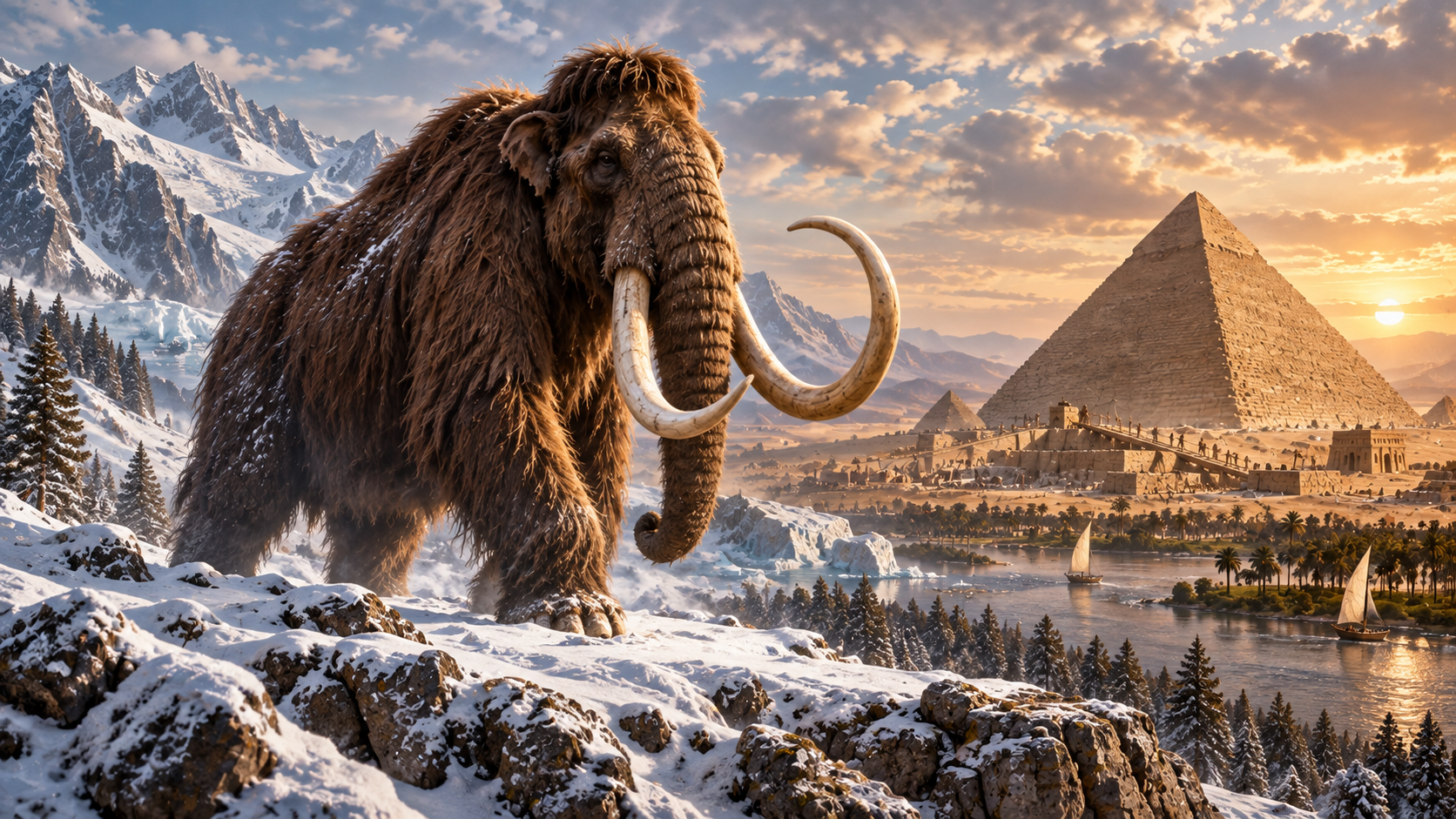
Woolly mammoths survived on Wrangel Island in the Arctic Ocean until roughly 4,000 years ago. By then, the Great Pyramid of Giza had already been standing for centuries.
The comparison compresses two periods that are often imagined as completely separate: the age of mammoths and the age of monumental Egyptian civilization overlapped.
How did mammoths survive so late?
Most woolly mammoth populations disappeared near the end of the last Ice Age. Rising temperatures, ecological change and human pressures all formed part of a complicated extinction process.
Wrangel Island was different. As sea levels rose, mammoths there became isolated from mainland populations. The island acted as a refuge, allowing a small population to survive long after mammoths had vanished across most of Eurasia and North America.
What the dating tells us
Radiocarbon studies of mammoth remains from Wrangel Island show surprisingly young dates. Research has placed the final population’s disappearance at around 4,000 calibrated years before present.
That is thousands of years after many mainland mammoths had vanished.
Meanwhile, in Egypt
Khufu’s Great Pyramid at Giza was built in the third millennium BCE. It was part of a mature state with centralized administration, long-distance transport, skilled labor and large-scale stone construction.
So while Egyptian workers and officials were living in the world of the Old Kingdom, mammoths still survived far to the north on an isolated Arctic island.
The last mammoths were not simply starving relics
One study examining isotopes in Wrangel Island mammoth remains found no clear evidence of a long, simple decline caused by deteriorating habitat or food supply. Researchers have instead considered the possibility that relatively sudden environmental events contributed to the population’s final collapse.
The exact extinction mechanism remains a subject of research, but the late survival date is well established.
Why this fact changes our sense of prehistory
“Prehistoric” animals can feel infinitely distant from recorded civilization. In reality, the boundary is much messier. Human societies were building cities, monuments and states while some animal populations commonly associated with the Ice Age still persisted in remote places.
The last woolly mammoths were not separated from the pyramids by tens of thousands of years. Their timelines overlapped.