Home / Ancient History / Ancient Egypt
Ancient Egyptian Gods: Ra, Osiris, Anubis, Isis and the Pantheon
Who were the gods of ancient Egypt? Meet Ra, Osiris, Isis, Anubis, Horus, Amun, Hathor, Thoth, Bastet and other major deities—and learn how Egyptians actually worshipped them.
Published 29 September 2026
Ancient Egyptian religion included hundreds of gods, goddesses and divine forms. Some were worshipped across Egypt for centuries, while others were especially important in particular cities, temples or periods.
Ra represented the sun, Osiris became central to beliefs about death and rebirth, Isis was associated with protection and magic, Horus with kingship, Anubis with embalming and the dead, and Amun rose from a local Theban god to one of the most powerful deities in the New Kingdom.
Egyptian religion was not a fixed system with one official list of gods. Deities could merge, acquire new titles and take on different roles over time. The same god might appear in several forms, and local temples could emphasize different creation myths without treating them as mutually exclusive.
For the wider society behind these beliefs, see Life and Society in Ancient Egypt. For a New Kingdom ruler whose reign restored traditional cults after the Amarna period, see our guide to Tutankhamun.
How many gods did ancient Egypt have?
There was no single fixed number.
Egyptian religion developed over more than three thousand years, and hundreds of divine names and forms are known from texts, temples, tombs and artifacts.
Some gods were national in importance. Others belonged mainly to a single region, profession, family tradition or ritual context.
This flexibility is one reason Egyptian religion can look confusing when reduced to a simple modern “pantheon chart.”
Why did Egyptian gods have animal heads?
Egyptian gods were often represented in human, animal or mixed forms.
A god with an animal head was not necessarily believed to be literally half human and half animal. The animal could express particular qualities of the deity.
Falcons could suggest the sky and kingship. Jackals were associated with desert-edge cemeteries and funerary protection. Cats could symbolize protective power, while crocodiles embodied dangerous force.
Different forms allowed artists to communicate divine attributes visually.
Ra: god of the sun
Ra was one of the most important solar gods in ancient Egypt.
He was especially associated with Heliopolis and with the daily movement of the sun across the sky.
Ra was often shown as a falcon-headed man wearing a solar disk.
In religious texts, his daily journey represented cosmic renewal: the sun crossed the heavens during the day, traveled through the night world and returned at dawn.
Ra’s journey through the night
Egyptian funerary texts describe the sun god traveling through the underworld during the night.
There he encountered dangers, including the serpent Apophis or Apep, who represented forces threatening cosmic order.
Ra’s successful return at sunrise symbolized the continued triumph of order and renewal.
Atum and the creation of the world
At Heliopolis, creation traditions often began with Atum.
Atum emerged from the primeval waters and generated the first divine pair, Shu and Tefnut.
Their descendants included Geb, Nut, Osiris, Isis, Seth and Nephthys.
This group became known by Egyptologists through the Greek term Ennead, meaning a group of nine gods.
The Ennead
A common Heliopolitan grouping included:
- Atum;
- Shu;
- Tefnut;
- Geb;
- Nut;
- Osiris;
- Isis;
- Seth;
- Nephthys.
Egyptian religious traditions were not standardized across the country, so other cities promoted different creation systems.
Amun: the hidden god
Amun began as an important deity at Thebes.
His name is often interpreted as “the hidden one.”
As Thebes became politically dominant, Amun’s cult gained enormous prestige.
By the New Kingdom, he was among Egypt’s most powerful state gods.
Amun-Ra
Amun was increasingly combined with the solar god Ra as Amun-Ra.
This did not necessarily mean Egyptians believed the two gods had ceased to exist separately.
Egyptian religion often allowed divine identities to overlap and combine.
Amun-Ra could therefore express both Amun’s hidden universal power and Ra’s visible solar force.
Karnak and the cult of Amun
The enormous temple complex at Karnak near Thebes became the principal center of Amun’s worship.
Successive pharaohs expanded the site with pylons, courts, obelisks, halls and chapels.
The wealth of Amun’s priesthood became politically significant during parts of Egyptian history.
Osiris: god of the dead and rebirth
Osiris became one of the most important gods connected with the afterlife.
He was usually represented as a mummified king wearing a crown and holding royal symbols.
His myth centered on death, restoration and legitimate kingship.
The murder of Osiris
In the best-known tradition, Osiris was killed by his brother Seth.
His wife and sister Isis, assisted in many versions by Nephthys and other deities, recovered and restored his body.
Osiris did not simply return to ordinary earthly life. He became ruler of the realm of the dead.
His son Horus then fought Seth for the kingship.
Why Osiris mattered to ordinary Egyptians
Osiris became closely associated with the hope of continued existence after death.
Over time, ordinary deceased people could be identified symbolically with Osiris in funerary texts.
His death and renewal also connected him with agricultural fertility and the recurring regeneration of the Nile landscape.
Isis: goddess of protection, motherhood and magic
Isis was wife of Osiris and mother of Horus.
She was associated with protection, motherhood, healing and magical power.
Myths emphasize her intelligence and persistence as she restores Osiris and protects the young Horus.
Her cult later spread far beyond Egypt into the wider Mediterranean world.
How was Isis shown?
Isis could be represented as a woman wearing the hieroglyphic sign for a throne on her head.
Later she was also shown with cow horns and a solar disk, imagery she shared with Hathor.
Images of Isis nursing Horus became especially widespread.
Horus: god of kingship and the sky
Horus was one of Egypt’s most important divine figures.
He was frequently represented as a falcon or as a falcon-headed man.
Horus was strongly associated with kingship. The living pharaoh could be identified with Horus, while the deceased king was associated with Osiris.
Horus and Seth
The conflict between Horus and Seth became one of Egyptian mythology’s central political stories.
Horus fought to inherit the kingship of his father Osiris.
The story could symbolize the restoration of legitimate order after disruption.
Several surviving texts preserve different versions of their struggle.
The Eye of Horus
The Eye of Horus, often called the wedjat eye, became a powerful protective symbol.
In myth it was connected with injury and restoration during the conflict with Seth.
Amulets shaped like the eye were commonly used for protection in life and burial.
Anubis: god of embalming and the dead
Anubis was closely associated with embalming, cemeteries and the protection of the dead.
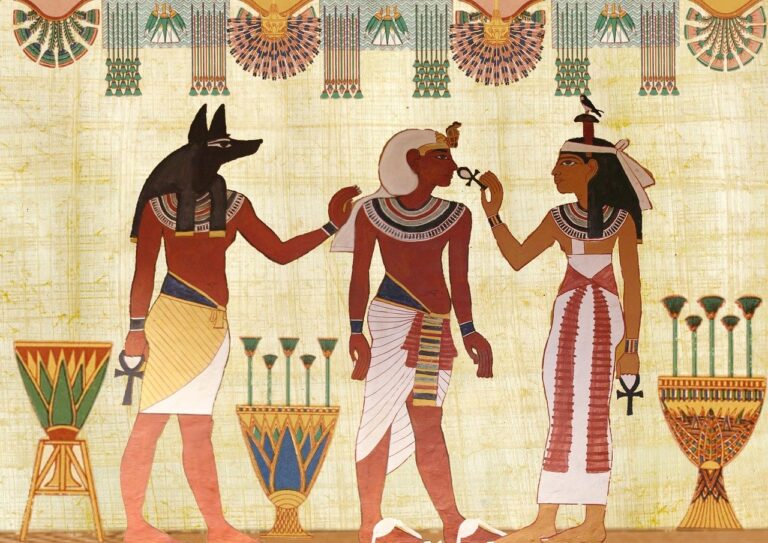
He was commonly shown as a black jackal or a man with a jackal head.
Before Osiris became dominant in many afterlife traditions, Anubis held especially important funerary roles.
Why was Anubis shown as a jackal?
Wild canids were often seen around desert margins, including areas near cemeteries.
Turning a potentially threatening animal into a divine protector may have helped express Anubis’s role as guardian of burial places.
The black color associated with Anubis could also suggest both mummified flesh and the fertile black soil of the Nile, linking death with regeneration.
Anubis and the weighing of the heart
One of the best-known scenes from Egyptian funerary religion shows the deceased’s heart weighed against the feather of Ma’at.
Anubis supervises the balance.
If the deceased is judged worthy, the individual can proceed toward a blessed afterlife.
The scribe god Thoth records the result, while the composite creature Ammit waits nearby in many representations.
Ma’at: goddess and principle of order
Ma’at was both a goddess and a fundamental concept.
She represented truth, justice, balance and proper cosmic order.
Egyptian kings were expected to maintain Ma’at and defeat forces of disorder.
Her feather became central to imagery of judgment after death.
Thoth: god of writing and knowledge
Thoth was associated with writing, wisdom, calculation, the moon and learned knowledge.
He was often shown with the head of an ibis or in baboon form.
As divine scribe, he recorded judgments and played important roles in myths involving the other gods.
Hathor: goddess of love, music and motherhood
Hathor was one of Egypt’s most widely worshipped goddesses.
She was associated with love, sexuality, music, dance, motherhood, joy and the sky.
Hathor could be represented as a cow, as a woman with cow horns and a solar disk, or in other forms.
Her major cult center was at Dendera.
Hathor and the afterlife
Hathor was not only a goddess of joy and fertility.
She also had funerary roles and could welcome the dead into the western realm.
This mixture of apparently different functions is typical of Egyptian deities.
Bastet: protective cat goddess
Bastet became one of the most recognizable Egyptian goddesses because of her cat imagery.
Her cult center was Bubastis in the Nile Delta.
Earlier forms could be more lioness-like and fierce, while later representations increasingly emphasized the domestic cat.
She was associated with protection, household life, fertility and celebration.
Did Egyptians worship cats?
Egyptians did not simply treat every cat as a god.
Cats could be sacred to particular deities, especially Bastet, and animals might be kept, dedicated or mummified within temple cult systems.
The relationship between animals and divinity was symbolic and ritual rather than a belief that every individual animal was itself a full deity.
Sekhmet: lioness goddess of destruction and healing
Sekhmet was a lioness-headed goddess associated with destructive power, warfare, disease and healing.
These roles were not contradictory in Egyptian thinking.
A deity capable of sending disease could also be invoked to control or prevent it.
Sekhmet was especially connected with Memphis and with the god Ptah.
Ptah: god of craftsmen and creation
Ptah was the great god of Memphis and patron of craftsmen.
In Memphite theology, creation could be explained through Ptah’s heart and speech.
This represented a different creation tradition from the Heliopolitan story of Atum.
Egyptians could preserve multiple creation accounts without requiring one to eliminate the others.
Sobek: crocodile god
Sobek embodied the dangerous power associated with crocodiles.
He was particularly important in the Faiyum and at Kom Ombo.
Sobek could represent strength, fertility and protection as well as danger.
Some temples kept sacred crocodiles associated with his cult.
Khnum: creator on the potter’s wheel
Khnum was associated with the Nile region around Elephantine and with creation.
One tradition described him forming human beings on a potter’s wheel.
He was commonly represented as a ram-headed god.
Nephthys
Nephthys was the sister of Isis, Osiris and Seth in the Heliopolitan Ennead.
She played important protective and funerary roles.
In the Osiris myth she often helps Isis mourn and restore the dead god.
Isis and Nephthys could appear together protecting coffins and the deceased.
Seth: god of disorder, desert and power
Seth is often presented in modern retellings as an Egyptian equivalent of an evil god.
That is too simple.
Seth could represent violence, desert, storms and disorder, and he was the enemy of Osiris and Horus in important myths.
But he also had positive protective roles, including defending the sun god against Apophis in some traditions.
Was Seth always hated?
No.
Seth was worshipped in some regions and periods.
Several New Kingdom kings, including Seti I and Seti II, bore names invoking him.
His reputation became more negative in some later periods, showing how divine identities could change historically.
Apophis: the serpent of chaos
Apophis, or Apep, was a giant serpent representing forces that threatened cosmic order.
He attacked the solar barque during Ra’s nightly journey.
Unlike many major gods, Apophis was not a normal deity receiving a positive cult.
Rituals could instead be performed to symbolically destroy or repel him.
Khepri: the rising sun
Khepri represented the rising sun and renewal.
He was associated with the scarab beetle.
The beetle’s rolling of a dung ball was compared with the sun’s movement across the sky.
Scarab amulets became extremely common in Egyptian material culture.
Nut: goddess of the sky
Nut represented the sky.
She was often shown as a woman arching over the earth god Geb, her body covered with stars.
Funerary texts describe her swallowing the sun in the evening and giving birth to it again at dawn.
Her image could also appear on coffin interiors as a protective sky over the deceased.
Geb: god of the earth
Geb represented the earth.
In Egyptian imagery, the earth was male and the sky female—the reverse of some other ancient mythological traditions.
Geb was father of Osiris, Isis, Seth and Nephthys in the Heliopolitan system.
Shu and Tefnut
Shu represented air and could be shown holding the sky goddess Nut above the earth god Geb.
Tefnut was associated with moisture.
Together they belonged to the earliest generation of gods after Atum in the Heliopolitan creation tradition.
Mut and Khonsu
At Thebes, Amun was commonly grouped with the goddess Mut and the moon god Khonsu.
Together they formed the Theban Triad.
Temple religion often organized gods into family groups, linking divine relationships with ideas of kingship and social order.
What was a divine triad?
Egyptian temples often grouped a male god, female goddess and child god as a local divine family.
Examples include:
- Amun, Mut and Khonsu at Thebes;
- Osiris, Isis and Horus;
- Ptah, Sekhmet and Nefertum at Memphis.
These groupings helped organize local theology but did not mean Egyptians worshipped only three gods at a time.
Did Egyptian religion have one creation story?
No.
Different religious centers preserved different explanations for creation.
Heliopolis emphasized Atum and the Ennead.
Memphis emphasized Ptah.
Hermopolis developed traditions involving primordial pairs known as the Ogdoad.
Later Theban theology could place Amun behind creation itself.
How could several creation myths all be true?
Ancient Egyptian religious thought often combined rather than eliminated traditions.
Different myths could express different aspects of divine reality.
A local temple did not necessarily need to prove that another city’s theology was false.
This flexibility helped Egyptian religion absorb new cults and reinterpret older gods over thousands of years.
How did ancient Egyptians worship the gods?
Temple religion centered on maintaining the presence and favor of the deity.
Daily rituals could include washing and dressing the cult image, burning incense, offering food and drink and reciting sacred texts.
Most ordinary people did not enter the deepest sanctuary areas.
Priests performed official rituals on behalf of the king and community.
What happened to food offerings?
Food presented ritually to a god did not simply disappear.
After the divine offering, it could be redistributed within the temple system.
Large temples therefore functioned not only as religious institutions but also as major economic organizations controlling land, workers and supplies.
Could ordinary Egyptians pray directly to gods?
Yes.
Religion existed beyond the monumental temple.
People used household shrines, amulets, votive offerings, prayers and visits to accessible areas of sacred sites.
Some individuals appealed directly to gods for healing, protection, fertility or justice.
Oracles
In some periods, divine statues carried in procession could be consulted through oracular procedures.
Questions might concern disputes, appointments or personal problems.
Movements of the sacred image could be interpreted as divine answers.
Egyptian priests
Priests maintained temples and performed ritual duties.
Many priests did not necessarily serve full time throughout their lives; temple service could rotate among groups.
Purity rules governed ritual behavior, clothing and washing.
High-ranking priesthoods could become politically and economically powerful.
The pharaoh and the gods
The pharaoh occupied a unique place in Egyptian religion.
He was expected to maintain Ma’at, build and restore temples, present offerings and preserve order.
Temple reliefs often show the king personally performing rituals even when priests carried out daily ceremonies in practice.
Kingship itself was therefore deeply religious.
Was the pharaoh considered a god?
The answer is more complicated than a simple yes or no.
Egyptian kings possessed divine associations and could be identified with gods such as Horus.
Deceased kings were linked with Osiris, and royal cults could continue after death.
But the king also remained a human ruler performing obligations toward gods whose power exceeded his own.
Akhenaten and the Aten
During the fourteenth century BCE, Pharaoh Akhenaten radically elevated the Aten, represented by the sun disk.
Traditional cults—especially that of Amun—lost royal support, and the court moved to a new capital at Akhetaten, modern Amarna.
The period was exceptional in Egyptian history.
Was Akhenaten the first monotheist?
Akhenaten is often described as the first monotheist, but the label is debated.
His regime promoted the Aten to an unprecedented level and suppressed important rival cults.
Whether this should be classified as strict philosophical monotheism in the modern sense is less certain.
It is safer to describe the Amarna religion as an extraordinary concentration of royal worship on the Aten.
Tutankhamun and the restoration of the gods
After Akhenaten’s reign, traditional cults returned to royal favor.
The young king originally named Tutankhaten changed his name to Tutankhamun, explicitly reconnecting the monarchy with Amun.
Temples and priesthoods were restored.
Read the full story in our Tutankhamun guide.
Egyptian gods and death
Religion shaped every stage of burial.
Anubis protected embalming, Osiris ruled the dead, Isis and Nephthys guarded and mourned, Thoth recorded judgment and Ma’at represented the standard of cosmic justice.
Funerary texts provided spells intended to help the deceased navigate the afterlife.
The Book of the Dead
The modern name Book of the Dead refers to collections of funerary spells used especially during the New Kingdom and later periods.
It was not one fixed book identical in every burial.
Different papyri contained different selections of spells and illustrations.
The famous weighing-of-the-heart scene belongs to this wider funerary tradition.
What happened during the weighing of the heart?
The heart of the deceased was weighed against the feather of Ma’at.
Anubis tended the scales and Thoth recorded the result.
If the deceased passed judgment, the individual could continue into the blessed afterlife associated with Osiris.
The scene expressed the importance of moral order as well as ritual preparation.
Why did Egyptians mummify bodies?
Preserving the body was connected with the Egyptian understanding of personhood and the afterlife.
The deceased needed continuing identity, ritual support and a place where different spiritual aspects could remain connected.
Mummification developed over centuries and varied enormously according to wealth, period and status.
Sacred animals
Several gods had sacred animal associations.
Examples included:
- cats with Bastet;
- ibises and baboons with Thoth;
- crocodiles with Sobek;
- falcons with Horus;
- rams with Amun or Khnum;
- bulls with deities including Ptah through the Apis cult.
Temple systems sometimes bred and mummified animals as votive offerings.
The Apis bull
The Apis bull was a sacred animal associated especially with Ptah at Memphis.
A living bull chosen according to specific markings could be treated as a divine manifestation.
After death it received elaborate burial.
The cult continued for centuries and later became linked with Osiris-Apis and the Greco-Egyptian god Serapis.
Egyptian gods under Greek and Roman rule
Egyptian religion continued after Alexander the Great and during Ptolemaic and Roman rule.
Temples remained active, and rulers presented themselves using traditional pharaonic religious imagery.
Some Egyptian cults also spread abroad.
Isis in the Roman world
The worship of Isis became especially popular around the Mediterranean.
Temples dedicated to Isis existed in cities far beyond Egypt.
Her cult adapted to new cultural settings while retaining strong Egyptian associations.
Serapis
Serapis became prominent under the Ptolemies.
The god combined Egyptian and Greek religious features and was associated with Osiris and the Apis bull.
His great sanctuary, the Serapeum of Alexandria, became one of the city’s major religious institutions.
When did ancient Egyptian religion end?
Traditional Egyptian religion declined gradually rather than disappearing in one moment.
Christianity spread through Egypt during the Roman period.
Temples lost state support, some were closed or converted and knowledge of hieroglyphic religious writing faded.
The last known dated hieroglyphic inscription was carved at Philae in 394 CE.
Ancient Egyptian gods: quick reference
- Ra: sun and solar kingship.
- Amun: hidden power; later major state god.
- Osiris: dead, rebirth and afterlife.
- Isis: protection, motherhood and magic.
- Horus: sky and kingship.
- Anubis: embalming and funerary protection.
- Ma’at: truth, justice and cosmic order.
- Thoth: writing, knowledge and calculation.
- Hathor: love, joy, motherhood and music.
- Bastet: household and protective power.
- Sekhmet: war, destructive force and healing.
- Ptah: craftsmanship and creation.
- Sobek: crocodile power, strength and protection.
- Seth: desert, storms, force and disorder.
- Nut: sky.
- Geb: earth.
- Khepri: rising sun and renewal.
- Khnum: creation and Nile-region cult.
- Nephthys: protection and funerary ritual.
Ancient Egyptian religion myths
Myth: Egyptians had one fixed list of gods
Egyptian religion changed over thousands of years and varied by region. Local cults and changing political centers produced different hierarchies of deities.
Myth: animal-headed gods meant Egyptians worshipped ordinary animals
Animal forms expressed divine characteristics. Sacred animals could be part of cult practice, but the system was more complex than worshipping every animal of a species.
Myth: Seth was simply the Egyptian devil
Seth could represent dangerous disorder, but he also had protective and royal roles in some periods.
Myth: Akhenaten permanently replaced all Egyptian gods
The Aten cult dominated royal policy for a short period. Traditional cults returned quickly after Akhenaten’s reign.
Myth: every Egyptian believed exactly the same creation story
Egypt preserved several major creation traditions associated with different religious centers.
Ancient Egyptian gods FAQ
Who was the most important Egyptian god?
There was no single answer for all of Egyptian history. Ra, Amun, Osiris, Horus and other gods became especially important in different periods and contexts.
Who was the Egyptian sun god?
Ra was the most famous solar god, though Egyptian religion also included other solar forms such as Khepri, Atum and Ra-Horakhty.
Who was the god of death?
Osiris ruled the realm of the dead, while Anubis was strongly associated with embalming, cemeteries and funerary protection.
Who was the Egyptian god with a jackal head?
Anubis was commonly shown as a jackal or jackal-headed man.
Who was the Egyptian cat goddess?
Bastet became strongly associated with cats, protection, household life and fertility.
Who was the falcon-headed god?
Horus was famously represented as a falcon or falcon-headed man. Ra and related solar gods could also appear with falcon heads.
Who judged the dead?
Osiris presided over the realm of the dead, while the weighing-of-the-heart scene involved Anubis, Thoth, Ma’at and other divine figures.
Did Egyptian gods have families?
Yes. Temples and myths often organized deities into family groups such as Osiris, Isis and Horus or Amun, Mut and Khonsu.
Sources and further reading
- British Museum — Ancient Egyptian Gods and Goddesses
- UCL Digital Egypt — Gods, Goddesses and Creation
- UCL Digital Egypt — Gods and Goddesses by Cult Place
- Geraldine Pinch, Egyptian Mythology.
- Richard H. Wilkinson, The Complete Gods and Goddesses of Ancient Egypt.
CONTINUE EXPLORING
More Ancient Egypt
Stories, people and events that shaped our world. Explore history with context, clarity and curiosity.
© 2026 Passion for History. All rights reserved.
Some content is created with AI assistance and may contain errors. We aim to review, verify and improve our articles over time.