Home / Ancient History / Ancient Rome
Why Ancient Roman Concrete Can Survive for Thousands of Years
Roman concrete has survived in harbors, walls and monumental buildings for centuries. Modern research is helping explain the chemistry behind its remarkable durability.
Published 10 September 2026
Roman bridges, walls, harbors and monumental buildings have survived for extraordinary lengths of time. Modern materials scientists are still studying exactly why some Roman concrete proved so durable. This engineering tradition was one part of the infrastructure that supported the Roman Empire; explore more technology, daily life and politics in our Ancient Rome hub.
The fact
Research published in 2023 found evidence that ancient Roman builders used a technique known as hot mixing, combining quicklime with other dry ingredients before or during the addition of water.
This process helped create distinctive lime-rich fragments inside the material. Far from being simply signs of careless mixing, these “lime clasts” may have contributed to the concrete’s ability to repair small cracks chemically.
What Roman concrete was made from
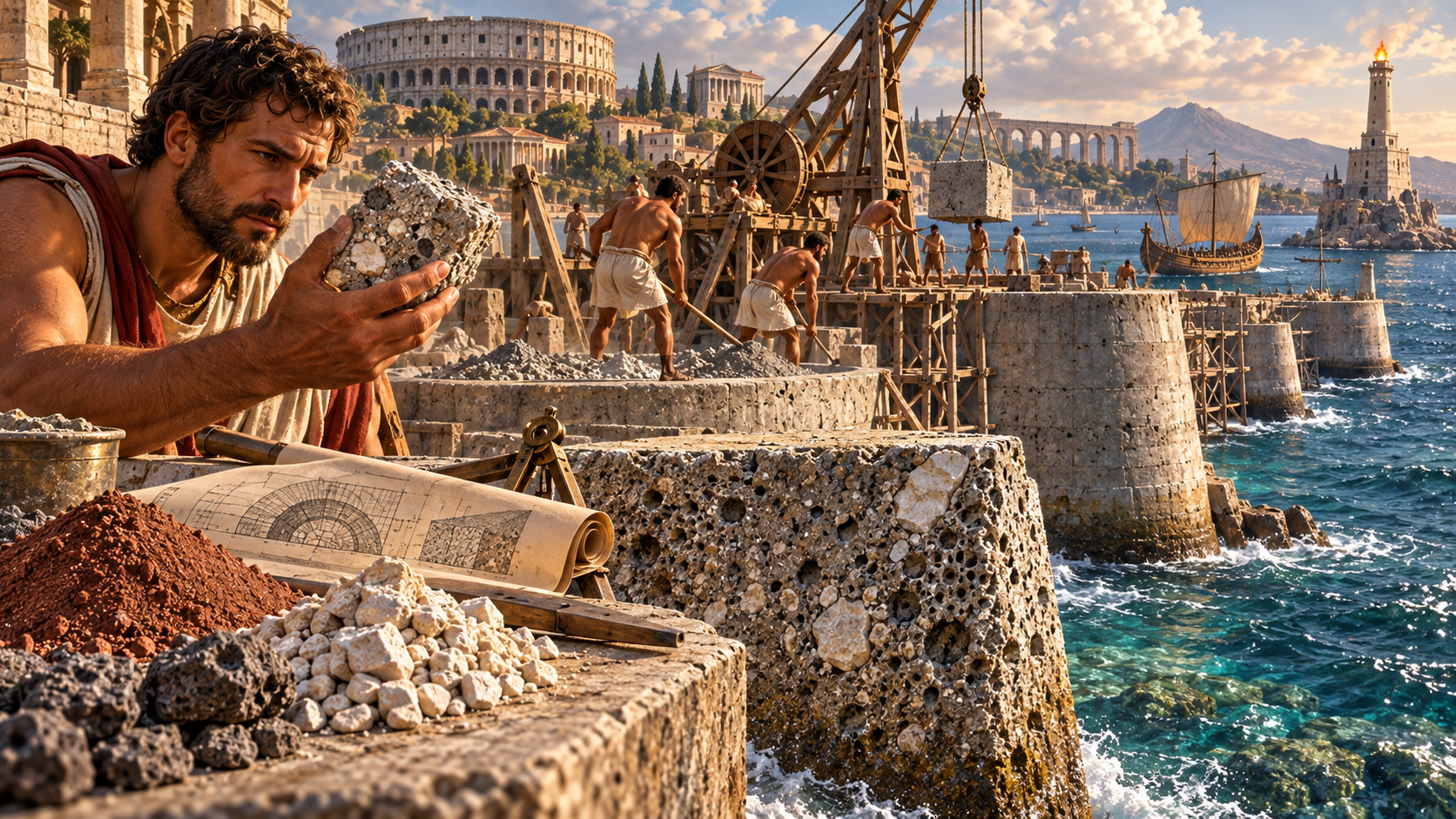
Roman concrete was not identical to modern Portland-cement concrete. Recipes varied, but builders often combined lime with volcanic ash, aggregate and water.
In regions with suitable volcanic material, these mixtures produced strong chemical bonds that performed especially well in demanding environments.
The puzzle of the lime clasts
Researchers had long noticed small white pieces of lime in Roman concrete. One interpretation was that ancient builders had mixed the material poorly.
Detailed chemical and microscopic analysis suggested another possibility: the fragments were linked to a deliberate high-temperature mixing process involving quicklime.
How self-healing can work
When water enters a small crack, calcium-rich material from lime clasts can dissolve and move through the fracture. New calcium compounds may then crystallize, filling or sealing part of the crack.
This does not mean every Roman structure magically repairs all damage. Durability depends on many factors, including the original recipe, environment, workmanship and centuries of maintenance or neglect.
But the chemistry helps explain why certain Roman concretes have remained remarkably resilient.
Roman engineering was highly sophisticated
The discovery also challenges the idea that ancient construction methods were merely crude predecessors to modern technology. Roman builders worked with materials through generations of practical experimentation.
They may not have described the chemistry in modern scientific language, but they understood that different ingredients and preparation methods produced different results.
Why scientists care today
Concrete production is a major modern industrial process, and researchers are interested in materials that last longer and require fewer repairs. Understanding ancient Roman techniques may inspire new approaches to durable construction.
The lesson is not that Roman concrete was universally “better” than modern concrete. Modern structures face different engineering demands. The more useful lesson is that ancient materials can contain design principles worth studying rather than dismissing.
Sources and further reading
CONTINUE EXPLORING ROME
Related Roman history


Stories, people and events that shaped our world. Explore history with context, clarity and curiosity.
© 2026 Passion for History. All rights reserved.
Some content is created with AI assistance and may contain errors. We aim to review, verify and improve our articles over time.