Cleopatra Lived Closer to the Moon Landing Than to the Great Pyramid
Cleopatra VII feels inseparable from the world of pyramids, pharaohs and ancient Egypt. Chronologically, however, she lived surprisingly late in Egyptian history.
The fact
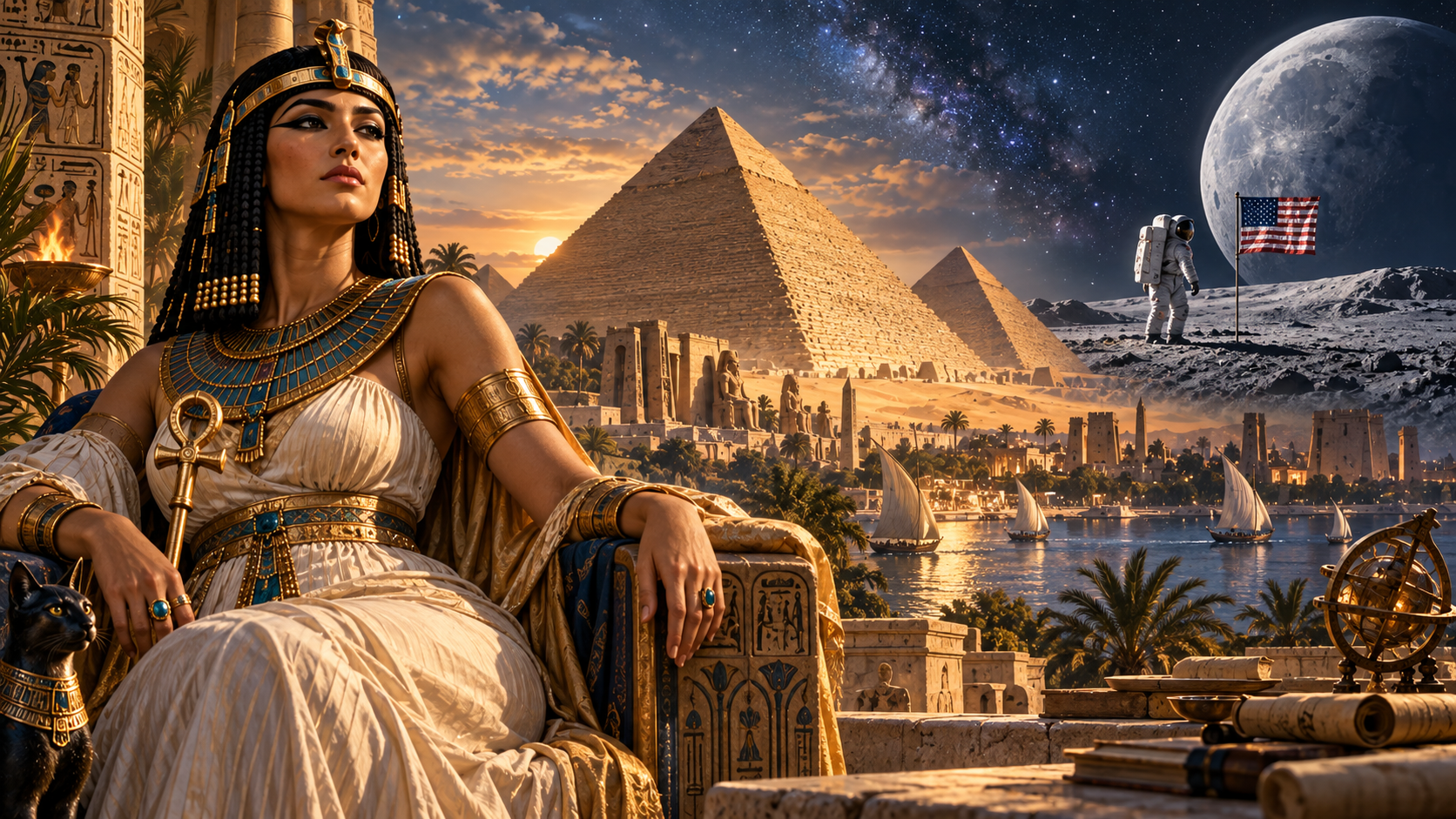
Cleopatra died in 30 BCE. The Great Pyramid of Giza had already been standing for roughly two and a half millennia. By contrast, the Apollo 11 Moon landing took place in 1969 CE. That means Cleopatra was closer in time to Neil Armstrong walking on the Moon than she was to the construction of the Great Pyramid.
Putting the dates side by side
- Great Pyramid of Giza: completed around the mid-26th century BCE, during the reign of Khufu.
- Cleopatra VII: ruled Egypt from 51 to 30 BCE.
- Apollo 11 Moon landing: July 20, 1969.
Using approximate dates, more than 2,500 years separated Cleopatra from the completion of Khufu’s pyramid. The gap from Cleopatra’s death to Apollo 11 was about 2,000 years.
Why the comparison feels so strange
Popular culture often compresses ancient Egypt into one timeless image: pyramids, hieroglyphs, pharaohs and Cleopatra all seem to belong to the same distant moment. In reality, Egyptian civilization lasted for thousands of years and changed dramatically over that span.
Cleopatra belonged to the Ptolemaic dynasty, a Macedonian Greek royal house established after the conquests of Alexander the Great. She ruled from Alexandria in a Mediterranean world deeply entangled with Rome. Julius Caesar and Mark Antony were her contemporaries; Khufu was not. Khufu had been dead for more than two millennia.
Cleopatra was living at the end of an era
Her death in 30 BCE marked the end of independent Ptolemaic rule. Egypt became part of the Roman Empire, and the long political tradition of pharaonic kingship entered a new phase under Roman control.
This makes Cleopatra a useful reminder that the phrase “ancient Egypt” covers an enormous stretch of time. The Step Pyramid of Djoser, the Great Pyramid, Tutankhamun, Ramesses II and Cleopatra were not close contemporaries. Some were separated from one another by longer spans than separate us from major events of the medieval world.
Why this fact matters
The comparison is more than a trivia trick. It helps recalibrate historical time. Human beings tend to group everything before a certain point into a vague “long ago,” but chronology becomes more vivid when distant dates are compared to familiar events.
Cleopatra stood closer to the age of rockets than to the age in which the Great Pyramid was new.
Explore the different periods of Egyptian history
The Great Pyramid belongs to the Old Kingdom, whereas Cleopatra VII ruled the much later Ptolemaic kingdom. Understanding the difference explains why the comparison works: ancient Egypt had already changed through many dynasties, foreign conquests and cultural exchanges before Cleopatra’s lifetime.
For the archaeological evidence behind Khufu’s monument, read How Were the Pyramids Built?. For a political figure from Cleopatra’s own world, see Julius Caesar: Life and Assassination. These guides help place two very different eras into their historical setting.