Presidential Election of 1936: Roosevelt vs. Landon, Results and the New Deal
Why Franklin D. Roosevelt won a 523–8 electoral landslide in 1936, how Alf Landon challenged the New Deal and what the famous polling failure revealed.
Quick answer
President Franklin D. Roosevelt defeated Republican Alf M. Landon in the November 3, 1936 election. Roosevelt won 523 electoral votes to Landon’s 8, carrying 46 of 48 states; Landon won only Maine and Vermont. Roosevelt received approximately 60.8% of the popular vote to Landon’s 36.5%. The campaign centered on the New Deal, economic recovery, federal spending and the role of government. The large *Literary Digest* poll incorrectly forecast a Landon victory, while George Gallup’s smaller survey correctly anticipated Roosevelt’s win.
Key facts
On this page
- What was at stake in the 1936 election?
- Roosevelt’s first term and the case for reelection
- The Republican nominee: Alf M. Landon
- What Landon criticized about the New Deal
- The New Deal coalition in 1936
- The actual result: 523 electoral votes to 8
- Why only Maine and Vermont voted for Landon
- The famous Literary Digest polling disaster
- Why George Gallup’s smaller survey fared better
- Third parties and other critics of Roosevelt
- The 1937 inauguration and the Twentieth Amendment
- Did the landslide end opposition to the New Deal?
- The historical significance of the 1936 election
- Timeline
- Frequently asked questions
- Sources
What was at stake in the 1936 election?
The 1936 presidential contest asked voters to judge the first term of Franklin D. Roosevelt and the large federal programs introduced during the Great Depression. Since taking office in 1933, the administration had responded to bank failures, high unemployment and falling incomes with emergency measures and legislation affecting finance, labor, agriculture and public works. Some Americans saw those efforts as necessary protection during a national crisis; others feared excessive government spending, regulation and concentration of executive authority.
The economy had improved from its worst early-Depression conditions, but unemployment remained painfully high. Recovery was uneven, and households experienced government programs differently. The election did not present a simple choice between a prosperous nation and a collapsed one. It was a debate about what recovery required, which institutions should help and whether Roosevelt’s enlarged federal role should continue. Those tensions made the campaign a major referendum on the New Deal’s political legitimacy.
Roosevelt’s first term and the case for reelection
Roosevelt could point to emergency banking measures, public employment programs and reforms that had altered American economic policy. The 1933 bank holiday and emergency banking legislation helped interrupt a severe panic. Other measures expanded federal roles in housing and regional development. The Social Security Act of 1935 introduced a national social-insurance framework, while legislation protecting collective bargaining strengthened the position of many workers.
His supporters argued that these steps restored confidence, assisted vulnerable households and prevented the economic emergency from becoming still worse. Critics pointed to continuing unemployment, administrative problems and legal disputes surrounding several programs. Roosevelt’s case was therefore partly about preventing a return to failed older methods and partly about continuing reforms whose effects remained uncertain. The electorate had practical reasons to care about policy, beyond enthusiasm for Roosevelt’s personal speaking style.
The Republican nominee: Alf M. Landon
Alf Landon was governor of Kansas when Republicans nominated him for president in 1936. He had gained a reputation as a comparatively moderate Republican who supported some forms of social insurance and economic reform while criticizing elements of Roosevelt’s administration. This background distinguished him from a simple caricature of a candidate opposed to every government measure. Landon argued that the New Deal’s spending and regulatory approach could threaten economic freedom and efficient administration.
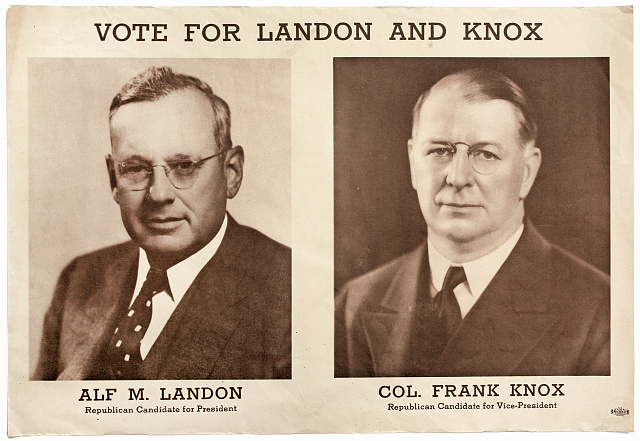
The Republicans chose newspaper publisher Frank Knox as the vice-presidential nominee. Landon and Knox attempted to unite Republicans dissatisfied with Roosevelt’s policies while attracting voters who favored reform but worried about its direction. The historical poster accompanying this article displays their campaign portraits and invitation to vote Republican. It shows what the party offered voters, rather than a neutral summary of every issue or evidence of the eventual vote.
What Landon criticized about the New Deal
Landon challenged aspects of Roosevelt’s spending, executive power and regulatory methods. He did not claim that the Depression had been harmless or that no public action was necessary. Instead he argued for a more limited and different form of federal assistance. The Republican platform criticized provisions that supporters believed threatened constitutional government or private enterprise. The campaign also confronted the Social Security system, which had been enacted the previous year but was still at an early stage of implementation.
Roosevelt responded by presenting the election as a choice between continuing efforts to protect ordinary Americans and returning influence to powerful economic interests. His rhetoric attracted attention and sometimes sharpened divisions. A historically responsible account should represent the disagreement as competing judgments about programs, costs and government authority. The eventual victory does not establish that every criticism was unfounded, just as an unsuccessful campaign does not prove that its proposals lacked all public support.
The New Deal coalition in 1936
Roosevelt drew support from a broad and diverse electoral coalition that included many urban workers, farmers, immigrant communities, organized labor and white southern Democrats. The economic benefits and political symbolism of New Deal programs encouraged some voters who had previously supported Republicans to vote Democratic. The coalition was not uniform: urban northern supporters could have very different views about civil rights and federal authority from southern party organizations that maintained segregation.
The Wagner Act and expanding union organization helped bring parts of organized labor closer to Roosevelt’s party. Many Black voters in northern cities also increasingly supported Democrats during the New Deal period, though the shift was not complete or the same in every region. Black people in much of the South continued to face discriminatory barriers to voting. The election’s demographic patterns therefore reveal change without suggesting full political inclusion.
The actual result: 523 electoral votes to 8
Roosevelt won 523 electoral votes while Landon received just 8, according to the National Archives. The Democratic ticket carried forty-six states; the Republican ticket carried only Maine and Vermont. The popular vote also strongly favored Roosevelt, roughly 60.8% to 36.5%, using the American Presidency Project’s historical compilation. Smaller parties and independent candidates accounted for the remaining share, so the two major-party percentages do not sum to exactly one hundred.
This was one of the most one-sided Electoral College victories in United States history. The contrast with the previous election is revealing: Roosevelt had defeated Herbert Hoover 472–59 in 1932 and then increased his electoral total in 1936. But electoral votes are allocated by state, not simply proportional to national popular votes. A 523–8 outcome does not mean 98.5% of individual Americans voted for Roosevelt; it means he won 98.5% of the electoral votes.
Why only Maine and Vermont voted for Landon
Maine and Vermont remained Republican in 1936 while Roosevelt won the other forty-six states. The result reflected the New Deal coalition’s exceptional reach across geographic and economic groups. In many states the incumbent built support among voters facing Depression-related hardship or benefiting from federal programs. Landon’s campaign could not overcome the national strength of the Roosevelt administration’s appeal even in areas where Republican politicians had previously been dominant.
The two states won by Landon should not be explained through one universal motive. Local party organization, political culture and different assessments of economic policy influenced voters. Nor does Roosevelt’s success imply that every state gave him the same popular-vote margin. Examining state results, rather than only the final Electoral College tally, provides a fuller picture of the campaign’s geography.
The famous Literary Digest polling disaster
The 1936 election is also remembered for an extraordinarily inaccurate survey conducted by *The Literary Digest*. The magazine collected millions of responses through a large mailed poll and predicted that Landon would win. Roosevelt instead won a decisive landslide. The episode demonstrated that a very large number of returned questionnaires cannot compensate for serious problems in selecting and reaching respondents.
The conventional explanation emphasizes the magazine’s reliance on lists of automobile owners and telephone subscribers, who were not fully representative of the electorate. Later research has shown that nonresponse and other sources of bias also mattered, and that a simple story about all car and telephone owners supporting Republicans is not sufficient. The historical lesson is about who was surveyed, who responded and how estimates were calculated, not merely that every large poll is inherently worse than a small one.
Why George Gallup’s smaller survey fared better
George Gallup’s polling organization used a different approach intended to make the sample more representative of voters. It correctly forecast Roosevelt as the winner, unlike the *Literary Digest*. This success helped establish the public reputation of modern opinion polling. However, Gallup’s predicted percentages were not identical to the final results, and the methods used were not the same as today’s probability-based election surveys.
Academic research emphasizes that the 1936 case should not be oversimplified into ‘Gallup used a tiny random sample and predicted the exact vote.’ It was a more complex episode involving quota sampling, selection methods and the measurement of nonresponse. The useful comparison is that well-designed estimates can outperform much larger collections of unrepresentative answers. The contrast made 1936 a landmark in the history of survey research.
Third parties and other critics of Roosevelt
Not every American dissatisfied with Roosevelt supported Landon. The 1930s featured movements that criticized the New Deal for being too limited or for taking the country in the wrong direction. The Union Party nominated Representative William Lemke, while socialists, communists and other groups advanced separate visions of economic reform. These organizations attracted smaller national vote shares but reflected a wider range of political responses to the Depression.
The existence of third parties also helps explain why Roosevelt and Landon’s percentages do not account for every vote. The campaign was not a perfectly binary contest between enthusiastic supporters and opponents of the New Deal. Some Americans supported stronger redistribution or more extensive economic planning than Roosevelt proposed, while others wanted stricter limits on federal power. Considering those views gives the election historical depth beyond a two-candidate tally.
The 1937 inauguration and the Twentieth Amendment
Roosevelt’s second inauguration took place on January 20, 1937, under the new constitutional timetable established by the Twentieth Amendment. This differed from his first inauguration on March 4, 1933. The amendment shortened the interval between election day and the beginning of the presidential term, reducing the long transition that had caused difficulties during the banking emergency of early 1933.
The difference is particularly useful when studying elections during the 1930s. The winning candidate did not assume office immediately after the November vote, but the inauguration date had changed by Roosevelt’s second term. The new schedule also altered congressional terms. A reader comparing election and inauguration chronologies should not apply the modern January date retroactively to every earlier presidency.
Did the landslide end opposition to the New Deal?
No. Roosevelt’s reelection gave him strong political authority, but critics in Congress, business organizations and the courts continued to challenge particular policies. In 1937 he proposed changes to the Supreme Court’s membership that produced major controversy. Economic recovery also remained incomplete, and another downturn later in 1937 weakened claims that the country’s problems had been settled. The 1936 victory was decisive without being the final verdict on every New Deal decision.
That distinction is central to understanding democratic elections. Voters can support a leader’s general direction while opposing particular measures, and future events can alter political judgments. The New Deal coalition would remain influential for decades, but the structure of American politics did not become permanently fixed after one election. Roosevelt faced new challenges at home and abroad in the years ahead.
The historical significance of the 1936 election
The 1936 election was a major confirmation of Roosevelt’s political appeal during the Depression. He won a vast electoral majority by defending the New Deal and presenting federal action as an essential response to economic hardship. Landon offered a competing vision of reform and restraint, but his campaign could not overcome the incumbent’s coalition. The 523–8 outcome remains a defining example of an electoral landslide.
The election is also important for the history of polling, the changing relationship between organized labor and the Democratic Party, and the political consequences of the Twentieth Amendment. Its significance becomes clearer when read alongside the 1932 election and specific New Deal laws rather than treated as evidence that recovery was complete. It marked overwhelming electoral support for a direction of government, with substantial disagreements still unresolved.
Timeline
- November 1932: Roosevelt wins first presidential election
- 1933–1935: Major New Deal programs enacted
- June 1936: Republicans nominate Landon and Knox
- 1936 campaign: New Deal and federal power dominate debate
- October 1936: Literary Digest publishes incorrect Landon forecast
- November 3, 1936: Roosevelt wins 523–8
- January 20, 1937: Roosevelt inaugurated for second term
Frequently asked questions
When was the 1936 presidential election?
November 3, 1936.
Who won the 1936 election?
Incumbent Democrat Franklin D. Roosevelt defeated Republican Alf Landon.
What was the Electoral College result?
Roosevelt won 523 electoral votes to Landon’s 8.
Which states voted for Landon?
Maine and Vermont. Roosevelt won the other 46 states.
What was the popular-vote split?
Approximately 60.8% for Roosevelt and 36.5% for Landon, with other candidates taking the remainder.
Who were the vice-presidential nominees?
John Nance Garner for the Democrats and Frank Knox for the Republicans.
Why was the Literary Digest poll wrong?
Its huge voluntary-response survey was not representative; selection and nonresponse biases undermined the result.
When was Roosevelt inaugurated after the election?
January 20, 1937, under the Twentieth Amendment timetable.