Charles Lindbergh’s 1927 Flight: First Solo Nonstop New York to Paris
How Lindbergh flew the Spirit of St. Louis alone from New York to Paris on May 20–21, 1927, winning the Orteig Prize and changing public interest in aviation.
Quick answer
Charles A. Lindbergh completed the first solo nonstop airplane flight across the Atlantic Ocean on May 20–21, 1927. He flew the Ryan NYP Spirit of St. Louis from Roosevelt Field on Long Island, New York, to Le Bourget Airport near Paris in approximately 33 hours and 30 minutes, covering about 3,610 miles. The flight won the $25,000 Orteig Prize. It was not the first nonstop crossing of the Atlantic by airplane: John Alcock and Arthur Brown had completed one in 1919.
Key facts
On this page
- Why an Atlantic flight became a public challenge
- Who was Charles Lindbergh before 1927?
- The design of the Spirit of St. Louis
- The final preparations at Roosevelt Field
- Flying across the Atlantic alone
- The arrival at Le Bourget on May 21
- Was Lindbergh the first person to fly across the Atlantic?
- The Orteig Prize and Lindbergh’s reception
- What became of the Spirit of St. Louis?
- How the flight affected aviation history
- Timeline
- FAQs
- Sources
Why an Atlantic flight became a public challenge
In the 1920s long-distance aviation was progressing rapidly, but ocean crossings remained exceptionally dangerous. Aircraft engines were less dependable than modern powerplants, weather forecasts covered broad areas imperfectly, and pilots navigated with limited instruments. A transatlantic route required many hours over water with no opportunity to land if a mechanical problem developed. A successful flight could demonstrate endurance, navigation and technology on a scale that captured public imagination far beyond aviation enthusiasts.
The New York hotelier Raymond Orteig had offered a $25,000 prize for the first successful nonstop flight between New York and Paris, in either direction. The challenge encouraged rival aviators to design long-range aircraft and seek financial backing. Some attempts ended in accidents, and the prize was still unclaimed by early 1927. Lindbergh decided that a carefully prepared single-pilot aircraft offered a viable way to attempt the journey, despite the obvious risks.
Who was Charles Lindbergh before 1927?
Lindbergh was born in 1902 and entered aviation during a period when flying was still a relatively new profession. He had experience as a barnstormer, military-trained aviator and airmail pilot. Those roles gave him practical familiarity with weather, navigation, mechanical problems and the discipline required for long routes. He was not an entirely unknown person who stepped into an airplane with no flight experience, though the Paris crossing quickly made him internationally famous.
Work as an airmail pilot linked his career to the growing U.S. commercial aviation system. The Kelly Act of 1925 helped private firms operate postal air routes, providing regular employment and flying experience for some aviators. Lindbergh’s flight was a separate privately financed prize attempt, not a regular mail delivery. The distinction shows how aviation’s commercial infrastructure and record-setting ambitions developed alongside one another.
The design of the Spirit of St. Louis
The aircraft was built by Ryan in San Diego and designated the Ryan NYP, the initials indicating New York–Paris. Its long-range configuration emphasized fuel capacity and reliability rather than passenger comfort. The single Wright J-5C Whirlwind radial engine was important to the plan because the entire trip depended on continued performance. The airplane had a high wing, a compact cockpit and extensive fuel storage designed for endurance.
Fuel tanks obstructed the pilot’s direct forward view, so Lindbergh relied on side windows and a periscope for some observations. That unusual arrangement reflected a deliberate tradeoff between range and visibility. The aircraft was not equipped with the modern navigation or autopilot systems that later made long oceanic routes more manageable. Lindbergh chose a relatively simple design and accepted considerable physical and navigational demands in exchange for a light aircraft capable of carrying enough fuel.
The final preparations at Roosevelt Field
After test flying, Lindbergh brought the Spirit of St. Louis east and waited near New York for suitable weather. Atlantic weather was a central concern: poor visibility, storms or strong headwinds could threaten the flight or make its fuel reserve inadequate. Other aviators were also preparing for the Orteig challenge. Lindbergh’s decision to depart on May 20 was therefore part of a competitive effort and depended on interpreting available forecasts.
He took off from Roosevelt Field on Long Island with a heavily loaded aircraft. The departure itself carried risk because the plane needed a long takeoff run before safely climbing. Lindbergh flew without a copilot or navigator; all decisions were his responsibility. The Smithsonian’s detailed account of the Spirit of St. Louis identifies the departure on May 20 and arrival on May 21, while artifacts from the flight preserve evidence of the aircraft’s equipment.
Flying across the Atlantic alone
The journey required continuous piloting through day, night and changing weather over the North Atlantic. Lindbergh faced cloud, limited visibility and the danger of fatigue as the hours accumulated. He used navigational calculations and observations of his surroundings while monitoring the engine and fuel supply. Any major technical failure could have forced a landing on open water, where rescue would have been extremely uncertain.
One famous challenge was staying alert during more than a full day in the cockpit. Lindbergh later described fighting sleep and concentrating on continuing the flight. His personal accounts are valuable evidence for his experience, but should be distinguished from contemporary operational records. There were no passengers to witness every moment. The overall route, elapsed time and successful arrival are established; small details of thoughts and sensations come mainly from Lindbergh’s own recollections.
The arrival at Le Bourget on May 21
After crossing the ocean and reaching Europe, Lindbergh continued toward Paris and landed at Le Bourget airfield on the evening of May 21, 1927. His flight had lasted approximately 33 hours and 30 minutes and covered about 3,610 miles, according to the National Air and Space Museum. A vast crowd had gathered, and the aircraft was surrounded by spectators when it arrived. The excitement reflected both the genuine danger of the journey and the prospect that ocean-spanning air travel might eventually become more practical.
The crowd’s reception is a central part of the public story, but the achievement rested on the flight itself. The aircraft had reached its intended destination without landing between New York and Paris. Lindbergh had proved that one pilot and one engine could complete the challenge under favorable conditions and with extensive planning. He had not shown that ordinary scheduled passengers could safely make the same crossing every day in 1927. That commercial transformation required later technical and institutional advances.
Was Lindbergh the first person to fly across the Atlantic?
No. In June 1919 British aviators John Alcock and Arthur Brown completed the first nonstop transatlantic airplane flight from Newfoundland to Ireland. Other aircraft had crossed the ocean with stops, and a United States Navy flying boat had reached Europe in 1919 by a route involving intermediate landings. Lindbergh’s distinction in 1927 was the first solo nonstop airplane crossing of the Atlantic and the fulfillment of the New York–Paris Orteig challenge.
This is one of the most important factual distinctions in aviation history. Calling Lindbergh ‘the first person to cross the Atlantic by air’ erases previous achievements. Calling him the first person to fly nonstop across the Atlantic is likewise inaccurate without the word solo. The more specific statement does not diminish his accomplishment: flying alone for thirty-three and a half hours over the ocean in a single-engine aircraft was an extraordinary technical and personal feat.
The Orteig Prize and Lindbergh’s reception
The flight earned Lindbergh the $25,000 Orteig Prize and made him one of the world’s most recognizable public figures. People celebrated in Paris and in the United States, while newspapers followed his movements closely. Public interest extended to aviation products, air travel and the possibilities of commercial routes. Manufacturers and investors saw the event as evidence that sustained long-distance flight had public appeal, even though a prize flight and a profitable airline service were different undertakings.
Attention to Lindbergh also affected the nature of celebrity. His image appeared in newspapers, photographs and souvenirs, and his visits attracted enormous crowds. That publicity could help promote aviation, but it also brought personal pressure and reduced privacy. An account of the historical event should separate the May 1927 flight from the much longer and more controversial public life Lindbergh later led. His later political positions belong to a different stage of his biography.
What became of the Spirit of St. Louis?
The Spirit of St. Louis did not disappear after reaching Paris. It returned to the United States and became a major symbol of aviation progress. Lindbergh continued to use the aircraft for demonstrations and goodwill flights before donating it to the Smithsonian Institution in 1928. The original airplane survives in the Smithsonian National Air and Space Museum collection, allowing visitors to examine the physical object central to the story.
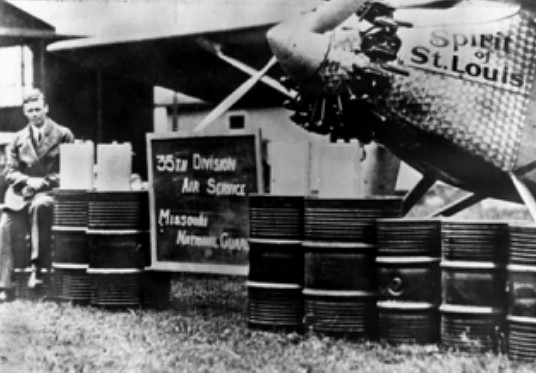
An original surviving aircraft provides a type of evidence that newspaper descriptions alone cannot supply. The tank arrangement, cockpit design and construction details reveal the constraints and choices involved in the flight. Museum documentation also explains the aircraft’s original role and later preservation. The photograph accompanying this article shows Lindbergh beside the airplane in 1927, but does not falsely present the image as the precise moment of his landing in France.
How the flight affected aviation history
Lindbergh’s success helped generate enthusiasm for flying and attracted public attention to the possibility of long-distance commercial aviation. It encouraged investment and interest, while technical work continued on safer engines, all-weather navigation, airports and larger passenger aircraft. It would be misleading to claim that one flight created the entire airline industry. Postal contracts, aircraft manufacturers, engineers and many pilots had already contributed to the development of aviation.
The flight’s enduring importance lies in its combination of engineering preparation, individual endurance and international publicity. It marked a powerful milestone between the first pioneering crossings and the later development of regular oceanic air transport. Comparing Lindbergh’s flight with the Kelly Act reveals two complementary histories: spectacular feats that inspired the public and less dramatic systems that made ordinary flying increasingly possible.
Timeline
- 1919: Alcock and Brown complete first nonstop transatlantic airplane crossing
- 1925: Kelly Act enables private airmail contracts
- Early 1927: Spirit of St. Louis built and tested
- May 20, 1927: Lindbergh departs Roosevelt Field
- May 21, 1927: Lindbergh lands at Le Bourget
- 1928: Spirit of St. Louis donated to Smithsonian
Frequently asked questions
When did Charles Lindbergh fly to Paris?
He departed New York on May 20, 1927, and landed in France on May 21.
How long did Lindbergh’s flight take?
About 33 hours and 30 minutes.
How far did he fly?
Approximately 3,610 miles, or 5,810 kilometers.
What was the airplane called?
The Spirit of St. Louis, a specially built Ryan NYP monoplane.
Was Lindbergh the first to cross the Atlantic nonstop?
No. Alcock and Brown flew nonstop in 1919. Lindbergh made the first solo nonstop transatlantic flight.
What was the Orteig Prize?
A $25,000 award for the first successful nonstop flight between New York and Paris.
Where is the Spirit of St. Louis now?
The original aircraft belongs to the Smithsonian National Air and Space Museum.