The Great Migration (1916–1970): Causes, Routes, Cities and Legacy
Why millions of Black Americans left the South, where they settled and how the movement reshaped American cities and politics.
Quick answer
The Great Migration was the movement of approximately six million African Americans from the U.S. South to Northern, Midwestern and Western communities during roughly 1916–1970. Racist violence, Jim Crow laws and limited rural opportunities encouraged departure, while industrial jobs, family networks and hopes for greater autonomy drew migrants to other regions. Historians often distinguish a first wave around 1916–1940 and a second during 1940–1970.
Key facts
On this page
- What was the Great Migration?
- Why families decided to leave the South
- Why the First World War accelerated migration
- How families chose routes and destinations
- The role of newspapers and family networks
- What migrants found in northern cities
- The first wave, about 1916–1940
- The second wave and the Second World War
- How migration shaped music, literature and community life
- The political consequences and civil-rights movement
- The legacy of six million journeys
- Timeline
- FAQ
- Sources
What was the Great Migration?
The Great Migration describes a long movement of Black Americans from the South to other parts of the United States. It was not organized by a single federal order and did not take place over one summer. Individual people and families made decisions over decades, often moving to join relatives or seek better jobs and schooling. The cumulative effect was enormous: millions changed residence, altering the demographics of cities in the North, Midwest and West. The National Archives estimates that roughly six million people participated between the 1910s and the 1970s.
Historians sometimes separate the first wave, commonly dated about 1916–1940, from the second, often dated about 1940–1970. These divisions help identify changing labor markets and destinations, but migration did not stop abruptly between the two periods. Nor did every person leave directly from a farm for a distant city. Some moved between southern towns, some relocated more than once, and some returned. The phenomenon was a collection of lives rather than a single planned exodus.
Why families decided to leave the South
Racial segregation, exclusion from voting and the threat of anti-Black violence were fundamental pressures behind migration. Jim Crow laws and discriminatory customs limited participation in public life. Lynching and other forms of intimidation made safety a daily concern in some communities. Rural poverty and restrictions on economic advancement compounded those dangers. Sharecroppers and tenant farmers could remain trapped in cycles of debt even when they worked hard, because land tenure, credit and crop prices constrained their choices.
These forces varied by place and person. Some migrants specifically sought safety or better schools for children, while others wanted to escape dependent labor relationships or join people already established elsewhere. The history of sharecropping and the crop-lien system explain why economic mobility could be so difficult in the rural South. But the movement cannot be explained by wages alone. Citizenship, dignity, family and freedom from violence were also major considerations.
Why the First World War accelerated migration
World War I changed American industrial labor markets. As immigration from Europe was disrupted and factories increased production, employers in northern cities sought new workers. Steel plants, meatpacking businesses, railroads and automobile manufacturers offered jobs that could pay more than many southern farm positions. Recruiters sometimes traveled south or used informal contacts to encourage workers to relocate. This opportunity coincided with existing pressure to leave, creating conditions for a more rapid movement after about 1916.
An available job was not a guarantee of security, and new arrivals often faced discrimination in hiring or assignment to particular types of labor. Yet industrial wages could support rent, education or savings that seemed unattainable in some southern communities. The possibility of joining relatives who could help find housing also influenced decisions. Wartime opportunity therefore mattered as part of a combination of economic and social factors. The date 1916 is a useful conventional starting point for the large-scale movement, not a claim that Black southerners had never migrated earlier.
How families chose routes and destinations
Railways were central to long-distance movement. People used passenger trains and connections through major hubs to reach Chicago, Detroit, Cleveland, Pittsburgh, Philadelphia, New York and other destinations. Route choices reflected where employers were hiring and where relatives, church members or friends could offer assistance. A family traveling from Mississippi might choose Chicago, while someone leaving Georgia might have stronger connections to a northeastern city. Later, migrants also headed in large numbers toward West Coast cities.
Migration maps often show broad northward or westward arrows, but they simplify an enormous variety of journeys. The route that worked for one household might be impractical for another because of fares, dependents or employment prospects. Travelers sometimes moved in stages and worked in several places. The Library of Congress warns that photographs commonly labelled ‘Great Migration’ may document related Black communities without proving that the specific subjects were permanent migrants. This caution also applies to map illustrations and individual anecdotes.
The role of newspapers and family networks
Newspapers played an important role in circulating job notices, accounts of racist violence and stories of opportunity. The Chicago Defender was particularly influential because its reporting and circulation reached readers in southern communities. It described conditions in northern cities and helped create a shared public conversation about leaving. The newspaper did not control all migrants’ decisions, and not every story was optimistic. Its influence is best understood alongside letters and reports from friends or relatives who had already moved.
Family networks often reduced uncertainty. Someone established in Detroit or Chicago could advise newcomers about neighborhoods, employers, transport or churches. These contacts could also concentrate migrants in particular areas when housing markets excluded them elsewhere. Such networks made movement easier but sometimes reinforced crowded settlement patterns. They helped turn a set of individual relocations into larger, self-sustaining migration streams across decades.
What migrants found in northern cities
Industrial cities presented opportunities unavailable to many southern residents, but they were not free of racial discrimination. Employers sometimes kept Black workers in lower-paid or more dangerous jobs and excluded them from certain unions or occupations. Housing discrimination limited where families could rent or buy. Overcrowded neighborhoods could have inadequate services, high rents and intense competition for space. Public schools and local politics also varied, and the right to vote could be exercised more effectively in some northern settings while discrimination persisted.
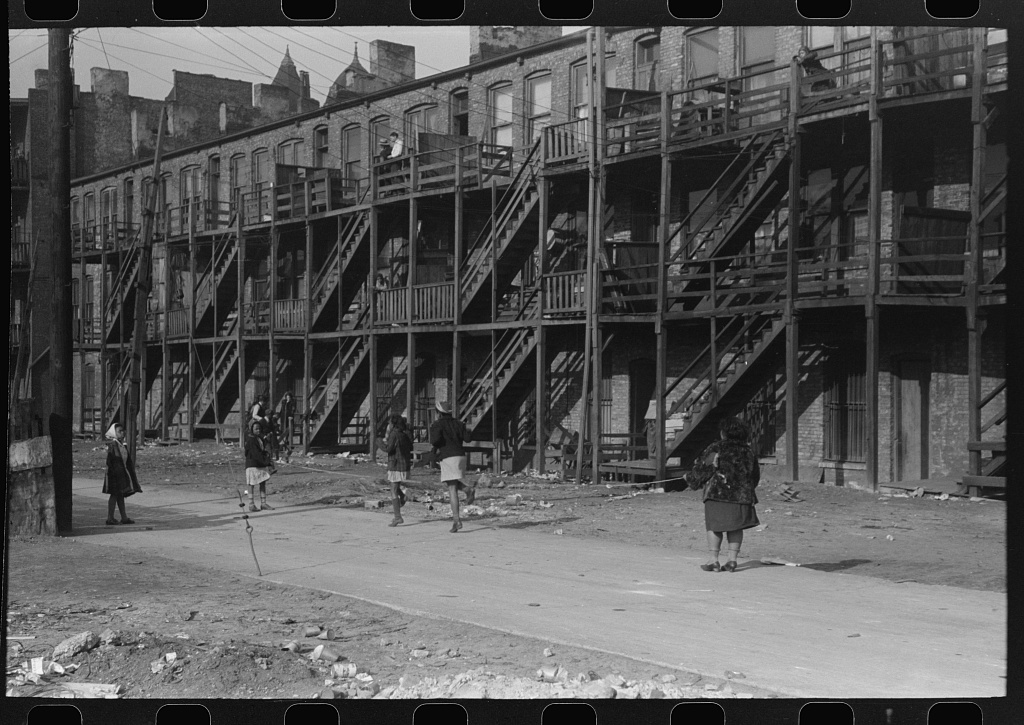
These realities challenge the simple story that leaving the South meant moving from oppression to full equality. Migrants often gained new choices and freedoms, yet confronted racial barriers in different forms. The 1941 photograph of Chicago housing accompanying this article illustrates the conditions of one Black neighborhood. It should not be described as a picture of migrants boarding a train in 1916, or as proof that every new arrival lived in identical accommodation. The city’s changing Black population offers a broader context for interpreting it.
The first wave, about 1916–1940
The first wave unfolded through World War I, the 1920s and the Great Depression. Its leading destinations included major manufacturing centers in the North and Midwest. Migrants were often drawn by factory and railway employment, although their livelihoods diversified. Urban communities expanded networks of churches, businesses, mutual-aid organizations, civic associations and newspapers. Residents used these institutions to secure housing, support families and assert political influence in places where they could often vote more effectively than in the segregated South.
The Great Depression altered job prospects and made economic relocation more difficult for many families. Nonetheless, the social connections formed by earlier migrants remained important. The movement was never just an economic event: it shaped religious life, music, literature, education and local political institutions. The Harlem Renaissance is associated with this period, but not every migrant lived in Harlem, and Black creative cultures also developed in Chicago and many other cities.
The second wave and the Second World War
World War II produced another major period of migration as defense industries and military-related production expanded. Western destinations became increasingly important, including California cities and other communities with shipyards, aircraft factories and industrial facilities. The National Archives describes this later movement as part of the same decades-long process. Migrants from the South brought relatives, skills, political traditions and cultural practices into growing urban populations.
The second wave did not simply repeat the first. Destination cities, manufacturing sectors and housing markets had changed, and the size and composition of communities varied. Black families continued to face discriminatory hiring and residential restrictions, even while new employment opportunities supported social mobility. Following wartime growth, shifting industrial conditions and suburbanization created further challenges. A single statistic for six million migrants summarizes scale, not uniform experience.
How migration shaped music, literature and community life
The movement contributed to the spread and transformation of Black cultural forms, including blues, jazz, gospel and later popular musical styles. Musicians and audiences brought southern traditions to northern cities, where new venues, recording industries and social environments helped those traditions develop. Writers and artists likewise explored themes of displacement, memory, opportunity and racial identity. The Harlem Renaissance was one prominent expression of the wider demographic and intellectual transformations under way.
It would be inaccurate to say that the Great Migration invented all of these traditions. They had histories within southern Black communities before migrants traveled. Relocation changed where artists lived and performed, who heard their work and how ideas circulated. Chicago, New York, Detroit and other centers developed distinctive cultural scenes rather than one generic northern culture. Family gatherings, churches, restaurants and newspapers also maintained ties between migrants and their regions of origin.
The political consequences and civil-rights movement
As Black populations increased in northern cities, they could gain greater electoral influence in districts where they were allowed to vote. Local organizations advocated for jobs, housing, education and fair treatment. The NAACP, founded in 1909, expanded during a period of changing demographics, and other organizations such as the National Urban League worked on employment and community services. These groups drew on longer histories of Black activism and were not created solely by the migration.
Urban political change did not eliminate racist violence. Riots and attacks erupted in several cities, notably during the Red Summer of 1919, revealing tensions over work, housing and political power. Civil-rights campaigns of the mid-twentieth century developed in this national landscape. The Brown v. Board of Education decision and March on Washington were shaped by many individuals and institutions; migration affected the setting in which those struggles unfolded without single-handedly producing every victory.
The legacy of six million journeys
The Great Migration transformed the geographic distribution of African Americans and contributed to lasting changes in U.S. industry, politics and culture. It also altered southern communities as younger workers and families left, creating changes in rural labor markets and social relationships. Some people returned south, and later decades brought a substantial reverse migration to parts of the region. This longer cycle reminds us that movement is a continuing feature of American life rather than a one-way process ending neatly in 1970.
The most informative way to understand the Great Migration is to connect broad statistics with specific evidence: census patterns, personal letters, photographs, oral histories, newspapers and institutional records. The National Archives and Library of Congress provide starting points for this work. Their collections reveal how diverse the journeys were and why a single image or dramatic anecdote cannot stand for all participants. Approximately six million decisions to move reshaped the United States through many different personal routes.
Timeline
- 1910s: Migration out of South grows
- 1916–1918: War-related industrial demand attracts migrants
- 1919: Racial violence erupts during Red Summer
- 1920s: Black communities expand in northern cities
- 1940s: Second World War fuels a second major wave
- 1970: Conventional endpoint of Great Migration period
Frequently asked questions
How many people took part in the Great Migration?
Historians commonly estimate around six million African Americans moved from the South to other U.S. regions between the 1910s and the 1970s.
When did it begin and end?
The major movement is often dated roughly 1916–1970, with earlier migrations preceding it.
What caused it?
Racist violence, Jim Crow discrimination, limited economic prospects and debt pushed many to leave; work opportunities and family networks drew them elsewhere.
Which cities received migrants?
Chicago, Detroit, Cleveland, Pittsburgh, Philadelphia and New York were major destinations, with western cities growing especially during the second wave.
Was the North free of segregation?
No. Migrants encountered discriminatory employment, housing barriers and racial violence in many northern cities.
What are the first and second waves?
A first large wave around 1916–1940 and a second wave around 1940–1970, with overlap and varied individual experiences.
Sources and further reading
Selected primary records and specialist historical collections document the dates, people, and institutions discussed here.