Adamson Act of 1916: Eight-Hour Railroad Day, Strike Threat and Court Ruling
How a threatened nationwide railroad strike produced a federal eight-hour standard and a constitutional test in 1917.
Quick answer
President Woodrow Wilson signed the Adamson Act on September 3, 1916, amid a threatened nationwide railroad strike. The law set an eight-hour basic workday for pay calculations for covered interstate railroad operating employees, without making longer work categorically illegal. The Supreme Court upheld the law in Wilson v. New in March 1917. It did not create a universal eight-hour workday for all American workers.
Key facts
On this page
- Why a railroad strike became a national crisis
- The railroad brotherhoods and the eight-hour demand
- Wilson’s attempts to mediate
- The act signed on September 3, 1916
- Eight hours as a pay standard—not a universal limit
- The role of the investigating commission
- The Supreme Court challenge in Wilson v. New
- What the law meant for railway workers
- Employers, shippers and the public
- How the Adamson Act fits into labor reform
- Why the 1916 dispute remains historically important
- Timeline
- FAQ
- Sources
Why a railroad strike became a national crisis
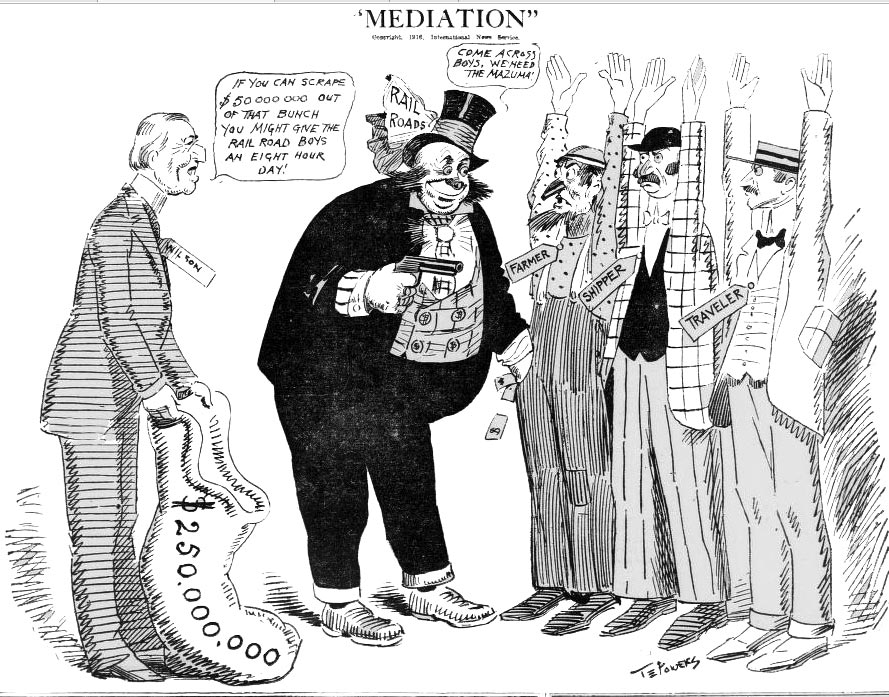
Railroads were the principal network for moving passengers, food, raw materials, industrial goods and mail across the United States in 1916. A nationwide interruption could affect cities and rural communities far from any individual labor dispute. Workers argued about long hours, fatigue and the relationship between working time and pay; railroad executives considered wage costs, service schedules and the practical need to keep trains running across a complex system. These were not merely local disagreements. Because lines connected across state borders, a major strike threatened the broader national economy.,Four major railroad brotherhoods negotiated over working conditions and compensation. Their proposals centered on the eight-hour standard and how additional time should be paid. When bargaining failed to produce agreement, the prospect of a widespread strike became imminent. The situation created political pressure on President Woodrow Wilson and Congress to intervene. Public concern was not confined to the bargaining parties: farmers, manufacturers, merchants and ordinary travelers feared the effects of halted rail traffic. The Adamson Act emerged directly from that emergency.
The railroad brotherhoods and the eight-hour demand
The railroad brotherhoods represented key groups of operating employees whose work was essential to moving trains. Their demands reflected the broader labor movement’s longstanding campaign to limit excessive working hours and provide predictable standards. In railroad service, however, the meaning of a day could differ from ordinary factory employment. Journeys, operating schedules, mileage arrangements and crew duties created complicated payment practices. Negotiating a new standard therefore raised questions about wages as well as the physical time spent on duty.,The workers’ demand was associated with the principle that eight hours should be treated as a normal day rather than a ten-hour benchmark. Railroad companies feared that adopting the standard while maintaining previous day wages would raise their operating costs. A dispute framed as a working-hours reform could also be a wage dispute. That distinction is central to understanding the eventual act, which set an eight-hour basic day for compensation while preserving the possibility that covered workers could labor for longer periods under applicable rules.
Wilson’s attempts to mediate
As negotiations stalled, Wilson attempted to secure a settlement between the brotherhoods and the railroad companies. The administration’s concern included economic disruption and national preparedness during a period of international instability. The United States had not yet entered World War I, but the conflict in Europe shaped public debate and calculations about reliable transportation. Wilson met representatives and explored proposals intended to avert a strike without immediately transferring control of the railroads to the federal government.,The parties failed to reach a negotiated agreement that both accepted. Wilson then asked Congress to act, and lawmakers considered legislation under severe time pressure. The U.S. House historical account records his August 1916 address to a joint session discussing the looming crisis. The fact that Congress acted rapidly does not mean every provision had been settled before the strike threat. It means a national emergency narrowed the time available for debate and pushed legislators toward a provisional solution.
The act signed on September 3, 1916
The bill associated with Representative William C. Adamson was signed by Wilson on September 3, 1916, shortly before the threatened strike. It applied to specified railroad employees operating trains in interstate commerce. Its central requirement was an eight-hour standard workday for the purpose of reckoning pay. Existing standard daily compensation was protected during an initial observation period, and the legislation called for a commission to investigate the consequences of the new arrangement.,The signed date matters because some descriptions refer generally to legislation passed in early September. A precise timeline distinguishes the railroad brotherhoods’ strike deadline from the day Wilson approved the act. It also distinguishes the statute from a later court judgment confirming its constitutionality. The federal government did not simply order every employee home after eight hours: Congress established a new pay standard to address a dispute in a particular industry while providing for study and further consideration.
Eight hours as a pay standard—not a universal limit
The most common misunderstanding is that the Adamson Act made working more than eight hours unlawful for everyone. It did not. The measure addressed a defined group of railroad operating employees and used eight hours as the standard day for calculating compensation. Work beyond that period remained possible, but additional time was to be compensated at least on the pro-rata basis identified in the statutory scheme for the covered period. It is important not to replace that legal wording with a blanket promise of a modern time-and-a-half overtime rate.,An eight-hour basic day can change pay without fixing the precise length of every shift. For example, if a covered worker’s old standard day’s wage had been based on a longer period, preserving that pay for eight hours would increase the effective hourly rate. The actual effects varied with work patterns, existing rates and subsequent negotiations. The act was thus a crucial labor-law milestone, but it should be described through its specific compensation rules rather than treated as the origin of all modern overtime laws.
The role of the investigating commission
Congress included an investigation mechanism to observe the effect of the eight-hour standard. Lawmakers wanted information about operating costs, labor conditions and the implications for the railway industry. The plan recognized that urgent legislation adopted to avert a strike might require further assessment after normal transport services were secured. A commission could gather evidence that neither side’s bargaining claims would resolve on their own. This was a common Progressive Era technique: combine a rule with organized fact-finding.,The investigation was not a promise that the legal standard would vanish automatically if railroad companies objected to its costs. The statute and later decisions involved questions about the transition period and compensation obligations. Historical accounts need to distinguish the existence of the commission from an assumption that every disputed claim was conclusively settled by it. The wider conflict over railway wages and hours continued to evolve, and later legislation developed a different legal framework for railway labor relations.
The Supreme Court challenge in Wilson v. New
Railroad interests challenged the constitutionality of the Adamson Act, raising questions about federal authority to establish wage-related standards in interstate transportation. In Wilson v. New, decided in March 1917, the Supreme Court upheld the law by a five-to-four vote. The case examined Congress’s ability to act when labor conflict threatened an essential interstate commercial network. It is significant because the Court approved federal intervention in a labor dispute that had immediate effects on national commerce.,The ruling did not decide that federal government possessed unlimited authority to regulate every wage or work schedule in the economy. The Court considered the context of interstate railways, the legislation’s terms and the threatened interruption of transport. Reading the decision alongside the statute provides a clearer view than describing it as a simple judicial declaration that all Americans were entitled to eight-hour shifts. The full judicial opinion is a valuable primary source for the constitutional reasoning.
What the law meant for railway workers
Covered railroad employees acquired a federal standard for calculating the basic workday and pay. This potentially changed bargaining power as well as earnings because it established a rule outside company-by-company negotiations. The effect for an individual worker depended on prior compensation, duties, actual working time and subsequent arrangements. It is therefore misleading to assign a uniform dollar raise or hours reduction to every railway employee. Some could experience changes in effective pay while still completing long or irregular shifts.,The legislation also showed the importance of collective organization. The railroad brotherhoods brought coordinated demands that the companies could not easily disregard, while the national importance of railway operations made the conflict politically consequential. Not all railroad workers had the same position or representation; the act focused on operating service rather than every kind of railway employment. Labor historians need to distinguish these groups to avoid assuming that all station staff, maintenance crews and contractors received identical statutory treatment.
Employers, shippers and the public
Railroad executives argued that changing compensation could increase operating expenses and affect the charges they needed to collect. Shippers and travelers were concerned about the cost of railway services but also faced the much greater immediate disruption of a stoppage. For Congress, the challenge was to balance the risk of an impending strike with uncertain long-term costs. The law was a product of competing priorities rather than a solution that every participant regarded as ideal.,Political cartoons from 1916 dramatized this tension. The period cartoon accompanying this article personifies railroads, workers and sections of the public, but it is satire rather than a factual transcript of negotiations. It is useful evidence of contemporary criticism and concern. Readers can pair it with congressional records and court opinions to understand both the political atmosphere and the precise rules. Neither visual rhetoric nor legislative text alone provides a complete history of the dispute.
How the Adamson Act fits into labor reform
The Adamson Act belongs to a longer history of the eight-hour-day movement, not to a single decisive invention of limited working hours. Earlier employees and unions had fought for shorter days, and some governments had already regulated hours in particular occupations. The 1916 measure stood out because it set a federal standard for an important private transportation industry under immediate threat of a national stoppage. It also came in the broader Progressive Era environment that produced new rules concerning transportation, commerce and safety.,The federal rules governing railway labor continued to develop, including later legislation addressing bargaining and labor relations. The Fair Labor Standards Act of 1938 eventually established a wider system of federal wage and overtime rules for covered employment. These different laws should not be merged into one timeline with identical provisions. The Adamson Act’s special place is its combination of urgent strike prevention, eight-hour basic pay and the constitutional dispute resolved in 1917.
Why the 1916 dispute remains historically important
The episode shows how an essential transportation network could turn a labor disagreement into a national political problem. A threatened strike made federal intervention attractive to leaders who feared broad commercial harm. But Congress still had to define who was covered, what the basic workday meant and how costs would be observed. The legal result was more nuanced than a slogan about eight hours of work: it was an industry-specific rule designed for a particular crisis.,Studying the law alongside the Hepburn Act of 1906 and Mann–Elkins Act of 1910 reveals different dimensions of the railway question. Those earlier statutes focused largely on carrier charges and commission authority; the Adamson Act concerned the relationship between labor compensation, bargaining and uninterrupted interstate service. Together they show why railroad policy stood at the center of federal economic reform.
Timeline
- 1915: Railroad brotherhoods formulate eight-hour demands
- March 1916: Brotherhoods present demands
- August 1916: Wilson attempts mediation
- Late August 1916: Wilson asks Congress to act
- September 3, 1916: Adamson Act signed
- March 1917: Supreme Court upholds law in Wilson v. New
Frequently asked questions
When did Wilson sign the Adamson Act?
September 3, 1916.
Who did the act cover?
Specified employees engaged in operating interstate railroad trains, not all American workers.
Did it forbid work beyond eight hours?
No. It established an eight-hour basic day for pay purposes, rather than an absolute limit on working longer.
Did it require time-and-a-half overtime?
The relevant original text provided compensation beyond eight hours at not less than the pro-rata rate during the protected period; it should not be equated with every modern overtime rule.
Why was it enacted so quickly?
Congress acted to prevent a threatened nationwide railroad strike.
Did the Supreme Court uphold it?
Yes. In Wilson v. New (March 1917) the Supreme Court upheld the act by five votes to four.
Sources and further reading
Primary documents and specialist historical sources support the dates and legal distinctions in this article.