Federal Reserve Act of 1913: Why the Fed Was Created and How It Worked
Why the United States created a central bank in 1913 and what the first Federal Reserve actually did.
President Woodrow Wilson signed the Federal Reserve Act on December 23, 1913, establishing a new U.S. central-banking system after recurring banking crises, especially the Panic of 1907. The law provided for a central Federal Reserve Board and regional Reserve Banks, an elastic currency and a system for rediscounting commercial paper. Twelve regional banks opened in November 1914, and the system’s powers developed substantially afterward.
This guide distinguishes the original statute and its regional banking structure from the powers the Federal Reserve developed in later decades.
On this page — 22 topics
What was the Federal Reserve Act of 1913?
The Federal Reserve Act was the statute that established the modern United States Federal Reserve System. Signed by President Woodrow Wilson on December 23, 1913, it created a central governing board and a network of regional Reserve Banks, with arrangements intended to make the financial system more flexible during changing demands for currency and credit. It was a response to repeated banking crises, not an immediate guarantee that recessions would never occur. The original act did not contain every tool associated with the modern Federal Reserve. Congress and banking officials subsequently revised the system, especially during the 1930s. Understanding the original structure and later evolution is essential to distinguishing the Fed of 1913 from today’s central bank.
Why did the United States need banking reform?
Before the Federal Reserve, the United States had many banks but no permanent modern central bank able to coordinate reserves and provide reliable emergency liquidity across the country. National and state banks operated under different rules, while seasonal demand for cash could put pressure on money markets. Farmers needed currency around harvests, businesses relied on short-term credit, and banks held substantial reserves through correspondent relationships. Trouble at a major institution could cause fear elsewhere as depositors demanded immediate withdrawals. Political resistance to concentrated financial power complicated proposals for reform. The 1913 act attempted to balance a national coordinating authority with regional institutions that represented different parts of the economy.
How did the Panic of 1907 influence the law?
The Panic of 1907 caused bank runs, trust-company failures and a serious disruption of credit. Private financiers, notably J. P. Morgan, coordinated emergency support for parts of the financial system. Their involvement demonstrated both the capacity of private banks to cooperate and the danger of depending on a few powerful individuals during crises. The episode persuaded more lawmakers that the country needed public institutions that could respond to severe cash shortages. It did not by itself create the Federal Reserve: several years of congressional investigations, banking proposals and political negotiation followed. Earlier crises, including the Panic of 1893, had already revealed weaknesses in the monetary and banking system.
What was an inelastic currency?
Contemporary reformers described the nation’s currency as inelastic when its supply could not readily expand and contract with legitimate seasonal and economic needs. The national bank note system linked important parts of currency issue to government bonds, while available reserves were unevenly distributed. A farm region needing cash for harvest purchases might face tighter credit even if underlying business conditions were sound. Reformers wanted banks to obtain additional funds by converting suitable short-term commercial assets into liquid resources through Reserve Banks. Elasticity did not mean unlimited printing of money. The proposals linked currency creation to banking assets, reserves, law and central oversight, with the goal of reducing sudden shortages and destabilizing withdrawals.
What was the National Monetary Commission?
Congress established the National Monetary Commission after the Panic of 1907 to study banking arrangements in the United States and other countries. Senator Nelson W. Aldrich led the work, and its publications assembled substantial information about monetary institutions. The commission’s proposals influenced the debate but were not enacted unchanged. Many reformers feared that private financiers would dominate a central banking institution, while bankers resisted a system controlled entirely by politicians. Those tensions produced competing plans involving regional banks, central oversight and the powers to issue currency. The final 1913 law arose from years of negotiation, rather than from one commission report unanimously adopted by all parties.
What was the Aldrich Plan?
The Aldrich Plan proposed a national reserve association with substantial participation by banks. Supporters believed professional banking governance and pooled resources would help address liquidity shortages. Critics objected that the design concentrated influence in the hands of large banks and financial interests, especially those associated with New York. The debate became an important part of the 1912 election and the Wilson administration’s subsequent proposals. Although the final Federal Reserve Act differed in governance, it shared a concern with pooling reserves and coordinating credit. Historians should avoid saying the Aldrich proposal itself became law in 1913. The differences help explain why the Federal Reserve was organized as a hybrid system with both governmental authority and regional financial institutions.
What role did Woodrow Wilson play?
Wilson entered the presidency in March 1913 promising financial reform as part of his New Freedom program. He worked with congressional leaders to develop legislation that offered public supervision while retaining regional institutions. The national debate included worries about Wall Street dominance, agricultural credit and the proper role of government in banking. Wilson’s support helped push the bill through Congress during a year that also saw major tariff and constitutional changes. His signature on December 23 established the legal framework, but the banks did not begin operating that same day. The administration then faced the practical work of defining districts, selecting officials and organizing the Reserve Banks.
Who were Carter Glass and Robert L. Owen?
Representative Carter Glass of Virginia and Senator Robert L. Owen of Oklahoma were important congressional figures in drafting and shepherding the legislation. Their respective approaches helped shape the compromise between regional banking operations and federal supervision. Glass favored a structure with strong regional banks and worried about too much centralized control, while Owen advocated measures intended to serve a wider public interest. Congressional debate modified details of the proposals, and the final system reflected many participants rather than two authors alone. The statute is sometimes called the Glass–Owen or Owen–Glass Act, reflecting their legislative roles. The official Federal Reserve histories provide a useful account of these negotiations.
Why were there twelve Federal Reserve districts?
The act divided the country into regions served by Reserve Banks rather than placing all central banking activity inside one Washington institution. A Reserve Bank Organization Committee studied economic connections and selected twelve districts and their headquarters in 1914. The arrangement was intended to recognize regional differences in banking, agriculture, manufacturing and trade. It also helped answer political fears that one financial center would dominate the nation. The original act authorized a system of regional banks but did not enumerate all twelve headquarters in its signed text. Later decisions established the final districts. Today the districts remain a distinctive element of the Federal Reserve’s organization, even though their economic roles have evolved.
Which cities received Federal Reserve Banks?
The twelve original Reserve Bank headquarters were established in Boston, New York, Philadelphia, Cleveland, Richmond, Atlanta, Chicago, St. Louis, Minneapolis, Kansas City, Dallas and San Francisco. Their district territories do not always match state boundaries, reflecting contemporary commercial patterns and banking connections. Selection was contested because cities believed a Reserve Bank could confer prestige and practical advantages. The Reserve Bank Organization Committee announced its choice in April 1914. No single Reserve Bank was designed to replace the central governing board, and the New York institution did not become the only bank of the system. The geographic structure was an intentional compromise between central coordination and regional operations.
What was the first Federal Reserve Board?
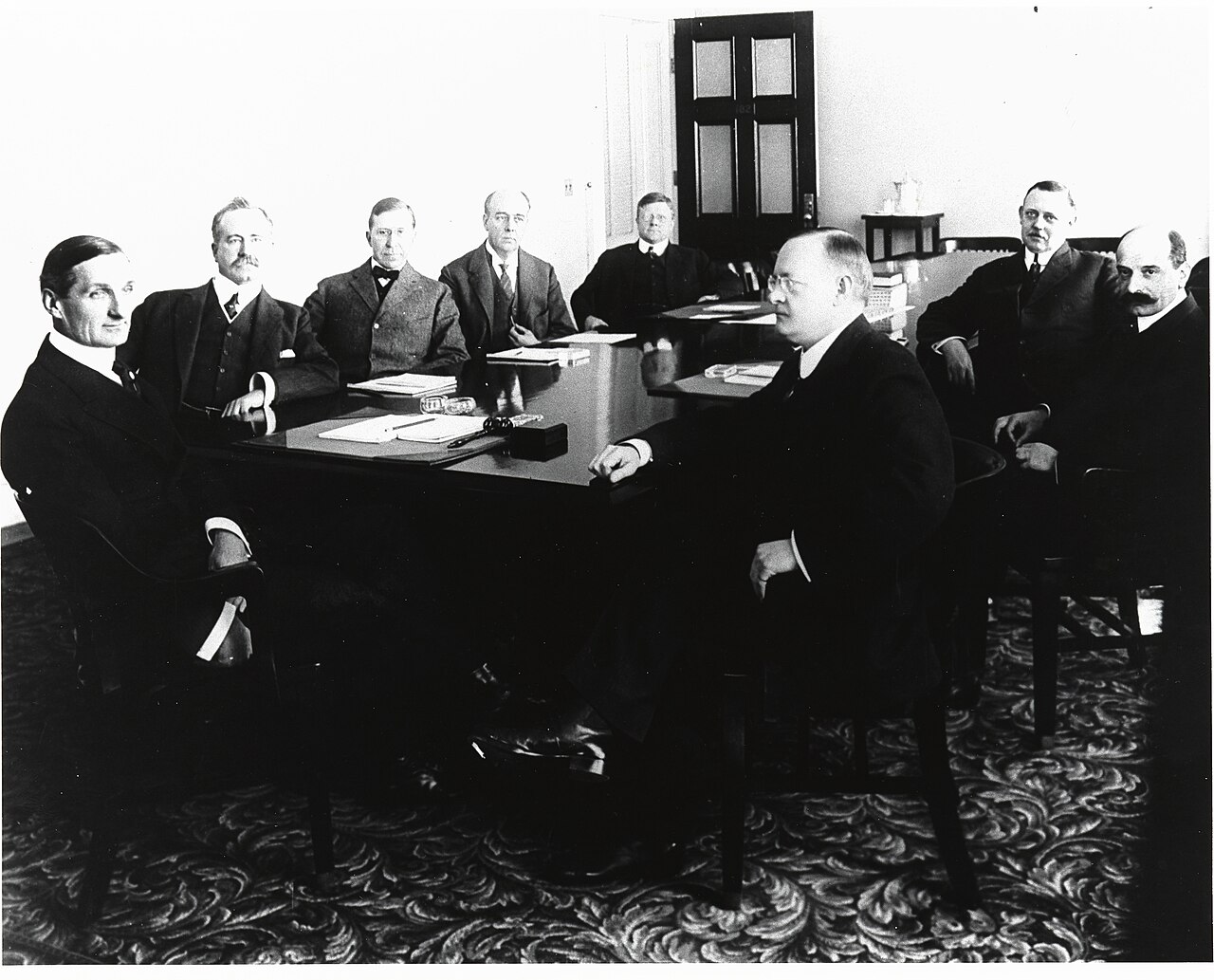
The original Federal Reserve Board was a Washington governing body with seven members under the 1913 framework, including specified government officials and appointed members. Its composition differed from the modern Board of Governors, which operates under later statutory changes. The group photograph accompanying this article shows early Board members in 1914, after the act had been signed and the organizational work had begun. The image is useful evidence of the institution’s early leadership but does not depict the December 1913 signing. The Board exercised supervisory responsibilities while Reserve Banks undertook regional banking functions. Its precise authority developed through later banking legislation, particularly reforms during the Great Depression.
When did the regional Reserve Banks open?
The twelve Federal Reserve Banks opened for business on November 16, 1914, according to the Federal Reserve Bank of Chicago’s centennial history. This date came almost eleven months after President Wilson signed the legislation. Organizing each bank required decisions about location, staffing, directors, accounts and relations with member banks. The beginning of World War I in Europe also changed financial conditions while the American institutions were being established. The opening did not mean all modern monetary policy mechanisms were immediately available. It represented the start of operations for a new central banking network that would have to learn how to manage banking conditions under changing economic circumstances.
How did rediscounting work?
One original purpose of the Reserve Banks was to provide liquidity by rediscounting eligible commercial paper held by member banks. A bank that had extended short-term business credit could bring qualifying assets to a Reserve Bank and receive funds before the underlying loans matured. This mechanism was designed to turn assets into reserves more readily and ease pressure during seasonal demand or unusual withdrawals. It did not mean the Reserve Bank would automatically accept every doubtful loan or guarantee the solvency of every institution. Eligibility rules, pricing and supervision mattered. Rediscounting was central to the original act and helps explain why the lawmakers spoke of an elastic currency rather than a modern interest-rate target.
What were Federal Reserve notes?
The act authorized Federal Reserve notes, an important part of the nation’s evolving currency arrangements. The notes were issued through a legally defined system involving Reserve Banks and federal oversight. Their original backing and redemption rules differed from today’s currency system, which no longer operates under the same gold-standard arrangements. The objective was to supply cash more flexibly when legitimate banking activity demanded it. A common misconception is that the Fed created paper money for the first time in American history. The United States already had several kinds of notes and currency before 1913. The reform changed the institutions and mechanisms that supplied money and supported bank reserves.
Did the law make the Fed a private bank?
The Federal Reserve combines public responsibilities with regional banking institutions that have legally distinct features. The central Board is a federal governmental agency, while the regional Reserve Banks were organized with member-bank participation under statutory rules. Their stock arrangements should not be confused with ordinary shares that can be freely bought and traded to control a company for unrestricted private profit. The original compromise reflected a political choice to combine oversight by public officials with financial expertise and regional operations. Neither the claim that the Federal Reserve is merely a private family-owned bank nor the claim that every part operates identically to a cabinet department accurately describes its organization.
Did the Fed immediately end banking panics?
No. Establishing the Reserve Banks did not prevent all later financial crises. Monetary policy and supervisory practice were still developing, and the bank failures and deflation of the early 1930s exposed profound limitations in the system’s response. The Great Depression prompted major legislative reforms and a reconsideration of central banking responsibilities. The Fed did provide important new mechanisms in 1914, but its effectiveness depended on leadership, economic conditions and the rules governing action. Historical evaluations often distinguish the intention to create a safer and more stable banking system from the actual performance of that system during different periods. Institutions can reduce vulnerabilities without eliminating the possibility of error or economic shocks.
What changed under the Banking Act of 1935?
The Banking Act of 1935 restructured important aspects of Federal Reserve governance and strengthened centralized monetary policymaking. It helped establish the modern institutional role of the Board of Governors and the Federal Open Market Committee. Open market operations had become increasingly significant in the decades after 1913, particularly as the Fed learned to affect bank reserves through securities transactions. Those powers and arrangements were not all specified in today’s form in the original statute. The distinction is important for students reading modern descriptions of how the Fed sets policy. A central bank founded in 1913 evolved through additional laws and experience, especially during and after the Depression.
How does the Federal Reserve Act relate to the Sixteenth Amendment?
Both measures belong to the reforms of 1913 but addressed different problems. The Sixteenth Amendment authorized Congress to tax incomes without apportionment among the states, supporting a new federal revenue structure. The Federal Reserve Act created a central banking system intended to improve currency and credit stability. It did not establish the income tax, and a federal tax return is not an instrument of the Reserve Banks. Their proximity in time reflects a broader Progressive Era willingness to revise important economic institutions. Studying them together can clarify the different roles of government taxation, fiscal policy, monetary institutions and private banking.
Why is the 1913 act historically important?
The law provided the enduring foundation for America’s central bank, created a decentralized network of Reserve Banks and established federal oversight of a national monetary institution. It reflected lessons from repeated panics and concern that economic stability should not depend entirely on a few financiers. Its design also incorporated compromises among regional interests, bankers and public officials. Over time the system acquired expanded monetary policy, supervisory and financial-stability responsibilities. The basic historical lesson is that the Fed was created in 1913 for specific currency and banking problems, while much of its modern structure developed later. Reading the original statute alongside authoritative Federal Reserve histories helps separate the founding purpose from subsequent institutional change.
Federal Reserve creation timeline
| Date | Development |
|---|---|
| 1907 | Banking panic reveals severe shortage of emergency liquidity. |
| 1908 | National Monetary Commission established. |
| 1911–1912 | Aldrich Plan and competing central-bank ideas debated. |
| March 1913 | Woodrow Wilson begins presidency. |
| December 23, 1913 | Wilson signs Federal Reserve Act. |
| April 1914 | Twelve Federal Reserve districts and headquarters announced. |
| November 16, 1914 | Twelve Reserve Banks open for business. |
| 1933–1935 | Banking legislation reshapes central-bank structure and monetary policy. |
| Today | Original act remains foundation, as repeatedly amended. |
Historical sources
- Federal Reserve Board — History
- Federal Reserve History — Signing of the Federal Reserve Act
- Federal Reserve History — The Fed’s Formative Years
- Federal Reserve History — Organizational Structure
- Federal Reserve Bank of Chicago — Centennial
- Library of Congress — December 23, 1913
- Original Federal Reserve Board Photograph — Commons