Antiquities Act of 1906: Roosevelt, Devils Tower and National Monuments
Why America began protecting national monuments and how the 1906 law worked.
The Antiquities Act, signed by Theodore Roosevelt on June 8, 1906, gave the president authority to proclaim national monuments on federal land to protect certain historic, prehistoric and scientific objects. Roosevelt designated Devils Tower in Wyoming as the first national monument that September and ultimately proclaimed 18 monuments. The law became a foundation of American archaeology and public-land conservation.
A historical guide to the original law, the first national monuments, archaeological preservation and limits of federal authority.
On this page — 23 topics
What is the Antiquities Act of 1906?
The Antiquities Act is a federal statute that allows presidents to proclaim national monuments protecting qualifying historic landmarks, prehistoric structures and other objects of historic or scientific interest on land owned or controlled by the United States. Signed by Theodore Roosevelt on June 8, 1906, it also addressed unauthorized excavation and destruction of archaeological materials. The law responded to repeated concerns that ancient sites and artifacts on public lands were being damaged or removed without proper study. It became a major conservation tool, but its powers are not unlimited. Monument boundaries, land ownership, federal agency responsibilities and the interpretation of the protected objects have generated political and legal debate since the act’s adoption.
Why did Congress create the law?
Archaeologists, Indigenous communities, educators and public officials had raised concerns that ruins and artifacts in the American Southwest and elsewhere were being looted or destroyed. Collectors sometimes removed objects from archaeological sites without recording their original context, causing permanent loss of historical information. Existing laws were uneven and did not provide broad, consistent federal authority for preservation. Congress discussed protections for years before enacting the 1906 legislation. The concern was not only scenic beauty: ancient dwellings, inscriptions, burial places and scientifically important landscapes also required preservation. The act created a means to act quickly on federal lands while developing rules for archaeological investigation and government stewardship.
When did Theodore Roosevelt sign the act?
Roosevelt signed the law on June 8, 1906. The full title is often given as an act for the preservation of American antiquities. The statute formed part of his wider conservation agenda, later summarized among the three Cs of the Square Deal. It was not the law that created the National Park Service, which Congress established in 1916, ten years later. The act’s passage provided authority that Roosevelt could exercise while president rather than creating a specific permanent agency for every monument. The National Park Service and other federal agencies later inherited responsibilities for managing different areas protected under this and other statutes.
What powers does the act give a president?
The most prominent provision empowers presidents to designate national monuments by public proclamation on land that is already federally owned or controlled. The protected objects must meet statutory categories involving history, prehistory or scientific interest. Such proclamations can protect landscapes and cultural sites from incompatible uses while government agencies develop management arrangements. The act is not a general authority to seize all privately owned land without legal process. Nor does it declare every national monument a national park. The specific objects, boundaries and managing agency are established through legal documents and subsequent action. Presidents of both parties have used the authority since Roosevelt, although its proper scale has often been contested.
Does the law protect archaeological sites?
Yes. The act was drafted partly to address looting and unauthorized damage to archaeological resources on federal land. It created penalties for unauthorized excavation or destruction of protected historic or prehistoric remains and provided a framework for permitted research by qualified institutions. Modern archaeological preservation involves additional laws, regulations and consultation standards that did not exist in 1906. In practice, protection requires site inventories, monitoring and cooperation among agencies and communities, especially tribal nations with ancestral connections to the places involved. The law’s significance is that it recognized archaeological context and cultural heritage as public interests rather than treating ancient objects as items anyone could freely take from public land.
What was the first national monument?
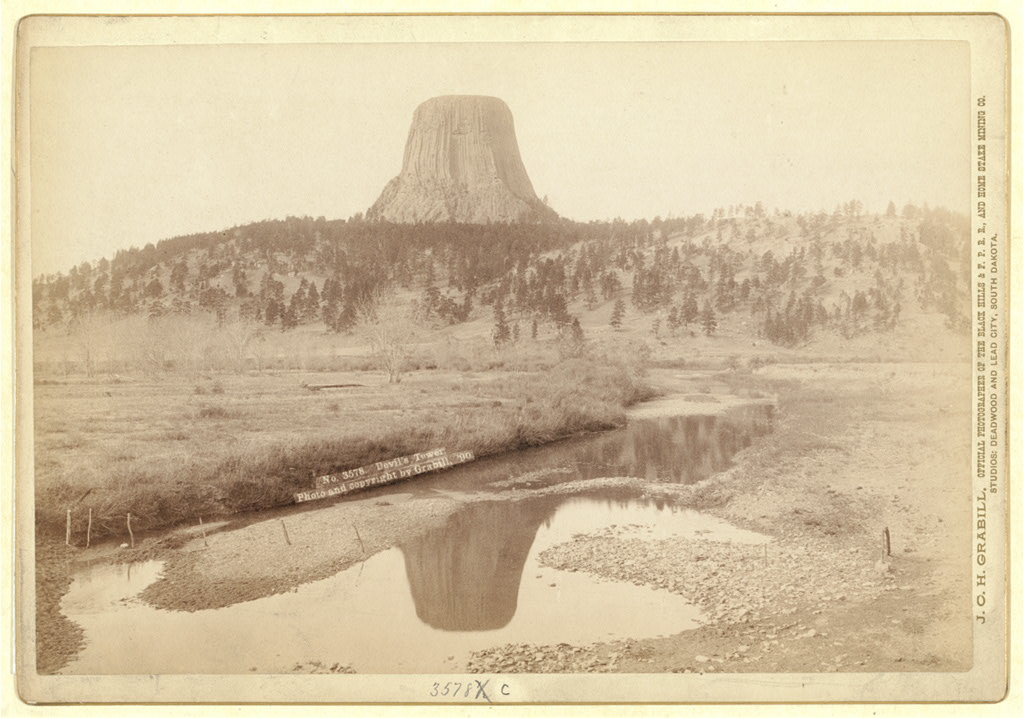
Devils Tower in northeastern Wyoming became the first national monument proclaimed under the Antiquities Act on September 24, 1906. The dramatic igneous landform had been known to Indigenous peoples for generations and already attracted scientific and scenic interest. Roosevelt’s proclamation protected it through a new legal mechanism rather than creating the rock formation or discovering it. The historic photograph accompanying this article predates the proclamation, making the chronology clear. Today the site is managed as Devils Tower National Monument by the National Park Service. Its selection demonstrated that the act could protect an important natural feature with scientific significance, not only a building or ancient ruin.
Where is Devils Tower?
Devils Tower rises in the Black Hills region of northeastern Wyoming near the Belle Fourche River. Its distinctive vertical columns and prominent position have attracted geologists, visitors and Indigenous communities for generations. The monument is not in Yellowstone National Park and does not lie within the state of South Dakota. Geological explanations involve volcanic or igneous processes and erosion over long periods. Indigenous names and spiritual relationships with the feature are equally important to its human history. A national monument designation did not end those relationships. Modern interpretation should acknowledge that the official name Devils Tower is not the only name associated with the site and that tribal communities have expressed concerns about naming and climbing practices.
Why is the site also called Bear Lodge?
Several Indigenous nations have traditional names and stories associated with the rock formation, including names translated as Bear Lodge or Bear’s Tipi. The designation Devils Tower reflects a name adopted in federal mapping and administration rather than the full range of Indigenous interpretations. For many Native communities the site is a place of cultural and spiritual significance, with continuing ceremonies and traditional use. The National Park Service interprets its geological and Indigenous histories together. The act’s original emphasis on protecting physical objects did not automatically guarantee that tribal voices would shape how every monument was managed. Later consultation and cultural resource policies developed in response to such concerns and long histories of Indigenous advocacy.
What were the next monuments Roosevelt designated?
Roosevelt proclaimed additional monuments during the last years of his presidency, including sites important for archaeological remains, unusual landforms and scientific study. Examples include El Morro, Montezuma Castle, Petrified Forest, Chaco Canyon, Muir Woods and the Grand Canyon. Their original names, boundaries and classifications sometimes changed later. Roosevelt ultimately used the act to establish 18 national monuments, according to National Park Service historical research. The range of sites helps explain why the law became more broadly important than an early measure against artifact looting. The designation process allowed preservation of many types of places before Congress considered whether some should become national parks or receive another form of management.
What was protected at El Morro?
El Morro in New Mexico contains a sandstone promontory bearing inscriptions from many periods, including Indigenous petroglyphs and later written records left by travelers. Roosevelt designated it a national monument in December 1906. Its cultural importance predates federal protection by centuries and includes histories of communities that traveled, lived and created inscriptions in the region. Preserving the rock does not mean every inscription is equally old or connected to one culture. The monument demonstrates the archaeological and historical purposes of the legislation: inscriptions and other features can be damaged irreversibly if left unprotected. Researchers study them in relation to the wider landscape and the people who created them.
Why is Montezuma Castle significant?
Montezuma Castle in Arizona protects a cliff dwelling constructed by Indigenous peoples commonly identified with the Sinagua cultural tradition. Despite the familiar name, the dwelling was not constructed by the Aztec ruler Montezuma, and repeating that assumption would be historically inaccurate. Federal monument status helped protect the archaeological structure and surrounding resources from continued disturbance. The site demonstrates why the original act addressed prehistoric and historic buildings, not only spectacular natural landforms. Modern archaeological interpretation treats the people who built and inhabited the dwelling as historical communities connected to a broader region. The monument’s name reflects earlier Euro-American assumptions rather than definitive evidence about its builders.
How did Petrified Forest benefit?
Roosevelt created Petrified Forest National Monument in Arizona in 1906, protecting scientifically important deposits of fossilized wood and associated landscapes. Petrified wood forms through geological processes in which minerals gradually replace the organic material of buried trees. Before systematic protection, collecting and commercial removal threatened important specimens and research contexts. Monument status increased federal oversight, though the area later received expanded boundaries and became a national park in 1962. The example shows how the act’s reference to objects of scientific interest could apply to geology and paleontology. It was therefore more than a law addressing historic ruins, even though concerns about artifact removal helped drive its original passage.
Why was the Grand Canyon designated?
Roosevelt proclaimed the Grand Canyon a national monument in 1908, using the Antiquities Act to protect a vast landscape of geological and scientific significance. The area later became Grand Canyon National Park in 1919 through an act of Congress. Those are distinct milestones, and it is incorrect to say Roosevelt founded Grand Canyon National Park in 1908 under its current designation. His action illustrated the broad interpretation of the statute’s ability to protect natural objects and their surrounding land. The canyon also has long Indigenous histories and continuing tribal connections that predate national-monument status. Its protection became central to debates about whether presidential monument authority could encompass very large landscapes.
What happened at Muir Woods?
Muir Woods in California protects coastal redwood forests in a region facing rapid development and commercial logging pressures in the early twentieth century. William and Elizabeth Kent donated land for protection, and Roosevelt proclaimed Muir Woods National Monument in 1908. The monument was named in honor of conservationist John Muir, whose advocacy influenced public understanding of forests and wilderness. The site demonstrates the role of private initiative combined with federal designation, while the act itself concerns land under federal ownership or control at the time of proclamation. It should not be treated as proof that presidents could designate monuments on arbitrary privately owned property without consent or another lawful mechanism.
How did Chaco Canyon become protected?
Chaco Canyon in present-day New Mexico preserves extensive ancestral Puebloan architecture and cultural landscapes. Roosevelt designated Chaco Canyon National Monument in 1907, seeking to protect significant archaeological resources. The site’s surviving structures reflect complex communities and regional relationships long before the nineteenth century. The area later received additional protection and a different official status as Chaco Culture National Historical Park. Archaeological interpretation benefits from the knowledge of modern Pueblo and other Indigenous communities with ancestral and cultural connections. A monument designation can protect physical structures, but responsible stewardship also requires attention to living heritage, sacred places and the effects of tourism and scientific investigation.
Why are national monuments different from national parks?
Both national monuments and national parks can protect significant cultural, natural and scientific resources, but the legal path to designation and the management arrangements differ. Congress usually creates national parks through legislation, while presidents may proclaim national monuments under the Antiquities Act on qualifying federal lands. Congress can also establish monuments, and protected areas may be managed by different agencies rather than exclusively the National Park Service. Some monuments eventually become national parks through later congressional action. A national monument is not automatically smaller or less important than a park. The distinction lies mainly in legal authority, purpose, boundaries and administrative responsibilities, not a simple ranking of scenic quality.
What does ‘smallest area compatible’ mean?
The Antiquities Act instructs that the area reserved around protected objects be confined to the smallest area compatible with their proper care and management. How that phrase applies to large landscapes has been debated in Congress, courts and public discussions. Protection of a geological feature, archaeological district or ecosystem may require more than a small fence around one visible point. Conversely, critics of large proclamations argue that the statute should be interpreted narrowly. The wording does not provide a universal numerical limit on acreage. Its interpretation has changed as government knowledge and conservation objectives developed, and particular proclamations have been challenged through legal and political processes.
Did the Antiquities Act create the National Park Service?
No. The Antiquities Act was enacted in 1906, while Congress established the National Park Service in 1916. Before the NPS existed, national monuments and other federal protected lands were administered through different government departments and offices. The Service later assumed management of many important sites, but some monuments today are managed by agencies such as the Bureau of Land Management or the Forest Service. The chronological distinction is central to understanding the evolution of federal conservation. The act gave the president a means of preserving selected resources; the later NPS Organic Act created a permanent administrative institution responsible for managing an expanding national park system.
How were Indigenous communities affected?
The 1906 law helped protect many ancestral sites from looting, but early federal conservation also reflected an era when Indigenous peoples had limited control over decisions affecting their cultural landscapes. Monument creation could restrict customary use or place traditional resources under agencies that did not initially consult communities adequately. Native nations have continued advocating for access, interpretation, protection of sacred places and meaningful participation in management. Modern histories should not treat Indigenous cultures as vanished simply because an ancient structure received federal protection. The places remain connected with living people and sovereign tribal governments. Conservation’s benefits and limits must be assessed together to understand both protection and the historical distribution of authority.
Why is the Antiquities Act historically important?
The law gave the federal government a flexible means of responding to threats against cultural and scientific resources before ordinary legislative procedures could provide site-specific protection. Roosevelt used it repeatedly, setting an example followed by later presidents. It helped shape archaeology, conservation and the growth of the National Park System while continuing to provoke debates over federal land management. Its significance cannot be reduced to one scenic photograph of Devils Tower. The act connects the protection of ancient places, geological formations, historic landmarks and landscapes whose boundaries may be contested. Studying its original terms alongside case histories demonstrates how legislation designed for antiquities became a durable public-land policy tool.
Antiquities Act timeline
| Date | Event |
|---|---|
| Late 1800s–early 1900s | Campaigns grow against archaeological looting on federal lands. |
| June 8, 1906 | Roosevelt signs Antiquities Act. |
| September 24, 1906 | Devils Tower proclaimed first national monument. |
| December 1906 | El Morro and several additional monuments designated. |
| 1907 | Chaco Canyon designated. |
| 1908 | Grand Canyon and Muir Woods designated. |
| 1909 | Roosevelt leaves office after proclaiming 18 monuments. |
| 1916 | National Park Service established by separate legislation. |
| 1919 | Grand Canyon becomes national park. |
| 1962 | Petrified Forest becomes national park. |
Research sources
- NPS — American Antiquities Act of 1906
- GovInfo — Antiquities Act of 1906
- NPS — Historical Proclamation of National Monuments
- NPS — Archeology and Preserving America’s Past
- Theodore Roosevelt Center — Antiquities Act History
- NPS — Theodore Roosevelt’s National Park Legacy
- Library of Congress — Devils Tower 1890 Photograph