Klondike Gold Rush (1896–1899): Chilkoot Pass, Dawson City and the Stampeders
Discover the extraordinary journey to the Klondike and what happened to the gold seekers.
Gold discovered in the Klondike region of northwestern Canada in August 1896 set off a rush after news reached Seattle and San Francisco in 1897. More than 100,000 hopeful travelers set out, but fewer than half reached Dawson City and only a minority found significant wealth. The journeys over Chilkoot and White Pass, followed by river travel, became defining episodes of northern frontier history.
From Bonanza Creek to the Golden Stairs, this guide follows the dates, routes, people and consequences of the rush.
On this page — 22 topics
What was the Klondike Gold Rush?
The Klondike Gold Rush was a surge of migration toward gold deposits in the Yukon region of northwestern Canada. Prospectors, merchants and adventurers from across North America and overseas traveled north after newspapers publicized a major discovery in 1897. The rush became famous for its difficult journey through the Coast Mountains, where travelers carried months of supplies before building boats to reach the goldfields. It was not a discovery of gold on Alaska’s Chilkoot Pass itself: the pass lay along a route to Canadian territory. The rush attracted large numbers of people, yet most participants never recovered the costs of the expedition or earned a substantial fortune.
Who discovered gold in 1896?
The major discovery associated with the rush occurred along Bonanza Creek, then called Rabbit Creek, in the Klondike watershed in August 1896. George Carmack, Skookum Jim Mason and Dawson Charlie are central to the recorded event, while Kate Carmack’s presence and the allocation of credit deserve attention. Accounts disagree about exactly who first spotted the gold, partly because later claims reflected colonial assumptions about Indigenous participants. Historians avoid awarding uncontested credit to one white prospector. The discovery occurred on lands used by Indigenous peoples long before miners arrived. The subsequent staking of claims transformed local economic life and sharply increased outside pressure on the region.
Why did the rush begin in 1897 rather than 1896?
The discovery occurred in August 1896, but much of the region’s travel was limited by season and distance. News spread slowly until ships carrying successful miners and gold reached West Coast ports in July 1897. Stories of valuable finds, dramatic newspaper coverage and the sight of returning prospectors encouraged thousands of people to head north. This distinction explains why guides sometimes date the gold rush from 1896 and others highlight the stampede of 1897–1898. Both are defensible when their scope is stated clearly. The discovery, publicity, great migration and later mining activity were related stages rather than a single summer event.
What happened when the ships arrived?
The arrival of vessels including the Portland at Seattle and the Excelsior at San Francisco in July 1897 helped turn a regional discovery into an international sensation. Newspapers reported the quantities of gold brought out and published stories of fortunes made in a remote northern territory. Some accounts were exaggerated, but they resonated with people recovering from the financial depression of the 1890s. Prospective stampeders bought clothing, tools and provisions with limited information about the journey or how many claims remained available. Merchants in port cities benefited immediately from the rush, often more reliably than individual miners trying to strike it rich.
Why was Seattle an important gateway?
Seattle developed into a major departure point where stampeders purchased supplies and boarded ships toward Alaska. The National Park Service estimates that about 70,000 of roughly 100,000 participants passed through Seattle at some stage of the rush. Business owners promoted the city as the best place to outfit an expedition, and hotels, outfitters, shipping firms and restaurants profited from the increased traffic. A stampeders’ journey might begin far from Seattle, but the port became one of the most visible commercial centers. The rush helped shape Seattle’s long-term reputation as a gateway to Alaska and the Pacific Northwest even though the richest goldfields were in Canada.
Where were Skagway and Dyea?
Skagway and Dyea were rival gateway settlements in southeastern Alaska, near the head of the Lynn Canal. From there, travelers could attempt mountain trails leading toward the lakes and river routes into the Yukon. Dyea was associated with the Chilkoot Trail, while Skagway provided access to the White Pass route. Both settlements experienced sudden growth and intense competition for lodging, transport, supplies and pack animals. Their fortunes diverged after railway construction and changes in transport patterns. Modern Skagway preserves historic buildings, while Dyea contains archaeological remains and protected landscapes. The geography is important because these Alaskan communities were transit points, not the actual gold-bearing Klondike district.
What was the Chilkoot Trail?
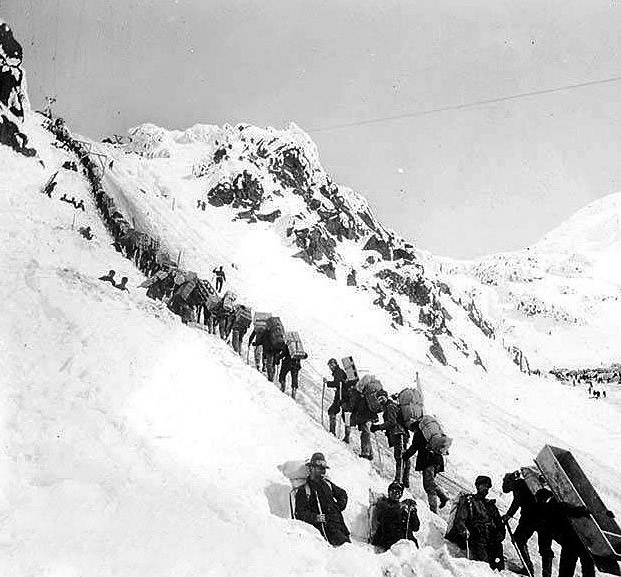
The Chilkoot Trail followed an Indigenous trade route across the Coast Mountains from the Alaska coast toward the interior lakes. Stampeders carrying heavy packs encountered steep terrain, ice, snow and dangerous conditions. The most famous section was the final climb to the pass, where a staircase cut into snow became an iconic photograph. Travelers often repeated sections of the trail many times because they could not carry their full outfit in one load. The route crossed the international boundary into Canadian territory. Indigenous Tlingit packers and other local experts played important roles in transport, although their knowledge was often minimized in stories centered on newcomers’ hardship and determination.
What were the Golden Stairs?
The Golden Stairs was a nickname for the steep, snow-covered ascent toward Chilkoot Pass during the height of the stampede. Climbers moved in long lines with packs and crates, sometimes using steps cut into compacted snow. The image is one of the best-known historical photographs of northern migration. It does not show an ordinary stairway built of gold or an approach that remained identical in every season. Avalanches, cold and exhaustion posed real dangers along the trail. The period image included with this guide is evidence of transport conditions in 1898, not proof that every stampeders’ route had the same terrain or that every person reached the goldfields afterward.
How was White Pass different?
The White Pass route began near Skagway and offered an alternative to the Chilkoot Trail. It attracted travelers using horses and pack animals, but difficult conditions, overloading and poor feed caused immense animal suffering. Sections became associated with the name Dead Horse Trail. The route’s hazards differed from the steep final Chilkoot ascent but were no less serious. Later railway construction transformed movement through White Pass, gradually reducing dependence on the worst mountain trails. Historians should avoid presenting one route as universally easy or safe. Conditions varied with weather, experience, season and the resources that a traveler could afford.
Why did prospectors need so many supplies?
Canadian authorities required many travelers entering the region to bring enough provisions for a year, commonly described as roughly a ton of supplies. Officials sought to prevent famine in a remote district where food was difficult to obtain during winter. The requirement made the journey expensive and exhausting because travelers had to carry provisions across the mountains before reaching navigable water. People sometimes hired packers, animals or transport services, but poorer stampeders repeated the route carrying their own gear. Supplying an expedition created substantial demand for merchants in Seattle, Skagway and Dyea. It also discouraged or stopped some travelers before they ever reached Dawson.
What happened at Bennett Lake?
After crossing the mountain passes, stampeders gathered at lakes including Bennett and Lindeman, where they prepared boats for the journey into the Yukon watershed. Winter ice often delayed departure until the spring thaw. Travelers cut timber, assembled vessels and tried to make boats seaworthy enough for river rapids and long downstream journeys. Many had little previous experience of building craft or navigating such waters. The gathering at Bennett became another famous scene of the stampede, illustrating how reaching the interior lakes was only one stage of a demanding route. A completed mountain crossing did not mean a person had reached a gold claim or avoided further danger.
How did people reach Dawson City?
From the interior lakes, travelers navigated waterways linked to the Yukon River toward Dawson City near the Klondike confluence. They faced rapids, weather, navigation problems and heavy river traffic when the ice broke in spring. Dawson became a commercial and administrative center because prospectors needed food, equipment, entertainment and ways to exchange gold for goods. It grew rapidly from a small settlement into a crowded boomtown. The journey to Dawson was far longer than the few miles shown in the most familiar Chilkoot Pass photograph. Guides should follow the full route, including maritime travel to Alaska, the mountain crossing and the inland water journey.
Why was Dawson City famous?
Dawson City grew at the meeting of the Yukon and Klondike Rivers and became the heart of the rush’s commercial life. Its businesses included stores, saloons, lodging houses, banks and services for prospectors. The population increased quickly, but reliable counts vary by season and definition. The National Park Service describes around 18,000 people in Dawson by midsummer 1898, when more than 5,000 were working the diggings. Stories about Dawson often focus on gambling and lavish spending, but many residents worked ordinary jobs serving the mining economy. The town was also built amid the displacement of the Tr’ondëk Hwëch’in from important traditional settlements and land use.
How many stampeders reached the goldfields?
The National Park Service estimates that more than 100,000 people set out for the Klondike between 1897 and 1900, but no more than about 40,000 reached Dawson City. The comparison explains why a famous mass migration did not produce equally large numbers of successful miners. Expenses, weather, accidents, illness and news that the best claims were taken caused many to turn back. Counts depend on dates, routes and whether people who worked as merchants are included. The numbers should not be treated as a census of people who personally discovered gold. They demonstrate a striking mismatch between the scale of public enthusiasm and actual arrival at the mining center.
Did most prospectors become rich?
No. Many profitable claims were staked before the great wave of new arrivals reached the Klondike, leaving latecomers with fewer opportunities. Some people earned money by providing supplies, transportation, food or other services instead of mining. Others lost savings on tickets, equipment and months of travel. Gold deposits varied in richness, and extracting material required physical work and access to claims. The most successful miners produced stories that newspapers amplified, giving potential travelers a distorted sense of the odds. The difference between a gold discovery and a profitable mining operation is crucial to understanding why so few stampeders became wealthy.
What did the rush mean for Indigenous peoples?
Indigenous nations had lived, traded and traveled through the region long before the discovery became international news. The Tr’ondëk Hwëch’in, among others, faced major disruption as outsiders built Dawson and appropriated land and resources. Tlingit communities were deeply familiar with coastal routes and provided transport services while experiencing changes to trade and authority. Historical writing that describes the Yukon as an empty wilderness awaiting discovery erases these peoples. The rush also brought disease risks, political pressure and new legal systems imposed by Canadian and other authorities. Recognizing Indigenous knowledge and dispossession gives a fuller account than one focused exclusively on miners crossing the Golden Stairs.
When did the gold rush decline?
The most intense public stampede took place in 1897 and 1898, and attention shifted as new discoveries offered alternative destinations. The Nome gold discoveries in Alaska around 1898–1899 attracted some prospectors away from the Klondike. Mining in the Yukon did not stop abruptly at the end of 1899, and commercial operations continued long afterward with changing technology and ownership. Calling 1899 the end of the rush is shorthand for the conclusion of its most famous migration phase, not the closure of every mine. The distinction helps explain why Dawson remained a community and why its mining history extends far into the twentieth century.
What was the link with the Panic of 1893?
The Panic of 1893 created prolonged unemployment and financial insecurity, making stories of sudden gold fortunes especially appealing. Some stampeders hoped to escape difficult job markets or debts, while others were drawn by adventure. The rush did not provide a reliable solution to the depression: many travelers spent more than they earned and had to seek new work. The economic context matters because it helps explain why people were willing to undertake dangerous, expensive journeys on uncertain information. The rush’s commercial profits often accrued to outfitters, transport companies and local merchants rather than the thousands chasing the richest deposits.
What can visitors see at Klondike Gold Rush parks?
Klondike Gold Rush National Historical Park protects and interprets parts of the journey in and around Skagway, while its Seattle unit explains the coastal city’s role as a departure point. Parks Canada interprets the Canadian side of the Chilkoot Trail and Dawson’s historical landscape. The National Park Service’s Klondike history provides reliable chronology, routes and photographic evidence. Visitors need to distinguish the historical route from today’s trail conditions and border regulations. The preserved buildings and landscapes show both the immense physical demands of the stampede and the enduring connections between commerce, migration and Indigenous histories.
Klondike Gold Rush timeline
| Date | Event |
|---|---|
| August 1896 | Major gold discovery on Bonanza Creek. |
| July 1897 | News spreads with returning prospectors and shipments of gold. |
| 1897–1898 | Stampeders pass through Seattle, Skagway and Dyea. |
| Spring 1898 | Large groups build boats at Bennett Lake for onward river travel. |
| Summer 1898 | Dawson City experiences peak crowds of the great stampede. |
| 1898–1899 | New discoveries and changing travel routes divert attention. |
| After 1899 | Mining continues while the mass rush fades. |