Sherman Antitrust Act of 1890: Trusts, Monopolies and Enforcement
What the first federal antitrust law prohibited—and why its meaning changed through the courts.
Signed July 2, 1890, the Sherman Antitrust Act prohibited unlawful restraints of interstate or foreign trade and monopolization. Early enforcement was limited, but later cases involving Northern Securities, Standard Oil and American Tobacco established its importance in U.S. business law.
This historical guide separates the original law from later interpretations, enforcement decisions and twentieth-century reforms.
On this page — 22 topics
What was the Sherman Antitrust Act?
The Sherman Antitrust Act was the first major federal law aimed at protecting competition from unlawful restraints of trade and monopolization. President Benjamin Harrison signed it on July 2, 1890. Section 1 targeted agreements among independent actors that restrained trade or commerce across state lines or with foreign nations. Section 2 addressed monopolization, attempts to monopolize and conspiracies to monopolize. The act created a legal foundation, but it did not instantaneously dismantle every powerful company or make having a large market share automatically illegal. Courts and government officials gradually determined how its broad language would apply to different businesses, and significant interpretations took decades to develop.
Why was a federal antitrust law needed?
Industrial expansion after the Civil War helped create large national markets dominated in some sectors by relatively few firms. Railroad systems, oil refiners, steel companies, sugar producers and other businesses sometimes combined operations or made agreements that limited independent competition. Critics feared that consumers, suppliers and smaller rivals would lose bargaining power. State laws were often ineffective against companies conducting business across borders. The federal government therefore used its constitutional authority over interstate commerce to establish a national rule. The law arose from public debate over business concentration rather than from one single price increase or one named corporation.
What did the word ‘trust’ mean in the 1880s?
A trust was one legal device through which owners could transfer control of several businesses to a central group of trustees while retaining financial interests. The arrangement could coordinate production, prices and market access across companies that had previously acted independently. In popular political language, trust also became a broad term for very large or dominant business combinations, even when their legal form was not literally a trust. The distinction is useful because the Sherman Act did not prohibit one narrow organizational document alone. Its language sought to address conduct restraining trade and attempts to monopolize, regardless of some differences in business structure.
Who was Senator John Sherman?
John Sherman was a Republican senator from Ohio who became closely associated with the legislation and whose name appears in the statute’s familiar title. He had a long political career involving finance and national economic policy. The measure was a congressional response shaped by many lawmakers, interest groups and competing proposals, not an individual senator’s unilateral invention. The name can also cause confusion with his brother, Civil War General William T. Sherman, who was not the author of the antitrust act. Examining John Sherman’s speeches and the congressional record helps explain why legislators spoke about protecting trade and competition while also debating how federal authority should be limited.
When did the act become law?
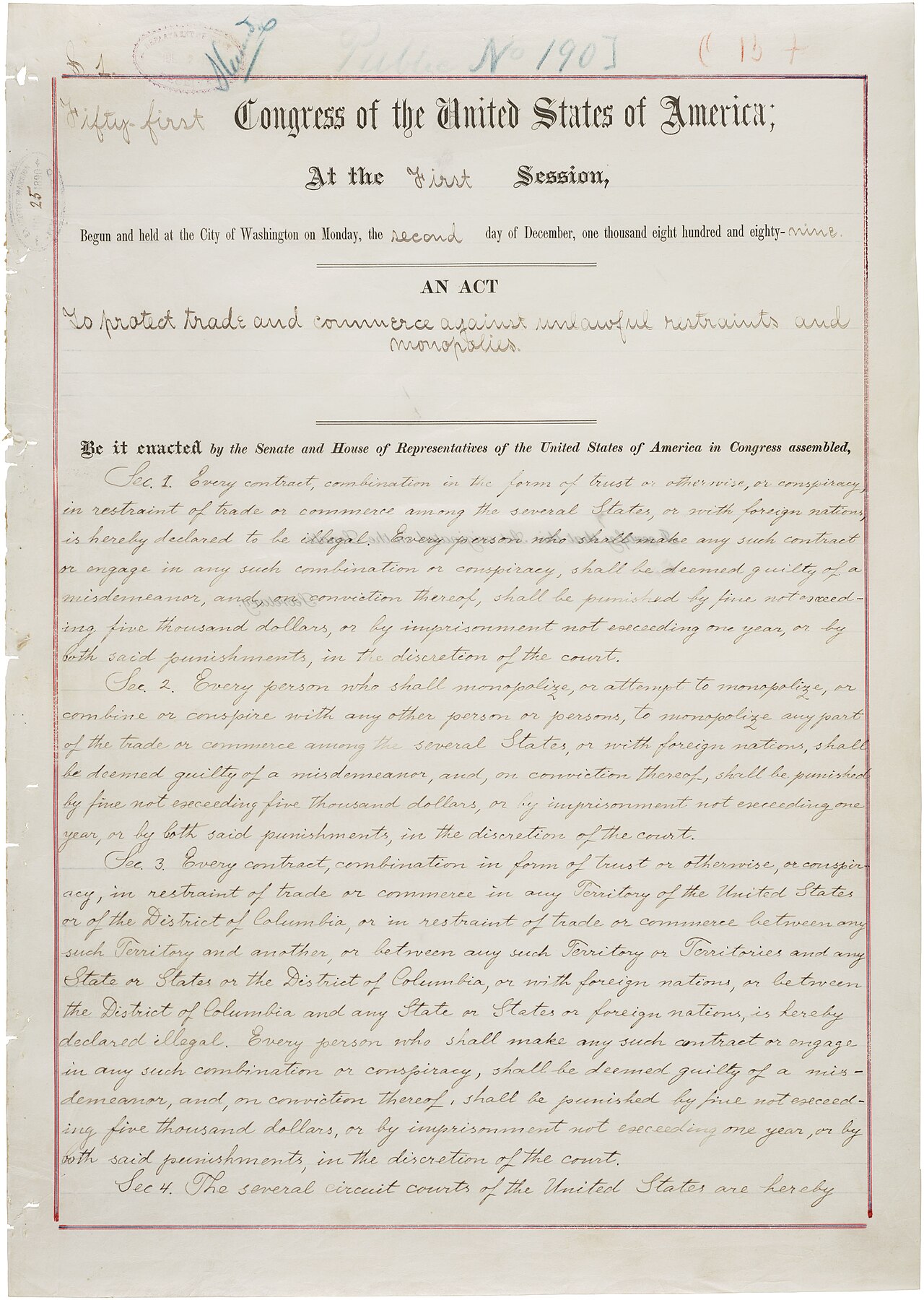
The statute became law on July 2, 1890, after passing the Fifty-first Congress and receiving President Benjamin Harrison’s signature. The National Archives preserves the enrolled legislative document. Although it is often described broadly as an 1890 law, the date matters when distinguishing events that preceded the legislation from later antitrust enforcement. The economic concentration that inspired the act had developed for years before its passage, and some of the most important court cases came long afterward. The act was not a constitutional amendment. It was a federal statute enacted under Congress’s power to regulate commerce, subject to interpretation by federal courts.
What does Section 1 prohibit?
Section 1 declares unlawful certain agreements among two or more economic actors that restrain trade or commerce among states or with foreign nations. The legal concept later developed to distinguish restraints that are inherently harmful, such as straightforward price-fixing among competitors, from arrangements requiring analysis of their actual competitive effects. The 1890 wording was broad and did not contain today’s entire body of tests and exceptions. It is therefore misleading to assume that every contract between businesses was illegal. The central concern was coordinated conduct that improperly reduced competition. Courts had to work out how to apply that principle to ordinary contracts and more aggressive business combinations.
What does Section 2 prohibit?
Section 2 addresses monopolization, attempted monopolization and conspiracies to monopolize interstate or international commerce. In modern law, possession of a strong market position alone is not always enough to establish unlawful monopolization; the means by which market power is obtained or maintained are crucial. The original legislation did not specify all the criteria that later courts would develop. This distinction prevents readers from equating any successful large company with an automatic violation. Congress sought to address abuses of concentrated economic power while allowing legitimate competition and growth. The boundary between ordinary business success and exclusionary conduct has remained a central antitrust question.
Did the law make every monopoly illegal?
The act’s title and language led many people to describe it as a simple ban on monopolies, but that shorthand hides important distinctions. Antitrust law is concerned with conduct, market structure, competitive effects and how firms obtain or preserve power. Over time courts distinguished the existence of monopoly power from unlawful acts used to acquire or maintain it. Some business combinations were challenged or broken apart, while large firms that did not meet the relevant legal requirements survived. The statute created rules for courts to apply, not a numerical limit on company size. A business’s profits, number of workers or public reputation alone cannot determine legal liability.
Why was interstate commerce central?
Congress relied on the Commerce Clause to regulate conduct affecting trade among states and with foreign countries. The United States had many individual state governments but increasingly integrated transport and business networks. An agreement among companies operating in multiple states could be difficult for a single state’s authorities to control. The federal statute aimed to supply national standards for those situations. Courts nevertheless debated the limits of federal commerce power, especially in early cases involving manufacturing activity. Those decisions influenced how effectively prosecutors could challenge powerful combinations. The federal-state division was not merely a technical detail; it shaped the first years of enforcement.
How was the law different from the Interstate Commerce Act?
The Interstate Commerce Act of 1887 focused on railroad rates, unjust discrimination and the creation of a specialized regulatory commission. The Sherman Antitrust Act addressed unlawful restraints of trade and monopolization across a wider set of industries. Regulation of an essential service and general antitrust enforcement are related but distinct approaches. The railroad law created the Interstate Commerce Commission to investigate carriers, while the Sherman Act initially depended heavily on courts and federal legal proceedings. Both statutes reflected concern about corporate power in the Gilded Age, but they did not impose identical restrictions or grant the same institutional authorities.
Who could enforce the original law?
The Sherman Act authorized federal legal action against unlawful combinations and monopolization. Federal officials could seek court intervention, and the statute also included criminal penalties. Private parties later became important in antitrust lawsuits under the evolving statutory framework. In 1890 there was no Federal Trade Commission; that agency was created in 1914. The success of the early law depended on government priorities, the quality of evidence and judges’ interpretation of interstate commerce. The existence of a statute did not mean that violations would be discovered automatically or that every complainant could easily demonstrate injury. Understanding enforcement requires looking beyond the law’s text to the institutions applying it.
Why was enforcement limited in the 1890s?
The act used broad language that left courts to decide what kinds of combinations and conduct were unlawful. Some judges interpreted federal power narrowly, and the government lacked the specialized investigation resources developed later. Businesses could reorganize in ways that complicated legal challenges. Political officials also disagreed over how vigorously to pursue powerful corporations. The Supreme Court’s 1895 decision in United States v. E. C. Knight Co. limited a challenge involving sugar refining by distinguishing manufacturing from interstate commerce. That outcome illustrated early constraints rather than a permanent exemption for all manufacturing. Subsequent cases gradually changed the practical reach of federal antitrust law.
What happened in United States v. E. C. Knight?
The case concerned an attempt to challenge American Sugar Refining Company’s acquisition of competing refiners. In 1895 the Supreme Court rejected the federal government’s approach, reasoning that manufacturing was distinguishable from the interstate commerce Congress could regulate under the circumstances. The result disappointed supporters of stronger antitrust enforcement and became a symbol of the act’s uncertain early power. Later legal developments narrowed some of the decision’s practical implications. Its importance is historical: the first Sherman Act era did not deliver straightforward victories against every large trust. Courts were still deciding the constitutional boundaries of national economic regulation.
Was the act used against workers and unions?
Yes. Early applications of antitrust law sometimes targeted labor combinations and boycotts, a result that angered union supporters who had hoped the law would curb corporate power. The legal conflict around the Pullman Strike of 1894 involved federal injunctions and antitrust-related arguments, although the Supreme Court’s In re Debs ruling did not depend solely on the Sherman Act. Employers also pursued suits against certain coordinated labor activities. This history explains why labor reformers demanded legal distinctions between collective action by workers and monopolistic arrangements among corporations. Later legislation, especially the Clayton Act and Norris–LaGuardia Act, addressed parts of this controversy.
What happened in the Northern Securities case?
The Northern Securities Company was a holding company associated with control over competing major railroads. President Theodore Roosevelt’s administration challenged the arrangement under the Sherman Act. In 1904 the Supreme Court upheld the government’s position against the combination. The case became a symbol of the federal government’s willingness to confront powerful business interests and contributed to Roosevelt’s reputation as a trustbuster. It did not establish that all holding companies were unlawful. Rather, it applied the law to a particular structure combining competing railroad interests. The decision showed the potential for enforcement to become more ambitious than it had seemed during the act’s early years.
How did the Standard Oil case change antitrust law?
The federal government challenged Standard Oil’s methods of consolidation and competitive conduct. In 1911 the Supreme Court ordered the breakup of the company’s combination after finding a violation of the Sherman Act. The decision also articulated an approach often called the rule of reason, focusing on whether restraints were unreasonable rather than treating every limitation arising from a contract as forbidden. Standard Oil’s case became one of the most famous examples of antitrust enforcement. It occurred twenty-one years after the original act, showing how slowly some decisive interpretations developed. The breakup did not demonstrate that every integrated industrial enterprise had to be divided into small firms.
What was the American Tobacco case?
In 1911 the Supreme Court also ruled against American Tobacco’s combination under the Sherman Act. Like Standard Oil, the case involved decades of consolidation and challenged the methods by which a dominant enterprise controlled a market. The outcome strengthened the impression that federal antitrust enforcement could reach major national corporations. Different firms were reorganized in ways determined by the litigation, and the decisions required analysis of their actual conduct. These cases belonged to a changing Progressive Era enforcement environment, not the immediate effects of the law in July 1890. Their significance is best understood as development of the original statute through later judicial interpretation.
What changed in 1914?
Congress enacted the Clayton Antitrust Act and the Federal Trade Commission Act in 1914. These measures expanded the legal framework for addressing certain business practices and created the FTC as a specialized agency. The Clayton Act also included labor-related provisions intended to address abuses in earlier applications of antitrust law, although their interpretation remained contested. The new statutes did not repeal the Sherman Act. Instead they supplemented and reshaped the system that had begun in 1890. This explains why modern competition policy refers to several overlapping federal laws and agencies rather than one single rule against any company with a large share of a market.
Why is the Sherman Act historically important?
The act marked a turning point in the idea that the federal government had a responsibility to protect competition within a national industrial economy. Its first years exposed considerable weaknesses, but subsequent presidents, courts and legislators developed the statute into a central part of American economic law. The debates it initiated remain recognizable: when does cooperation become collusion, when does size become exclusionary power, and how can regulation protect the public without preventing productive business activity? As a historical reference, the most important point is that the law established a durable principle but did not immediately produce a fully developed regulatory regime. Readers should distinguish the 1890 statute from its later interpretation rather than treating modern tests as if Congress wrote them out in detail in 1890.
Antitrust history timeline
| Date | Event |
|---|---|
| 1887 | Interstate Commerce Act begins federal railroad rate oversight. |
| July 2, 1890 | Benjamin Harrison signs Sherman Antitrust Act. |
| 1895 | E. C. Knight case shows limits of early enforcement. |
| 1904 | Northern Securities antitrust decision. |
| 1911 | Standard Oil and American Tobacco decisions. |
| 1914 | Clayton Act and FTC Act expand federal competition framework. |