Great Railroad Strike of 1877: Causes, Riots, Federal Troops and Outcome
How railroad wage cuts ignited protests from Martinsburg to Pittsburgh and Chicago.
The Great Railroad Strike of 1877 began with railroad employees protesting pay reductions during a prolonged depression. Starting with major stoppages at Martinsburg, West Virginia, the unrest spread across many states in July. Clashes with militia and federal troops caused deaths and damage, and workers failed to win most immediate wage demands.
Follow the regional chronology and learn how federal and state responses shaped the outcome.
On this page — 22 topics
What was the Great Railroad Strike of 1877?
The Great Railroad Strike of 1877 was a wave of labor protests and work stoppages that disrupted rail service across much of the United States during July. It began among Baltimore & Ohio Railroad workers in West Virginia after wage reductions and spread to major rail centers including Baltimore, Pittsburgh, Reading, Chicago and St. Louis. Troops, state militia and local police confronted demonstrators, and violence caused numerous deaths and extensive property destruction. It is often described as the first major national labor uprising in the United States, although the protests were not coordinated by a single nationwide union. Its consequences revealed the depth of post-depression discontent and the difficulty of resolving labor disputes through military force.
Why did the strike begin?
The immediate trigger was another round of railroad wage reductions during an extended economic downturn. Workers had already experienced cuts in pay and employment insecurity after the Panic of 1873. Railway companies argued that declining freight and passenger business required lower operating expenses, while employees maintained that their income had fallen too far to support their families. Locomotive crews, brakemen and other railway workers depended on employers with significant control over local employment. When companies announced further cuts, resentment could spread quickly along the same network of tracks that connected workplaces. The strike was therefore rooted in both a specific 1877 decision and several years of economic hardship.
How did the Panic of 1873 lead to labor unrest?
The Panic of 1873 was followed by a long depression that affected investment, railroads, wages and employment across the economy. Railroad construction had been a focus of speculation, and companies faced serious financial pressures when demand weakened. Employers cut costs while workers competed for fewer jobs. By 1877 many families had exhausted savings and resented additional wage reductions. The depression did not automatically produce a nationwide strike: local leadership, working conditions and confrontations shaped the timing. But it helps explain why relatively small groups of railroad employees could attract sympathy from industrial workers, unemployed residents and members of their communities.
Where did the first stoppage occur?
The National Park Service traces important early walkouts to the Baltimore & Ohio Railroad shops at Martinsburg, West Virginia, on July 16, 1877. Workers responded to the wage cut by refusing service and preventing freight trains from moving. Accounts also describe an earlier aborted stoppage in Baltimore. The precise starting point of a national movement is therefore sometimes simplified, but Martinsburg was central to its rapid expansion. Railroad crews were especially capable of disrupting traffic because a train required coordinated labor to move safely. The B&O and government authorities responded by seeking armed assistance, converting a wage conflict into a confrontation about public authority and railway operations.
Why was Martinsburg important?
Martinsburg was a crucial Baltimore & Ohio railroad center containing workshops, yards and crews whose labor kept freight moving across the region. Trains delayed there affected traffic far beyond the city. Employees could see their actions as part of defending wages, while company officials viewed blocked rail operations as a threat to contracts, customers and investment. The conflict escalated when attempts to move trains under armed protection met resistance. West Virginia authorities struggled to restore order with available forces and requested federal help. The incident demonstrates how a dispute in one transport hub could become a national crisis in an economy increasingly dependent on interconnected rail lines.
How did the strike spread across the country?
News moved rapidly by telegraph, newspapers and railway employees traveling between towns. Stoppages and demonstrations occurred in Maryland, Pennsylvania, New York, Illinois, Missouri and other locations, but conditions varied. Some groups demanded an end to wage cuts, others expressed solidarity, and unemployed residents sometimes joined protests against broader inequality. There was no single national command structure capable of directing every action. In some cities labor leaders supported peaceful stoppages; in others confrontations and damage to property developed. This combination of a common economic grievance and distinct local events is central to the strike’s history. The breadth of disruption should not be confused with a fully unified national union campaign.
What happened in Baltimore?
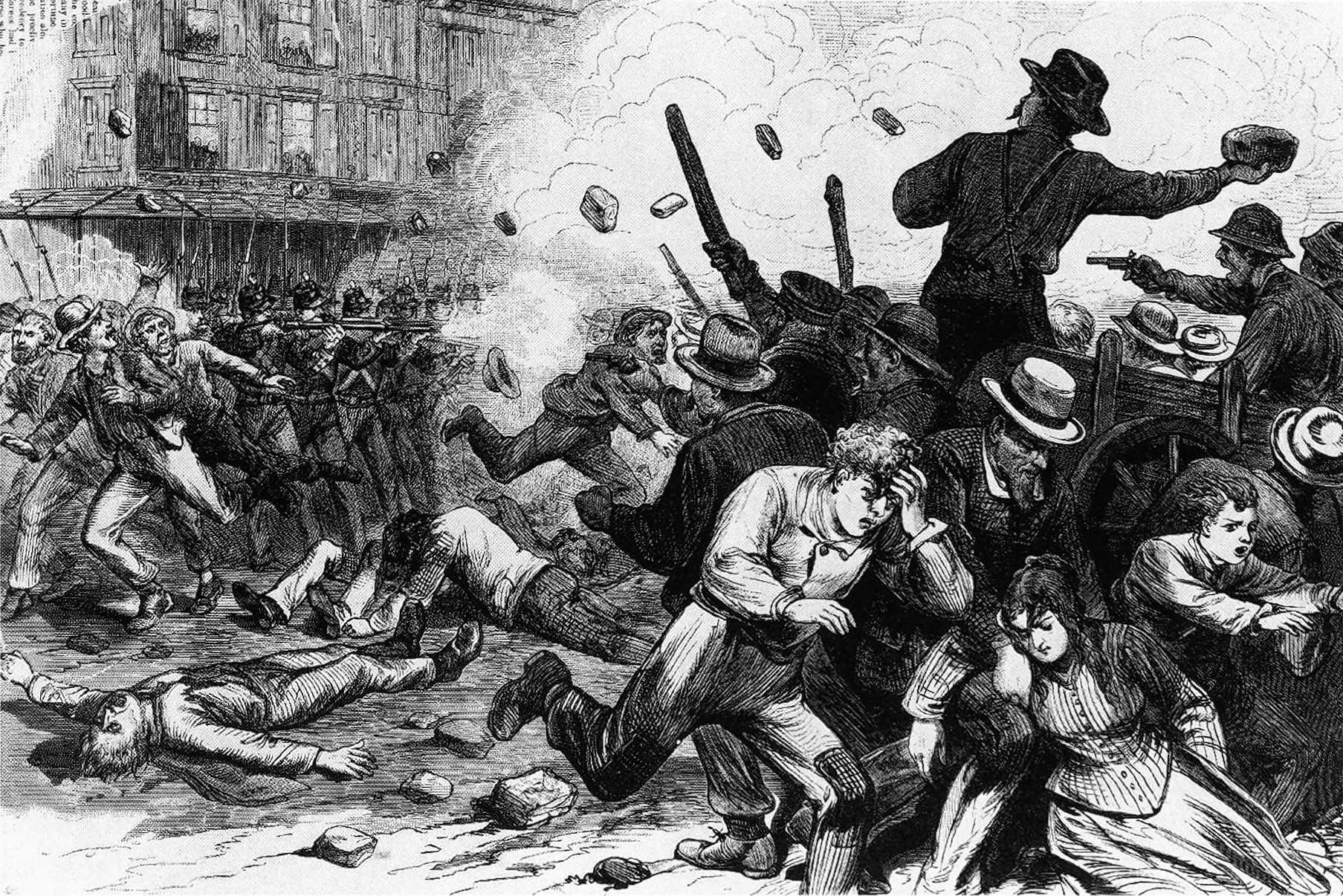
In Baltimore, Maryland militia units were called out as railroad traffic and public order deteriorated. On July 20 confrontations occurred as soldiers attempted to move through crowds toward transport routes. Soldiers fired, civilians were killed, and anger intensified. The historic illustration accompanying this article depicts the Sixth Regiment firing during the Baltimore unrest; as a period engraving, it reflects one newspaper’s interpretation rather than a camera’s exact record. The city’s events showed how quickly a labor dispute could become a violent confrontation between troops and residents. The situation also illustrated the difficulty of using local militia drawn from communities where workers and protesters had neighbors and relatives.
What happened in Pittsburgh?
Pittsburgh became one of the most destructive centers of the strike. Railroad workers protested wage and operational changes, and Pennsylvania militia were deployed to clear the lines. During clashes on July 21–22, soldiers fired on crowds and violence escalated. Railway buildings, locomotives and cars were burned, and many people were killed or injured. Estimates of the total vary, but the Library of Congress notes that an official Pittsburgh death toll of twenty-six was probably incomplete. The extensive destruction made the city a national symbol of labor conflict, although the actions of workers, crowds and militia were not identical across every location. A history of Pittsburgh must include both human deaths and attacks on railway property.
Why were railroad depots burned?
In some cities the confrontation expanded from preventing train movements to destroying locomotives, railcars and stations. Damage could reflect anger toward companies, retaliation after shootings or the actions of crowds whose members did not belong to a railway union. It is unsafe to attribute every fire to organized strike leadership. Newspapers emphasized burning trains because images of destruction were dramatic and politically useful. The damage nevertheless disrupted commerce and strengthened officials’ arguments for military intervention. Different participants had different motivations, and some workers tried to prevent destruction. The distinction helps explain why labor historians separate a strike’s aims from violence committed in the course of a much wider public disturbance.
What happened in Chicago?
Chicago experienced railroad stoppages and broader worker protests, including demonstrations involving people from industries beyond rail transportation. Police confronted crowds, and violence occurred as authorities attempted to restore movement and control of streets. The city’s experience was shaped by its status as an enormous transportation hub linking Midwestern farms and industries with eastern markets. Events there also anticipated later labor struggles, particularly the Haymarket Affair of 1886, although the two incidents took place nine years apart and arose from different immediate disputes. They share a wider context of rapid industrialization, economic insecurity and conflict over how workers could organize.
What happened in St. Louis?
In St. Louis, Missouri, railroad stoppages became part of a broader general strike movement involving workers in various trades. Labor organizations and radicals helped coordinate meetings and demands, but political aims differed among groups. The actions challenged transportation and industrial operations until authorities regained control. The episode attracted attention because it showed how an initial railroad wage dispute could become a citywide protest over the distribution of power and income. It also highlighted the diversity of nineteenth-century workers, including immigrants with different political traditions. National histories sometimes neglect St. Louis by focusing on the particularly deadly clashes in Pittsburgh and Baltimore, yet its broad labor mobilization is important.
Why were state militia called in?
Railroad companies sought protection for their property and assistance in moving trains. Governors faced pressure to restore order while large crowds challenged local police and, in some places, sympathized with employees. State militia were deployed to protect depots, open lines or confront demonstrators. But militia units could be ineffective or hesitant, especially if soldiers felt sympathy for workers or were unfamiliar with controlling large urban crowds. The use of military force raised questions about whose interests the state was defending. Officials argued that transport and public safety required intervention, while workers criticized the treatment of wage protest as an emergency rather than a problem to be negotiated.
Why did President Rutherford Hayes deploy federal troops?
President Rutherford B. Hayes authorized federal military intervention after state authorities requested help and disruptions spread. Troops were sent to protect interstate transport and restore order in several locations. This was a politically sensitive choice because the United States was emerging from Reconstruction and debate continued over the army’s use in domestic affairs. Federal soldiers helped reopen transportation routes, but the underlying wage grievances were largely unresolved. The intervention showed the government’s willingness to defend railway operations as nationally important infrastructure. It also contributed to the perception among many workers that public authority aligned with corporate owners when large industrial disputes threatened the economy.
Was it a single organized nationwide strike?
No central labor union directed every protest. The wave was united by anger about railroad wages and working conditions, but each city’s actions depended on local organizations, company policies, state responses and crowd dynamics. Some participants tried to maintain disciplined peaceful action, while others took part in violent confrontations or attacks on property. A general strike in a city was not necessarily a formally coordinated component of an existing national railway organization. These differences are important when assessing responsibility for particular acts. Describing the events as one strike is historically useful as a broad label, but it should not imply that all workers shared one leadership, strategy or set of political beliefs.
How many people died?
Deaths occurred in multiple states during confrontations involving soldiers, police, protesters and bystanders. Modern summaries often describe roughly one hundred or more people killed nationally, but the exact total varies according to the locations and dates included. Estimates for Pittsburgh alone differ because contemporary reporting and official accounting were incomplete. It is better to use qualified figures and identify their source than to claim a perfectly established national count. The violence also left numerous injured and caused enormous damage to railway property. Lives were affected even in locations where no one died, as wages remained depressed and people were dismissed for taking part.
Did the railroad workers win?
Most wage cuts were not permanently reversed as a direct result of the work stoppages, and companies resumed operations once troops and other forces cleared the lines. Many striking workers faced dismissal or blacklisting. The movement was therefore largely unsuccessful in securing its immediate economic objectives. However, it revealed the possibility of broad labor solidarity and the weakness of institutions for resolving disputes. Employers and governments began thinking more carefully about security and strike preparedness, while organizers sought more durable unions. A strike can fail in immediate bargaining terms yet influence later political debate and organization. Keeping those outcomes separate avoids exaggerating success or minimizing historical importance.
How did companies respond after 1877?
Railroads and other employers improved coordination to deal with future stoppages and often supported measures that would make protection of transport infrastructure more effective. Some industries relied more heavily on private security, company police or close relationships with state authorities. These strategies reflected the financial importance of keeping national trade routes open, but they also widened distrust among workers. Labor organizations, meanwhile, concluded that spontaneous regional protest was difficult to sustain without durable membership and clear objectives. Later conflicts such as the Homestead Strike of 1892 and Pullman Strike of 1894 demonstrated different methods of employer resistance and government intervention.
Why did the strike matter for the labor movement?
The strike was among the first nationwide demonstrations of how workers could disrupt an industrial economy dependent on transportation. It exposed the tension between the constitutional freedoms claimed by citizens, the rights of property owners and officials’ desire to preserve commerce. Many participants did not win wage concessions, yet the unrest shaped public discussion about unions, inequality and state power. The Knights of Labor and later labor federations operated in a political culture influenced by such confrontations. Researchers avoid treating 1877 as the beginning of all American labor organizing, which had a much longer history. Its importance lies in scale, geography and the unprecedented public visibility of industrial conflict.
What sources help reconstruct the Great Strike?
The Library of Congress research guide traces the movement across regions and provides contemporary newspaper sources. National Park Service interpretation of the B&O Martinsburg Shops explains the initial dispute, including the date and wage reductions. Historic illustrated newspapers show how different publics perceived the confrontations, but their images and captions are not neutral eyewitness photographs. For each city, researchers should compare local accounts, company records and state military reports before quoting casualties or assigning responsibility for destruction. The Great Railroad Strike is a connected national event made up of locally distinct histories.
Great Railroad Strike timeline
| Date | Events |
|---|---|
| 1873–1877 | Depression weakens employment and railroad wages. |
| July 16, 1877 | Major walkout at Martinsburg B&O shops. |
| July 20 | Violence during militia deployment in Baltimore. |
| July 21–22 | Deadly clashes and property destruction in Pittsburgh. |
| Late July | Railroad stoppages and broader protests spread across several states. |
| Late July–early August | State and federal troops help restore railroad operations. |