Pullman Strike of 1894: Eugene Debs, Railroad Boycott and Federal Troops
Why a company-town wage dispute escalated into a nationwide railway boycott and federal intervention.
The Pullman Strike began on May 11, 1894, when factory workers near Chicago protested falling wages and unaffordable rents. The American Railway Union expanded the conflict through a boycott of trains carrying Pullman cars. Federal injunctions and troops helped break the boycott, and leader Eugene V. Debs was jailed. The strike ended in defeat for workers.
Explore the company town, the American Railway Union, federal intervention, Labor Day and the long-term legal impact.
On this page — 24 topics
What was the Pullman Strike of 1894?
The Pullman Strike began in May 1894 when employees of the Pullman Palace Car Company near Chicago stopped working in response to wage reductions and conditions in a company town. The dispute spread beyond the factory when the American Railway Union supported a boycott of trains hauling Pullman cars. Railroad service was disrupted over a wide area of the United States. Federal authorities intervened with an injunction and troops, citing the need to protect the mail and interstate commerce. The strike and boycott collapsed, and union leader Eugene V. Debs was jailed for contempt of court. The episode shaped American labor law, politics and views of corporate power.
Who was George M. Pullman?
George Mortimer Pullman had built a major business manufacturing sleeping cars used on passenger railways. His company became famous for comfortable travel and for an ambitious planned community for employees south of Chicago. Pullman presented that community as a model of orderly industrial life, with company-controlled buildings and services. Workers, however, lacked many ordinary forms of control over their neighborhood and rent arrangements. During the depression beginning in 1893, declining demand led the company to reduce wages. Pullman refused demands to lower rents proportionally, contributing to hardship. His name became associated with the conflict because employees’ homes and income were controlled by closely related corporate arrangements.
What was the Pullman company town?
The Pullman community was constructed near Chicago as a planned industrial neighborhood with factories, homes, shops, parks and civic buildings. It offered amenities often praised by visitors, but the company owned important property and exercised considerable influence over residents’ lives. Workers rented housing from the employer and faced rules that limited their independence. Such arrangements could combine real physical improvements with paternalistic control. Critics argued that industrial employment and domestic life were too closely connected when the same company could cut wages without making housing costs more affordable. The town is now part of Chicago and is interpreted by Pullman National Historical Park.
What caused wages to fall?
The Panic of 1893 and the economic depression that followed reduced orders for passenger railcars. The Pullman Company cut jobs and wages as demand declined, while employees argued that they continued to face fixed living expenses. The National Park Service reports wage reductions of around a quarter in important categories, though actual changes varied among workers and contracts. The broader economic crisis had different effects across industries, and managers described their decisions as necessary for survival. For employees receiving smaller paychecks, that explanation did not resolve the practical problem of paying rent and purchasing necessities. The dispute therefore combined cyclical economic stress with company control over workers’ living conditions.
Why were rents controversial?
Pullman employees lived in a town where the company owned the housing and controlled many services. As wages fell, rent obligations remained burdensome, producing a sense that management imposed its financial difficulties on workers without sharing the costs of adjustment. Housing at Pullman was sometimes of better physical quality than that available in other industrial settlements, but standards of construction did not determine affordability or fairness. Workers could be vulnerable when wages and rent were both influenced by the same employer. The refusal to make meaningful rent concessions helped transform dissatisfaction with the recession into organized opposition to the company.
When did workers walk out?
Employees at the Pullman factories went on strike on May 11, 1894, after demands for improved conditions and negotiation failed. The initial walkout was local to the manufacturing works rather than an immediate shutdown of the nation’s railway network. The company did not concede the workers’ central demands, and the dispute continued. Its significance grew as members of the American Railway Union considered whether to intervene through a boycott of Pullman cars. Distinguishing the May factory strike from the later nationwide rail boycott is essential. Newspapers and textbooks sometimes compress the two phases into one event, obscuring how a dispute over manufacturing wages became a confrontation involving federal transportation policy.
Who was Eugene V. Debs?
Eugene Victor Debs was an experienced labor organizer and president of the American Railway Union, established in 1893. The ARU attempted to bring railway employees from different crafts into a broader organization, challenging some traditional divisions among unions. Debs became the most famous leader associated with the Pullman boycott. His reputation grew after the conflict, and he later emerged as a leading American socialist politician. In 1894 he did not own the Pullman Company or control all railway workers. His power depended on persuading union members to refuse handling cars and maintaining solidarity while management, government and courts opposed the action.
What was the American Railway Union?
The American Railway Union was a labor organization created to unite many categories of railroad workers rather than organize solely by a particular occupation. Its broad membership made it capable of affecting operations across multiple companies when members supported a common cause. The union nevertheless had important limitations, including exclusionary racial practices and disputes over strategy. In 1894 ARU delegates voted to support Pullman employees by refusing to handle Pullman cars. Railway managers responded by treating that action as an attack on their ability to operate trains. The conflict became a major test of industrial unionism at a time when the legal protection of collective bargaining was weak.
How did a factory strike become a railway boycott?
Pullman sleeping cars were attached to passenger trains operated by many independent railroads. ARU members could therefore put pressure on Pullman by refusing to work on trains carrying its cars. This strategy extended the dispute far beyond the manufacturing plant. It created tension with railroad companies whose own employees and passengers were affected even though they did not set Pullman factory wages or rents. The boycott became especially disruptive in late June and early July as railway managers attempted to maintain service. Its supporters argued that solidarity was necessary because an individual employer could otherwise refuse to negotiate. Opponents emphasized interruption of commerce and the transportation system.
When did the national boycott begin?
The organized refusal to handle Pullman cars expanded in late June 1894, after the factory walkout had continued for weeks. Workers at different railroads responded unevenly, so the scale of service interruptions varied by region and company. Some trains continued operating while others were delayed or stopped. The General Managers’ Association, representing numerous railroad executives, coordinated employer responses. Because major lines carried mail and interstate passengers and freight, the dispute quickly became a national political question. The late-June expansion explains why the crisis intensified around the beginning of July. It did not begin with federal troops arriving in Chicago or with the burning of railcars during later unrest.
What was the General Managers’ Association?
The General Managers’ Association brought together executives from important Chicago-area railroads to coordinate their response to the boycott. Members sought to preserve operations, protect equipment and resist union demands. The association worked with government officials and legal advisers as transportation disruption increased. Railroad companies could move resources and legal arguments across corporate lines, creating a powerful counterpart to the ARU’s effort to organize across jobs. The resulting contest showed how employer coordination and labor coordination might collide in a national infrastructure industry. It also illustrated why disputes over privately owned railway equipment could attract federal intervention once mail service and interstate trade were affected.
Why did the federal government intervene?
President Grover Cleveland’s administration argued that the disruption threatened interstate commerce and the delivery of federal mail. Federal officials obtained a court injunction against obstructing railway operations and sent troops to protect transportation routes and enforce the law. Illinois governor John Peter Altgeld objected to the use of federal soldiers, exposing disagreement over the proper relationship between state and national authority. The government portrayed intervention as necessary to maintain lawful transportation, while critics saw it as taking the side of employers in a labor dispute. The conflict became a test case for the use of federal courts and executive power against coordinated strikes.
When did federal troops enter Chicago?
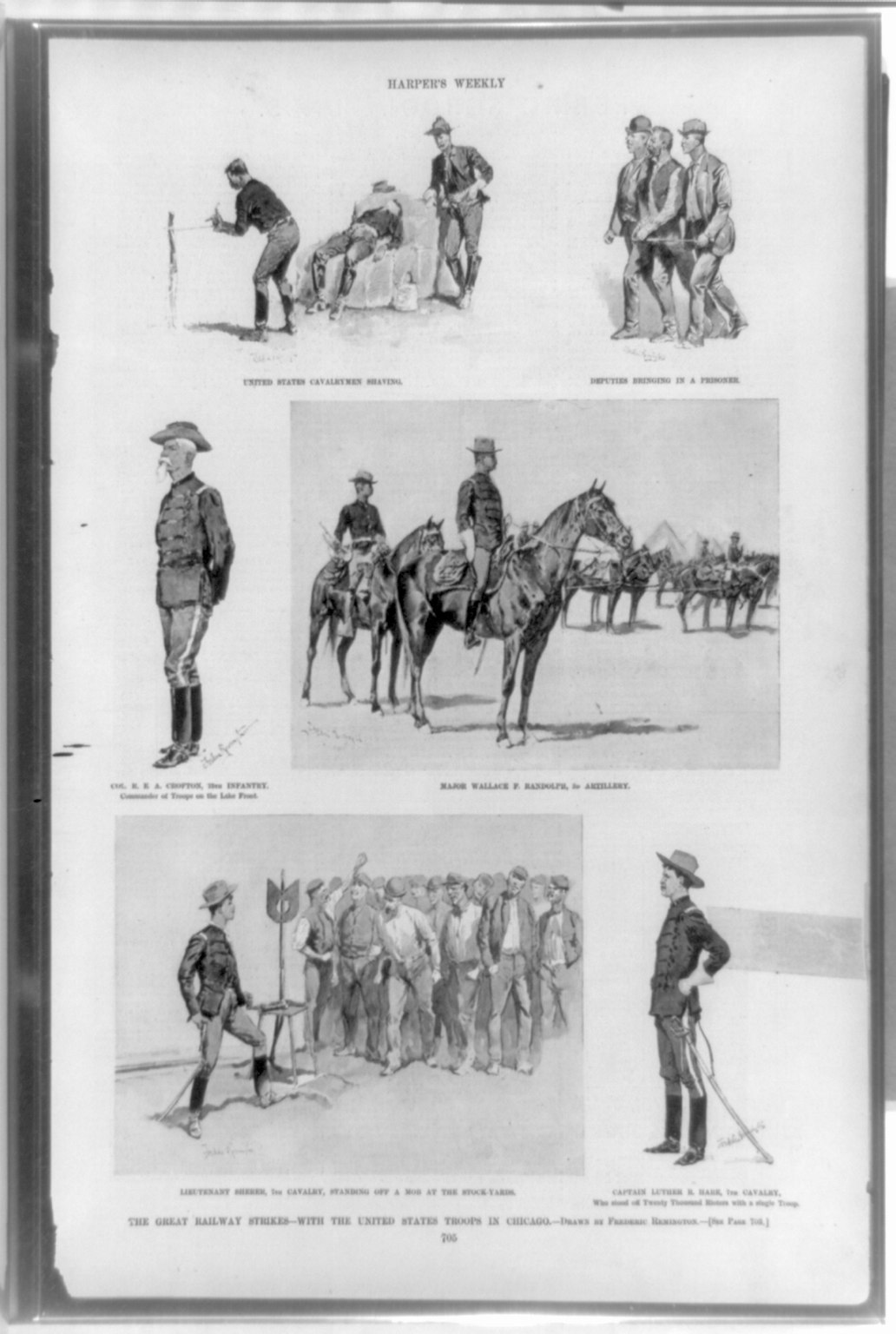
Federal soldiers began arriving in Chicago in early July 1894, with an important deployment on July 3. Their presence intensified tension and did not immediately restore normal service. Demonstrations, confrontations and destruction of railroad property followed in a chaotic environment where responsibility for particular incidents was sometimes disputed. Troops were also used to protect rail centers in other areas. The decision to send soldiers was controversial precisely because the government was acting in an industrial conflict involving civilians rather than repelling a foreign attack. Studying the chronology requires separating peaceful refusal to work from violent acts and distinguishing local events from the nationwide effects of the boycott.
What happened to railway cars and buildings?
Railroad property was damaged in several places during the upheaval, with cars overturned or burned and tracks obstructed. Contemporary photographs and illustrations of wrecked freight cars became influential in shaping public impressions of the strike. Some violence involved people who were not formal ARU members, and historians should not automatically attribute every destructive act to Debs or to organized union policy. The National Park Service interprets the unrest alongside police and military deployments. Damage was real and consequential, but dramatic images can give a distorted view if they are presented as the experience of every worker or as proof that all strike activity was violent.
How many people died during the unrest?
Deaths occurred during the strike and boycott, especially as confrontations developed between crowds, police and military forces. National Park Service biographical material gives a figure of 34 people killed by the end of July, although estimates vary depending on geographic scope, dates and what is counted. These fatalities should not be described as all occurring at the Pullman factory or all caused by one incident. Many people participated in peaceful work stoppages, while violence developed at particular railroad locations. The human cost included injuries and families’ lost income as well as deaths. A careful account identifies the limits of aggregate totals instead of presenting them as a precise count for a single battle.
What happened to Eugene Debs?
Debs and other ARU leaders were charged with violating a federal injunction against obstructing railway operations. Debs was jailed for contempt of court, and his experience became a formative episode in his later political development. The case reached the Supreme Court in In re Debs (1895), which upheld broad federal authority to intervene to protect interstate commerce and the mail. The legal outcome strengthened the government’s tools against certain labor actions and was widely criticized by supporters of unions. Debs later became a socialist leader and presidential candidate, but the 1894 case should be examined in the context of that year’s legal framework rather than later labor legislation.
What was In re Debs?
In In re Debs (1895), the United States Supreme Court upheld federal judicial intervention connected with the Pullman boycott. The decision recognized broad national authority to protect the free flow of interstate commerce and the postal system. It became a key precedent in the development of labor injunctions. The ruling did not declare all unions illegal or abolish the possibility of striking in every context. Its importance was that the federal government had powerful legal means to restrain a coordinated boycott disrupting national transportation. The case helps explain why later labor reformers demanded stronger statutory protections for organizing and limits on injunctions in industrial disputes.
Did the Pullman workers win?
No. The company did not accept the main demands that had sparked the factory walkout, and the wider boycott collapsed under employer resistance, legal action and military intervention. The ARU suffered severe damage as an organization. Many participants faced job loss, prosecution or blacklisting, while employees remaining in Pullman continued living with unequal bargaining power. The result was a defeat for the immediate labor campaign, even though it brought national attention to company towns and the conditions experienced by industrial workers. Describing the strike as a success simply because it drew sympathy would confuse its long-term historical influence with its direct bargaining outcome.
Did the strike cause Labor Day to become a holiday?
The federal Labor Day law was approved on June 28, 1894, while the Pullman conflict was developing. Labor Day observances already existed in states and labor organizations, so the holiday was not invented in response to one strike. Nevertheless, the nationwide dispute added urgency to national leaders’ efforts to address labor discontent. President Cleveland signed the law establishing the first Monday in September as a federal holiday. The timing matters: it was not a reward issued after the strike had ended. The act recognized the public significance of labor while the government was simultaneously preparing to suppress a disruptive railway boycott.
How did Pullman compare with the Homestead Strike?
The Homestead Strike of 1892 centered on a steelworks and the arrival of armed private Pinkerton guards. Pullman began with a factory walkout but became a far-reaching boycott involving many railroads, the federal mail, an injunction and U.S. Army troops. Both ended in defeats for the unions. Comparing them illustrates different means by which powerful businesses and public authorities resisted labor action during the Gilded Age. Both also influenced later demands for legal protections. The distinctions between private security, state militia, federal troops and federal courts are important because each institution exercised a different form of power.
Where can readers visit the Pullman historic site?
Pullman National Historical Park preserves portions of the planned industrial town on Chicago’s South Side and interprets its architecture, workforce and the 1894 strike. The park explains the relationship between manufacturing, housing and company control. The National Park Service strike history provides chronology and firsthand context, while federal judicial records illuminate the Debs case. Visitors should distinguish original structures, restored buildings and exhibits developed long after the conflict. The surviving neighborhood offers an unusual opportunity to study how a corporate vision of an ideal town became the setting for a defining national labor confrontation.
Pullman Strike timeline
| Date | Event |
|---|---|
| 1893 | Depression causes decline in railroad-car orders. |
| May 11, 1894 | Pullman manufacturing workers strike. |
| Late June | American Railway Union begins broad boycott of Pullman cars. |
| June 28 | Federal Labor Day legislation signed. |
| Early July | Federal injunction and troops deployed during unrest. |
| July–August | Boycott collapses and union is weakened. |
| 1895 | Supreme Court rules in In re Debs. |