Carlisle Indian Industrial School (1879–1918): Students and Forced Assimilation
How the Carlisle school operated, who attended, and why its assimilation policies caused lasting harm.
Carlisle Indian Industrial School operated in Pennsylvania from 1879 to 1918 as the first federally operated off-reservation boarding school for Native children. Founded by Richard Henry Pratt, it enrolled more than 7,800 children from over 140 Indigenous nations. Officials used education, labor and separation from families to suppress Native identities and promote assimilation.
This source-based guide places student experiences and family histories at the center of the school’s history.
On this page — 23 topics
What was the Carlisle Indian Industrial School?
Carlisle Indian Industrial School was a federally operated, off-reservation boarding school in Carlisle, Pennsylvania, open from 1879 until 1918. Its purpose was not simply to provide classroom education. Officials sought to replace Indigenous children’s languages, cultural practices and community ties with the norms of white American society. Children from many Native nations attended, often far from their families. Military-style rules shaped daily life, while vocational training, English instruction and compulsory labor were central to the program. The school became a prototype for other federal boarding schools. Understanding Carlisle requires looking at students’ experiences as well as the policies and public claims made by its administrators.
When did Carlisle open and close?
The first group of Native children arrived on October 6, 1879. The school operated at the former Carlisle Barracks, a military site transferred for educational use. It remained active until 1918, when the military reclaimed the installation for wartime needs. Over nearly four decades, more than 7,800 children from over 140 Indigenous nations attended, according to the National Park Service’s current historical interpretation. Older publications sometimes give higher estimates based on different methods of counting enrollment. Neither figure should be used to suggest that every child stayed for four years or had the same experience. Some remained briefly, some returned, and others died while enrolled.
Who established the school?
U.S. Army officer Richard Henry Pratt founded and initially directed Carlisle. His experiences with Native prisoners at Fort Marion in Florida influenced his belief that removing Indigenous young people from their communities could accelerate cultural assimilation. Pratt served as superintendent until 1904 and became a leading advocate of the off-reservation school model. He publicly advanced an ideology aimed at eliminating Native cultural identity while incorporating students into mainstream society. That philosophy is central to evaluating the school; the institution did not aim to preserve tribal languages or support Indigenous self-government. The school subsequently changed leadership, but the wider system of assimilation continued.
Why did the government send Native children away from home?
Federal authorities regarded Indigenous self-governance, languages and customs as obstacles to policies favoring settlement and assimilation. Taking children away from families made cultural replacement easier for administrators because students could be immersed in English, Christianity and school discipline without regular support from elders. Some families sought educational opportunities, but others were pressured, deceived or compelled to send children. Consent and circumstances varied greatly. A historically accurate account cannot treat enrollment as an ordinary private-school choice available on equal terms. Removal from home was a mechanism of federal power within the same period as reservation confinement and land allotment.
Which nations were represented among the students?
Children came from many communities, including Lakota, Cheyenne, Apache, Diné (Navajo), Pueblo, and others across the United States and Alaska. The National Park Service describes students from more than 140 Native nations, a reminder that they did not share one uniform language or culture. Their ages, family circumstances and experiences of schooling varied. Administrators sometimes placed people from different nations together to encourage English communication, making it harder to maintain their own languages. School records should be read carefully because officials often altered names or used inconsistent tribal classifications. Individual students’ nations and family identities remain important parts of their history.
What happened when children arrived?
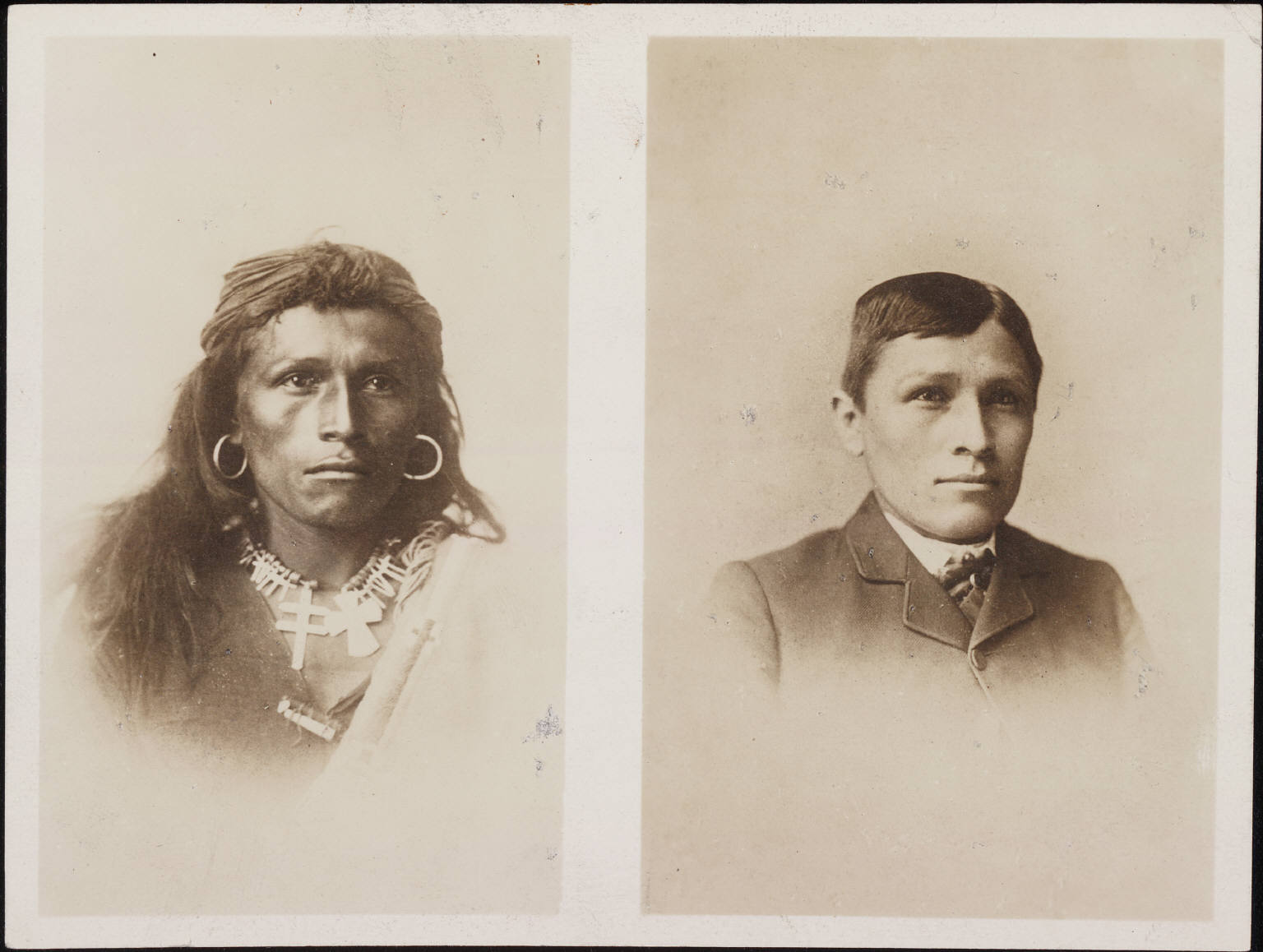
New arrivals were commonly issued school clothing, subjected to hair cutting and assigned English-language names or standardized forms of their existing names. Photography was used to present these transformations as proof of the institution’s success. Staff enforced strict rules, including punishment for using Indigenous languages or retaining customs that administrators considered unacceptable. Students often felt fear or grief because they were separated from family and familiar life. Not every child experienced exactly the same introduction, but the program’s stated objective was cultural replacement. The surviving portraits document how officials wanted Native children to appear, not whether those children consented or felt that the transformation benefited them.
What did students learn in classrooms?
Academic subjects included reading, writing, arithmetic and English-language instruction. The curriculum also promoted American national symbols, Christian practice and standards of behavior associated with mainstream white society. Education could give some students skills they later used, but the goals and conditions were not comparable to a school designed by Native nations to preserve their cultural autonomy. Administrators evaluated success largely through assimilation measures rather than students’ ability to sustain their own communities. Daily schedules were regulated, and classroom time was often combined with manual work. Studying the curriculum means considering both practical skills and the power imbalance under which those skills were taught.
How did industrial training operate?
Carlisle emphasized vocational training, with boys and girls commonly directed toward different kinds of work according to contemporary gender assumptions. Activities could include farming, carpentry, printing, tailoring, domestic service and other trades. School-produced newspapers and publications helped present the institution to supporters. Work was described as character building but could also provide the labor required to run the school. Students’ experiences varied by assignment, age, skill and treatment from supervisors. The label industrial school should not obscure the labor obligations or the limits on personal choice. Students did not control the rules under which they worked or the larger policy that had placed them there.
What was the outing system?
The outing system sent some students to live and work in non-Native households, farms or businesses outside the campus. Administrators claimed that prolonged contact with white families would improve English and accelerate assimilation. Students might perform farm work, domestic labor or other duties, and supervision could be uneven. Some built useful relationships or obtained income, while others faced exploitation, isolation or discrimination. Official reports often emphasized favorable outcomes because the system was presented as evidence of progress. Personal letters and later testimony are necessary for a fuller view. The system extended Carlisle’s cultural-control program into students’ lives beyond the school buildings.
Were Indigenous languages permitted?
School policy generally favored exclusive use of English and discouraged or punished Indigenous-language speaking. Language restriction was a core part of the effort to reshape identity. For children whose first language linked them with family, ceremonies, stories and community knowledge, the consequences could be profound. Some students continued speaking or remembering their languages privately, and survivors later helped sustain and revive traditions. Claims that the school taught English therefore need the additional context that English instruction came with deliberate suppression of other languages. Modern language-revitalization efforts by Native nations are part of the long response to that historical loss.
What role did religion play?
Christian worship and moral instruction formed important parts of the program, contributing to the intended replacement of Indigenous religious practices. Officials frequently presented Christian conversion and participation in church activities as evidence that students were becoming civilized by their standards. This framework disrespected the spiritual traditions of the children and their families. Students and their communities did not respond uniformly: some adopted elements of Christianity, while others resisted or combined beliefs in ways that reflected personal choices and circumstances. The historical issue is the compulsory institutional environment and the government’s use of education to exercise authority over religious and cultural identity.
What do the photographs of Tom Torlino show?
Tom Torlino, a Diné student, appears in before-and-after photographic portraits made by John N. Choate in the early 1880s. One shows him wearing clothing associated with his community; the later image presents a short haircut and Western-style suit. These portraits were part of a visual campaign used to promote assimilation policy. They cannot show how Torlino felt, what he thought of the school or how he lived after leaving. A portrait is evidence of how the institution wanted to represent its students. For that reason the photographs should be captioned with their dates, maker and purpose rather than offered as an uncomplicated story of educational success.
Did students always accept the school’s rules?
No. Students responded in different ways, including compliance, efforts to maintain cultural ties, expressions of frustration and attempts to leave. Individual letters and accounts show attachment to families as well as complex experiences of friendship, learning and punishment. Native children were not passive subjects of policy, although their choices were sharply constrained. School newspapers and superintendent reports often minimized conflict or presented administrators’ views as the students’ own. Historians therefore examine student writing, family correspondence, tribal oral histories and records of discipline together. The evidence reveals people negotiating difficult circumstances rather than a single uniform pattern of either acceptance or resistance.
What happened to students’ health?
Crowded dormitories, contagious disease and medical limitations created risks. Tuberculosis and other illnesses affected boarding schools during a period when effective treatment was limited. Children sometimes died at Carlisle and were buried in the school cemetery, far from their home communities. The number of deaths is documented through records but depends on the precise period, category and source being used. In recent years descendants and tribal governments have sought the return of children’s remains, a process requiring historical research and consultation. An article about Carlisle cannot treat mortality as a minor footnote to vocational education; deaths and separation from families are central to the institution’s legacy.
What was the Carlisle Indian School cemetery?
The cemetery at Carlisle Barracks held the remains of children who died while associated with the school. Some graves were moved during subsequent development of the military installation, complicating research into exact burial locations. Tribal nations and families have pursued repatriation of relatives’ remains. These efforts connect historical documents to living descendants, names and cultural obligations. Researchers must avoid treating cemetery records as impersonal statistics. Identifying individual children can involve school registers, military records, correspondence and cooperation with their communities. The ongoing work underscores that the harms of the boarding-school system did not end when Carlisle closed in 1918.
How did Carlisle relate to the Dawes Act?
Carlisle and the Dawes Act of 1887 formed part of a broader policy environment that favored assimilation over tribal autonomy. Allotment sought to divide collective landholding into individual parcels; boarding schools sought to change children’s languages, work and identity. The two measures operated through distinct institutions and legal procedures, so it would be inaccurate to say that the Dawes Act itself founded Carlisle. Their goals nonetheless complemented one another. Both undermined communal systems that had supported Native political and cultural life. Studying them together clarifies how land, schooling, religion and family separation were connected within federal Indian policy.
Who was Jim Thorpe at Carlisle?
Jim Thorpe, a citizen of the Sac and Fox Nation, attended Carlisle and gained national attention through his athletic achievements. He became famous in American football and won the pentathlon and decathlon at the 1912 Olympics. Carlisle’s athletic programs attracted attention and sometimes challenged racist stereotypes about Indigenous ability. Yet athletic success should not be used to excuse the school’s coercive assimilation program. Students could display extraordinary talent and agency while living within a system that suppressed their languages and separated them from home. Thorpe’s achievements are part of Carlisle’s history, not proof that the system was beneficial to everyone who attended.
When did Carlisle close?
The school ceased operating in 1918, as the Army resumed use of Carlisle Barracks during World War I. The boarding-school model did not end at the same time. Other federal and religious institutions continued programs intended to assimilate Native children for decades. The fact that Carlisle closed after nearly forty years demonstrates its influence but should not imply its policies were immediately abandoned nationwide. Records of the campus survived in military, educational and federal repositories. These materials help historians reconstruct attendance, experiences and later efforts by families to locate relatives or learn what happened to children who did not return.
How is Carlisle remembered in recent history?
Federal investigations and Native-led efforts have brought increasing attention to the harms of boarding schools, including family separation, cultural suppression and deaths. In December 2024, the federal government established Carlisle Federal Indian Boarding School National Monument. The National Park Service describes its interpretation as a collaborative process involving tribal nations, families, the U.S. Army and historians. Recognition of the site does not undo the damage or replace the perspectives of communities whose children attended. Public history has shifted from praising assimilation as progress toward documenting coercion and supporting Indigenous-led remembrance. Readers should check current park guidance because access to military property is not identical with access to an ordinary open park.
Where can families find student records?
The Carlisle Indian School Digital Resource Center at Dickinson College provides searchable records, images, documents and individual student information. The National Archives holds significant federal Indian boarding-school materials, while tribal archives and oral histories offer evidence beyond institutional paperwork. Researchers should search variant names because staff sometimes changed spelling or assigned English names. Enrollment registers alone cannot explain whether a child consented or what happened after departure. Comparing letters, outing records, medical information and later family histories offers a stronger picture. Privacy and the wishes of descendants matter when using sensitive records or photographs of children who were separated from their communities.
Timeline of Carlisle Indian School
| Date | Event |
|---|---|
| October 6, 1879 | First group of Native children arrives. |
| 1880s | School expands; photography and outing system support assimilation. |
| 1892 | Richard Henry Pratt publicly articulates his assimilation philosophy. |
| 1904 | Pratt leaves position as superintendent. |
| 1912 | Carlisle student Jim Thorpe wins two Olympic gold medals. |
| 1918 | School closes; military reclaims barracks. |
| December 2024 | Carlisle Federal Indian Boarding School National Monument established. |
Sources and historical records
- National Park Service — History & Culture
- NPS — Carlisle School and Assimilation
- Dickinson College — Carlisle Indian School Digital Resource Center
- Dickinson College — History of the School
- National Library of Medicine — Native Voices
- NPS — National Monument proclamation
- Wikimedia Commons — Tom Torlino portrait