Panic of 1873: Causes, Jay Cooke, Railroad Collapse and Depression
Why railroad financing collapsed, how the banking panic spread and what it meant for American politics.
The Panic of 1873 was a major financial crisis triggered in September by the collapse of Jay Cooke & Company’s railroad financing. Bank failures, a temporary New York Stock Exchange closure and shrinking credit contributed to prolonged economic distress and influenced politics during the late Reconstruction era.
Explore the railroad investment boom, Jay Cooke, employment losses, monetary debates and the downturn’s connection to Reconstruction.
On this page — 22 topics
What was the Panic of 1873?
The Panic of 1873 was a major financial crisis that began in the United States in September 1873 and contributed to years of severe economic distress. The failure of the investment bank Jay Cooke & Company, heavily exposed to railroad finance, helped set off withdrawals, bank failures and disruption in securities markets. Railroad construction slowed, businesses failed and unemployment rose. The period is sometimes associated with the Long Depression, although historians and economists differ over precisely when the downturn ended and how its phases should be measured. The crisis took place during President Ulysses S. Grant’s second term and weakened public confidence in political institutions. It also affected Reconstruction by shifting Northern attention toward unemployment, wages and disputes over currency and federal economic policy.
When did the panic begin?
The central American financial panic developed in September 1873, especially after Jay Cooke & Company suspended payments on September 18. Investors and depositors feared that other institutions had made similarly risky commitments. Financial pressure spread quickly through banks and brokerage firms. On September 20 the New York Stock Exchange closed its doors, an extraordinary response intended to halt disorderly trading. The exchange later reopened, but the wider economic consequences continued well beyond the immediate crisis. Distinguishing the panic’s initial days from the subsequent depression is essential: a short exchange closure did not mean factories, railroads and households had recovered. The Library of Congress business-history guide provides a detailed introduction to this chronology.
Who was Jay Cooke?
Jay Cooke was a prominent American financier whose banking house had become influential during the Civil War by helping market federal government bonds. After the war, Cooke’s firm took a leading role in financing railroad expansion, particularly the Northern Pacific Railway. The project required enormous sums before profits could be realized, leaving the firm vulnerable when investor demand weakened. Cooke was not the only banker whose activities contributed to instability, and the crisis cannot be explained simply as one man’s poor judgment. Nevertheless, the failure of his well-known company in September 1873 became a powerful signal that confidence in major financial institutions had broken down. Its collapse helped transform concerns about railroad finance into a wider panic.
Why were railroads at the center of the crisis?
Railroad networks expanded rapidly after the Civil War, attracting investors who expected new lines to create towns, markets and rising land values. Construction required enormous amounts of borrowing before passenger and freight revenues could pay the costs. Some projects overestimated demand or committed too much capital to distant routes. Banks and investors held railroad bonds whose value depended on confidence that lines would be completed and profitable. When financing became difficult, incomplete projects faced immediate problems. The Northern Pacific was especially important in the story of Jay Cooke’s failure. Railroads were productive infrastructure, but speculative investment and excessive borrowing made parts of the industry vulnerable to a sudden withdrawal of credit.
What was the Northern Pacific Railway?
The Northern Pacific Railway was a proposed transcontinental line intended to connect the Great Lakes region with the Pacific Northwest. Supporters anticipated that settlement and trade would produce profitable traffic, but the construction costs were immense. Jay Cooke & Company became a key promoter and financier of the enterprise. Selling sufficient bonds proved increasingly difficult as investors questioned the project’s prospects. When the firm could no longer meet its obligations, its failure triggered broader alarm. The Northern Pacific was not the only railroad under financial pressure, yet its association with a celebrated banking house made the collapse particularly consequential. The case illustrates how long-term infrastructure projects could create immediate financial danger when funded by short-term confidence and continually renewed borrowing.
Did international economic events contribute?
The American crisis developed in a broader international environment of financial instability. Markets in Europe had experienced serious disruption earlier in 1873, notably the Vienna stock-market crash in May. Capital flows, securities prices and investment expectations crossed national borders, influencing the willingness of investors to finance American railroads. However, the relationship was complex, and it would be inaccurate to describe the American panic as a mechanical consequence of one European event. Domestic overinvestment, bank balance sheets and railroad finance were crucial. The international dimension matters because the late nineteenth-century economy was becoming increasingly connected through bonds, trade and migration, even though modern central banking and financial regulation did not yet exist in their later forms.
What happened when Jay Cooke’s firm failed?
Jay Cooke & Company suspended operations on September 18, 1873. News traveled quickly through financial networks, and investors began questioning other securities firms and banks. Attempts to sell assets and withdraw funds put additional pressure on institutions that depended on confidence. Railroad securities were especially vulnerable because their value rested on future construction and earnings that might not materialize as planned. The resulting contagion spread beyond people who had directly invested with Cooke. Businesses that relied on loans found credit harder to obtain, while speculative projects lost financing. The episode is a classic example of how a highly visible failure can reveal weaknesses elsewhere and convert localized financial trouble into a national crisis.
Why did the New York Stock Exchange close?
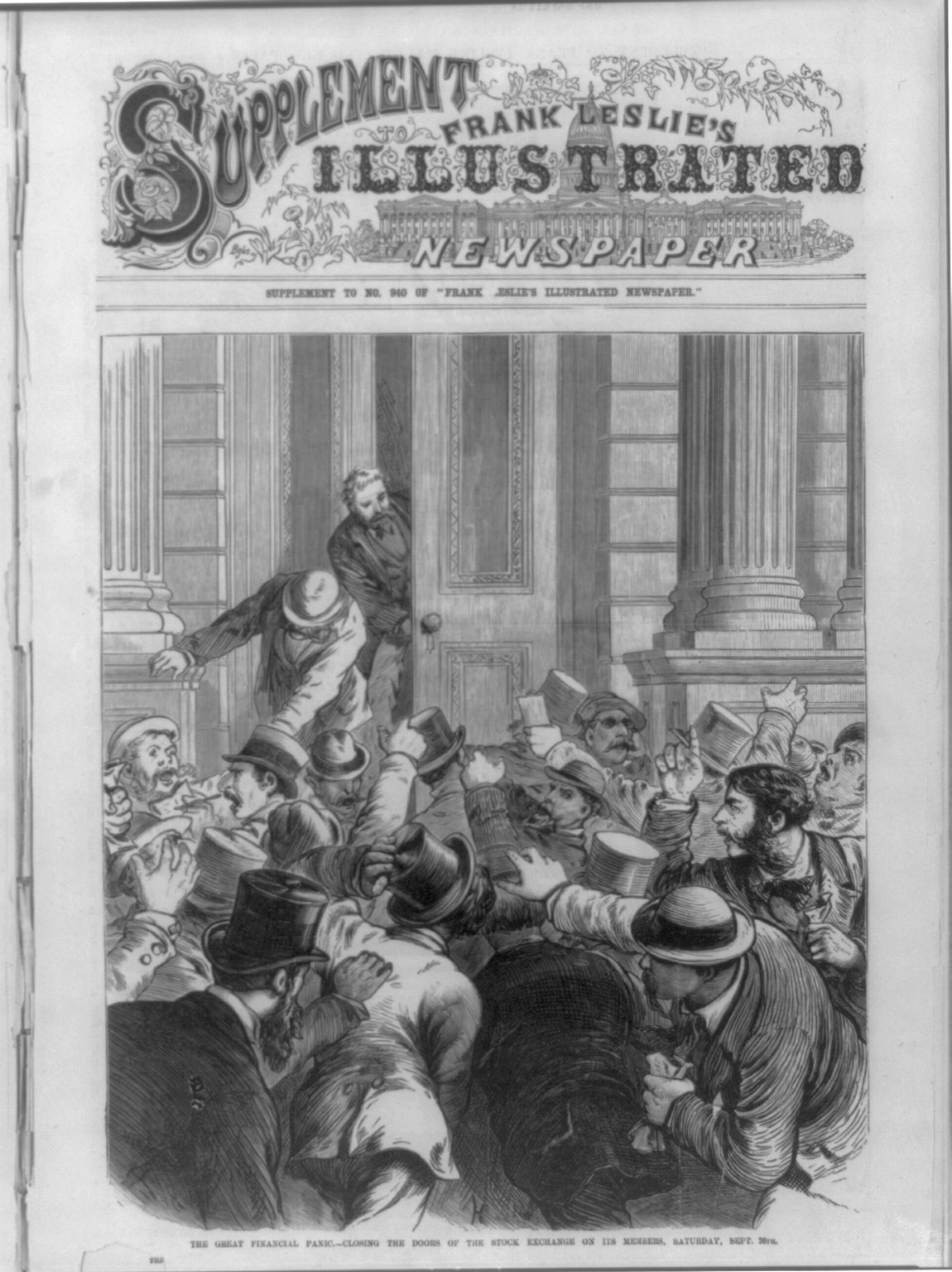
On September 20, 1873, the New York Stock Exchange suspended trading during the panic. The closure was an effort to contain disorderly market conditions as investors rushed to sell and securities firms faced mounting pressure. The period illustration accompanying this article portrays crowds outside the exchange and was published in Frank Leslie’s Illustrated Newspaper. It is a contemporary engraving rather than a camera photograph of every person present. The exchange reopened after a brief suspension, but the halt demonstrated the severity of financial stress. It also reminds readers that stock markets are institutions whose operations can be interrupted without ending the underlying economic crisis. The effects continued through railroad closures, business failures and unemployment.
How did bank failures spread?
Banks and brokerage firms were interconnected through loans, securities holdings and obligations to customers. When confidence in prominent institutions collapsed, depositors and investors sought cash or safer assets. Banks holding difficult-to-sell railroad bonds could struggle to meet immediate demands even when their assets might eventually recover value. Financial contagion increased pressure on businesses dependent on routine credit. The banking system lacked the modern Federal Reserve, deposit insurance and other mechanisms later introduced to address liquidity crises. That does not mean every bank failed or that all savers lost their money. The panic’s importance lies in how a concentrated problem in railroad finance spread into the availability of credit across much of the economy.
What happened to workers and factories?
As credit tightened and investment stalled, employers reduced activity, postponed construction or dismissed workers. The collapse of railroad projects affected manufacturers of iron, machinery and other materials, while reduced demand spread into additional industries. Unemployment and wage cuts imposed serious hardship on households without savings. Economic reports from the period vary in their measurement methods, so precise national unemployment percentages should be used cautiously. Families experienced the crisis through rent, food prices, job searches and dependence on community support. This human dimension is essential because a financial panic is not only an event in stock-exchange records. It can reshape migration, schooling and political choices for years after the first bank failure.
What was the Long Depression?
The term Long Depression describes an extended period of economic weakness and price decline often associated with the years after 1873. Historians disagree about its duration and about whether it should be understood as one continuous depression or a sequence of different downturns. Economic data from the nineteenth century also measure production, prices and employment differently from modern statistics. Industrial production did not necessarily fall every year, even while workers faced severe unemployment and declining wages. The phrase is therefore best used with explanation rather than a claim that absolutely every economic measure declined without interruption for a fixed number of years. The political and social consequences nonetheless lasted far longer than the immediate September panic.
Was the Coinage Act of 1873 responsible?
The Coinage Act of 1873 changed federal monetary arrangements, including provisions affecting silver coinage, and later became a major subject of controversy. Critics labeled it the “Crime of 1873,” arguing that restrictions on silver worsened financial hardship and favored creditors. The politics of silver and gold became increasingly important as farmers and debtors struggled. But attributing the initial September panic solely to the coinage act would ignore the immediate collapse in railroad financing and bank confidence. The monetary controversy unfolded over subsequent years and became part of the larger debate about debt, prices and the money supply. Readers should distinguish legislative changes from the specific sequence of financial failures in September.
How did President Ulysses S. Grant respond?
Grant faced calls for federal action as banks failed and businesses struggled. His administration considered currency and financial-policy options amid disagreement over whether expanding paper money would help the economy or undermine long-term stability. Debates involved inflation, gold backing, government bonds and the proper role of the Treasury. Grant’s choices did not create a rapid recovery, and his administration’s public standing suffered during the extended downturn. The political context was complex because Republicans were already divided over economic policy and Reconstruction. An accurate account avoids portraying the president as possessing the modern central-bank tools that later administrations would use in financial crises. The institutional options available in 1873 were substantially different.
How did the panic affect Reconstruction?
The downturn shifted political attention toward unemployment, wages, corruption and government spending. Northern voters who had supported federal protection of Southern civil rights faced economic insecurity and became more receptive to arguments against sustained intervention. The crisis was not the sole cause of Reconstruction’s rollback; white supremacist violence, judicial decisions and political disagreements were already important. But financial distress contributed to weakening support for national activism in the South. The National Park Service connects the post-1873 depression with the political retreat from Reconstruction. Our Reconstruction overview traces the broader transformation. The economic crisis and the erosion of civil-rights enforcement should be understood as interacting developments rather than one event mechanically causing the other.
What happened in the congressional elections of 1874?
Democrats made major gains in the 1874 midterm elections, gaining control of the House of Representatives. Voters were responding to a mixture of economic discontent, corruption allegations and disagreement over Republican policies. The effects of the Panic of 1873 contributed to that climate by undermining confidence in the party governing during the crisis. The election shift made further federal Reconstruction measures more difficult and altered national politics ahead of the disputed presidential contest of 1876. It would overstate the evidence to say every voter changed parties solely because of railroad failures. Economic events mattered through the way they combined with other political concerns and regional conflicts.
How did the downturn connect to the Great Railroad Strike of 1877?
Economic hardship persisted into the mid-1870s, and railroad companies imposed wage reductions as they struggled with costs and weak conditions. In 1877 major labor unrest developed into the Great Railroad Strike, with protests and confrontations spreading through several states. The strike had its own immediate causes and local histories, but it grew from an environment of long-term employment insecurity and wage pressure. Federal and state authorities sometimes deployed troops in response to disorder. This episode shows how a financial crisis can generate social and political consequences years later. The Panic of 1873 did not directly dictate every decision by workers or company officials, but it helped shape the conditions in which the strikes occurred.
What was the Freedman’s Savings Bank connection?
The Freedman’s Savings and Trust Company had been established in 1865 to encourage saving among African Americans, especially former slaves and Black veterans. It failed in 1874 after serious financial problems, mismanagement and risky investment practices. The broader Panic of 1873 and its financial environment contributed to those difficulties, but the institution’s collapse had distinctive causes that must not be reduced to the failure of Jay Cooke’s own bank alone. Depositors lost savings, damaging trust in financial institutions among communities that had recently emerged from slavery. The Library of Congress research presentation explores the bank’s failure and its wider significance. This was one of the most painful links between national financial instability and Reconstruction’s economic promises.
How did the panic eventually end?
Financial markets gradually stabilized, and the economy recovered unevenly in later years. However, the definition of the downturn’s end depends on the economic measure used, and some sectors and workers continued to struggle after national output began improving. Railroad construction and industrial investment eventually resumed, while arguments over money and credit persisted into later decades. It is misleading to identify a single presidential speech or exchange reopening as the instant end of all hardship. The most useful account distinguishes recovery in securities markets, business activity and employment. The crisis left a long legacy in political attitudes toward banking, railroad expansion and the need for financial safeguards.
Why is the Panic of 1873 historically important?
The panic demonstrates how speculative infrastructure finance, banking relationships and investor confidence could produce a national economic shock. It affected construction, employment, family finances and the politics of monetary policy. Its consequences also intersected with Reconstruction, helping shift attention away from federal protection of Black civil rights during a crucial period. The Library of Congress financial-history guide offers authoritative background and further reading. Understanding the crisis requires both financial details and the experiences of workers and households. It should not be treated as a purely Wall Street episode, nor as the sole explanation for the political changes of the 1870s.
Panic of 1873 timeline
| Date | Event |
|---|---|
| May 1873 | Financial instability erupts in Vienna. |
| September 18, 1873 | Jay Cooke & Company suspends payments. |
| September 20 | New York Stock Exchange closes temporarily. |
| 1874 | Freedman’s Savings Bank fails; Democrats gain House in elections. |
| 1877 | Widespread railroad labor strikes follow years of economic strain. |