Seven Days Battles (1862): Gaines’s Mill, Glendale and Malvern Hill
The fighting that saved Confederate Richmond but cost both armies tens of thousands of casualties.
The Seven Days Battles were a sequence of fighting near Richmond from June 25 to July 1, 1862. Newly appointed Confederate commander Robert E. Lee attacked George B. McClellan’s Army of the Potomac, winning at Gaines’s Mill while suffering costly failures elsewhere. McClellan ultimately withdrew to the James River, ending the Union’s immediate attempt to capture Richmond.
Explore the chronology, key commanders, terrain, outcomes and surviving historical evidence.
On this page — 23 topics
What were the Seven Days Battles?
The Seven Days Battles were a week of fighting outside Richmond, Virginia, from June 25 to July 1, 1862, during the American Civil War. Confederate General Robert E. Lee attacked the Union Army of the Potomac led by George B. McClellan, which had advanced close to Richmond during the Peninsula Campaign. The week included several major engagements and smaller actions. Although Union troops repulsed important Confederate assaults, McClellan withdrew to a new base on the James River. The result secured the Confederate capital for the time being and established Lee’s reputation as an aggressive battlefield commander.
Why did Lee decide to attack?
Lee had taken command after Joseph E. Johnston was wounded at Seven Pines and faced a large Union force close to Richmond. Remaining on the defensive could allow McClellan to strengthen siege positions, bring forward artillery and intensify pressure on the capital. Lee therefore planned to strike Union formations north of the Chickahominy River, threaten the railroad supply line and make McClellan abandon his advance. The offensive carried substantial risk because the Confederates needed to coordinate several columns over difficult roads. Lee accepted that risk in pursuit of a major strategic reversal before the Union’s advantage became overwhelming.
How did Stonewall Jackson join the offensive?
Thomas J. “Stonewall” Jackson had recently won important victories in the Shenandoah Valley. Lee sought to bring his troops east to reinforce the defense of Richmond and help turn McClellan’s flank. Jackson’s arrival expanded Confederate strength but complicated coordination because men were exhausted and routes were unfamiliar. The planned timing of his movement became central to the first major attack. Delays on June 26 helped leave Confederate troops fighting without the support anticipated. Jackson’s presence should therefore be understood as a strategic reinforcement with practical limits, not a guarantee of flawless execution across every battlefield.
What happened at Oak Grove on June 25?
On June 25, McClellan launched a limited Union attack at Oak Grove southeast of Richmond. The action was intended to gain advantageous ground for the army’s ongoing approach toward the capital. Fighting produced a modest advance but not a decisive change. Lee’s broader offensive began the following day north of the Chickahominy, rapidly shifting attention away from McClellan’s local gains. Oak Grove is often included in chronologies of the Seven Days, although different historians distinguish the opening action from the series of larger Confederate attacks. These distinctions explain why some summaries use differing counts for the week’s battles.
What happened at Beaver Dam Creek on June 26?
Confederate units attacked Union positions near Mechanicsville and Beaver Dam Creek, where Fitz John Porter’s V Corps held strong ground. Repeated Confederate attacks, including those involving A. P. Hill’s troops, were repulsed with substantial losses. Jackson’s delayed movement prevented Lee’s original timing from working as planned. Despite the Union’s tactical success, McClellan decided to move Porter toward another defensive line because he feared the increasingly vulnerable northern wing and its supply route. The battle shows how an army can win the immediate fight while its commander still decides that the broader position cannot be maintained.
Why did Gaines’s Mill become decisive?
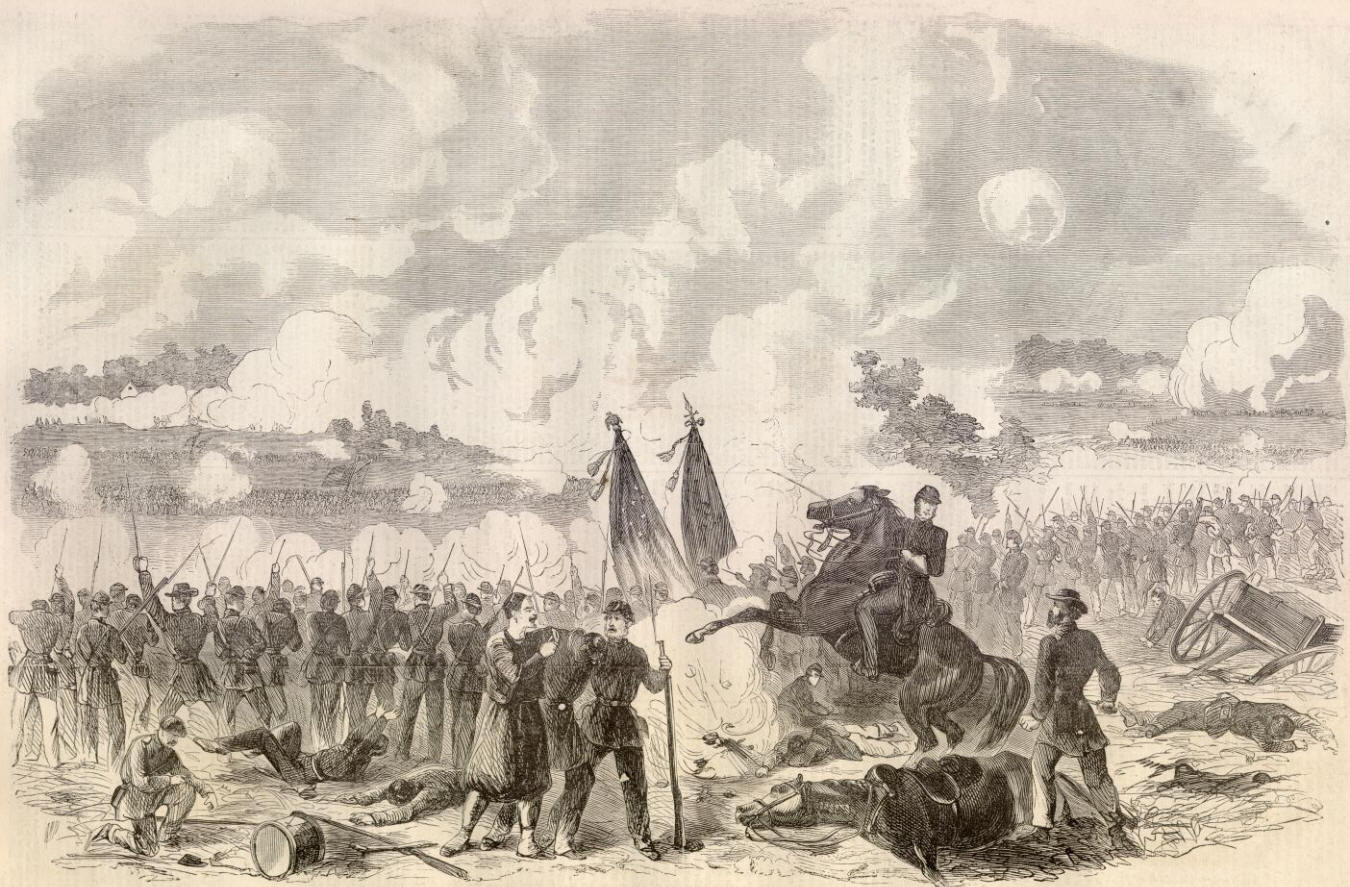
On June 27, Lee concentrated attacks against Porter’s force near Gaines’s Mill north of the Chickahominy River. Union infantry and artillery defended a strong position but faced repeated Confederate assaults and pressure on their flanks. Late in the day a large Confederate attack broke through sections of the federal line, forcing Porter to withdraw across the river. The battle was a major tactical Confederate victory, though it came at heavy cost. Its strategic effect was greater than the ground captured: McClellan concluded that his northern supply connection was endangered and began shifting his army toward the James River.
How did the Chickahominy River affect the battle?
The Chickahominy divided the Union army’s positions and required bridges to move reinforcements, wagons and artillery. Rain and swampy terrain made crossing difficult and complicated communication. For Lee, the river offered a chance to attack an isolated federal wing. For McClellan, it increased the danger that forces on opposite banks might fail to support one another at critical moments. The topography was especially significant at Gaines’s Mill, where Porter’s men had to withdraw through constricted crossing points. Understanding the river is essential to appreciating why military decisions sometimes contradicted the results shown on tactical battlefield maps.
What happened at Garnett’s and Golding’s Farms?
Skirmishes and smaller Confederate attacks along the Union line south of the Chickahominy occurred around June 27–28, including near Garnett’s and Golding’s Farms. These actions formed part of the effort to hold McClellan’s attention and complicate federal movements while fighting intensified elsewhere. Their scale was smaller than Gaines’s Mill, but they affected decisions about where reserves were needed and whether portions of the army could move safely. Summaries that omit them entirely can suggest that the seven days consisted only of famous set-piece battles. In reality, patrols, demonstrations and local clashes mattered to commanders struggling to maintain an accurate picture.
Why did McClellan change his supply base?
After Gaines’s Mill, McClellan judged the railroad supply connection toward the Pamunkey River too vulnerable to Confederate attack. He ordered his army and wagon trains to move south toward the James River, where naval support and new landing sites offered an alternative. The maneuver preserved the Union army but abandoned the position close to Richmond that it had reached during the Peninsula Campaign. Roads became crowded with troops, wounded men, artillery and supply vehicles. Confederate attacks during the withdrawal attempted to disrupt this movement and destroy sections of the army before they reached relative safety.
What happened at Savage’s Station on June 29?
On June 29 Confederate forces pursued retreating Union units near Savage’s Station, an important railroad point. Union rearguards resisted attacks while wounded soldiers and military stores complicated the withdrawal. The engagement did not give Lee the decisive destruction he sought, and the Union army continued south. Some wounded men could not be transported and were left behind under the constraints of rapid movement. The station’s role demonstrates how rail lines and depots could become liabilities during retreat. Fighting there was not simply an isolated cavalry skirmish; it formed part of the attempt to cover a major army’s movement.
What was the Battle of Glendale?
On June 30 Confederate attacks struck near Glendale, also called Frayser’s Farm, where several Union roads converged during the retreat. Lee hoped to cut across the Army of the Potomac’s route toward the James River, divide the columns and destroy them in detail. Fierce fighting developed, but Confederate forces failed to break the federal defensive line decisively. Some Confederate columns arrived too late or did not attack in coordination. The Union withdrawal continued. Glendale was arguably one of Lee’s best opportunities for a larger victory because the moving federal army was exposed at a critical road junction.
Why was White Oak Swamp important?
White Oak Swamp and its crossings created another obstacle during the Union retreat. Confederate and Union artillery exchanged fire, and Confederate attempts to advance were delayed by damaged crossings and the difficulty of moving troops through swampy ground. These delays reduced the support available for attacks near Glendale. The terrain divided forces operating only a few miles apart, turning what looks on a map like one coordinated Confederate attack into several actions with imperfect communication. The episode illustrates a recurring feature of the Seven Days: Lee’s ambitious plan demanded precise timing from units that often could not move as quickly as expected.
What happened at Malvern Hill on July 1?
At Malvern Hill, Union forces occupied strong defensive ground with extensive artillery support. Confederate commanders sent infantry forward across exposed approaches in attacks that were poorly coordinated. Union artillery and musketry inflicted heavy losses, and the defenders held the position. The battle was a clear Union tactical victory, the opposite result from Gaines’s Mill. Yet McClellan did not use it to renew the advance toward Richmond, instead completing the withdrawal to Harrison’s Landing. Malvern Hill therefore became a lasting example of the difference between winning an individual battle and attaining the objective of an entire campaign.
Why did Confederate attacks fail at Malvern Hill?
Union guns had strong fields of fire from elevated ground, while attacking Confederate infantry crossed difficult and exposed approaches. Orders were unclear, artillery preparation was insufficient and Confederate units engaged at different times rather than as a concentrated, coordinated force. Heavy federal fire punished assaults before they could establish a secure foothold. The failure cannot be explained simply by soldiers lacking courage: many Confederate units advanced into extremely dangerous conditions and suffered serious casualties. It reflected structural flaws in the assault plan and the defenders’ advantages, compounded by the fatigue produced by nearly a week of marching and fighting.
Did Lee win every Seven Days battle?
No. Lee’s army lost or failed to achieve its tactical goals in several engagements, including Beaver Dam Creek and Malvern Hill, while gaining a major victory at Gaines’s Mill. It would be misleading to describe the sequence as uninterrupted Confederate battlefield triumph. The overall Confederate strategic result was nevertheless favorable because McClellan relinquished his advance and Richmond remained secure. Historians distinguish the outcome of an individual action from the consequences of a larger operation. This makes the Seven Days an especially useful case study in assessing military success by objectives, losses, logistics and subsequent decisions.
How many casualties did the Seven Days produce?
National Park Service research gives totals of approximately 15,849 Union and 20,614 Confederate casualties during the Seven Days, or more than 36,000 combined. Casualties include soldiers killed, wounded, missing and captured. Not all were fatalities, and estimates vary among books depending on the dates and engagements included. The Confederates suffered particularly heavy losses relative to what they achieved tactically in several attacks. The figures also omit aspects of civilian suffering and deaths from disease. They remind us that the defense of Richmond required an enormous human sacrifice even though the Union did not capture the capital.
How did the retreat affect Union soldiers?
The Army of the Potomac moved along crowded roads amid heat, rain, wounded men, interrupted meals and constant uncertainty about the location of Confederate forces. Medical staff struggled to evacuate casualties while wagons and guns competed for limited space. Soldiers who had advanced confidently toward Richmond now had to defend a retreat. Yet much of the army retained organization and equipment, and its rearguard performed effectively under pressure. The retreat was a strategic setback but not a collapse equivalent to the complete destruction of an army. Preserving this distinction explains why federal forces could return to major operations later in 1862.
What happened after the army reached Harrison’s Landing?
McClellan’s troops established a position at Harrison’s Landing along the James River, supported by Union naval forces. The Confederate offensive had removed the immediate threat to Richmond but had not driven the federal army out of Virginia. Political and military leaders debated whether to reinforce McClellan, withdraw forces or reorganize strategy. Ultimately much of his army was transferred to support operations in northern Virginia. Lee then shifted attention to the separate Union force under John Pope, leading toward the Second Battle of Bull Run. The Seven Days thus redirected the war’s course in Virginia.
Why are the Seven Days historically important?
The battles established Lee’s offensive approach, lifted the immediate danger to the Confederate capital and exposed weaknesses in the coordination of very large Civil War armies. They also revealed the defensive power of artillery and prepared ground and the enormous cost of frontal assaults. The episode did not end the war; in fact, the strategic opportunity that McClellan lost prolonged the contest for Richmond. The week connects the earlier Peninsula Campaign to the later fighting at Second Manassas and Antietam. It should be understood as a complex military reversal, not a string of identical battle outcomes.
Where can the Seven Days battlefields be visited?
Richmond National Battlefield Park preserves portions of the Gaines’s Mill, Beaver Dam Creek, Glendale and Malvern Hill landscapes. Visitors can follow park trails and historical maps to understand distances, river crossings and the roads used by armies. Modern woodland and roads differ from 1862 conditions, and some significant battlefield land has changed through development. The National Park Service’s Seven Days overview distinguishes the major engagements and explains the decisions that produced the retreat. Exploring several sites is more informative than treating Malvern Hill or Gaines’s Mill as representative of every action.
Timeline
| Date | Event |
|---|---|
| June 25 | Union attack at Oak Grove. |
| June 26 | Confederate attacks repulsed at Beaver Dam Creek. |
| June 27 | Lee gains a decisive victory at Gaines’s Mill. |
| June 29 | Savage’s Station during the Union retreat. |
| June 30 | Glendale and White Oak Swamp engagements. |
| July 1 | Union holds at Malvern Hill. |
| Early July | McClellan’s army reaches Harrison’s Landing. |