Battle of Chattanooga (1863): Lookout Mountain, Missionary Ridge and Victory
How Grant reopened supplies and defeated Bragg at Lookout Mountain and Missionary Ridge.
The Battles for Chattanooga were a Union victory in November 1863. After reopening supply routes, Union forces under Ulysses S. Grant attacked Confederate positions around Chattanooga. They captured Lookout Mountain and broke Braxton Bragg’s line on Missionary Ridge on November 25, securing the city as a base for the 1864 advance into Georgia.
Explore the Cracker Line, the Battle Above the Clouds, Missionary Ridge and the campaign’s consequences.
On this page — 23 topics
When were the Battles for Chattanooga fought?
The decisive Battles for Chattanooga took place November 23–25, 1863, after weeks of Confederate pressure on Union forces defending the Tennessee city. The events included the capture of Orchard Knob, fighting on Lookout Mountain and the Union assault up Missionary Ridge. Ulysses S. Grant directed the broader Union operation against Braxton Bragg’s Confederate Army of Tennessee. Although the engagements were linked, they unfolded across different terrain and involved several Union armies. Their outcome was a decisive federal victory that ended Confederate control of the heights surrounding the city and opened a route for later campaigns into Georgia.
Why was Chattanooga strategically important?
Chattanooga lay at the meeting point of transportation routes connecting Tennessee with Georgia and other Confederate regions. Railroads, river access and passages through mountain country made it a natural military gateway. Union control threatened Confederate communications and allowed armies to assemble for operations deeper into the South. Confederate leaders therefore regarded the city as a major prize, even after they had been unable to recover it in September 1863. The campaign was not merely a competition for scenic high ground. It concerned the ability to supply large armies, transport reinforcements and use Chattanooga as a base for the next phase of the war.
How did the Battle of Chickamauga lead to Chattanooga?
In September 1863, Bragg defeated Rosecrans’s Union army at Chickamauga in northwestern Georgia. The Union soldiers withdrew into Chattanooga, while Confederate forces occupied surrounding ground. The Confederates did not fully close every approach, but they interfered seriously with food and forage entering the city. The Union army remained defensible but risked losing its ability to stay in place. Chickamauga therefore began a new contest over logistics rather than producing immediate surrender. Federal commanders had to secure a reliable route before considering an assault against the Confederate heights.
Who commanded the Union forces?
Ulysses S. Grant assumed command of the Military Division of the Mississippi in October 1863. George H. Thomas took command of the Army of the Cumberland after William Rosecrans was replaced. William T. Sherman brought additional troops, while Joseph Hooker arrived with forces transferred from the eastern theater. Grant coordinated these formations to restore supply lines and attack Bragg’s positions. The relationships among the commanders were sometimes tense, and events did not always follow the original plan. It is misleading to assign every action to a single general when the operation depended on several armies and subordinate commanders.
Who was Confederate commander Braxton Bragg?
Braxton Bragg led the Confederate Army of Tennessee, defending the heights overlooking Chattanooga. His forces held important positions on Lookout Mountain and Missionary Ridge and initially appeared able to starve the Union army into withdrawal. However, the army was stretched, supply problems persisted and divisions among Confederate commanders undermined cooperation. Bragg also detached troops under James Longstreet for operations elsewhere in eastern Tennessee, reducing forces available at Chattanooga. These decisions became controversial after the defeat. Bragg’s army retained formidable defensive ground, but it could not prevent Union troops from reestablishing supplies and eventually launching a coordinated offensive.
What was the Cracker Line?
The “Cracker Line” was a Union supply route established in late October 1863 that improved movement of food and equipment into Chattanooga. Operations at Brown’s Ferry and nearby positions allowed the Federals to use river and wagon connections that Confederate forces had obstructed. The night action at Wauhatchie helped secure the route. Once supplies improved, the Union army became far less vulnerable to a siege-like pressure campaign. This development demonstrates the importance of logistics: a battle can be decided partly before the main attack, when one army gains the ability to sustain its soldiers and horses and another loses that pressure as a weapon.
What happened at Brown’s Ferry?
Union troops crossed the Tennessee River at Brown’s Ferry in a carefully planned operation intended to open a new line of supply. The crossing helped establish communication between Chattanooga and federal positions farther west. Engineers, boats and soldiers worked together to secure the route. The operation was less visually dramatic than the later assault on Missionary Ridge, but it changed the military situation substantially. With the route open, the city’s defenders had better access to food and reinforcements. Histories focused only on November’s battlefield spectacle often understate how important this earlier operation was to the eventual victory.
What happened at Wauhatchie?
Fighting near Wauhatchie in late October 1863 took place at night as Confederate troops attempted to disrupt the newly opened supply line. Union forces held the critical connection, frustrating efforts to restore pressure on Chattanooga. The engagement demonstrated the unusual complexity of fighting in darkness, where identifying troops and transmitting orders could be particularly difficult. It also showed that the Cracker Line would require active defense rather than simply existing on a map. The tactical result supported Grant’s ability to feed and reinforce his troops before undertaking the larger offensive against Bragg’s army the following month.
What happened at Orchard Knob on November 23?
On November 23, Union forces advanced from Chattanooga toward Orchard Knob, a lower elevation between the city and Missionary Ridge. The movement began as a demonstration but developed into the seizure of an important Confederate position. Federal troops secured the hill, giving Grant and his staff an observation point and putting greater pressure on the Confederate line. Bragg reinforced parts of Missionary Ridge in response. The action was the opening engagement of the final series of battles and helped shape the positions from which the Union would launch its attack two days later.
What was the Battle Above the Clouds?
The Battle of Lookout Mountain on November 24 became known as the “Battle Above the Clouds” because fog and low clouds frequently covered parts of the mountain during fighting. Union troops under Joseph Hooker’s command advanced against Confederate positions on the slopes and forced the defenders to withdraw. The name gives the episode a romantic atmosphere, but the real fighting involved steep ground, difficult visibility and organized military movement. Union success reduced Confederate control over the western approaches to Chattanooga. The action also helped clear the way for the more decisive struggle against Missionary Ridge on November 25.
Did Union troops fight at the top of Lookout Mountain?
The most significant fighting was on the mountain’s lower slopes and around important paths and positions rather than a dramatic charge across the very summit. Later paintings and popular descriptions can make it appear that the entire battle occurred at an inaccessible cliff top. The landscape’s steep face did matter because it channeled movement and created opportunities for defenders. But the tactical objective was to remove Confederate resistance from the positions controlling approaches to the city. Distinguishing the slope fighting from the summit helps visitors interpret the actual ground and prevents an image-driven account of the battle.
What was Missionary Ridge?
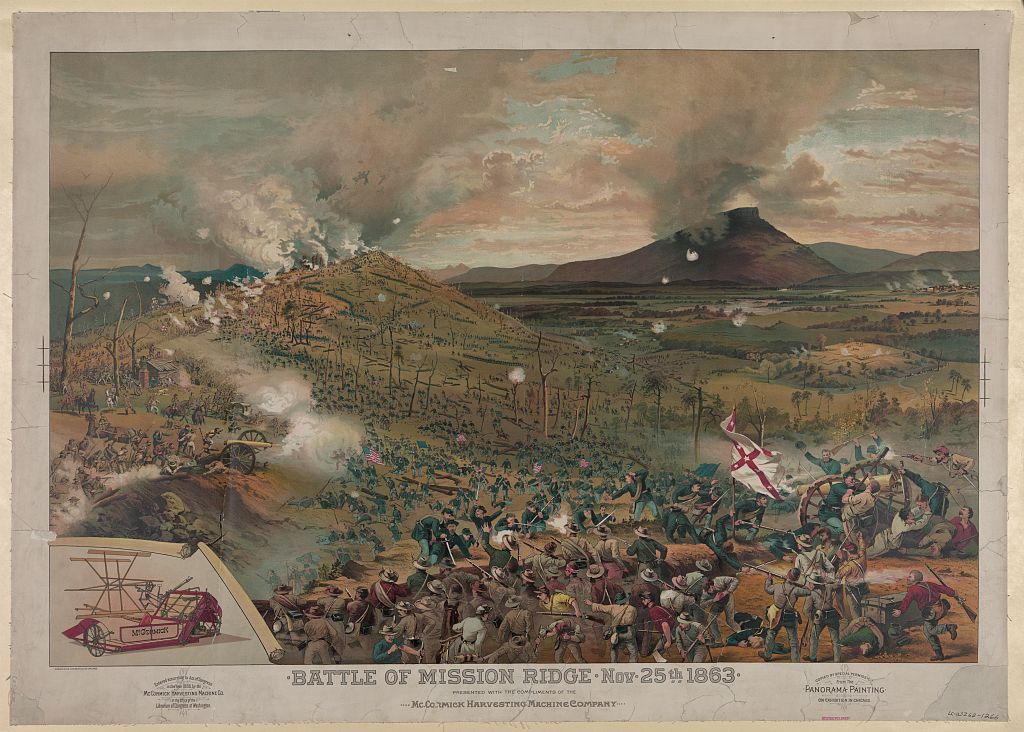
Missionary Ridge is an extended line of high ground east and southeast of Chattanooga. Confederate troops occupied positions on the ridge and at its base, expecting that the steep climb would make a Union attack difficult. The height gave the defenders an apparent advantage, but the position’s layout and placement of artillery limited the effectiveness of some defensive fire. The ridge was also too long to defend equally everywhere with available forces. These practical factors were essential when Union troops unexpectedly advanced up the slopes on November 25. The name refers to the local geographic feature, not to a separate religious campaign.
What happened on November 25, 1863?
Grant’s forces attacked Confederate positions at both ends of Missionary Ridge, while Thomas’s Army of the Cumberland advanced toward rifle pits at the base. After taking the lower positions, many Union soldiers continued climbing the slope without a clear original order to carry the entire ridge. Their momentum, Confederate confusion and weaknesses in the defensive line produced a breakthrough. Bragg’s troops retreated southward toward Georgia. The result shocked observers because a position believed difficult to assault had fallen comparatively quickly. The events are better explained through the interplay of terrain, morale and command than through a single heroic gesture.
Why did the Union charge continue uphill?
Grant had ordered the capture of Confederate positions at the base of Missionary Ridge. Once soldiers reached the lower rifle pits, remaining there exposed them to fire from above, and groups began moving farther up the slope. Officers joined or attempted to direct the advance, which developed with limited centralized coordination. The climb was difficult, but the defenders were increasingly disorganized. The success has inspired stories of spontaneous collective bravery, which are partly accurate but incomplete. The tactical situation after the first objective fell created strong pressure for soldiers to seek better ground rather than remain under fire.
Why did the Confederate defense collapse?
Bragg’s troops faced a broad Union attack that stretched their ability to communicate and reinforce threatened sections. The placement of some artillery and rifle pits offered imperfect fields of fire against attackers climbing the slope. Confederate command problems and falling morale compounded the situation. Once Union soldiers reached parts of the crest, retreats spread along the line, and units could no longer hold a coherent defense. The collapse cannot be attributed solely to one unpopular general or a magical advantage possessed by the attackers. It reflected interacting weaknesses in defensive design, troop dispositions and battlefield coordination.
How many casualties were there?
National Park Service battle summaries give estimates of thousands of casualties during the November engagements. One summary of Chattanooga III lists approximately 12,482 combined Union and Confederate casualties. As in other Civil War battles, casualties include killed, wounded and captured or missing soldiers, not merely battlefield deaths. Figures vary among historical works because different authors count operations over different dates. Readers should confirm which engagements a number includes before comparing it with Chickamauga or the entire Chattanooga campaign. The victory came at a serious human cost despite the dramatic appearance of the Union advance.
What was the final result?
The Union won a decisive victory. Bragg’s army retreated from the positions that had threatened Chattanooga, and the United States retained a secure transportation and supply center. This reversed much of the effect of the September defeat at Chickamauga. Confederate leaders lost the initiative in the region and were forced to reorganize farther south. Grant’s prestige increased, while Bragg’s command became even more controversial. The outcome illustrates how a campaign can include both an earlier tactical defeat and a later strategic success. Chattanooga remained in Union hands and served as the base for operations into Georgia.
What happened to Bragg afterward?
After the defeat at Missionary Ridge, Bragg’s army withdrew toward Dalton, Georgia. He subsequently left command of the Army of Tennessee, which would be led by Joseph E. Johnston during the opening phases of the 1864 Atlanta Campaign. Confederate officials struggled to resolve underlying disputes over leadership, resources and military strategy. The departure of Bragg did not fix the Confederacy’s widening problems in the western theater. His removal followed a chain of results and command controversies, so it should not be treated as though the battle alone explained every earlier disagreement within his army.
How did Chattanooga affect Sherman’s Atlanta Campaign?
Chattanooga became a vital Union staging and supply base for William T. Sherman’s 1864 Atlanta Campaign. Federal troops could use the city’s rail and river connections to support a sustained advance through northern Georgia. Confederates were forced to defend a succession of positions rather than rely on holding the approaches to Chattanooga. The strategic value of the November 1863 victory therefore extended beyond one dramatic charge up Missionary Ridge. It created conditions for the next year’s operations, and ultimately for Union advances that influenced the presidential election of 1864 and the war’s outcome.
What can visitors see in Chattanooga today?
Chickamauga and Chattanooga National Military Park interprets Lookout Mountain, Missionary Ridge and the earlier Chickamauga battlefield. Visitors can examine the terrain from Point Park, explore military maps and follow preserved segments of the battlefield landscapes. Modern roads and buildings have changed parts of the ridge, so the park’s maps and signage help explain which areas remain recognizable. The NPS Battles for Chattanooga narrative is a useful place to verify the November timeline and distinguish the individual engagements that together produced Union victory.
Chattanooga campaign timeline
| Date | Event |
|---|---|
| September 19–20, 1863 | Union defeat at Chickamauga. |
| Late October | Cracker Line opened after Brown’s Ferry and Wauhatchie operations. |
| November 23 | Union forces capture Orchard Knob. |
| November 24 | Union attack clears Confederate forces from Lookout Mountain. |
| November 25 | Union troops break the Confederate line on Missionary Ridge. |
| Spring 1864 | Chattanooga supports Sherman’s Atlanta Campaign. |