Battle of Nashville (1864): George Thomas, John Bell Hood and the Outcome
After Franklin, Thomas’s Union forces attacked Hood’s weakened army and routed it south of Nashville.
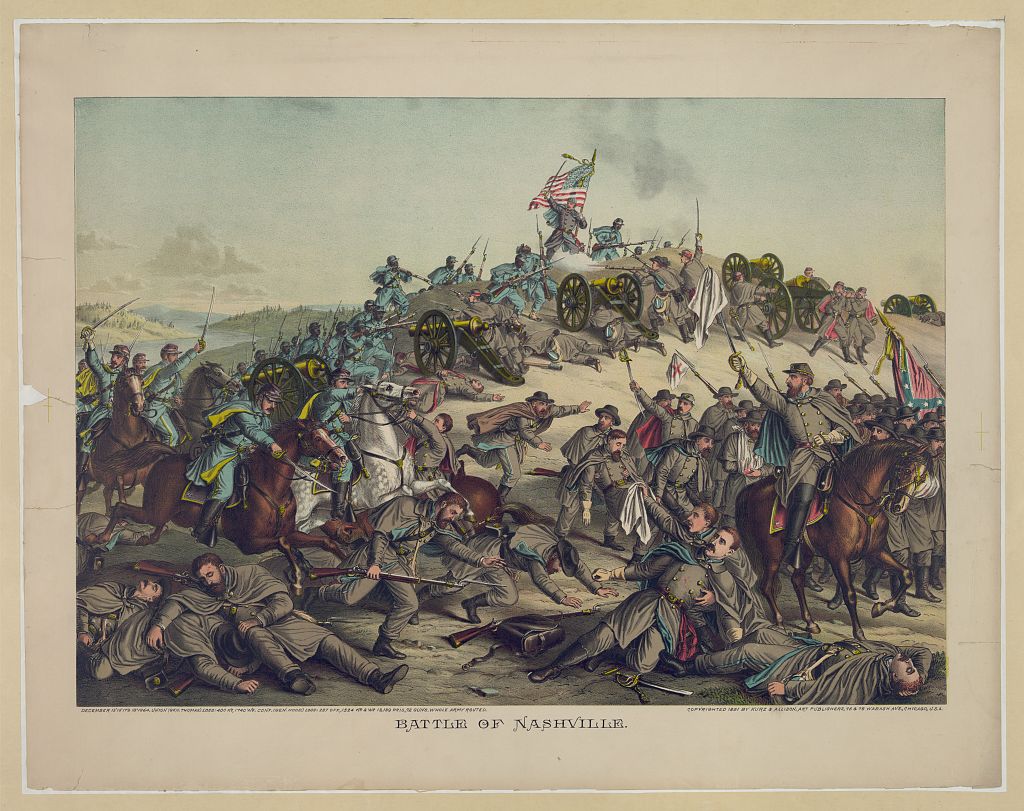
The Battle of Nashville was fought on December 15–16, 1864, in Tennessee. Union general George H. Thomas attacked John Bell Hood’s Confederate Army of Tennessee, which had suffered heavy losses at Franklin. Thomas’s forces pushed Hood back on the first day and overwhelmed crucial positions, including Shy’s Hill, on the second. The Confederate retreat ended Hood’s effort to regain the initiative in Tennessee.
A source-based guide to the sequence, commanders, decisions and historical consequences.
On this page — 20 topics
What happened at the Battle of Nashville?
The Battle of Nashville was a two-day Union offensive that defeated Confederate forces south of Tennessee’s capital in December 1864. George H. Thomas commanded the Union army, while John Bell Hood led the Army of Tennessee. Thomas attacked a Confederate force already weakened by the disastrous assault at Franklin two weeks earlier.
On the first day the Union pushed Hood’s army backward and forced a shorter line of resistance. On December 16 further attacks broke the Confederate defenses and sent them into retreat. Nashville was not merely a hard-fought engagement with no result; it effectively ended Hood’s effort to conduct a successful campaign in Tennessee.
Why was Hood near Nashville?
After losing Atlanta, Hood had moved north, hoping to threaten Union communications and perhaps force Sherman to divert troops from Georgia. His army pursued John M. Schofield through middle Tennessee and suffered severe losses when it attacked the fortified Union position at Franklin on November 30.
Hood nonetheless advanced toward Nashville, where Thomas was combining federal forces. He hoped to seize an advantage, but the march placed an exhausted and diminished army opposite a larger defending force. Nashville was also an important Union depot and transportation center, making it difficult to attack and sustain a victory without considerable strength.
Who was George H. Thomas?
George Henry Thomas was an experienced Union commander whose forces had defended key positions during earlier western campaigns. At Nashville he directed a combination of infantry, cavalry and artillery. He emphasized preparation before attacking Hood, arranging formations and logistics for an offensive intended to defeat rather than simply push away the Confederate army.
Thomas’s measured pace drew impatience from some senior Union leaders, but he faced genuine concerns about weather, cavalry readiness and coordination. The ultimate victory strengthened his reputation as a careful commander. Assessing him fairly requires distinguishing prudent preparation from delay that might have allowed the enemy to escape.
Who was John Bell Hood?
Hood had taken command of the Confederate Army of Tennessee during the Atlanta Campaign and attempted aggressive attacks against Sherman. After the loss of Atlanta, he moved north in a bid to change the wider strategic balance. By the time he reached Nashville, his army had been weakened by months of campaigning and especially by Franklin.
Hood’s decision to remain before Nashville is often criticized. He faced limited options but also had to contend with the strong Union concentration behind the city’s defenses. His hope that circumstances might favor him was not realized. The decisive defeat sent his army south and effectively destroyed its ability to mount another major offensive.
Why were Nashville’s fortifications important?
Union engineers had developed substantial defenses around Nashville during earlier years of the war. The city was an important railroad and supply center, and its fortifications protected men, depots and river connections. Hood’s approach did not leave Thomas in the same exposed position Schofield had occupied during the withdrawal at Franklin.
These defenses helped Thomas gather and organize his army before moving out to attack. They also reduced the risk that a sudden Confederate assault would take the city. The eventual battle, however, was not won by defenders sitting behind the forts: Thomas deliberately moved beyond them and attacked Hood’s positions south of Nashville.
Why did Thomas wait before attacking?
Thomas faced pressure from Washington to strike, but heavy weather and the need to organize cavalry and infantry complicated preparations. Ice, poor roads and incomplete arrangements could make a large offensive dangerous. He wanted a coordinated attack that could exploit success across more than one part of the Confederate line.
The delay gave Hood time to remain in his positions, but it also enabled Thomas to concentrate his strength. The debate over timing persists in military history because it illustrates a commander’s dilemma: acting quickly may secure surprise, while premature action can sacrifice the coordination necessary for victory. At Nashville the eventual attack succeeded decisively.
What was Thomas’s plan on December 15?
Thomas designed a coordinated assault that engaged Hood’s right while applying powerful pressure against the Confederate left. Attacks near Montgomery Hill and other positions threatened the line’s stability. Cavalry and infantry worked to turn the defenders rather than relying on a single narrow frontal attack.
The plan used numerical strength and maneuver to isolate parts of the Confederate front. As Union attacks succeeded, Hood’s line became untenable. Darkness ended major operations before the Confederates were destroyed, but the first day’s movement deprived them of important ground and forced them into a reduced defensive position to the south.
What happened at Montgomery Hill?
Union troops attacked Confederate positions near Montgomery Hill on the afternoon of December 15. The assault helped open the wider pressure against Hood’s left and contributed to a series of gains across the front. It was one part of a coordinated offensive rather than an isolated effort whose success alone decided the battle.
The attacking troops moved toward prepared positions, and success depended on support from neighboring formations. A defender faced with threats to the front and flank had fewer options than one confronting a single direct charge. Montgomery Hill helps show why Thomas’s plan worked differently from Hood’s unsuccessful frontal assault at Franklin.
How did Hood respond after the first day?
Hood withdrew from the positions he had occupied before December 15 and formed a shorter defensive line farther south. The new line relied on elevated ground, including Shy’s Hill and Overton’s Hill. His troops built or improved fieldworks while attempting to recover from the previous day’s pressure.
The shorter line was easier to man but contained serious vulnerabilities. If one flank collapsed, the remaining formations might be enveloped or forced to retreat. Hood had few fresh reserves and could not easily replace his earlier losses. The second day’s battle would test whether those positions could withstand renewed Union attacks.
What happened at Shy’s Hill?
Shy’s Hill was a key part of the Confederate left on December 16. Union troops attacked it after maneuvering into position, and the defenders eventually collapsed under concentrated pressure. The breakthrough endangered Hood’s entire line and helped turn an increasingly difficult defense into a general retreat.
The hill’s significance came from its relationship to the rest of the position. Once Union troops controlled the left flank, other Confederate formations faced threats from the side and rear as well as from the front. The event illustrates how an attacking commander can use pressure against several points to make a battlefield position fail as a connected system.
What happened at Overton’s Hill?
Union soldiers also attacked the Confederate right at Overton’s Hill. Initial assaults encountered strong resistance and suffered losses. The position did not fall simply because the Union had more troops. Its defenders had selected ground and prepared works that made an uphill attack difficult.
As other parts of Hood’s line broke, the situation at Overton’s Hill changed. Union forces renewed pressure, and the defense could no longer hold within the collapsing Confederate arrangement. The fighting at Overton’s and Shy’s hills should be studied together because each affected the security of the other and the possibility of an organized withdrawal.
How many casualties were there?
The National Park Service’s battle database estimates approximately 9,561 combined casualties, with Confederate losses exceeding Union losses. These figures include killed, wounded, captured and missing soldiers. Because large numbers were taken prisoner during the retreat, the difference between casualties and deaths is especially important.
Hood’s army was already weakened after Franklin. The additional losses at Nashville were therefore devastating for its remaining organization and morale. Historians compare figures using specific dates and sources rather than combining Franklin and Nashville totals casually. The decisive outcome is clear even when exact estimates differ across historical accounts.
How did the Union pursue Hood afterward?
After the Confederate line collapsed, Hood’s men withdrew southward while Union forces pursued them. Weather and terrain complicated the pursuit, and not every Confederate soldier was captured. Nevertheless, the Army of Tennessee had been routed and was no longer capable of conducting the campaign Hood had envisioned.
The retreat continued toward the Tennessee River and eventually farther south. Hood later relinquished command. The pursuit is important because the battle’s effects extended well beyond the second afternoon. Destroying a military force as an effective offensive instrument requires more than winning ground; it involves preventing rapid recovery and reorganized resistance.
How did Nashville affect Tennessee?
The victory secured Union control of a strategically important region and ended the immediate threat posed by Hood’s field army. Nashville had functioned as a major Union base, and continued occupation allowed federal authorities to maintain transport and supply connections. The result was a serious blow to Confederate prospects in the western theater.
Civilian experiences remained difficult. Tennessee was deeply divided by the war, and families faced losses, military government, displacement and an uncertain future. Enslaved people sought freedom amid changing federal policy and military presence. Winning a battle did not by itself settle the state’s political and social problems.
Was Nashville more decisive than Franklin?
Franklin defeated Hood’s assault against Schofield’s temporary defenses but did not prevent Hood from advancing. Nashville, by contrast, broke the Confederate army’s position and led to a prolonged retreat. Both were Union victories, but their immediate military effects differed substantially.
Reading them as a sequence helps explain why the losses at Franklin mattered so much. Hood entered the Nashville confrontation with fewer experienced soldiers and officers, while Thomas could prepare a coordinated offensive. The two battles show the cumulative consequences of campaigns, where earlier decisions change what an army can attempt later.
Why is the Battle of Nashville important today?
Nashville is often regarded as one of the Union’s clearest major battlefield victories in the late Civil War. Thomas combined preparation with an effective two-day offensive, and Hood’s army could not recover. The victory strengthened the broader Union campaign as Confederate resistance weakened across several regions.
A careful account avoids the misconception that Thomas merely defended the city behind its forts. He assembled a force and moved it forward to destroy Hood’s position. Examining the actual sequence also clarifies why the battle was a decisive military result but not the formal end of the entire Civil War.
Battle of Nashville 1864 timeline
These dates distinguish the main stages of the event; the consequences often continued beyond the date of battle or election.
| Date | Event |
|---|---|
| Nov 30 | Hood suffers heavy losses at Franklin. |
| Dec 2 | Confederate troops approach Nashville and take positions. |
| Dec 1–14 | Thomas prepares the Union attack. |
| Dec 15 | Union forces strike both Confederate flanks; Hood withdraws to a shorter line. |
| Dec 16 | Assaults at Shy’s Hill and Overton’s Hill break the Confederate defense. |
| Dec 17–late Dec | Union forces pursue Hood’s retreating army. |
| January 1865 | Hood eventually relinquishes command. |
Frequently asked questions
When did it happen? December 15–16, 1864.
Where did it happen? Nashville, Tennessee.
Who were the principal figures? George Thomas, John Hood.
What was the outcome? Decisive Union victory. The sections above explain the immediate result and the wider consequences.
How does it fit into the Civil War? For a broader chronology see our American Civil War guide.
Historical sources and further reading
This article draws on National Park Service history and Library of Congress records. Pictures are labeled as contemporary artifacts or later historical representations.