Siege of Petersburg (1864–1865): Trenches, Railroads and the Fall of Richmond
Nine and a half months of trenches and railroad attacks gradually broke Confederate defenses south of Richmond.
The Siege of Petersburg was a series of military operations from June 1864 to April 1865 in and around Petersburg, Virginia. Union forces under Ulysses S. Grant tried to cut the roads and railroads supplying Richmond and Robert E. Lee’s army. Initial attacks failed to capture Petersburg, and both sides constructed extensive lines of earthworks. The Union breakthrough in early April 1865 forced the Confederate evacuation of Petersburg and Richmond.
Discover what happened, why it mattered, and how historians interpret the military decisions and the human cost.
On this page — 20 topics
What was the Siege of Petersburg?
The Siege of Petersburg was a prolonged campaign around the Virginia city whose railroads supplied Richmond and the Confederate Army of Northern Virginia. It was not a classic siege in which one army completely encircled a single fortress. Rather, Union forces established extensive lines and launched repeated offensives to sever roads and rails south and west of the city.
From June 1864 to early April 1865, earthworks, artillery duels, raids and battles altered the front. The Confederates held for months but had to defend a growing perimeter while their resources diminished. The operations ended when Union advances made Petersburg impossible to sustain, compelling Lee to evacuate the city and Richmond.
Why was Petersburg strategically important?
Petersburg lay south of Richmond, the Confederate capital, and served as a major rail junction. Railroads carried food, ammunition and reinforcements to Lee’s soldiers. Threatening Petersburg endangered Richmond even when Union troops could not enter the capital directly. Logistics therefore made the city valuable beyond its size.
Grant’s strategy sought to damage the system that kept the Confederate army in the field. Instead of trying only to capture important buildings, Union troops targeted transport corridors and forced the defenders to stretch their lines. Petersburg illustrates a central feature of modern warfare: an army’s ability to fight depends on supply networks far beyond the front-line trenches.
How did the campaign reach Petersburg?
After weeks of combat in the Overland Campaign, Grant disengaged from Lee at Cold Harbor and moved forces across the James River. He hoped to attack Petersburg before defenders could concentrate. The transfer demanded careful coordination of troops, artillery, wagons and bridge crossings on a considerable scale.
That shift demonstrated Grant’s willingness to maneuver after failed frontal assaults. The Union armies did not simply continue toward Richmond along the same road. They moved south to threaten a different part of the Confederate defense. The speed of Lee’s response would determine whether the fighting became a short campaign or something much longer.
What happened during the June 15–18 attacks?
Union forces attacked Petersburg in mid-June when relatively limited Confederate troops initially defended important works. Early opportunities were not fully exploited, and reinforcements arrived. Additional Union assaults encountered increasingly organized resistance. By June 18 the city remained in Confederate hands despite heavy fighting and casualties.
These opening days were consequential because a quick Union success might have avoided months of entrenched warfare. Instead, the attacking forces settled into positions opposite the defenders and began extending their works. The failure should not be attributed to one person or a single moment without considering fatigue, coordination and uncertainty about enemy strength.
What were the trenches like?
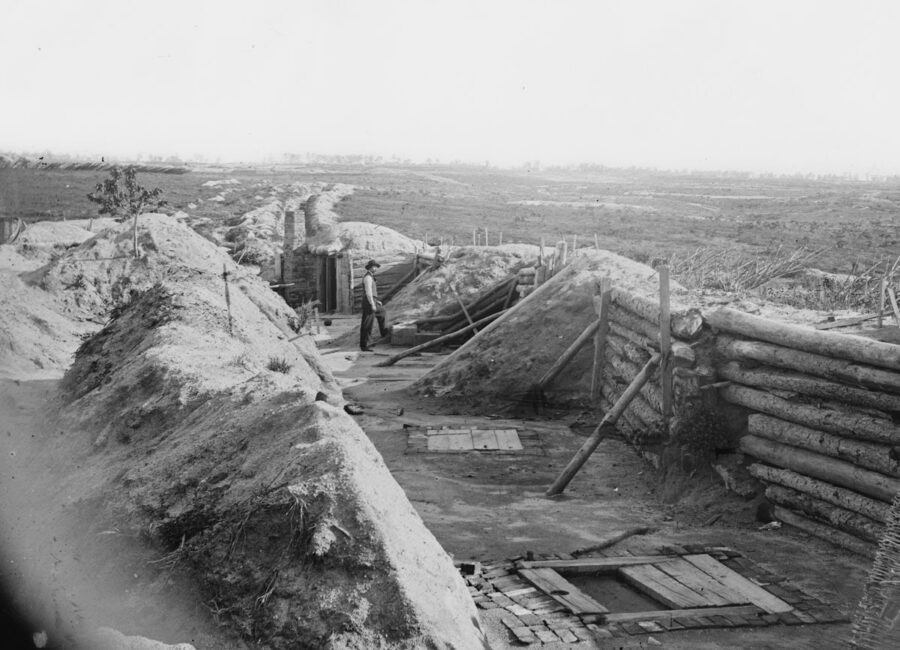
Soldiers constructed earthen parapets, bombproof shelters, firing positions and communication trenches. Long stretches of fieldworks formed opposing networks separated by dangerous open ground. Men spent hours on guard, dug and repaired defenses, worked with artillery and endured periods of sniping that could make ordinary movement hazardous.
Conditions varied with weather, unit and location. Heat, rain, insects, poor sanitation and the fear of unexpected attacks made routine life difficult. The entrenched front required vast quantities of timber and labor. Photographs of the defenses, such as the period image above, show their scale more reliably than later romantic paintings of neatly arranged soldiers.
Why did the Union extend its lines westward?
Grant repeatedly sought to reach the railroads and roads entering Petersburg from the south and west. When attacks or flanking moves gained ground, federal troops often connected new positions to the existing trench system. Each extension forced Lee to defend a broader perimeter with limited manpower.
The process was gradual and sometimes expensive. Confederates counterattacked, defended rail crossings and occasionally defeated isolated Union units. Yet the cumulative effect constrained their ability to move supplies and reserve troops. The National Park Service’s sequence of battles makes clear that Petersburg was a chain of linked operations rather than one static confrontation.
What was the Battle of the Crater?
Union soldiers dug a mine under a Confederate fortification, planning to explode it and open a route for an infantry assault. The blast on July 30, 1864, created a large gap. The attackers then moved into confusion, with many soldiers descending into the crater rather than passing around it to exploit the breach.
Confederate forces counterattacked, and the operation became a costly Union defeat. African American soldiers in the United States Colored Troops experienced intense fighting, and some Black prisoners were killed after being captured. The battle reveals both operational failures and racial violence; a discussion limited to the engineering feat would overlook a central part of its history.
What happened to the Weldon Railroad?
The Weldon Railroad was one of the vital transport routes leading toward Petersburg. In August 1864 Union forces fought to control portions of the line, making it more difficult for Confederates to send supplies directly into the city. Supplies had to be rerouted by other means, adding time and burden to the Confederate system.
Cutting one railroad did not immediately force surrender. The Confederates adapted by using surviving routes and wagons, while Union armies had to defend the ground they gained. The importance lay in cumulative disruption. By holding sections of the rail network and extending their positions, the Union made Lee’s defensive system progressively harder to maintain.
How did Petersburg affect ordinary residents?
The campaign disrupted commerce and daily life around Petersburg, while bombardment, troop movements and shortages created danger for residents. Farms and neighborhoods became part of a contested military landscape. Civilians were not spectators watching distant battles; they faced damage to homes, limited food and uncertainty about the future.
Enslaved people living in the region faced the possibility of liberation through Union military advances, though escape and movement were dangerous. Refugees and families also faced disrupted employment and separation. The city’s historical significance extends beyond the trenches to the people whose homes and labor were tied to a society at war.
What role did African American soldiers play?
United States Colored Troops served in the wider Petersburg and Richmond operations, including the Battle of the Crater and fighting at New Market Heights. Their service demonstrated the military importance of Black enlistment after the Emancipation Proclamation and challenged racist claims that African Americans would not fight effectively.
Black soldiers still faced unequal treatment, dangerous assignments and the threat of murder or enslavement if captured by Confederate troops. Their participation connects battlefield history with the war’s central question of slavery and freedom. A complete military account must include who served, under what conditions and what their actions meant for the broader struggle.
How did the winter change the fighting?
Cold weather and deteriorating roads affected movement, camp life and supply deliveries, but the campaign did not stop. Soldiers continued fortifying positions, repairing shelters and manning long defensive lines. Both armies struggled with fatigue, desertion and problems of morale as the conflict extended into another year.
Grant retained the resources to reinforce and extend Union positions, while Lee’s army found it increasingly hard to cover every approach. Confederate defenses were formidable in places but depended on communications and reserve forces that were growing weaker. The apparent stability of winter trenches disguised a deteriorating strategic position.
Why did Lee attack Fort Stedman?
In March 1865, Confederate commander John B. Gordon organized a surprise attack on Fort Stedman, hoping to disrupt the Union system and create a chance for Lee’s army to withdraw or improve its position. The attack initially captured the fort and nearby works, showing that the Confederate army could still mount a dangerous offensive.
Union troops counterattacked and regained the position in a matter of hours. The failed gamble cost the Confederates personnel they could scarcely replace. It did not restore their freedom to maneuver. Within days, Union operations against the remaining supply routes intensified, pushing the Petersburg front toward final collapse.
What happened at Five Forks?
On April 1, Union forces under Philip Sheridan and Gouverneur K. Warren attacked Confederate defenders near the Five Forks crossroads. The Union victory endangered the South Side Railroad, one of the remaining important connections supplying Petersburg. The action combined cavalry pressure with a powerful infantry assault.
The defeat made Lee’s position at Petersburg increasingly untenable. Grant followed with a general attack on April 2, breaking key Confederate positions. Five Forks did not alone end the entire war, but it was a decisive step in forcing the withdrawal from Petersburg and Richmond. The military story connects directly to Lee’s retreat toward Appomattox.
When did Petersburg and Richmond fall?
On April 2, 1865, Union attacks broke important Confederate lines around Petersburg. Lee informed the Confederate leadership that Petersburg and Richmond could no longer be held. Confederate troops withdrew that night. On April 3, Union forces entered both cities, bringing the immediate struggle for their defense to an end.
Richmond’s fall did not equal the formal dissolution of every Confederate military command, and Petersburg’s occupation did not complete the nation’s political reconciliation. Lee’s army moved west, pursued by Union forces, and surrendered at Appomattox Court House on April 9. Other armies surrendered later, and Reconstruction brought new disputes over freedom and citizenship.
How many soldiers were casualties?
The long Petersburg campaign produced large numbers of killed, wounded, missing and captured men across many separate engagements. Individual battle estimates differ, and campaign totals depend on whether one counts the opening attacks, later railroad operations and final April assaults. The National Park Service notes about 70,000 casualties in the ten-month struggle.
Using a single casualty total for all of Petersburg without specifying the source can be misleading. Siege losses accumulated through combat, raids, disease and the grinding conditions of trench life. The most responsible approach compares like with like, explains that casualties are not identical to deaths and acknowledges uncertainty in historical records.
Why is Petersburg important in Civil War history?
Petersburg shows how strategic pressure on supply networks could succeed where direct attacks failed. The Union did not win by one spectacular charge; it extended positions, cut railroads and forced Lee to defend an ever larger perimeter. Civil War tactics increasingly incorporated extensive fieldworks and sustained operational planning.
The campaign also demonstrates the interaction of soldiers, engineers, African American troops, civilians, rail workers and medical teams. Its end opened the way to Richmond and Appomattox, but it did not settle the contested future of the former Confederate states. The military victory forms an important bridge between the war and Reconstruction.
Siege of Petersburg 1864 1865 timeline
The sequence below separates the main phases instead of treating several weeks or months of operations as a single battle.
| Date | Event |
|---|---|
| June 15–18, 1864 | Opening Union attacks fail to capture Petersburg. |
| July 30, 1864 | Battle of the Crater. |
| August 18–21 | Union forces target the Weldon Railroad. |
| September–October | Union positions extend farther west. |
| March 25, 1865 | Confederate attack on Fort Stedman fails. |
| April 1, 1865 | Union victory at Five Forks. |
| April 2 | General assault breaks key Confederate lines. |
| April 3 | Union troops enter Petersburg and Richmond. |
| April 9 | Lee surrenders at Appomattox. |
Frequently asked questions
When was it fought? June 1864–April 1865.
Where was it? Petersburg, Virginia.
Who commanded the armies? Grant, Meade, Lee.
Who won? Union victory; Confederate retreat. See the analysis above for the difference between tactical and strategic outcomes.
What else should I read? Start with our Civil War timeline and causes and the related guides below.
Historical sources and further reading
Sources include federal battlefield scholarship, campaign research and archival visual material. Interpretations and numerical estimates have been distinguished from direct documentary evidence where necessary.