Monitor vs. Merrimack (1862): USS Monitor and CSS Virginia Explained
Why the first famous battle between ironclads transformed the future of naval warfare.
At Hampton Roads, Virginia, on March 8–9, 1862, the Confederate CSS Virginia—rebuilt from USS Merrimack—destroyed two Union wooden warships. On March 9, the new USS Monitor fought Virginia in a prolonged ironclad duel that ended without a decisive victor. The battle demonstrated how armored steam-powered warships could withstand gunfire and helped transform naval shipbuilding.
Compare the ships’ designs, commanders, March 8 and March 9 actions, results and influence on naval technology.
On this page — 23 topics
What happened at the Battle of Hampton Roads?
The Battle of Hampton Roads was fought on March 8–9, 1862, in Virginia during the American Civil War. On the first day the Confederate ironclad CSS Virginia attacked Union wooden warships, sinking USS Cumberland and USS Congress and threatening the federal blockade. On March 9 the newly arrived USS Monitor fought Virginia in the first famous engagement between armored steam-powered warships.
Their duel ended without either ironclad being destroyed, but it demonstrated the vulnerability of traditional wooden ships to armored naval vessels. The outcome is generally described as a tactical draw between the ironclads, while the Union continued its blockade and the Confederate ironclad could not eliminate it.
Why is the battle called Monitor versus Merrimack?
The Confederate CSS Virginia had been rebuilt from the remains of the former United States steam frigate USS Merrimack, sometimes spelled Merrimac in period sources. Northern newspapers frequently continued calling the Confederate ship ‘Merrimack,’ producing the familiar name Monitor versus Merrimack.
Technically the armored Confederate warship was named CSS Virginia. Distinguishing the names matters because the old frigate’s hull had been dramatically altered before it fought Monitor. The different spellings and ship names are not evidence of multiple Confederate ironclads in the same famous duel.
Where is Hampton Roads?
Hampton Roads is a broad harbor region of southeastern Virginia where waterways including the James, Elizabeth and Nansemond rivers meet the Chesapeake Bay. Its geography was strategically important because it served access to Norfolk and nearby naval installations, while Union ships tried to prevent Confederate movement and trade.
The nearby Gosport Navy Yard had been abandoned by United States forces early in the war and became a Confederate resource. The geography explains why both sides invested in new ship designs: an armored warship might disrupt a blockade or protect access to ports without needing a much larger traditional fleet.
How was CSS Virginia constructed?
After the Confederate government gained control of the Gosport Navy Yard, it used the burned and sunken hull of USS Merrimack as the basis for an ironclad. Workers cut down the old ship and constructed a sloped armored casemate over machinery and batteries. The finished vessel carried guns and an iron ram intended to damage wooden ships.
The conversion was a major engineering undertaking under wartime constraints. Its armor provided protection from many ordinary shells, while its deep draft and slow handling limited mobility. The design made sense for attacking nearby blockading vessels but was not a universal solution to naval warfare.
What was unusual about USS Monitor?
Designed by Swedish-born engineer John Ericsson, USS Monitor had an extremely low profile above the water and a rotating armored turret that carried two powerful guns. Instead of a high wooden hull lined with broadside guns, it used a compact steam-powered platform suited to confronting armored enemies.
The turret allowed its crew to aim guns without turning the whole vessel. Yet Monitor had limitations in speed, visibility, seaworthiness and the practical operation of new machinery. Its novelty should not be confused with instant technical perfection; the March battle tested an experimental ship under dangerous conditions.
Who commanded the two ships?
Lieutenant John L. Worden commanded USS Monitor during the battle, while Captain Franklin Buchanan initially led CSS Virginia on March 8. Buchanan was wounded during that day’s action, and Lieutenant Catesby ap Roger Jones directed Virginia on March 9.
These command changes matter for the two-day chronology. Claims that the same two captains fought each other throughout both days obscure who was actually on the bridge at each stage. The National Park Service battle history distinguishes the initial Virginia attack from the later duel.
What happened on March 8?
CSS Virginia steamed into Hampton Roads and attacked Union wooden warships. It rammed and sank USS Cumberland and used gunfire to help destroy USS Congress. The ironclad’s protection made ordinary naval fire much less effective than expected, while its heavy guns and ram inflicted devastating damage on the opposing vessels.
Virginia’s success shocked observers because it threatened to make established wooden ships obsolete for important coastal missions. The Union still had other vessels and fortifications, but the first day’s action demonstrated that the blockade could face a serious new threat if the Confederacy built more similar warships.
Why did Monitor arrive at such a critical moment?
USS Monitor reached Hampton Roads after a difficult voyage from New York, arriving just as Virginia’s attack had shown what an armored warship could do against wooden vessels. Its crew had to fight soon after an exhausting passage and while learning the practical limitations of their unfamiliar vessel.
The timing is one reason the battle acquired such a dramatic reputation. Without Monitor, the Confederates might have attempted further attacks against Union vessels near the harbor. Yet historians should not assume that Virginia could have destroyed the entire Union navy unopposed; geography, mechanical limitations and other defenses still constrained its operations.
How did the two ironclads fight?
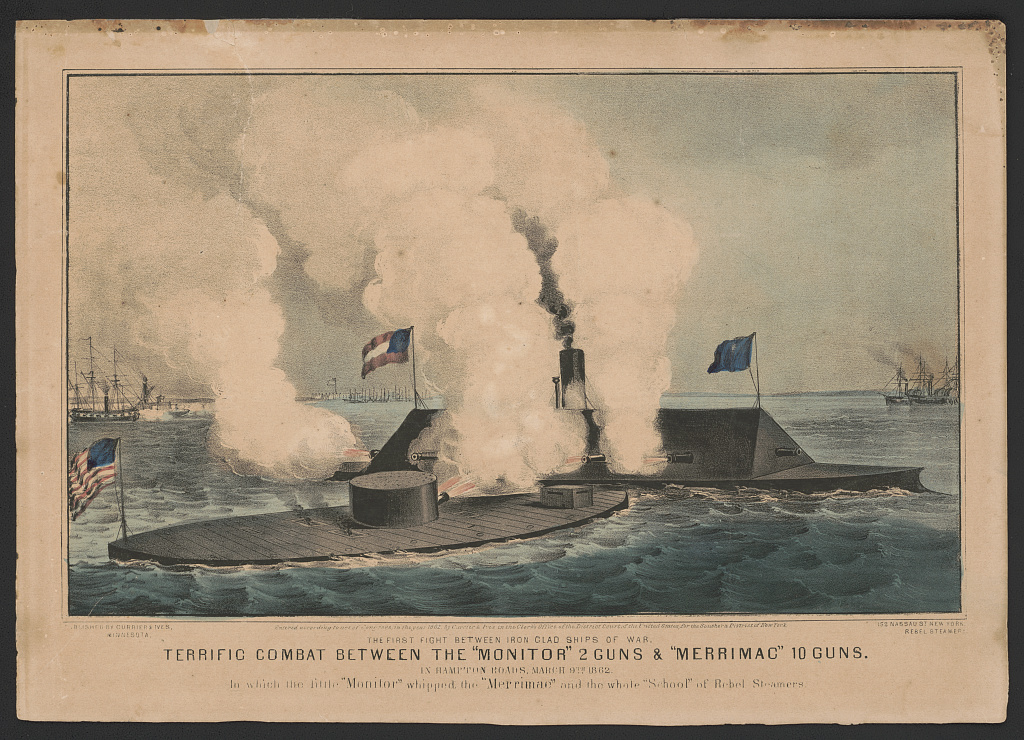
On the morning of March 9, Monitor and Virginia exchanged cannon fire at relatively close range. Their armor deflected or absorbed much of the impact, and neither vessel could easily achieve a decisive blow. The ships maneuvered with difficulty while their crews struggled with smoke, visibility and mechanical limitations.
The duel lasted for hours and ended without a clear winner between the two armored ships. The National Park Service account emphasizes the unprecedented nature of the engagement and how armor changed naval assumptions. It was not a battle in which one ironclad sunk the other.
What happened to Lieutenant Worden?
Worden was injured when a Confederate shell struck near Monitor’s pilot house, temporarily blinding or incapacitating him. Lieutenant Samuel Dana Greene took over command. This incident revealed that even an armored vessel could have vulnerable observation and command points.
With Worden out of action, Monitor briefly withdrew to assess damage and reorganize. Different participants interpreted the pause in ways favorable to their own side. The episode illustrates why official claims of victory should be compared with the actual movements and remaining operational condition of each vessel.
Why was the duel considered a draw?
Neither ship was destroyed or captured, and both retained the ability to leave the engagement. Virginia withdrew toward Confederate-held waters, while Monitor remained to protect Union naval forces. Each side claimed to have fulfilled important elements of its objective.
Confederate writers emphasized Virginia’s previous destruction of wooden ships and its survival against Monitor. Union observers emphasized that Monitor prevented the ironclad from breaking the blockade. A balanced assessment distinguishes the March 8 Confederate successes against wooden ships from the March 9 armored duel, which did not produce a decisive tactical winner.
What did the battle mean for wooden warships?
The destruction of Cumberland and Congress showed how vulnerable wooden warships could be to a heavily armored attacker with powerful guns and a ram. Naval administrators around the world took notice, accelerating investment in armored vessels and reconsideration of traditional ship designs.
The change did not mean every wooden ship vanished overnight. Navies still needed vessels for transport, reconnaissance, trade protection and operations in different sea conditions. But Hampton Roads helped demonstrate that armored steam warships had become essential to future naval strategy.
How did ironclads change gun design?
Armor posed a challenge to existing naval artillery. Guns that were devastating against timber might fail to penetrate iron plates, prompting experimentation with larger calibers, improved projectiles and new methods of aiming. Monitor’s rotating turret offered a different solution to the problem of gun placement and the ship’s direction.
The battle thus influenced a larger technological contest between offense and defense. Naval architecture, metallurgy, engines, armor and artillery developed together. No one innovation solved every problem, but Hampton Roads made it clear that warship design could no longer rely on the assumptions that dominated earlier sailing fleets.
Did Monitor immediately defeat Virginia?
No. Monitor prevented Virginia from continuing its attack against vulnerable Union ships on March 9, but it did not destroy or capture the Confederate vessel. Virginia returned to Confederate-controlled waters and remained a threat for a time.
Later patriotic lithographs sometimes describe Monitor as having whipped its opponent, reflecting Northern public celebrations rather than an impartial tactical result. The historical print accompanying this guide uses such language in its original title. Readers should distinguish the claims printed beneath the artwork from what the ships actually achieved.
What happened to CSS Virginia?
Confederate forces abandoned Norfolk in May 1862, making it difficult for Virginia to reach a new safe base because of its deep draft. Rather than permit the ship to be captured, Confederates destroyed it. Its service life as an ironclad was therefore brief despite its enormous historical fame.
The destruction did not undo the technological lessons of the March battle. Other ironclads would be built and used in coastal and river warfare. Virginia’s fate demonstrates a recurring limitation of specialized military technology: a powerful vessel may still depend on access to suitable ports and maintenance facilities.
What happened to USS Monitor?
Monitor continued in Union service after Hampton Roads but sank in a storm off Cape Hatteras in December 1862 while being towed south. Several crewmen died when the vessel foundered. Its low freeboard, useful in protected waters, contributed to difficulties operating in heavy seas.
The wreck later became an important underwater archaeological site. Artifacts, components and conservation projects help historians understand both the revolutionary design and the conditions faced by its crew. The USS Monitor Center provides details about the ship’s recovery and preservation.
Was Hampton Roads the first naval battle of ironclads?
It is usually described as the first battle between two ironclad warships. Armored vessels had already existed and had seen use in other conflicts, including the Crimean War, so the broader claim that iron armor was entirely invented in 1862 would be wrong.
Hampton Roads became historic because two purpose-built or converted ironclads met directly and demonstrated that their armor could resist much of the other ship’s gunfire. This specific milestone is more precise than declaring it the invention of all modern naval warfare at one moment.
How did the battle influence the blockade?
The Union maintained a blockade of Confederate ports as part of its wider strategy to restrict imports, exports and military supply. Virginia temporarily threatened that effort around Hampton Roads, while Monitor’s presence helped prevent a complete disruption of nearby Union naval operations.
Armored vessels became important for attacking fortified ports and supporting river campaigns later in the war. The blockade’s effectiveness depended on many ships, bases and supply systems rather than the success of one ironclad. Hampton Roads fits within this larger contest over the Confederacy’s access to the sea.
Hampton Roads timeline
The chronology separates the destructive first day’s Confederate attack from the unprecedented duel on the second day.
| Date | Event |
|---|---|
| 1861 | Confederates gain Gosport Navy Yard and begin converting Merrimack. |
| Mar 8, 1862 | Virginia destroys Cumberland and Congress. |
| Night of Mar 8 | Monitor arrives near Hampton Roads. |
| Mar 9 | Monitor and Virginia fight without a decisive victor. |
| May 1862 | Confederates destroy Virginia after abandoning Norfolk. |
| Dec 1862 | Monitor sinks in a storm off Cape Hatteras. |
Frequently asked questions about the ironclads
When did they fight? March 9, 1862.
What was the correct Confederate ship name? CSS Virginia.
Why is it called Merrimack? Virginia used the former USS Merrimack hull.
Who won? The ironclad duel ended without a decisive tactical winner.
What sank on March 8? Union wooden warships Cumberland and Congress were destroyed.
What was revolutionary? Rotating turrets and armored steam-powered ship design.
Which sources document Hampton Roads?
The National Park Service Battle of the Ironclads explains the two-day action and the vessels’ designs. The NPS Civil War chronology verifies the dates, while the Monitor conservation center documents the wreck and surviving material. The Library of Congress 1862 print shows how Northern popular imagery described the duel.
Compare its partisan wording with the evidence that neither ironclad was destroyed. Material evidence, naval reports and photographs of surviving components offer different kinds of information, all more reliable for technical details than dramatized battle artwork alone.