Battle of Iwo Jima (1945): Landing, Mount Suribachi, Flag Raising and Casualties
What happened during the February–March 1945 Battle of Iwo Jima, why Marines fought for Mount Suribachi and what the famous photograph represents.
Quick answer
The Battle of Iwo Jima began with U.S. Marine landings on February 19, 1945, and the island was declared secure on March 26. American commanders wanted to capture airfields on the small Japanese island between the Mariana Islands and the Japanese home islands. Japanese troops led by Lieutenant General Tadamichi Kuribayashi defended an extensive network of tunnels and fortified positions. Marines raised two American flags on Mount Suribachi on February 23; Joe Rosenthal photographed the second raising. The battle caused roughly 26,000 U.S. casualties, including about 6,800 deaths, while most of the Japanese garrison was killed. Its costs and strategic value remain subjects of historical analysis.
Key facts
On this page
- Why the United States targeted Iwo Jima
- Where Iwo Jima is located and what the island was like
- Kuribayashi’s defensive preparations
- The American force and invasion planning
- Preparatory bombing and naval bombardment
- The first landings on February 19, 1945
- The struggle to isolate Mount Suribachi
- The first flag raised on February 23
- Joe Rosenthal’s iconic second flag photograph
- The advance across the island’s airfields
- Why the northern fighting was so difficult
- Casualties and the difficult accounting of losses
- When the island was declared secure
- The strategic value of Iwo Jima after capture
- How Iwo Jima fits into the final Pacific campaign
- The meaning of the Iwo Jima memorial
- Timeline
- FAQs
- Sources
Why the United States targeted Iwo Jima
By early 1945 American forces had advanced across the central Pacific, capturing islands that could support air and naval operations closer to Japan. U.S. strategic bombers operating from the Mariana Islands faced long flights to reach Japanese industrial targets. Iwo Jima lay between the Marianas and the Japanese home islands, making it significant for air operations and Japan’s warning network. American planners believed capturing its airfields could provide emergency landing facilities, fighter support and improved control of routes used by bomber formations.
The island was small but heavily defended. Its volcanic landscape offered limited space for landing and maneuver, while Japanese garrisons could exploit caves, hills and prepared positions. A map might make Iwo Jima appear like a minor steppingstone, yet controlling it required a major amphibious operation. The eventual utility of its airfields and the number of lives lost remain important questions in historians’ evaluations of the battle.
Where Iwo Jima is located and what the island was like
Iwo Jima, now also officially called Iō Tō in Japan, is a volcanic island in the Ogasawara chain, roughly halfway between the Mariana Islands and the Japanese home islands. Its distinctive Mount Suribachi stands near the southwestern end, while the main airfields occupied flatter ground in the central and northern areas. Volcanic sand, ash and rough terrain created unusual challenges for vehicles and troops.
The landing beaches consisted of dark, steep volcanic material that offered poor footing. When Marines attempted to move inland, the sand could make it difficult to dig effective positions or move heavy equipment. Higher ground and concealed Japanese defenses overlooked key approaches. These geographic facts explain why bombardment and numerical superiority did not automatically produce a quick advance.
Kuribayashi’s defensive preparations
Japanese Lieutenant General Tadamichi Kuribayashi directed the island’s defense and rejected a strategy centered on destroying attackers at the waterline. Instead, his troops developed interconnected tunnels, caves and fortified positions intended to survive bombardment and inflict casualties over an extended campaign. Defenders could shelter underground, move between protected positions and fire on American forces after the invasion began.
Kuribayashi knew his men were unlikely to receive meaningful reinforcement or evacuation. His strategy aimed to prolong resistance and increase the cost of an American advance toward Japan. This did not make the defense invulnerable, but it changed the character of the battle. The American landing force faced an opponent that had spent months preparing concealed positions and was instructed to fight for as long as possible.
The American force and invasion planning
American planners assembled a large amphibious assault involving the U.S. Navy and Marine Corps. The principal ground formations were the 3rd, 4th and 5th Marine Divisions, supported by naval gunfire, aircraft, engineers, tanks, medical units and logistical personnel. Commanders expected difficult fighting but hoped preparatory bombardment and concentrated fire would reduce the defenders’ ability to resist the initial landings.
The landing plan had to account for tides, approach routes, the location of airfields and the danger of congestion on narrow beaches. U.S. forces also needed to keep supplies flowing ashore despite enemy artillery and small-arms fire. A successful amphibious assault depended on communications and coordination among ships, aircraft and ground troops. Those problems became especially serious during the first hours when Marines were packed into exposed landing zones.
Preparatory bombing and naval bombardment
Before the Marines landed, U.S. aircraft and warships attacked Japanese positions on the island. Naval gunfire sought to destroy fortifications and suppress defenders, while bombing targeted infrastructure and known positions. However, many Japanese troops occupied reinforced underground shelters that could survive or avoid much of the bombardment. Concealed artillery and strongpoints remained available when the landings began.
The effectiveness of preparatory fire became a subject of debate. Some American officers wanted longer and more intensive naval bombardment, while operational demands limited the time and ammunition available. The results illustrate the difficulty of attacking an enemy protected by volcanic rock and prepared tunnels. Bombardment could damage surface targets but did not guarantee that underground defenses had been neutralized.
The first landings on February 19, 1945
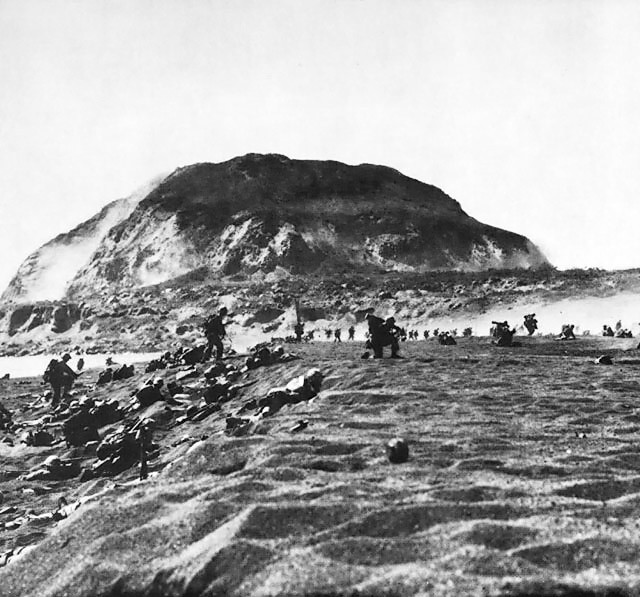
Marines began landing on February 19 after naval and aerial preparation. Initially some troops encountered less immediate fire than expected, but Japanese weapons soon struck crowded beaches and approaches. Deep volcanic sand slowed movement and made it hard to establish secure positions. Vehicles bogged down, casualties mounted and landing areas became congested with men, equipment and damaged vehicles.
The historical image accompanying this article depicts American Marines on Iwo Jima’s beach on the opening day of the assault. It is not the famous Mount Suribachi flag-raising photograph. The landing photo helps readers understand the difficult physical conditions and the density of troops on a beach exposed to fire. The first day secured important footholds but did not bring swift control of the island.
The struggle to isolate Mount Suribachi
Mount Suribachi dominated the southern end of the island and provided an important observation point. American units worked to cut it off from Japanese positions farther north, isolating defenders while continuing to fight through difficult ground. The mountain’s steep volcanic slopes and fortified caves made a direct advance hazardous. Marines gradually established control of routes around its base.
Securing Suribachi was a major local objective but not equivalent to winning the whole battle. Japanese positions elsewhere remained formidable, including airfield defenses and fortified northern terrain. The chronology matters because the famous photograph taken on February 23 came only four days after the landings. Large-scale fighting continued for weeks afterward, and many of the battle’s casualties occurred after the flag appeared above the mountain.
The first flag raised on February 23
On February 23 Marines reached the summit area of Mount Suribachi and raised a small American flag. The first raising was photographed by Marine Sergeant Louis R. Lowery. It became an encouraging symbol for troops who could see the flag from below, but the photograph that later became most famous depicted a different moment. The distinction between the first and second raising prevents a common misunderstanding of the visual record.
A larger flag was subsequently brought to the summit, in part so it would be more visible. Marines and a Navy corpsman raised the second flag later the same day. Photographers and motion-picture personnel were nearby, allowing the event to be recorded. The flags represented progress on the southern part of the island, not the formal end of Japanese resistance.
Joe Rosenthal’s iconic second flag photograph
Associated Press photographer Joe Rosenthal captured the second flag being raised on Mount Suribachi. The image shows six American servicemen working together around a flagpole and became one of the best-known photographs of World War II. The photograph later inspired the Marine Corps War Memorial near Washington, D.C., and became a powerful symbol of collective sacrifice.
Claims that Rosenthal staged the action for the camera are misleading. The second flag raising was a genuine event, distinct from the earlier first raising. Historical identifications of the people in the photograph have been corrected as researchers reexamined photographs, film and testimony. Present-day accounts should acknowledge those revisions rather than repeat inaccurate lists of names. The famous image is authentic, but it depicts one moment within a far longer campaign.
The advance across the island’s airfields
After the southern objective was secured, American troops continued toward the island’s central and northern defenses. Capturing airfields required movement across exposed terrain and reduction of fortified positions. Japanese artillery, machine guns and concealed defenses forced advances to proceed slowly. Marine divisions coordinated attacks, engineers cleared obstacles and medical units treated a continual flow of wounded personnel.
Control over airfields mattered because it was a major reason for choosing Iwo Jima as an objective. The island eventually became a location for emergency landings by U.S. aircraft, including damaged B-29 bombers returning from missions against Japan. Supporters of the operation have cited those landings as a significant benefit, while critics examine whether the original operational expectations justified the casualties. The full evaluation requires evidence about actual aircraft operations and alternative choices.
Why the northern fighting was so difficult
Japanese defenders held numerous caves, ridges and mutually supporting positions in the northern part of the island. American Marines fought through areas that became known for their fierce resistance, including the Motoyama Plateau and the region around Hill 382. Progress could be measured in yards because attackers needed to locate and suppress individual strongpoints before advancing.
The tunnel system allowed Japanese troops to survive attacks that destroyed visible surface structures. U.S. forces used artillery, tanks, flamethrowers and specialized engineer tactics to overcome fortifications, but casualties remained high. This was an environment of extreme danger for combatants on both sides. The campaign should not be reduced to one heroic flag-raising moment when the subsequent weeks involved sustained close combat and severe losses.
Casualties and the difficult accounting of losses
The U.S. military suffered nearly 26,000 casualties during the Iwo Jima operation, including approximately 6,800 killed, according to Air Force and Marine Corps histories. Exact totals differ slightly depending on whether Navy personnel, later deaths of wounds and specific dates are included. The Japanese garrison also suffered catastrophic losses; most defenders were killed, and relatively few prisoners were taken during the main fighting.
Casualty figures do not all mean deaths. They may include killed, wounded and missing, so an unqualified statement that ‘26,000 Americans died’ would be inaccurate. The number of Japanese killed or captured also depends on accounting and the inclusion of later holdouts. Historians should use the figures supplied by particular institutions and explain their scope rather than presenting incompatible totals as a single exact number.
When the island was declared secure
Although organized Japanese resistance weakened progressively, fighting continued throughout March. American commanders declared Iwo Jima secure on March 26, 1945, after more than a month of combat. Isolated Japanese soldiers remained concealed in some areas afterward, so ‘secure’ was an operational designation rather than proof that no defender remained alive or that all danger had vanished on that date.
The timing also shows why the flag-raising date cannot be used as the battle’s end. February 23 was a milestone, but March 26 is the date commonly associated with the conclusion of the main campaign. The Marines paid an extraordinary price to capture a small area that Japanese commanders had transformed into an intricate defensive fortress.
The strategic value of Iwo Jima after capture
American forces used captured airfields to support operations and provide emergency landing facilities for aircraft operating against Japan. U.S. B-29 crews sometimes relied on Iwo Jima when fuel shortages or damage made a return to the Marianas uncertain. Fighter operations also developed from the island, connecting its capture to the wider bombing campaign and preparations for the final phase of the Pacific War.
Scholars have debated how much those benefits justified the invasion’s immense costs and whether some anticipated uses were achieved as originally planned. Contemporary military commanders had to make decisions without knowing every later event. A careful evaluation weighs real operational benefits against casualties and alternatives rather than treating either the famous flag photo or the final airfield statistics as the only relevant evidence.
How Iwo Jima fits into the final Pacific campaign
Iwo Jima was captured as the United States moved closer to the Japanese home islands, while fighting continued elsewhere in the Pacific. The Battle of Okinawa began shortly afterward in April 1945 and involved even larger forces and immense civilian suffering. Together the campaigns influenced American expectations about the cost of future amphibious assaults and the challenge of defeating Japanese forces defending prepared terrain.
The war did not end when Iwo Jima fell. Japan’s surrender followed in August after the atomic bombings of Hiroshima and Nagasaki, Soviet entry into the war against Japan and other military and political developments. The Manhattan Project article provides context for one element of that final period. Iwo Jima’s battle is important in its own right, not simply as a prelude to the war’s concluding decisions.
The meaning of the Iwo Jima memorial
The Marine Corps War Memorial in Arlington, Virginia, was inspired by Rosenthal’s photograph and commemorates Marines who died in service across the history of the Corps, not only those killed on Iwo Jima. Its sculptural depiction of the second flag raising became a symbol of military service and collective sacrifice. The photograph’s visual power contributed to widespread public familiarity with the battle.
Commemoration can preserve memory, but it should also encourage deeper historical understanding. The island’s defenders, American casualties, captured prisoners and surviving families all formed part of the event. The famous image is not a substitute for the broader history of the invasion, prolonged fighting and enormous human cost. Its place in national memory is most valuable when linked to accurate chronology and military records.
Timeline
- 1944: Allied planning targets Iwo Jima
- February 19, 1945: U.S. Marines land
- February 23: First and second flags raised on Suribachi
- Late February: Airfield and central-island fighting continues
- March 1945: Northern defenses reduced through intense combat
- March 26: Island declared secure
- April 1945: Battle of Okinawa begins
- August 1945: Japan surrenders
Frequently asked questions
When did the Battle of Iwo Jima begin?
February 19, 1945.
When was the island declared secure?
March 26, 1945.
Why did the U.S. invade?
To capture strategically located airfields and reduce Japanese defenses affecting air operations.
Who commanded Japanese defenders?
Lieutenant General Tadamichi Kuribayashi.
When was the famous flag raised?
The second flag raising was photographed February 23, 1945.
Was the flag-raising staged?
No. The famous Rosenthal photograph depicts a genuine second raising, distinct from an earlier first raising.
How many Americans died?
Around 6,800 were killed, within total U.S. casualties approaching 26,000.
Did the battle end on February 23?
No. Fighting continued through March, and the island was declared secure on March 26.
Who took the famous photograph?
Associated Press photographer Joe Rosenthal.