Bretton Woods Conference of 1944: How the IMF and World Bank Began
Why 44 Allied countries met at Bretton Woods in July 1944, how the IMF and World Bank originated, and what the dollar-gold system meant.
Quick answer
The United Nations Monetary and Financial Conference met at Bretton Woods, New Hampshire, from July 1 to 22, 1944. Delegates from 44 Allied countries negotiated a new international monetary order intended to prevent destabilizing currency practices and support postwar recovery. Their agreements provided for the International Monetary Fund (IMF) and the International Bank for Reconstruction and Development (IBRD), the institution that became the core of the World Bank. The arrangements linked currencies to the U.S. dollar, which was convertible into gold for foreign monetary authorities at $35 per ounce. The institutions came into legal existence after later ratifications, not immediately on opening day.
Key facts
On this page
- Why nations planned a monetary system before war ended
- The Mount Washington Hotel and 44 delegations
- Harry Dexter White and John Maynard Keynes
- What problem the IMF was intended to solve
- Why the IBRD later became known as the World Bank
- How the dollar-gold exchange-rate framework worked
- Why exchange rates could be adjusted
- The role of U.S. financial power
- What the final agreement did in July 1944
- How Bretton Woods related to postwar reconstruction
- Why the original system eventually came under strain
- The historical significance of Bretton Woods
- Timeline
- FAQs
- Sources
Why nations planned a monetary system before war ended
World War II had not yet ended when delegates gathered in New Hampshire in July 1944. The Allies had recently landed in Normandy, and major fighting continued in Europe and the Pacific. Yet policymakers worried that victory could be followed by new unemployment, protectionism and currency crises if governments failed to prepare for peacetime trade and reconstruction. The interwar years had demonstrated how financial instability could amplify political conflict and obstruct international exchange.
The Great Depression was a central warning. During the 1930s countries devalued currencies, imposed restrictions and struggled with collapsing demand and trade. Not every policy had the same consequences, but the fragmentation made international payments and business planning difficult. American and British officials believed that coordinated monetary rules and institutions could reduce those dangers after the war. Bretton Woods was therefore an economic peace-planning conference conducted while armies were still fighting.
The Mount Washington Hotel and 44 delegations
The conference was held at the Mount Washington Hotel in Bretton Woods, New Hampshire. Delegations from forty-four Allied countries and governments attended, making it a substantial multinational negotiation. The United States hosted the meeting and supplied extensive administrative resources. Delegates worked through committees, technical drafts and overnight negotiations during the first three weeks of July. Not every country possessed equal economic influence, despite formal participation.
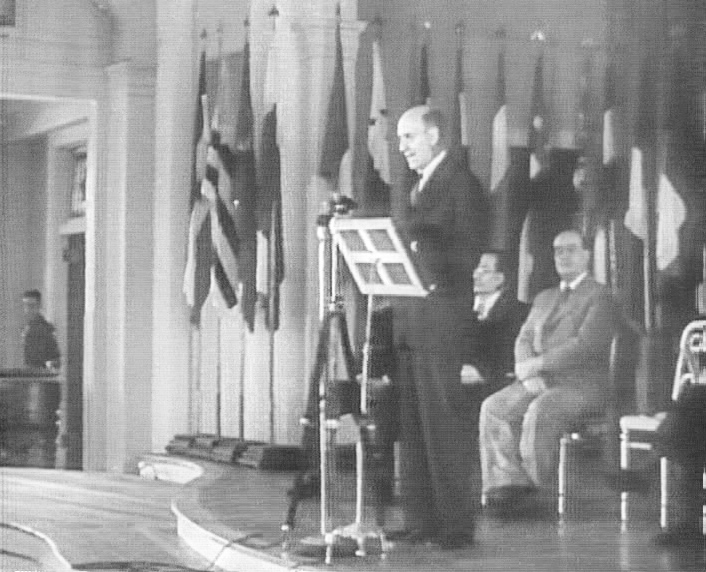
The venue was selected partly because a large hotel could accommodate delegates and the numerous working groups needed to prepare complex agreements. The conference photograph shows Treasury Secretary Henry Morgenthau Jr. addressing participants. It represents the actual negotiations, not the later formal establishment of the IMF or World Bank. The distinction matters because the 1944 meeting produced agreements requiring subsequent approval by governments.
Harry Dexter White and John Maynard Keynes
Two prominent architects of the negotiations were American Treasury official Harry Dexter White and British economist John Maynard Keynes. They developed competing but related proposals for a postwar monetary system. White’s approach favored a stabilization fund within a framework reflecting the United States’ major financial position. Keynes advocated an international clearing union with a new unit of account and mechanisms intended to distribute some burdens of adjustment more evenly among surplus and deficit countries.
The final system was closer in important respects to White’s plan, while including compromises negotiated with Britain and other delegations. Neither man single-handedly invented the entire arrangement. Technical officials, national governments and economic realities shaped the settlement. Britain’s financial weakness and America’s growing share of global gold reserves gave the United States considerable negotiating influence, even as the proposals were presented as international cooperation.
What problem the IMF was intended to solve
The International Monetary Fund was designed to promote exchange-rate stability, facilitate international payments and provide temporary financial assistance for countries experiencing balance-of-payments difficulties. Policymakers wanted members to avoid abrupt competitive devaluations and restrictions that could damage international trade. Under the original framework, countries declared par values for their currencies and maintained exchange relationships within established rules, subject to procedures for changes.
That original IMF should not be described as identical to every program the institution operates today. Its lending facilities, surveillance methods and membership evolved over many decades. In 1944 the immediate goal was to make exchange rates and international payments more predictable during postwar adjustment. Governments retained important policy choices but accepted a framework intended to reduce the instability that had characterized parts of the interwar period.
Why the IBRD later became known as the World Bank
The second major institution was the International Bank for Reconstruction and Development, or IBRD. Its initial emphasis included financing reconstruction in countries devastated by war and encouraging long-term development investment. It was expected to help mobilize capital for projects that private markets alone might not adequately finance. The IBRD became the original institution in the group of organizations now collectively known as the World Bank.
World Bank history notes that creating the IBRD was not necessarily the central original focus of the whole conference, which concentrated heavily on monetary stability. But the bank became a significant long-term outcome. Its lending and development role changed as Europe recovered and newly independent countries sought infrastructure financing. A history of Bretton Woods should distinguish the 1944 institution from the broader modern World Bank Group with its later-created affiliates.
How the dollar-gold exchange-rate framework worked
The original arrangement established a system of fixed but adjustable exchange rates. Participating currencies were linked to par values, with the U.S. dollar serving as a central reference. The dollar was convertible into gold for eligible foreign official holders at the established price of $35 per troy ounce. This was not a promise that every private person anywhere could take cash to a bank and automatically demand gold without restriction.
The system depended on the confidence of countries holding dollars and on the United States’ ability to maintain official convertibility. Other governments intervened to keep their currencies near declared values while having procedures to change parities under specified circumstances. A common simplification says Bretton Woods created a universal gold standard identical to nineteenth-century arrangements. It did not; official-dollar convertibility and capital controls created a different institutional structure.
Why exchange rates could be adjusted
Delegates wanted stability without making countries endure indefinite domestic hardship to defend a misaligned currency. The framework therefore allowed exchange-rate changes in cases of fundamental disequilibrium, subject to the applicable rules. That idea sought a compromise between rigid monetary commitments and the instability of frequent competitive devaluation. A government experiencing persistent external payments problems could seek adjustment rather than treating any change as an automatic violation.
The phrase ‘fixed but adjustable’ captures an essential feature of the Bretton Woods approach. Exchange-rate rules were intended to support trade and confidence, but the system still recognized that national economies could develop differently. That flexibility became important in the decades after 1945. Whether the adjustment mechanisms were sufficient would remain a subject of debate as inflation, international capital flows and American deficits changed.
The role of U.S. financial power
The United States entered the postwar era with enormous industrial capacity, significant gold reserves and a comparatively strong international financial position. Those conditions gave American proposals substantial weight at the conference. Britain, by contrast, faced wartime financial exhaustion despite its global diplomatic influence. Other delegations also brought particular concerns about trade, currency stability and reconstruction resources.
This imbalance influenced the institutions that emerged. Their design used subscriptions, voting arrangements and financial commitments connected to members’ economic weight. The settlement was multilateral, but not a meeting in which every participant exercised identical power. Historians therefore study both the cooperative aims of Bretton Woods and the geopolitical conditions that made the dollar central to the new order.
What the final agreement did in July 1944
By July 22 the conference approved a Final Act containing the proposed Articles of Agreement for the IMF and IBRD and recommendations on other monetary questions. Delegates signed documents recording the negotiated results, but their governments still had to adopt or ratify the arrangements through domestic procedures. The conference did not instantly begin issuing IMF loans or World Bank development projects on the same day.
The United States approved participation through the Bretton Woods Agreements Act in 1945. The IMF formally came into existence in December 1945 after sufficient states accepted its Articles of Agreement. The IBRD was similarly established after ratification, and actual lending followed later. These dates matter because institution-building involves negotiation, legal formation, operational staffing and the first transactions as distinct historical events.
How Bretton Woods related to postwar reconstruction
European economies emerged from the war with destroyed infrastructure, displaced populations and serious shortages. Stable currencies and long-term lending could help rebuild transport, power and industry, but reconstruction also required direct assistance, trade and domestic policy. The Marshall Plan of 1947–48 eventually became central to European recovery. Bretton Woods institutions operated within this larger network of aid and economic policy rather than replacing every other form of cooperation.
The United States and Britain also negotiated wartime and postwar financial arrangements separately from the conference. The Lend-Lease program had supplied Allied governments during the war; the new institutions aimed at a more stable peacetime financial environment. One involved wartime matériel transfers, while the other addressed monetary cooperation and longer-term finance. The distinction helps explain continuity without conflating their legal purposes.
Why the original system eventually came under strain
During the 1950s and 1960s international trade and dollar holdings expanded, while U.S. balance-of-payments deficits contributed to the accumulation of dollars abroad. Foreign official dollar claims eventually became large relative to U.S. gold reserves at the official price. This created pressure on the credibility of gold convertibility. Other countries faced questions about the value of their currencies and the costs of maintaining parities.
In August 1971 President Richard Nixon suspended official dollar-gold convertibility, a major breakdown of the original framework. The principal industrialized currencies later moved toward floating exchange rates. These developments did not abolish the IMF or World Bank, which continued operating with changed roles. The end of the original exchange-rate system was a later consequence of evolving financial conditions, not a collapse that occurred during the July 1944 conference.
The historical significance of Bretton Woods
Bretton Woods transformed wartime economic planning into institutions that outlived the original exchange-rate rules. The IMF and IBRD became central parts of international finance, while the dollar-centered monetary arrangement shaped trade and payments for decades. The conference marked an effort to avoid repeating the destructive financial fragmentation associated with the Great Depression and the interwar period.
An accurate history recognizes both ambition and limitation. The conference could negotiate rules but could not guarantee that every currency crisis, recession or political conflict would disappear. It also operated within an unequal world economy dominated by major powers. The most durable legacy was the creation of institutions capable of adapting long after the fixed exchange-rate framework itself ended.
Timeline
- 1930s: Global Depression and currency instability
- 1941–1943: British and U.S. monetary proposals developed
- July 1, 1944: Bretton Woods Conference opens
- July 22, 1944: Final Act approved
- 1945: U.S. Bretton Woods Agreements Act enacted
- December 1945: IMF formally established
- Late 1940s: IMF and IBRD begin operational work
- August 1971: Dollar-gold convertibility suspended
Frequently asked questions
When was the Bretton Woods Conference?
July 1–22, 1944.
Where was it held?
At the Mount Washington Hotel in Bretton Woods, New Hampshire, United States.
How many countries participated?
Forty-four Allied countries or governments sent delegates.
What institutions resulted?
The International Monetary Fund and the International Bank for Reconstruction and Development, which became the World Bank’s core institution.
What was the official gold price?
The U.S. dollar’s official gold conversion price was $35 per troy ounce.
Did the IMF start lending immediately in July 1944?
No. Formal establishment and operations followed later legal ratification and organization.
Who were Keynes and White?
John Maynard Keynes and Harry Dexter White were influential British and American designers of proposals for the postwar system.
When did the original dollar-gold system end?
The United States suspended official gold convertibility in 1971, and major currencies subsequently moved toward floating rates.