Tennessee Valley Authority Act of 1933: Dams, Electricity and the New Deal
Why Roosevelt created the TVA in May 1933, how its dams and power lines transformed the Tennessee Valley and what communities lost to the projects.
Quick answer
President Franklin D. Roosevelt signed the Tennessee Valley Authority Act on May 18, 1933, creating a federal corporation to develop the Tennessee River region. The TVA’s responsibilities included flood control, river navigation, electrical power generation, land improvement and regional economic development. Projects such as Norris Dam helped expand electricity and infrastructure, but dam construction also displaced communities, altered ecosystems and raised disputes about federal competition with private utilities.
Key facts
On this page
- Why the Tennessee Valley needed regional development
- The Muscle Shoals debate before 1933
- How the TVA Act became law on May 18
- Why a federal corporation was selected
- Norris Dam: the early emblem of TVA construction
- How dams changed flooding and river navigation
- Electricity generation and rural communities
- Soil conservation, agriculture and land use
- The human cost of relocation and displacement
- Conflict with private power companies
- What the TVA accomplished and what it could not solve
- The TVA’s place in New Deal history
- Timeline
- FAQs
- Sources
Why the Tennessee Valley needed regional development
Much of the Tennessee Valley faced poverty, soil erosion, destructive flooding and limited access to modern electrical service in the early twentieth century. Communities depended heavily on agriculture, while the river system could both aid commerce and damage homes and farmland during high water. Some towns and industries had electricity, but rural communities often remained beyond the reach of profitable private distribution networks. These conditions made the valley a prominent subject for debates over federal planning and economic development.
The region was not uniform, and a simple picture of an entirely powerless or undeveloped valley would be inaccurate. It included towns, farms, businesses, communities and longstanding social institutions. The TVA’s planners believed coordinated management of the river and its resources could create opportunities that fragmented local efforts had not achieved. Their approach also required difficult choices about land, water, property rights and who would benefit from large public investments.
The Muscle Shoals debate before 1933
Federal involvement in the region did not begin with Roosevelt. During World War I the government developed facilities near Muscle Shoals, Alabama, for the production of materials associated with national defense. Wilson Dam, built by the Army Corps of Engineers and completed in the 1920s, formed part of the existing infrastructure. After the war, officials and lawmakers debated how the government should use the facilities, including proposals to sell or lease them to private operators.
Senator George W. Norris of Nebraska supported public operation and broader regional development rather than privatizing the assets. The debate stretched across different administrations and contributed to the ideas eventually incorporated into the TVA. This context explains why the federal corporation inherited projects and facilities that predated 1933. It also prevents the common mistake of describing every dam in the Tennessee Valley as a structure first built by the New Deal.
How the TVA Act became law on May 18
Roosevelt signed the Tennessee Valley Authority Act on May 18, 1933. The National Archives preserves the original enrolled legislation, which specified purposes including improved navigation, flood control, agricultural and industrial development and operation of government properties at Muscle Shoals. Congress created a federal corporation with a board to direct a broad program rather than a single conventional department limited to electricity generation.
The timing placed the TVA among the early New Deal measures, when the new administration pursued emergency action and long-term reform simultaneously. The act did not merely authorize the construction of one dam. It created an institution with responsibilities extending across power production, land management and economic planning. The regional scale of those powers made the TVA one of the era’s most distinctive experiments in public enterprise.
Why a federal corporation was selected
A corporation could operate facilities, employ staff, sell electricity and manage assets within a statutory public framework. The TVA’s governing structure was intended to combine technical management with regional objectives. Its early board included Arthur Morgan, Harcourt Morgan and David Lilienthal, who brought differing backgrounds and ideas. Their disagreements over administration and public development later became part of the institution’s history.
The corporate form did not remove the TVA from politics or public accountability. Congress controlled its legal mandate, and federal authorities supervised appropriations and broad policy. Disputes arose over management practices, the distribution of benefits and relations with private utilities. The central issue was whether an integrated public corporation could achieve outcomes that separate commercial firms, local authorities and engineering agencies had struggled to coordinate.
Norris Dam: the early emblem of TVA construction
Norris Dam in Tennessee became one of the TVA’s first major dam projects. Construction began in 1933, and the dam was completed in 1936. Located on the Clinch River, a tributary of the Tennessee, it contributed to flood regulation and power generation and created a large reservoir. The project required extensive excavation, construction equipment, housing, roads and workers. The federal government also created the planned town of Norris to accommodate some of the project’s employees.
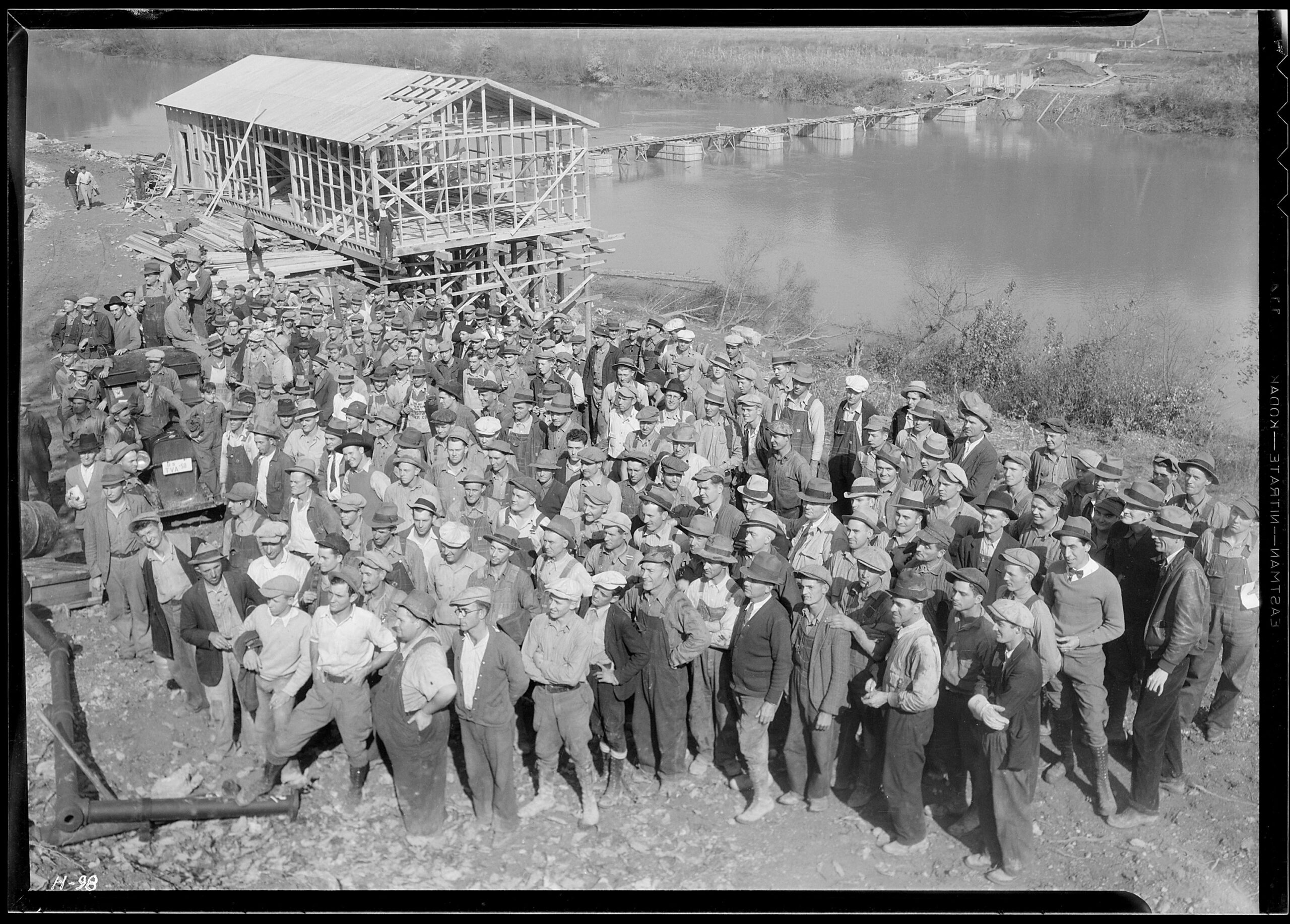
The historical photograph accompanying this article shows workers at the Norris Dam site during the 1930s. It documents labor and early construction activities rather than the appearance of the finished structure. The photograph should not be described as depicting the actual signing of the TVA Act. Understanding the construction timeline matters because the authority’s first years were devoted to building a system whose major effects developed gradually.
How dams changed flooding and river navigation
The Tennessee River and its tributaries experienced seasonal changes in flow that could flood vulnerable settlements and interrupt commercial transport. Dams and controlled reservoirs offered a way to store water and release it according to changing conditions. The TVA developed a linked network intended to improve navigation on the main river while reducing some flood risks. These objectives required coordinated operation rather than allowing each dam to be managed wholly independently.
Flood-control infrastructure can reduce many hazards without eliminating flooding altogether. Reservoir operations also affect downstream water levels, river habitats and the distribution of sediment. The TVA’s projects should therefore be evaluated in terms of both benefits and environmental consequences. An account that simply says dams stopped all floods or had no effect on the river ecosystem would misrepresent the complexity of river management.
Electricity generation and rural communities
Hydroelectric facilities produced power that the TVA could supply through transmission arrangements and local distributors. Lower-cost and more widely available electricity was a major political objective because electrification could change household labor, farm production and small business activity. Lights, pumps and appliances offered practical benefits, while industrial users valued dependable power. The TVA’s activity also encouraged discussion of how private utilities should price electricity.
Rural electrification did not happen solely because one TVA law was passed. Local cooperatives, municipal utilities, private networks and later federal programs such as the Rural Electrification Administration contributed to broader access. The TVA’s regional power projects were a significant part of the story, not the entire national history of bringing electricity to farms. Comparing their development helps readers distinguish energy generation from the separate challenge of delivering power to widely scattered households.
Soil conservation, agriculture and land use
The TVA’s broader program included research and demonstration work connected to soil improvement, reforestation and more productive land use. Erosion and declining soil fertility affected agricultural livelihoods in parts of the valley, and planners saw environmental management as integral to regional development. The authority’s work intersected with other New Deal efforts addressing conservation and rural poverty.
Those goals also involved choices about what kinds of farming or land use were desirable. Programs could promote new techniques while challenging established local practices. The experience varied by community and the ownership of affected land. It would be misleading to present the TVA as a program concerned only with concrete dams and generators. Its creators conceived an integrated regional experiment that connected physical infrastructure with agriculture, public health and economic opportunity.
The human cost of relocation and displacement
Large reservoirs required land that was sometimes occupied by farms, homes, schools, churches and cemeteries. Families faced relocation when valleys were flooded or property was acquired. Compensation and relocation assistance did not necessarily replace community connections or the personal value of ancestral land. Some residents opposed particular projects or felt that their needs were subordinated to public plans.
Displacement is essential to the historical account because the familiar image of a finished dam may conceal the communities that existed along the river before construction. The National Archives and TVA collections preserve relocation records, maps and accounts of affected families. A fair assessment acknowledges the employment, power and flood benefits while also recognizing the losses associated with moving people and altering landscapes. Public infrastructure can create regional gains and local harms at the same time.
Conflict with private power companies
Private utilities argued that federally backed electricity could compete under conditions unavailable to companies financed by investors. Supporters of the TVA considered public power an essential means of providing affordable service and comparing costs. Litigation challenged aspects of the authority’s activities and powers. In Ashwander v. Tennessee Valley Authority in 1936, the Supreme Court upheld federal authority involved in the sale of power generated at government-owned facilities, though the ruling did not decide every constitutional question about the entire TVA program.
The disputes highlight competing visions of the federal government’s role in economic development. Could a public corporation own and operate a large electrical system? Should commercial electricity be supplied mainly by private firms, municipal organizations or federal entities? Arguments over prices, legal authority and public investment continued long after the TVA was founded. Those debates are part of its history, not a minor distraction from technical engineering.
What the TVA accomplished and what it could not solve
The TVA built dams, expanded regional power infrastructure, contributed to navigation and flood-management systems and helped create jobs during years of economic hardship. Its projects changed the landscape and supported forms of industrial and agricultural development that had been difficult under earlier conditions. But the authority did not end poverty across every community or guarantee that all benefits were shared equally.
Industrial growth, electricity use and rural incomes were influenced by many forces beyond TVA construction, including wartime demand, national economic recovery and later federal programs. Environmental and social costs likewise persisted. A balanced history describes measurable accomplishments and identifies limits rather than treating the Tennessee Valley as a single experiment with an unquestioned success or failure grade.
The TVA’s place in New Deal history
The Tennessee Valley Authority is an example of the New Deal’s willingness to use public institutions to reshape regional infrastructure. Its law was enacted during Roosevelt’s first hundred days but had consequences extending far beyond the immediate Depression. Compared with emergency bank stabilization, TVA planning involved years of construction, institutional management and changes to the physical environment.
The TVA remains an unusually visible New Deal institution because dams and electricity networks are tangible evidence of its work. Yet its lasting significance also includes debates over public power, federalism, environmental management and the treatment of relocated communities. The New Deal programs overview explains the broader policy setting, while the original TVA Act demonstrates the extent of Congress’s initial regional ambitions.
Timeline
- World War I: Muscle Shoals federal development begins
- 1920s: Debates over public or private operation of Muscle Shoals
- May 18, 1933: TVA Act signed
- 1933: Norris Dam construction begins
- 1936: Norris Dam completed; Supreme Court addresses TVA power sales
- 1940s: Regional power system and wartime production expand
Frequently asked questions
When was the Tennessee Valley Authority created?
May 18, 1933, when Roosevelt signed the TVA Act.
What was the TVA intended to do?
Improve navigation and flood management, generate electricity and support agricultural and industrial development in the Tennessee Valley.
What was its first major new dam?
Norris Dam was an early major TVA project, begun in 1933 and completed in 1936.
Did the TVA build Wilson Dam from scratch?
No. Wilson Dam at Muscle Shoals was a federal project dating from before 1933.
Did TVA electricity reach every American household?
No. TVA was a regional authority; nationwide rural electrification involved other programs and utilities.
Were people displaced by reservoirs?
Yes. Dam and reservoir projects acquired property and required relocation of families and communities.
Was the TVA challenged in court?
Yes. The Supreme Court’s Ashwander decision in 1936 addressed federal power sales, but not every possible dispute over the TVA.