Panic of 1907: Knickerbocker Trust, J. P. Morgan and the Road to the Fed
A banking crisis that exposed fragile trust companies, an inelastic currency system and the limits of private rescues.
Quick answer
The Panic of 1907 began after failed stock speculation triggered losses of confidence in New York banks and trust companies. The Knickerbocker Trust Company suspended operations on October 22, 1907, intensifying withdrawals and a national shortage of credit. J. P. Morgan, other bankers, clearing-house institutions and the U.S. Treasury organized emergency support. The crisis helped spur the reforms that culminated in the Federal Reserve Act of 1913.
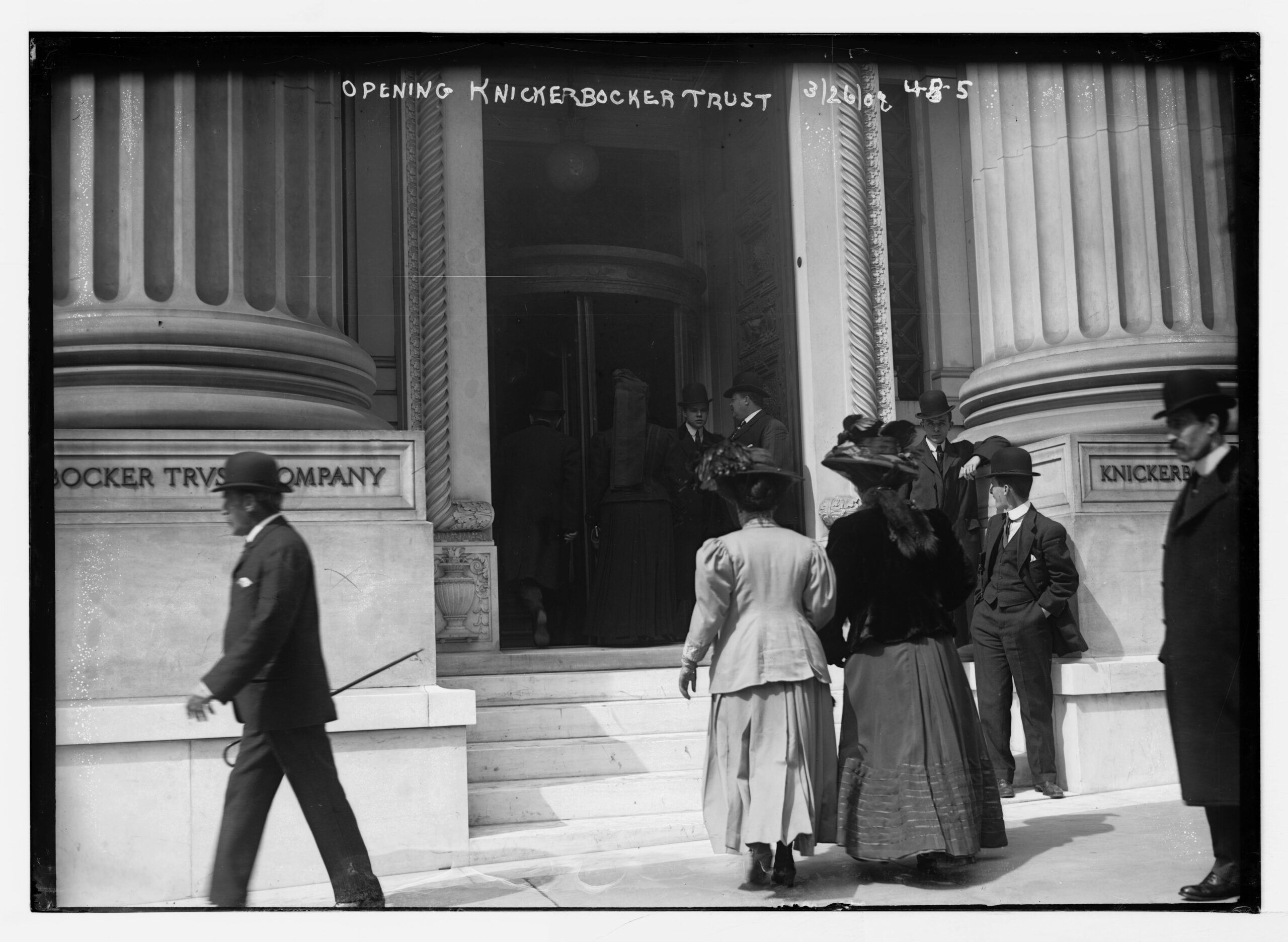
A failed stock-market maneuver exposed a network of financial vulnerabilities. The panic spread through trust companies and banks and eventually shaped the debate over monetary reform.
Key facts
On this page
- An American financial system without a central bank
- Why trust companies were vulnerable
- The failed attempt to corner United Copper
- The Knickerbocker Trust run of October 22
- How panic spread beyond one trust
- The emergency action by J. P. Morgan
- The Clearing House and the Treasury
- What the crisis did to ordinary businesses
- The Aldrich–Vreeland Act and the monetary commission
- From the Panic of 1907 to the Federal Reserve Act
- What historians should—and should not—conclude
- Timeline
- FAQ
- Sources
An American financial system without a central bank
In 1907 the United States had a large, fast-growing economy but no modern central bank providing a nationwide framework for emergency liquidity. The earlier Second Bank of the United States had lost its federal charter many decades before, and later legislation had created a complex national banking system rather than a unified lender of last resort. Money and credit could become scarce at predictable times of year, including agricultural harvest seasons, when funds moved from eastern financial centers toward farms and merchants. That seasonal pressure did not by itself create a panic, but it made an already strained system less able to absorb shocks.
New York occupied a special position because major banks held funds for institutions elsewhere in the country and financed securities markets through short-term loans. A local fear could therefore turn into a national squeeze. Banks, clearing-house associations and trust companies did not all operate under identical rules. Some institutions enjoyed access to established clearing-house support; others relied on private connections and market confidence. The crisis revealed how dangerous those differences could become when depositors simultaneously demanded cash and securities lenders tried to withdraw funds.
Why trust companies were vulnerable
Trust companies had expanded rapidly in the years before the panic. They offered financial services and held deposits, yet many faced a different regulatory and reserve framework from national banks. Their growth exposed a weakness in a system whose emergency arrangements relied heavily on the membership of private clearing houses. When confidence deteriorated, depositors did not need to prove that an institution was insolvent before demanding their money. A solvent firm might still struggle if too many people wanted cash at once and its assets could not be sold quickly without large losses.
That distinction between solvency and liquidity is essential. Solvency asks whether an institution’s assets ultimately exceed its liabilities. Liquidity asks whether it can meet immediate withdrawals. Banks and trusts often held loans that could not be transformed instantly into currency. If depositors doubted that others would wait, a rush to withdraw could worsen the institution’s position. The Panic of 1907 illustrates how fears about a particular speculative episode spread into doubts about institutions that had not participated directly in the original transactions.
The failed attempt to corner United Copper
In mid-October 1907 speculators attempted to manipulate the market for shares of United Copper Company. The effort is associated with F. Augustus Heinze and his associates. When the attempt failed, share prices fell and the repercussions damaged confidence in banks connected to the speculators. Charles W. Morse, another prominent financier, also became entangled in the controversy. News about these relationships encouraged depositors and other bankers to question the safety of institutions associated with the men involved.
It is tempting to say that one failed stock-market corner caused the entire nationwide crisis. The historical explanation is more complicated. United Copper was a trigger that exposed pre-existing vulnerabilities: thin reserves, short-term funding, interlocking business relationships and uneven access to emergency support. A market scandal can remain a localized event when institutions are resilient. In 1907 it was transmitted through a broader network of uncertainty about whose assets and reputation could be trusted. That is why the sequence from copper speculation to bank runs matters more than the details of the trade alone.
The Knickerbocker Trust run of October 22
The Knickerbocker Trust Company was one of New York’s prominent trusts. Its president, Charles T. Barney, had business connections that heightened suspicion as the copper episode unfolded. On October 21, the National Bank of Commerce withdrew clearing services from Knickerbocker. Because the trust was outside the New York Clearing House Association’s ordinary membership protection, that loss was especially serious. Depositors interpreted the withdrawal of support as a warning about the institution’s condition, and the following day the rush to withdraw funds became acute.
On October 22 Knickerbocker suspended operations after the pressure overwhelmed its available cash. Contemporaries did not know whether other trusts would fail next. A line of worried depositors was not simply a symbol of the crisis; withdrawals physically drained liquidity and could force asset sales or suspension. The word ‘failure’ sometimes appears in accounts of Knickerbocker, but its history requires care: the institution later reopened. What made October 22 decisive was the suspension and the message it sent to everyone holding deposits at similar companies.
How panic spread beyond one trust
The withdrawal rush moved toward other trust companies, including the Trust Company of America. Investors and banks also demanded cash for their own needs, tightening the market for call loans used to finance securities. When lenders recalled short-term loans, borrowers might have to sell stocks into a falling market. Falling securities values then threatened the balance sheets of institutions holding such assets or accepting them as collateral. This created a damaging feedback loop between deposit withdrawals, asset prices and credit contraction.
New York’s role as a banking center carried the pressure across state lines. Regional banks had balances and correspondent relationships in the city, and reports of restrictions and failures encouraged caution elsewhere. Institutions could respond by hoarding currency, curtailing loans or limiting payments. Merchants who depended on short-term financing, and firms attempting to meet payroll, could be affected even without a direct connection to United Copper. A financial panic becomes an economic crisis when the effort of each institution to protect itself makes credit scarcer for the rest.
The emergency action by J. P. Morgan
Financier J. P. Morgan became a central coordinator of the emergency response. With experienced associates, he examined the condition of threatened financial institutions and brought together bankers who might provide loans or other support. This was not a general promise to save every institution. Morgan and his advisers sought to distinguish firms they considered viable from those they would not support. Knickerbocker was not rescued before suspension, while coordinated assistance helped other institutions, including the Trust Company of America, survive the pressure.
Popular accounts sometimes reduce the episode to a single wealthy man rescuing American banking. That is incomplete. The New York Clearing House provided mechanisms for mutual support among members, and the U.S. Treasury also placed funds into the banking system. Morgan’s influence, wealth and ability to organize private cooperation mattered greatly, but the rescue depended on a network of participants. It was also improvised: private bankers did not have the same public responsibilities, authority or standardized tools as a future central bank. Their decisions about whom to assist were neither automatic nor politically uncontroversial.
The Clearing House and the Treasury
Clearing-house associations already helped banks settle payments and could issue loan certificates that conserved scarce currency among member institutions during panics. In 1907 the New York Clearing House became important for preserving confidence in its own network. However, the unequal relationship between member banks and nonmember trust companies left gaps in support. The crisis therefore exposed the limits of relying on private associations whose responsibilities stopped at the boundaries of their membership.
Treasury Secretary George B. Cortelyou and the federal government also played roles by supplying or depositing funds in banks in an effort to ease money-market pressure. The Treasury could help, but it lacked a fully developed modern central-bank system. Private organizers also coordinated support for endangered parts of the New York financial market and municipal borrowing. These multiple interventions help explain why the panic was eventually checked. They also raise the larger historical question: if stability required such extraordinary individual negotiations, what would happen in a future crisis without someone able to reproduce them?
What the crisis did to ordinary businesses
The stock market and New York trust companies drew headlines, but the squeeze extended to loans, commerce and employment. Businesses depended on credit to pay suppliers, buy stock and maintain operations. Banks that feared withdrawals could refuse new lending even to customers whose enterprises were healthy. The result was contraction that moved through the real economy. Factory orders, hiring and investment were vulnerable to conditions originating far from their own operations.
Deposit holders experienced the panic in a more immediate way: uncertainty about whether a bank would honor withdrawals. The public face of a run was a crowd, but the underlying issue was a coordination problem. Each individual depositor might rationally attempt to withdraw early, while the collective rush made survival harder for the institution and potentially harmed those who waited. The scale of fear in 1907 helps explain why subsequent reformers concentrated on confidence, emergency reserves and the ability to provide liquidity to institutions under temporary pressure.
The Aldrich–Vreeland Act and the monetary commission
After the panic, Congress sought ways to prevent future nationwide currency shortages. The Aldrich–Vreeland Act of 1908 permitted certain emergency currency arrangements and created the National Monetary Commission to examine banking practices at home and abroad. That commission studied alternatives to the fragmented American system, including European central-banking arrangements. The proposals that emerged remained contested, particularly over how much influence bankers, politicians and different regions should hold in a future reserve institution.
Reform did not follow one uninterrupted line from J. P. Morgan’s library to a finished Federal Reserve law. The intervening years brought argument over private versus public control, regional representation, and who should make decisions in emergencies. Yet the 1907 episode gave reformers a vivid example of the costs of inadequate liquidity. For context, compare this crisis with the earlier Panic of 1893, another major downturn that had revealed problems in the financial order.
From the Panic of 1907 to the Federal Reserve Act
President Woodrow Wilson signed the Federal Reserve Act on December 23, 1913. The new system included regional Federal Reserve Banks and a central governing board, reflecting compromises made after years of debate. Its creation followed the 1907 panic but was not an instantaneous reaction. The design was influenced by earlier proposals, political conflict, experiences with recurring banking stress and a desire to make the supply of currency more responsive to commercial needs.
The Federal Reserve Act of 1913 warrants its own account because creating a reserve system required far more choices than the 1907 emergency revealed. The two stories have different search intentions: the panic explains what broke, who intervened and how Americans experienced the crisis; the Federal Reserve law explains the institution Congress subsequently built. Taken together, they illustrate a larger Progressive Era effort to revise economic systems that had become national in scale.
What historians should—and should not—conclude
The Panic of 1907 shows that banking crises emerge from interacting conditions rather than from a single villainous trade. Copper speculation accelerated the loss of confidence, Knickerbocker’s suspension converted concern into panic, and the structure of reserves and settlement networks helped spread the effects. Private and public efforts together stopped the most acute emergency. These are distinguishable steps in a causal explanation, not interchangeable anecdotes about Wall Street personalities.
The episode also warns against simple claims that the Federal Reserve immediately ended panics or that a private banker single-handedly saved the country. Central-bank design evolved, later crises still occurred, and the response of 1907 combined many actors. The most durable historical lesson is institutional: a nationwide financial system needs reliable means to move liquidity when fear interrupts ordinary lending. That question was sharpened by 1907 and shaped the American debate leading to the Fed.
Timeline
- October 1907: United Copper stock-corner attempt collapses
- October 21: National Bank of Commerce withdraws clearing support from Knickerbocker
- October 22: Knickerbocker Trust suspends during a depositor run
- Late October: Bankers, clearing houses and Treasury organize liquidity support
- 1908: Congress passes the Aldrich–Vreeland Act
- December 23, 1913: Federal Reserve Act is signed
Frequently asked questions
What caused the Panic of 1907?
A failed attempt to corner United Copper shares triggered loss of confidence, while weaknesses in reserves, bank connections and trust-company funding turned the shock into a wider crisis.
What happened on October 22, 1907?
The Knickerbocker Trust Company suspended operations following a severe run by depositors.
Did J. P. Morgan save the banking system alone?
No. Morgan coordinated an important private response, but clearing-house banks, other financiers and the U.S. Treasury all played substantial roles.
Was Knickerbocker permanently closed?
No. It suspended operations during the panic and later reopened; suspension during the crisis is the key event.
Was there a Federal Reserve in 1907?
No. Congress created the Federal Reserve System through the Federal Reserve Act of December 1913.
How did the panic affect people outside New York?
National bank connections and credit markets spread liquidity pressure, which reduced lending and contributed to broader economic contraction.
What was the Aldrich–Vreeland Act?
A 1908 law that provided emergency currency arrangements and created the National Monetary Commission to study banking reform.
Sources and further reading
These specialized research and public historical resources describe the event, institutions and subsequent reforms.