Panic of 1893: Causes, Bank Failures, Depression and Recovery
Why the financial crisis spread from railroads to banks and American households.
The Panic of 1893 was a severe American financial crisis triggered by collapsing confidence, railroad overexpansion, company failures and pressure on banks and gold reserves. It developed into a prolonged depression with extensive unemployment and political debate over money backed by gold or silver. Recovery was uneven and extended through much of the 1890s.
This guide explains railroad failures, bank runs, currency policy, unemployment and the uneven recovery through the 1890s.
On this page — 22 topics
What was the Panic of 1893?
The Panic of 1893 was a financial crisis that became a severe, prolonged economic depression in the United States. Banks faced runs by depositors, railway companies struggled under debt, stock prices fell, and many industrial employers reduced wages or closed. The crisis spread beyond Wall Street because workers depended on the same firms and financial institutions for jobs and savings. The name identifies the year confidence collapsed most dramatically, not the entire duration of the downturn. Economic distress continued for several years and left an enduring mark on debates over banking, currency and government policy. It was among the country’s worst pre-Depression economic contractions.
Why did the economy become vulnerable?
Railway construction and other industrial expansion had relied heavily on borrowing and expectations of continued growth. Some companies built lines faster than freight traffic or passenger demand could justify. Investors held railway securities, and banks and other lenders were exposed to these businesses. When expectations weakened, the value of securities fell, making it harder for companies to borrow or refinance debts. The national financial system also lacked the stabilizing institutions that would develop in the twentieth century. Regional banks depended on confidence and available reserves, so trouble in one part of the economy could spread to others. These weaknesses explain why one firm’s failure could provoke a larger panic.
Why were railroads central to the crisis?
Railroads were essential infrastructure and prominent investments in nineteenth-century America. Competition encouraged costly construction even where traffic was insufficient. Companies sold stocks and bonds to finance lines, bridges and equipment; investors expected future revenue to service the debt. Several large railroads failed or entered receivership during the 1893 downturn, including Philadelphia and Reading. Their difficulties hurt bondholders, suppliers, construction crews and towns depending on railway jobs. The network connected the national economy but also transmitted financial distress when heavily indebted companies failed. Railroad overexpansion was an important contributing factor, though it is misleading to claim it alone caused every bank failure or unemployment increase.
What happened to Philadelphia and Reading Railroad?
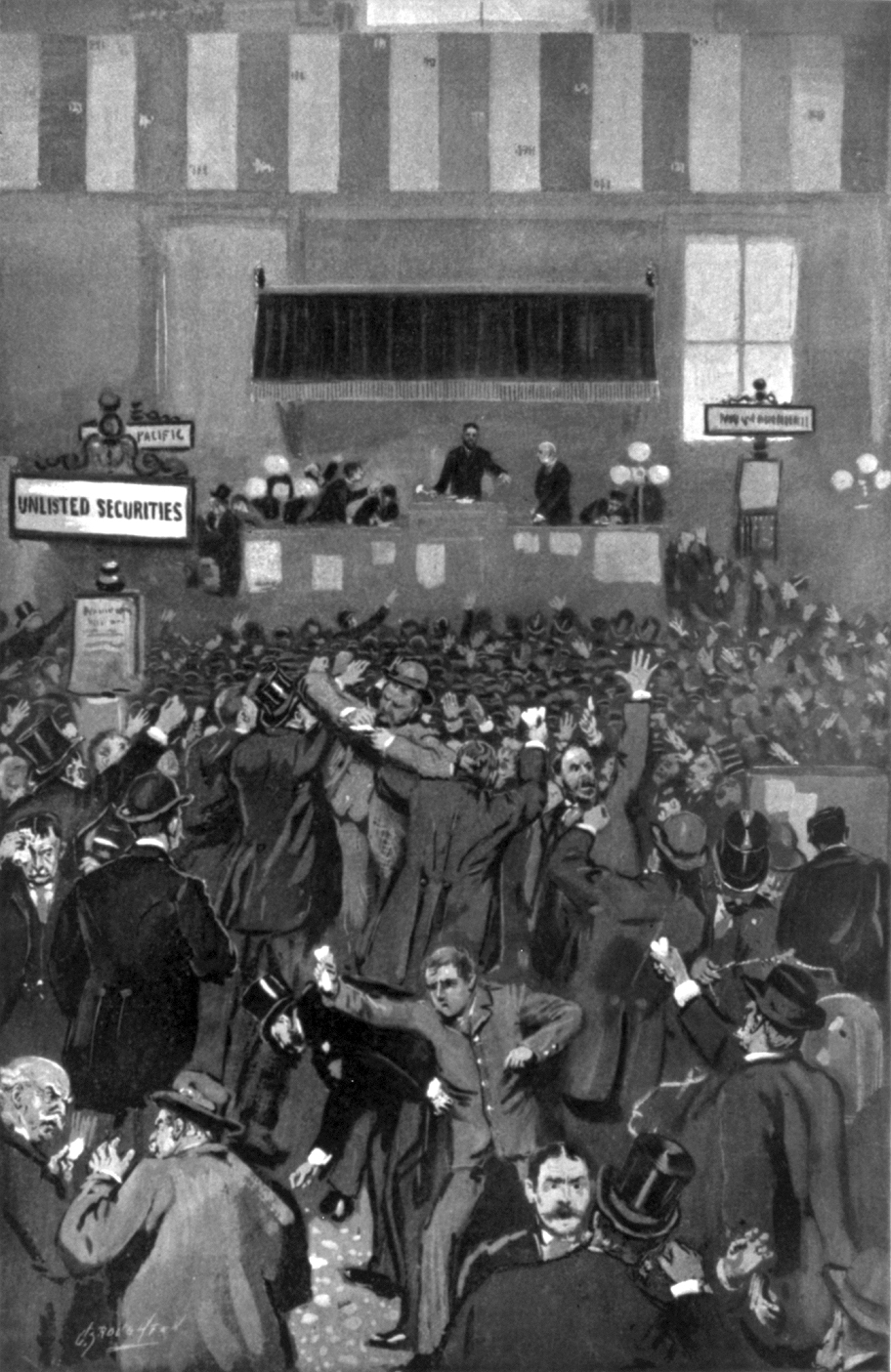
The Philadelphia and Reading Railroad and associated enterprises entered financial distress early in 1893, showing that heavily indebted railroads were already vulnerable. Their problems shook confidence among investors who had treated railway securities as a major source of wealth. The failure preceded some of the best-known stock exchange scenes in May. Distinguishing a developing contraction from a single dramatic crash helps explain the crisis’s chronology. Railway companies often had complex corporate structures and related mining or transport businesses, so losses could extend well beyond train operations. Investors’ concerns over one prominent failure could lead them to reassess the safety of other bonds and bank loans.
Why did National Cordage collapse?
The National Cordage Company, a major manufacturer associated with rope and twine, failed in May 1893 after financial difficulties and speculation. Its collapse became an important immediate shock to market confidence and helped intensify selling on the New York Stock Exchange. The company’s troubles did not originate every underlying weakness in the economy; railway debt and currency anxieties had been building before May. But its failure became a visible sign that large industrial combinations could be financially fragile. The Panic of 1893 is therefore connected to the broader Gilded Age debate over trusts and corporate power, including concerns later addressed through antitrust law and more rigorous disclosure.
What were bank runs?
A bank run occurs when many depositors simultaneously try to withdraw funds because they fear the bank may fail. Nineteenth-century banks kept only part of deposits in cash or immediately available reserves, having loaned the remainder to borrowers. Even a bank with valuable long-term assets could struggle to meet sudden withdrawals. During the panic, rumors and actual failures encouraged more people to demand cash, making fear self-reinforcing. There was no nationwide federal deposit insurance to reassure ordinary depositors. Distinguishing a liquidity problem from an insolvent bank is important, although panicking customers could rarely evaluate the difference. The FDIC’s historical accounts describe how such runs spread across regions.
Why was the gold reserve an issue?
The United States maintained monetary arrangements linked to gold while also issuing or purchasing silver under federal laws. Investors and other holders of currency worried that Treasury gold reserves were becoming inadequate to preserve confidence in redemption. Some exchanged paper money for gold, worsening the pressure on reserves. International investors’ decisions also affected gold movement and capital availability. The resulting currency debate was technical but politically explosive: supporters of gold emphasized stability and credit, while free-silver advocates wanted an expanded money supply. The reserve question interacted with bank failures and weak investment rather than replacing those problems as one simple explanation for the crisis.
What was the Sherman Silver Purchase Act?
The Sherman Silver Purchase Act of 1890 required increased federal purchases of silver and the issue of Treasury notes under its rules. Critics argued that it contributed to pressure on gold reserves and confidence in the monetary system. Supporters of silver believed that the country needed more money in circulation to ease debt burdens and support trade. In 1893 President Grover Cleveland pressed Congress to repeal the act’s silver-purchase provisions, and repeal became law in November. The controversy was not the same as the Sherman Antitrust Act of 1890; both laws carried Senator John Sherman’s name but addressed fundamentally different issues. Currency policy remained fiercely debated after repeal.
Who was president during the panic?
Grover Cleveland began his second, nonconsecutive presidential term in March 1893, just as serious economic problems were gathering. He favored maintaining confidence in gold and sought repeal of silver-purchase obligations. His administration encountered criticism from people who wanted more aggressive relief, monetary expansion or a different approach to public borrowing. Cleveland inherited vulnerabilities that developed over several administrations, and no presidential decision explains the entire downturn. His response nevertheless influenced the political struggle over currency and government’s responsibilities during a depression. The episode later contributed to divisions within the Democratic Party and to public dissatisfaction with established political leadership.
How severe was unemployment?
Unemployment surged, but precise national figures are difficult because the United States lacked the modern statistical surveys used to measure today’s jobless rate. Historical estimates sometimes put unemployment near or above one in six workers at the worst point, depending on methodology. Manufacturing shutdowns, railway failures and reduced construction produced hardship across cities and industrial towns. The effects were not evenly distributed: households with savings or secure employment could withstand conditions better than casual workers or those dependent on seasonal wages. Local charity and mutual aid groups were overwhelmed in many places. Describing the depression only through stock prices conceals the scale of lost income and insecurity.
What happened to family savings?
Depositors at failed banks could lose access to savings or recover only a portion through lengthy liquidation. Businesses unable to obtain new credit reduced operations, making it difficult for workers to find employment or support relatives. Families might pawn possessions, take boarders, move in with kin or seek charitable assistance. Farmers faced declining demand and debt obligations that did not shrink when crop prices fell. These varied experiences are not captured by an overall unemployment estimate. Bank runs were particularly damaging because the financial system did not have the federal deposit protection or central-bank lending institutions familiar to modern Americans. The hardship reached beyond major financial centers.
How did farmers experience the downturn?
Farmers were affected by lower commodity prices, debts, transportation charges and limited access to credit. Borrowers who had purchased land or equipment during better years sometimes found it difficult to meet fixed payments from declining income. Regional conditions varied, especially with drought, harvests and the distance to rail markets. The depression strengthened political support for movements demanding monetary reform and more favorable treatment of agricultural producers. Some hoped that an expanded silver-backed currency would make debt easier to repay by increasing available money, while creditors worried about its effect on financial obligations. These competing concerns fed the People’s Party and the election debate of 1896.
What was Coxey’s Army?
In 1894 unemployed workers and supporters joined a movement organized by Ohio businessman Jacob Coxey to march on Washington and demand federal action, including a public works proposal. Newspapers called participants Coxey’s Army, although they were civilians rather than military forces. The march attracted public attention as a visible protest against unemployment and the perceived inadequacy of relief. Its immediate legislative goals were not achieved, but it illustrated the growth of calls for a stronger government response to economic crisis. The participants’ grievances were not limited to stock market losses; they faced unemployment, poverty and limited opportunities for work. The episode was a notable moment in the history of public protest.
How did the depression shape the Pullman Strike?
The Pullman Strike of 1894 arose after reduced railcar orders led the Pullman Company to cut wages while worker housing costs remained burdensome. The wider depression contributed to employers’ insistence on lowering labor expenses and workers’ fear of losing jobs. The local factory dispute then expanded into a railway boycott that disrupted federal mail and interstate commerce. Soldiers and court injunctions helped break the strike. The events are related through the economic setting, but the panic did not mechanically cause every decision made by Pullman, the American Railway Union or federal authorities. The strike is an example of how prolonged financial distress magnified existing conflicts over wages and corporate control.
What role did J. P. Morgan play?
Financier J. P. Morgan helped arrange private syndicate operations intended to bolster Treasury gold reserves during Cleveland’s presidency, most famously in 1895. The deals became controversial because critics believed national financial stability depended too heavily on a small group of wealthy bankers. Supporters viewed access to gold as necessary to maintain confidence in government obligations. The arrangement did not immediately cure unemployment or reverse every bank failure, and it took place after the initial 1893 panic. Its political significance lay in revealing tensions between the federal Treasury, private capital and public accountability before the creation of the Federal Reserve System.
How did the crisis affect the 1896 election?
The presidential election of 1896 featured a major contest over gold and silver monetary policy. Republican William McKinley defended the gold standard, while Democrat William Jennings Bryan called for free coinage of silver and became famous for his Cross of Gold speech. The People’s Party also supported currency-related reforms, though its political strategy was complicated by fusion alliances and regional differences. The election did not function as a simple referendum on one bank failure. Voters faced years of unemployment, farm distress and debates over industrial power. McKinley’s victory helped confirm a policy direction toward gold, while the depression’s political consequences extended into the Progressive Era.
When did the economy recover?
Recovery was gradual and uneven, rather than a single date when every region suddenly regained prosperity. Industrial output and business activity strengthened later in the 1890s, though labor conditions and wages recovered at different rates. Economic historians sometimes identify shorter business-cycle phases within the broader 1893–1897 period, and a further downturn occurred during the decade. For this reason, saying simply that the depression ended in 1894 or that it lasted unchanged until 1900 obscures important differences. The historical lesson is that rebuilding confidence after widespread insolvency can take years, even when financial markets show improvement before employment and household security do.
How was the Panic of 1893 different from the Panic of 1873?
Both crises involved railroad investment, financial instability and long periods of economic hardship, but they occurred in different monetary and political settings. The Panic of 1873 followed the collapse of prominent financial houses including Jay Cooke & Company; the 1893 crisis involved new railroad insolvencies, bank runs and especially intense disputes over silver and gold reserves. The national economy had also changed substantially between the two dates. Comparing the panics helps show recurring weaknesses in credit-financed expansion without assuming they had identical causes or outcomes. Modern central banking and nationwide deposit insurance did not yet exist during either event.
Why does the Panic of 1893 matter?
The crisis exposed weaknesses in the American financial system and influenced debates over currency, government responsibility and corporate power. It also connected economic history with labor protest, presidential elections and the development of stronger national institutions in the early twentieth century. The Federal Reserve System created in 1913 responded to a longer history of instability, especially the later Panic of 1907; it was not established immediately after 1893. Studying the severe downturn helps explain why many Americans questioned whether private banks and laissez-faire policies provided enough security. Its history is most useful when financial measures are linked to the lived experiences of unemployed workers and struggling families.
Panic of 1893 timeline
| Date | Development |
|---|---|
| February 1893 | Philadelphia and Reading Railroad experiences insolvency. |
| May 1893 | National Cordage failure intensifies financial panic. |
| Summer 1893 | Bank runs, railroad receiverships and industrial shutdowns spread. |
| November 1893 | Silver-purchase provisions repealed. |
| 1894 | Coxey’s Army and Pullman Strike reflect deep unemployment. |
| 1895 | Treasury gold-reserve arrangements involve private financiers. |
| 1896 | Gold versus free-silver debate dominates presidential election. |
| Late 1890s | Uneven industrial recovery proceeds. |
Sources and further reading
- Federal Reserve Bank of Minneapolis — History of Central Banking
- Federal Reserve Bank of New York — Founding of the Fed
- FDIC — Banking history, 1850–1899
- Federal Reserve Education — 1893 panic lesson
- Library of Congress — Panic of 1893 stock exchange illustration
- Wikimedia Commons — May 5, 1893 panic scene