Dawes Act of 1887: Native American Land Allotment and Its Effects
The Dawes Act, signed on February 8, 1887, authorized the division of certain Native American reservation lands into individual allotments, replacing communal t
The Dawes Act, signed on February 8, 1887, authorized the division of certain Native American reservation lands into individual allotments, replacing communal tribal holdings under federal policy. Unallotted land could be declared surplus and opened to non-Native settlers. The policy was promoted as assimilation but contributed to the loss of roughly 90 million acres of Native-held land by 1934.
A documented account of what occurred, the people involved, the evidence and the longer-term consequences.
On this page — 21 topics
What was the Dawes Act?
The Dawes Act, also called the General Allotment Act or Dawes Severalty Act, was a federal law approved on February 8, 1887. It authorized the division of land held collectively on many Native American reservations into parcels assigned to individual Native households. U.S. officials claimed that individual ownership would promote farming and assimilation into mainstream American society. In practice, it undermined tribal landholding systems and permitted large areas not allotted to Native individuals to be transferred to non-Native settlers. It became one of the defining instruments of federal Indian policy during the late nineteenth century.
Who proposed the legislation?
The act is named for Massachusetts senator Henry L. Dawes, a prominent advocate of allotment. Reformers, missionaries, politicians and land interests supported varying versions of the plan, sometimes presenting it as a humanitarian alternative to military conflict. They assumed that private farming and the abandonment of communal land systems were signs of progress. Many Native nations disputed these assumptions or resisted the loss of collective authority. The law should therefore not be described as an agreement reached equally by tribes and the federal government. It was enacted through federal power within a larger system of treaties, reservations and political pressure.
What was meant by ‘severalty’?
The term “severalty” referred to holding land as separate individual property rather than as part of a collectively recognized tribal land base. Under the Dawes system, federal agents could survey reservations and assign parcels to eligible people, frequently with different allocations according to family status or intended use. The government asserted control over titles and often held allotments in trust for a period before imposing other legal arrangements. This was a major transformation in governance, not merely a change in farm size. Ownership and use arrangements already varied among Native nations, and federal officials imposed a narrow legal model on these distinct traditions.
How large were the allotments?
The act described different acreage categories, with a commonly cited figure of 160 acres for a head of family and smaller allotments for some other eligible individuals. The precise acreage available could depend on age, family status, land classification, amendments and the terms applicable to a particular reservation. A popular summary claiming that every Native person received exactly 160 acres is inaccurate. Many people obtained smaller or environmentally poor parcels, and some were left out of rolls entirely. Legal descriptions and agency records are needed to determine what a particular individual was actually assigned and whether title was later issued.
What happened to land called surplus?
After officials allotted land to enrolled individuals, remaining reservation land could be designated surplus and opened for acquisition by non-Native settlers through federal processes. This transfer mechanism was central to the policy’s impact. From the government’s viewpoint, allotment was supposed to create farms and release land seen as unused; from the perspective of Native communities, collectively controlled territory was being removed and sold. The designation did not mean the land had no cultural, agricultural or political value to the tribe. Even lands not immediately cultivated could be important for grazing, hunting, seasonal movement and community continuity.
Why was the act tied to assimilation?
Federal policy makers believed that private landholding, Christian schooling and agriculture modeled on white American farms would replace Indigenous forms of political and cultural life. Their assumptions often ignored ecological differences and long-established practices of Native communities. Allotment operated alongside boarding schools and restrictions on languages and religious practices. The goal was not simply to teach new agricultural skills; it involved weakening tribal governance and identity. For that reason, historians study the Dawes Act as part of a larger coercive assimilation program. The Carlisle boarding school history explores another element of this policy system.
How did the land trust work?
Many allotments were held in federal trust for a period intended to protect recipients from immediate sale or taxation. The original act commonly provided for a twenty-five-year trust, although later legislation and administrative decisions changed how restrictions operated. The protection was incomplete, and allotments could become vulnerable through changes in ownership status, federal approval of transactions or inheritance. This system produced complicated records and long-term legal problems. A trustee arrangement imposed by a government also differs fundamentally from Native nations choosing their own land tenure. Federal authority over title reduced communities’ ability to decide collectively how their territory would be managed.
Did the Dawes Act give Native people citizenship?
The statute contained provisions linking some allotments and Native people leaving tribal relations to U.S. citizenship under specified circumstances. The details were complex and did not create full, equal political rights for all Native Americans in 1887. Citizenship and voting rights were also subject to other laws and discriminatory state practices. Congress later enacted the Indian Citizenship Act of 1924, extending citizenship to Native Americans born in the United States who had not already obtained it, though barriers to voting persisted. It is therefore misleading to state either that no Native person was a citizen before 1924 or that the Dawes Act made every Native American a full citizen.
Were all tribes covered by the original act?
No. The original statute contained exclusions for certain tribes and territories, and some land policies were controlled by separate treaty or legislative arrangements. Later laws, including provisions affecting the Five Tribes in Indian Territory, expanded allotment in different forms. The Curtis Act of 1898 and work of the Dawes Commission involved a related but distinct process. Readers researching family membership or land in Oklahoma should not assume that the Dawes Act automatically governed every Nation on the same terms in 1887. The National Archives distinguishes the general allotment statute from the special enrollment records associated with the Dawes Commission.
What was the Dawes Commission?
The Dawes Commission was established in the 1890s to negotiate and administer allotment and enrollment arrangements among the Five Tribes of Indian Territory. Its records later became widely used in genealogy. Despite the shared name, the commission’s rolls and the original 1887 statute are not identical documents or processes. Enrollment was contested, and surviving records reflect federal categories and decisions that did not always match community understandings of identity. The National Archives research guide explains the records and their limitations. It is particularly important not to treat a surname appearing on a roll as automatic proof of a specific tribal citizenship today.
How much land was lost?
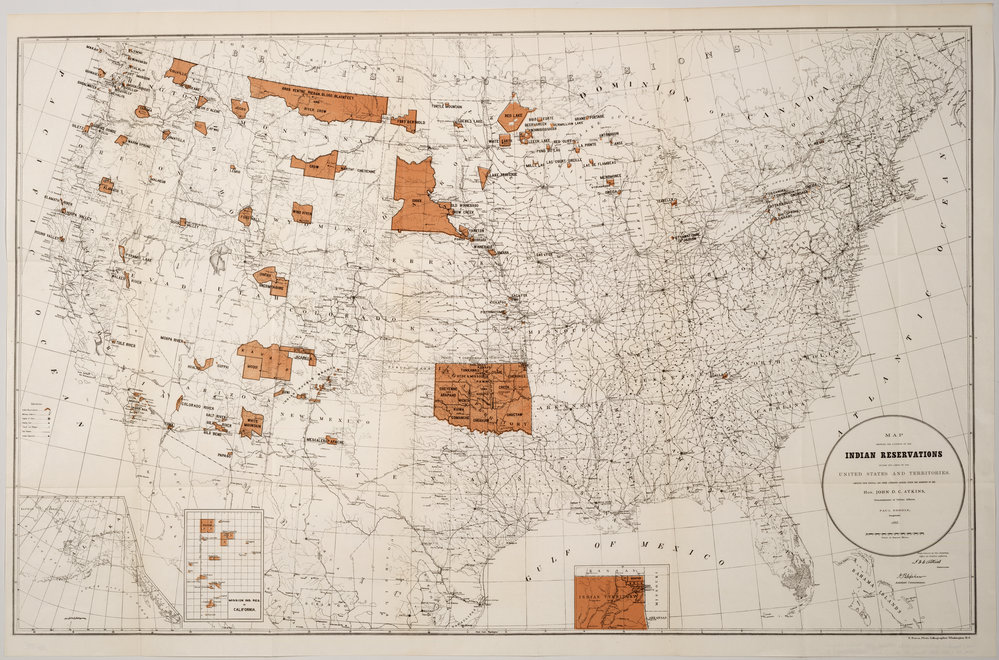
The National Park Service describes more than 90 million acres of Native land lost during the allotment period. The Bureau of Indian Affairs estimates that Indigenous-held land fell from roughly 138 million acres in 1887 to approximately 48 million by 1934. These figures reflect decades of allotment and related policy rather than transfers completed in the year the law passed. Differences in totals can arise from definitions of landholding, dates and administration. The scale was extraordinary and severely affected the resources available to tribal communities. It is one reason modern histories emphasize land loss, not simply the number of individual patents issued.
Did farming become easier for allotment recipients?
Often it did not. Some parcels were poorly suited to agriculture without irrigation, equipment or livestock. Families were sometimes expected to adopt unfamiliar crop systems while maintaining their livelihoods under severe federal oversight. Many faced problems obtaining loans, seeds or transportation to markets. Some Native people successfully adapted land use within the new constraints, but that does not demonstrate the policy as a whole was beneficial. The loss of communal land bases reduced flexibility and could disrupt grazing, seasonal movement and kinship networks. Economic outcomes differed substantially across regions and people and cannot be reduced to one national average.
How did outsiders acquire former reservation lands?
Some lands were opened through federal sales after being declared surplus, while others moved into non-Native ownership through later sales, taxation, fraud or inheritance arrangements. The mechanisms differed among reservations and periods. Government land offices and railroads promoted settlement in regions newly opened to homesteaders. The policy linked Native land loss to wider western expansion, including the Homestead Act. It is important to explain these as separate laws that interacted, not claim that allotment itself automatically turned every remaining acre into a free homestead. Detailed historical maps show the dramatic reduction in tribal land bases across the late nineteenth and early twentieth centuries.
How did the policy affect tribal governments?
Collective landholding was tied to tribal authority, community planning and treaty relationships. Breaking reservations into individual parcels reduced the territorial resources over which tribal institutions could exercise meaningful control. Federal agents and land offices gained power over membership lists, boundaries and title decisions. The consequences extended beyond economics to family life, political representation and ceremonial connections to place. Tribes responded in different ways, including protest, legal challenges and adaptations designed to preserve communities. The Dawes Act did not extinguish tribal governments, but it imposed pressures that Native nations continued contesting well into the twentieth and twenty-first centuries.
What was the connection to Indian boarding schools?
Allotment and off-reservation schools shared an official aspiration to transform Indigenous identities and ways of life. The federal government attempted to replace tribal land systems with individual farms while schools sought to change children’s languages, clothing, religious practice and family relationships. Native children were sometimes taken far from their communities, often under coercion. These policies operated together but should not be conflated into one statute; the Dawes Act did not itself establish every boarding school. Exploring both policies shows the breadth of the assimilation project and the resilience of families and tribes that resisted efforts to sever cultural continuity.
What did the Indian Reorganization Act of 1934 change?
The Indian Reorganization Act of 1934, associated with the policy shift sometimes called the Indian New Deal, ended further general allotment and supported renewed tribal self-government in certain forms. It did not restore all land previously sold or remove every legal complication created by fractionated ownership. Different tribes responded to its provisions differently, and some rejected the governmental structures it offered. The 1934 act marked a major change from the federal objective of dismantling communal land bases, but it was not a complete reversal of the preceding fifty years. Present-day land trust questions often reflect the unresolved legacy of allotment.
Why are land records important?
Allotment applications, agency rolls, maps, patents and land transactions can help reconstruct what happened to particular families and parcels. These records can also reveal how government officials defined identity and eligibility in ways that Native communities disputed. Researchers need to connect records to a specific tribe and jurisdiction, because the Dawes Commission rolls do not cover all Native peoples. Federal documents should be interpreted alongside tribal archives and oral histories. The original act at the National Archives provides the legal starting point, while Bureau of Indian Affairs records illuminate later administration and land loss.
How should the Dawes Act be understood today?
The Dawes Act is a central example of policy presented as reform while producing profound harm. It promised individual landownership but worked within a system that denied Native nations control over their territories. The resulting loss of land undermined economic resources, governance and cultural continuity. A historically responsible explanation acknowledges that some people received and retained land, while the wider system enabled extraordinary transfers to outsiders. It also recognizes Native communities as active participants who negotiated, resisted and survived. The law’s history illuminates why modern debates about tribal sovereignty, land restoration and trust ownership have deep nineteenth-century roots.
Timeline
| Date | Event |
|---|---|
| February 8, 1887 | Dawes Act signed under President Grover Cleveland. |
| 1890s | Federal allotments expand on many reservations. |
| 1893–1898 | Dawes Commission and later laws address Indian Territory. |
| 1924 | Indian Citizenship Act extends citizenship broadly. |
| 1934 | Indian Reorganization Act ends the general allotment program. |