Battle of Fort Fisher (January 1865): Wilmington and the Confederate Blockade
Union army and naval forces captured Fort Fisher near Wilmington, North Carolina, on January 15, 1865, after a powerful bombardment and coordinated infantry a
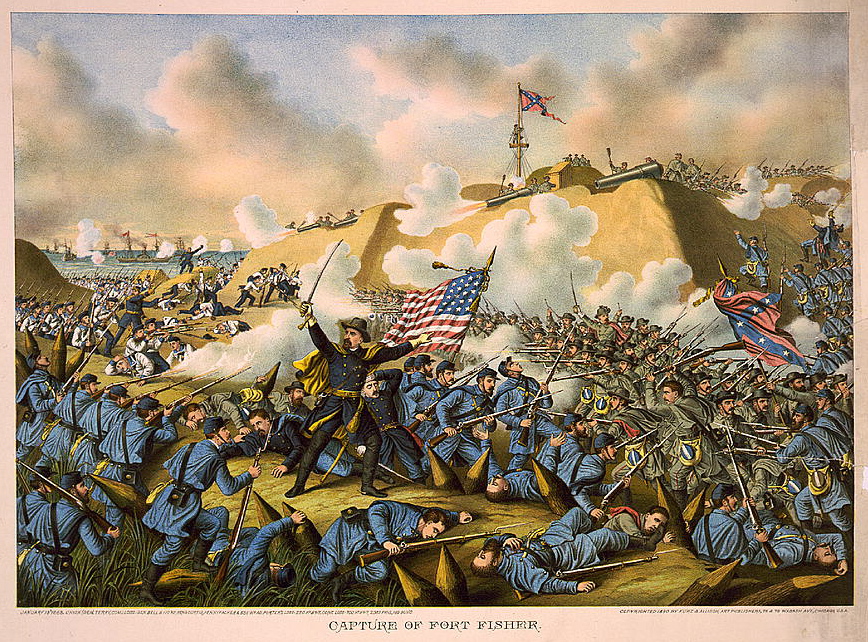
Union army and naval forces captured Fort Fisher near Wilmington, North Carolina, on January 15, 1865, after a powerful bombardment and coordinated infantry assault. The fort protected the Cape Fear River entrance to Wilmington, an important Confederate blockade-running port. Its fall closed a crucial foreign supply route and led to the capture of Wilmington in February.
This guide separates events, causes, battlefield decisions and long-term consequences using historical research.
On this page — 23 topics
What happened at Fort Fisher in January 1865?
Fort Fisher was a Confederate coastal fortification guarding the entrance to the Cape Fear River in North Carolina. In January 1865, Union troops under Alfred H. Terry and naval forces commanded by David D. Porter launched a renewed operation after an earlier December attack had failed. Naval bombardment weakened the defenses, while an infantry assault on January 15 overcame the garrison. The fort surrendered late that day. Capturing it blocked Confederate access to Wilmington, a remaining major Atlantic port used by blockade runners. The victory was a strategic blow to Confederate supply during the last months of the Civil War.
Why was Wilmington important?
Wilmington’s position on the Cape Fear River allowed blockade runners to reach warehouses and rail connections behind the Confederate lines. Vessels traveled between North Carolina and foreign ports such as those in Bermuda and the Bahamas, carrying supplies essential to the Southern war effort. Unlike a large open seaport exposed directly to naval gunfire, Wilmington was approached through navigable channels protected by a network of forts and batteries. As other Confederate ports fell or became unusable, Wilmington grew in importance. Closing its sea approaches would restrict imported weapons, medicines, clothing and other supplies available to remaining Confederate armies.
Where was Fort Fisher located?
Fort Fisher occupied Federal Point near the mouth of the Cape Fear River, south of Wilmington and near the Atlantic Ocean. The fort’s long earthen works were designed to protect the New Inlet approach to the river. Its defenses included a land-facing line of large earthworks and a separate sea-facing system with guns aimed at approaching vessels. The landscape of sand, marsh and coastal channels shaped how soldiers and sailors could attack. Modern coastline erosion has removed substantial portions of the original defenses, making historical maps particularly important for reconstructing the fort’s appearance and the routes used in 1865.
How was Fort Fisher built?
Confederate engineers constructed Fort Fisher primarily with earth, sand and timber instead of vulnerable masonry walls. Its massive traverses separated gun positions and reduced the damage caused by exploding shells. Bombproof shelters provided some protection from naval fire. The earthwork system was well suited to withstanding bombardments that might have shattered older brick forts. The defenders also placed palisades and obstacles before the land front. These characteristics explain why the fort survived a powerful Union naval attack in December 1864 and why the final January assault required infantry to penetrate individual defensive positions rather than simply wait for all the walls to collapse.
What happened during the December 1864 attack?
The first major Union attempt against Fort Fisher occurred on December 24–25, 1864. A large naval force bombarded the fort while troops under Benjamin F. Butler landed nearby. The operation was badly coordinated, and the fort was not assaulted successfully. Butler withdrew his troops, prompting criticism and the appointment of Alfred H. Terry to command the next expedition. The December failure demonstrated that bombardment alone was insufficient if it was not combined with a timely, determined attack by land. Federal planners returned with lessons about how to coordinate naval fire and infantry movement more effectively.
Why was Alfred Terry selected?
Major General Alfred H. Terry was chosen to lead the renewed ground operation after the failure of the first expedition. He worked closely with Rear Admiral David D. Porter to organize a coordinated bombardment, landing and assault. Their planning emphasized gaining a secure beachhead north of Fort Fisher, cutting off possible Confederate reinforcements and selecting a moment when naval fire had weakened the defenders. Terry’s forces included Black Union troops, though the assault itself involved specific designated formations. His approach contrasted with the poorly integrated December attack. The renewed effort showed how effective cooperation between army and navy could transform the results of a coastal operation.
What role did Admiral David Porter play?
David Dixon Porter commanded the Union fleet that supported the Fort Fisher operations. His warships bombarded the Confederate batteries on a huge scale, using carefully timed fire to suppress guns and protect troops moving ashore. Porter also organized a naval assault force of sailors and marines on January 15. The naval landing suffered a serious defeat, but it helped draw Confederate attention toward part of the fort while Terry’s infantry attacked elsewhere. The operation should not be described as an exclusively naval victory. Its success depended on Porter and Terry cooperating despite different responsibilities, weapons and command structures.
How did the January attack begin?
Federal ships renewed their bombardment on January 13, 1865, while Union troops landed north of Fort Fisher and established positions on the peninsula. The landing threatened to isolate the fort from Confederate reinforcements farther inland. Heavy naval fire continued over subsequent days, damaging gun positions and disrupting communication. Union officers examined the defenses and prepared separate attacks against different sectors. The success of the landing was as important as the shelling because it gave Terry space to organize forces without immediately being trapped on the beach. Confederate commanders now faced simultaneous threats from land and sea.
Why was the bombardment effective?
The second naval bombardment was better coordinated than the first and concentrated on the earthwork defenses, traverses and artillery positions. The U.S. Naval History and Heritage Command records that the fleet fired nearly 20,000 projectiles during the second attack. Bombardment disabled guns, killed or wounded defenders and complicated the garrison’s attempts to move or communicate. It did not destroy every Confederate position; soldiers still fought fiercely when the infantry advanced. The principal achievement was reducing defensive fire and making it possible for attackers to penetrate the land front with a better prospect than in December.
Who defended Fort Fisher?
Confederate Colonel William Lamb was a central figure in Fort Fisher’s defense, while Major General W. H. C. Whiting was also present and became closely associated with the final battle. Both were wounded during the fighting. Confederate troops held strong works but faced overwhelming pressure from the fleet and attacking infantry. The defenders were not necessarily cowards or ineffective soldiers; many fought for hours among the traverses after Union troops entered the fort. Their resistance prolonged the battle but could not restore the damaged guns or bring enough reinforcements from Wilmington. The result reflected the larger deterioration of Confederate military power.
What happened during the naval landing?
On January 15 a Union force of sailors and marines advanced against a northeastern part of Fort Fisher. Their weapons, formation and route left them vulnerable to concentrated Confederate fire. The attempt was repulsed with heavy losses. This failure has sometimes led to questions about Porter’s plan, but the fighting also helped draw defenders toward the exposed coastal sector. Terry’s infantry attacked a different part of the land front around the same time. The two assaults illustrate why it is misleading to describe the final capture as one continuous, uniformly successful Union advance along the beach.
How did Union infantry capture the land face?
Union infantry attacked near the western portion of Fort Fisher’s landward line on January 15 and penetrated the works. Fighting continued from traverse to traverse as Confederate defenders attempted to hold each section. The earthworks that had protected the garrison from naval bombardment now divided the interior into separate positions that the attackers could reduce gradually. Union officers and soldiers faced intense close combat, and victory was far from automatic after the first entry. By late evening, however, organized Confederate resistance had collapsed and the fort surrendered. The assault was a combined-arms success achieved with substantial casualties.
Did United States Colored Troops take part?
African American Union soldiers formed part of the expeditionary force and its supporting operations, including units of United States Colored Troops assigned to Alfred Terry’s command. North Carolina’s Fort Fisher State Historic Site identifies the 27th U.S. Colored Troops among participants in the operation. Their role should be described precisely rather than claiming every Black unit led the attack that broke into the fort. Black soldiers served across the Union war effort at a time when their military performance also carried implications for emancipation and citizenship. The wider history is explained in our Black Union soldiers guide.
When did Fort Fisher fall?
The decisive assault occurred on January 15, 1865. After hours of close-range fighting, Confederate resistance ended late that evening and the garrison surrendered. The fort’s fall did not mean every Confederate position in the Cape Fear region surrendered simultaneously. Union forces still had to occupy river defenses and advance toward Wilmington. Nevertheless, capturing Fort Fisher eliminated the principal protection of the New Inlet entrance and made it much harder for blockade runners to use the port. The exact January date matters because it separates the battle’s climax from the later occupation of Wilmington.
How many casualties were recorded?
The National Park Service gives an estimate of 3,642 casualties for the Second Battle of Fort Fisher, including approximately 1,059 Union and 2,583 Confederate casualties. The totals include people killed, wounded, missing or captured as defined by military reporting, not fatalities alone. Prisoners account for a substantial part of Confederate losses. Some historical works use different figures because they include the separate December attack or other operations in the vicinity. To compare numbers accurately, readers should specify whether they refer to the January assault, the wider Wilmington campaign or all attacks on Fort Fisher.
Did Fort Fisher’s fall end the blockade-running trade?
The loss of Fort Fisher effectively closed the New Inlet route to Wilmington, stripping the Confederacy of one of its most important remaining access points for transatlantic supplies. Other smaller forms of coastal movement and trade did not immediately cease everywhere in the South, but the fall was a major strategic blow. Confederate armies already suffered supply problems, and losing Wilmington’s maritime connection made them worse. The result illustrates the cumulative effects of the Union blockade: success did not depend on stopping every vessel every day, but on progressively closing the few ports still capable of sustaining large-scale imports.
When did the Union capture Wilmington?
Federal troops advanced toward Wilmington after Fort Fisher’s capture and eventually occupied the city on February 22, 1865. Confederate defenders withdrew as the remaining positions on the Cape Fear River became untenable. This was more than a month after the decisive fight at Fort Fisher, and the two dates should not be merged. The city had been a major commercial and military hub, and its loss further isolated Confederate armies in the eastern United States. The port’s capture followed the fort’s fall, showing how coastal strongpoints supported inland logistical networks and how their defeat opened additional military objectives.
How did the victory affect the final months of the war?
By January 1865 the Confederacy was under severe pressure in Virginia, the Carolinas and other theaters. Closing Wilmington denied military supplies at a time when Confederate forces had little capacity to replace losses. The victory also showed the strength of the United States Navy working closely with an army expedition. It did not independently force Lee to surrender, but it contributed to the worsening strategic conditions that preceded the Appomattox surrender in April. Historians assess Fort Fisher as one of several linked operations that dismantled Confederate communications and material resources.
What remained of Fort Fisher?
After the war the fort gradually changed through storms, coastal erosion and later development. Only part of its immense wartime earthworks survives on the modern landscape. State preservation efforts maintain the historic site and interpret its surviving features, coastal geography and archaeological remains. Visitors should not assume that today’s shoreline matches the shape of the peninsula in 1865. Maps, aerial views and preserved traverses offer a more accurate sense of the fort’s scale. The surviving site is an important resource for studying defensive engineering as well as the role of blockade-running trade in the Civil War.
Where can the battle be researched?
The North Carolina State Historic Site provides a detailed history and an explanation of the assaults. The U.S. Naval History and Heritage Command documents the fleet’s planning, bombardment and role. The National Park Service battle summary gives the outcome and casualty estimate. Comparing the three helps avoid confusing the December and January attacks or reducing the capture to one famous illustrated charge.
Timeline
| Date | Event |
|---|---|
| December 24–25, 1864 | First major Union attack fails to take Fort Fisher. |
| January 13, 1865 | Naval bombardment resumes; Terry’s troops land north of the fort. |
| January 14 | Union commanders prepare for coordinated assault. |
| January 15 | Naval landing is repulsed; Union infantry captures the fort. |
| February 22 | Union forces occupy Wilmington. |