Peninsula Campaign (1862): McClellan, Yorktown, Seven Pines and Richmond
How McClellan approached Richmond by water, gained ground in Virginia and ultimately withdrew.
The Peninsula Campaign was Union General George B. McClellan’s 1862 attempt to capture Richmond by moving the Army of the Potomac up the Virginia Peninsula. His army advanced from Fort Monroe past Yorktown and Williamsburg to the outskirts of Richmond, but Confederate defenses, the Battle of Seven Pines and Robert E. Lee’s Seven Days offensive forced a retreat to the James River.
Explore the chronology, key commanders, terrain, outcomes and surviving historical evidence.
On this page — 23 topics
What was the Peninsula Campaign?
The Peninsula Campaign was the United States Army’s major spring and early-summer 1862 effort to capture Richmond, Virginia, the Confederate capital. General George B. McClellan transported the Army of the Potomac by ship to the peninsula between the York and James Rivers, hoping to use water transport and coastal bases to approach Richmond from the southeast. The plan bypassed many overland Confederate positions between Washington and Richmond. It succeeded in bringing a huge Union force close to the city, but the campaign ended without taking the capital after Confederate counteroffensives pushed the Union army to the James River.
Why did McClellan choose the Virginia Peninsula?
McClellan believed that an amphibious movement would permit the Union to maneuver around Confederate forces defending northern Virginia and advance toward Richmond on a route supported by the navy. The geography offered navigable waterways, but it also presented swamps, muddy roads, fortified crossings and vulnerable supply lines. Movement along the peninsula could be slower than expected because armies still depended on roads and bridges once ashore. The plan reflected McClellan’s preference for carefully assembled forces and logistics before major attacks. It was a serious operational alternative, not a simple mistake, although its execution remained subject to persistent disputes.
How did the Union army reach Fort Monroe?
Beginning in March 1862, Union authorities organized a vast movement of troops, horses, artillery and stores from the Washington region to Fort Monroe near Hampton Roads. Water transport allowed much of the Army of the Potomac to arrive without fighting through northern Virginia. The fleet’s complexity mattered: units, wagons, animals and supplies did not all arrive simultaneously, and the army needed suitable landing places and depots. Fort Monroe was already a United States stronghold. From there, McClellan’s forces could begin moving northwest toward Yorktown and ultimately Richmond while using the region’s rivers to receive vital logistical support.
What was happening at Hampton Roads?
In March 1862, the Confederate ironclad CSS Virginia and the Union USS Monitor fought at Hampton Roads. Their encounter demonstrated the importance of armored naval vessels and complicated plans for using the James River. The CSS Virginia threatened conventional wooden warships and restricted Union freedom of movement in some waters. Although the Monitor prevented an immediate Confederate naval breakthrough, the presence of the Confederate ironclad affected McClellan’s thinking about a riverborne approach. See our Monitor versus Virginia guide for the separate naval battle, which was related to but not identical with the Peninsula Campaign.
Why did Yorktown delay the Union advance?
McClellan encountered Confederate defensive works near Yorktown and along the Warwick River in early April. Confederate General John B. Magruder used fieldworks, deceptive troop movements and the difficult terrain to suggest a formidable defensive position. McClellan chose to prepare heavy siege artillery rather than launch an immediate major assault. The resulting pause provided Confederate leaders with time to reinforce or reorganize their army. Historians disagree about the balance between sensible caution and excessive delay, but the consequence is clear: the Union advance stalled for much of April while Richmond’s defenders improved their options.
Did the Confederates surrender Yorktown?
No. Confederate commanders withdrew from the Yorktown–Warwick line early in May before McClellan’s planned bombardment and assault. The Union occupied abandoned positions and began pursuit. This distinction matters because maps that show Yorktown falling into Union hands can create the impression of a siege completed by a dramatic battlefield capture. The Confederate retreat preserved much of their army for further fighting, although it also conceded ground. The episode illustrates how fortified positions can delay a much larger opponent without being held indefinitely. It also set up the fighting at Williamsburg, where Confederate troops covered the continuing withdrawal.
What happened at Williamsburg on May 5?
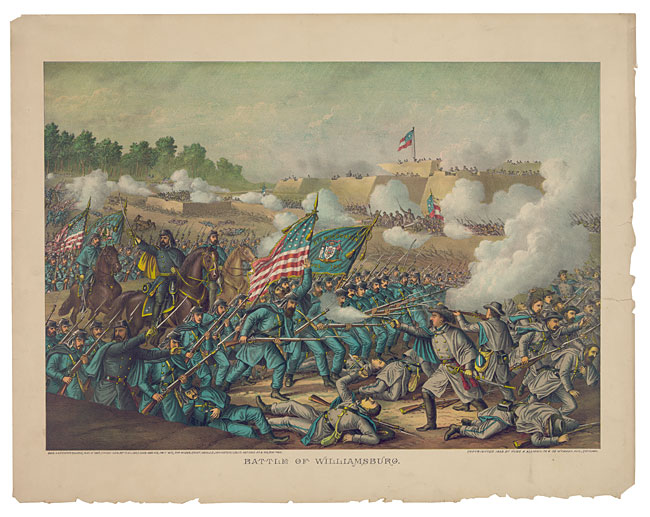
On May 5, Union forces pursuing the Confederate retreat encountered a Confederate rear guard near Williamsburg, Virginia. Fighting occurred around earthworks and roads in heavy rain, with soldiers struggling through mud and woodland. Officers such as Joseph Hooker and Winfield Scott Hancock participated in contested Union efforts, while Confederate forces fought to protect the retreat of the main army. The engagement did not produce a decisive destruction of either side. Confederate troops withdrew afterward, and McClellan’s army continued toward Richmond. The historical illustration accompanying this guide depicts Williamsburg, one episode of the wider campaign rather than its entire outcome.
How important were the York and James Rivers?
The peninsula’s rivers were indispensable to Union planning because vessels could carry enormous quantities of food, ammunition, medical stores and other essentials. Bases such as White House Landing on the Pamunkey River connected the army to the railroad toward Richmond. The James River also offered an alternative line of supply and withdrawal. However, water transport did not solve every problem: bridges over the Chickahominy, rain-swollen lowlands and the distance between river depots and combat units created additional vulnerabilities. A campaign map that ignores supply routes cannot fully explain McClellan’s choices or Lee’s later attacks on the Union line.
What happened when the Confederates left the Peninsula defenses?
Confederate commander Joseph E. Johnston pulled his forces back toward Richmond as Union troops advanced. The retreat traded territory for time and avoided a potentially disastrous confrontation with the entire federal army at the Yorktown line. Confederate troops fought rear-guard actions and took up new positions closer to the capital. The movement increased anxiety in Richmond, where political leaders recognized that the Union army was approaching within striking distance. At the same time, the defenders operated on shorter interior lines. The campaign therefore became a race between Union concentration and Confederate reinforcement and counterattack.
What was the Battle of Seven Pines?
The Battle of Seven Pines, also called Fair Oaks, took place May 31–June 1, 1862, on the approaches to Richmond. Johnston attempted to strike Union formations separated by the flooded Chickahominy River. Confederate attacks achieved some local success, but communication failures and strong Union resistance prevented a decisive victory. Johnston was seriously wounded, creating a change in Confederate command. The battle cost thousands of casualties and demonstrated how the river could divide McClellan’s army during intense combat. It was inconclusive tactically but pivotal politically and institutionally because Robert E. Lee soon assumed command near Richmond.
How did Robert E. Lee become the Confederate commander?
After Johnston was wounded at Seven Pines, Confederate President Jefferson Davis appointed Robert E. Lee to command the force defending Richmond. Lee reorganized his army, strengthened defensive arrangements and planned an offensive to push the Union army away from the capital. His approach contrasted with the expectation that the Confederates would merely hold fortifications while McClellan gathered more strength. Lee’s planning involved bringing Stonewall Jackson’s troops from the Shenandoah Valley to reinforce the Richmond front. The command change helped transform the campaign from a slow federal approach into a sequence of aggressive Confederate attacks.
Why did McClellan not immediately capture Richmond?
McClellan’s advance faced formidable obstacles, including difficult ground, separated formations, uncertain intelligence and the challenge of coordinating an army of enormous size. He consistently believed that Confederate forces were stronger than they actually were, which reinforced his caution. Political disagreements about troop availability also affected planning. Yet it would be simplistic to attribute the failure solely to fear or indecision: defending Richmond was important to the Confederacy, whose armies actively fought to disrupt the Union approach. The decisive development came when Lee gained time to initiate an offensive before McClellan could establish a secure, effective siege.
What role did the Chickahominy River play?
The Chickahominy River and its swampy bottomlands crossed the Union front northeast of Richmond. Heavy rain caused flooding and damaged bridges, threatening to divide the Army of the Potomac into separated groups. Commanders needed working crossings to reinforce or retreat, while Confederate troops looked for opportunities to attack isolated units. The river was central both to Seven Pines and the later Seven Days engagements. Engineering and the maintenance of roads and bridges therefore mattered as much as battlefield courage. A general could have tens of thousands of soldiers nearby yet be unable to place them quickly where they were needed.
What were the Seven Days Battles?
The Seven Days Battles were a series of engagements around Richmond between June 25 and July 1, 1862. Lee’s army struck the Union position and supply connections, while McClellan withdrew toward the James River. Confederates suffered heavy losses in repeated attacks, and Union troops won several defensive engagements, including at Beaver Dam Creek and Malvern Hill. Nevertheless, the overall operation ended McClellan’s immediate threat to Richmond. This article covers the complete Peninsula Campaign; the separate Seven Days guide examines the specific battles and tactical sequence.
What happened to Union supplies during Lee’s offensive?
The approach of Confederate forces toward the Army of the Potomac’s northern supply line prompted McClellan to shift his logistical base away from the railroad and toward the James River. Moving a major army and its wagon trains while engaged in battle required careful rearguard actions and difficult road movements. The decision gave the army a defensible destination but also relinquished the positions close to Richmond it had spent weeks gaining. Lee did not capture or annihilate all Union supplies, and McClellan preserved much of his army. The change of supply base helps explain why a series of defensive battlefield successes still accompanied a strategic retreat.
What happened at Malvern Hill?
On July 1, Union artillery and infantry occupied strong positions at Malvern Hill while Confederate units attacked the open approaches. The Confederate assaults were poorly coordinated and suffered severe losses from Union gunfire. Federal forces held the field, a clear Union tactical success. Nevertheless, McClellan subsequently moved the army to Harrison’s Landing on the James River instead of resuming a direct offensive toward Richmond. This apparent contradiction is central to evaluating the campaign: winning the last battle did not mean the Union restored its former operational position or achieved the objective of taking the Confederate capital.
Why was the campaign considered a Union failure?
The Union had aimed to capture Richmond, damage Confederate military power and potentially shorten the war. At the end of the campaign Richmond remained Confederate, and the Army of the Potomac was positioned along the James River rather than approaching the city. McClellan’s troops had won important actions and remained an effective force, so this was not the complete destruction of a Union army. But strategic objectives determine the result of a campaign. The failure contributed to command disputes, altered federal plans in Virginia and gave Lee the opportunity to conduct operations against Union forces elsewhere in the state.
How many soldiers became casualties?
The campaign involved multiple battles with distinct casualty totals, including Yorktown, Williamsburg, Seven Pines and the Seven Days. Figures should not be combined casually because some sources count only the final week while others cover the entire campaign. The Seven Days alone produced more than 30,000 combined casualties according to commonly used battlefield totals. Casualties include killed, wounded, missing and captured; they are not identical with deaths. The scale of suffering strained field hospitals and civilian communities around Richmond. Comparing clearly defined time periods is more useful than citing an unexplained grand total for every engagement.
What was the effect on Richmond and Virginia civilians?
Farms, roads and communities around the capital were occupied or damaged by both armies. Soldiers cut timber, consumed food, moved livestock and created enormous demand for transport and medical care. Refugees and enslaved people encountered Union lines in search of safety or freedom, while Confederate authorities mobilized workers and resources to defend Richmond. Disease killed many soldiers who never fell in battle. The civilian dimensions demonstrate that the peninsula was an inhabited landscape, not an empty corridor leading to a capital. The campaign’s legacy also includes its contribution to the growing national debate over emancipation and the treatment of people escaping slavery.
How did the Peninsula Campaign shape later fighting?
Lee’s successful defense of Richmond allowed him to move against Union armies in northern Virginia, producing the Second Battle of Bull Run in August and the Maryland Campaign that followed. McClellan eventually returned to prominent command during Lee’s invasion, culminating in the Battle of Antietam. The Peninsula Campaign thus links the initial Union strategic effort of 1862 to the later development of Lee’s reputation and Lincoln’s wartime decisions. Its failure did not predetermine the war’s outcome, but it ended the hope that Richmond would fall quickly through an amphibious advance.
Timeline
| Date | Event |
|---|---|
| March–April 1862 | Union Army of the Potomac moves by water to Fort Monroe. |
| April 5–May 4 | Confederates delay the advance at Yorktown; then withdraw. |
| May 5 | Battle of Williamsburg. |
| May 31–June 1 | Battle of Seven Pines; Johnston wounded. |
| June 26–July 1 | Lee’s Seven Days offensive. |
| July 1 | Union defensive victory at Malvern Hill. |
| July 2 onward | Union army consolidates at Harrison’s Landing. |