Overland Campaign (1864): Grant vs. Lee, Battles and Timeline
Grant kept moving south despite terrible casualties, forcing Lee into a prolonged struggle for Richmond and Petersburg.
The Overland Campaign was a series of battles in Virginia from May to June 1864 between Union forces directed by Ulysses S. Grant and the Confederate Army of Northern Virginia under Robert E. Lee. It began at the Wilderness, continued through Spotsylvania, North Anna and Cold Harbor, and ended as Grant crossed the James River to attack Petersburg. Lee often blocked Grant tactically, but could not stop the Union armies from moving south.
This guide explains the military decisions, sequence of events, human experiences and historical significance of Overland Campaign 1864.
On this page — 20 topics
What was the Overland Campaign?
Rather than a single battle, the Overland Campaign was a continuous offensive that carried two large armies across Virginia in late spring 1864. The Union army repeatedly moved southeast, hoping to get between Lee and Richmond or force a decisive battle. Lee used shorter routes and defensive positions to protect the Confederate capital. As one engagement ended, new marches and encounters began.
The campaign is also called Grant’s Virginia campaign, but Grant did not replace George G. Meade as the Army of the Potomac’s commander. Meade retained direct command of that army, while Grant, the Union general-in-chief, traveled with it and directed the larger effort. That distinction helps explain the complicated command relationships recorded in soldiers’ letters and operational reports.
Why did Lincoln appoint Grant general-in-chief?
By 1864 the United States had won important victories in the West and at Gettysburg, but Confederate armies remained dangerous. Lincoln needed more effective coordination among separate federal forces. Grant’s promotion to lieutenant general placed him above the field commanders and enabled a broader strategy rather than disconnected campaigns whose successes could be offset elsewhere.
Grant planned simultaneous pressure in Virginia, Georgia and other theaters. Lee would have less freedom to send reinforcements to armies facing Sherman, while Confederates in Georgia could not easily spare troops for Richmond. The Vicksburg campaign had already demonstrated Grant’s persistence in combining movement, logistics and pressure against an entrenched opponent.
What were Grant’s and Lee’s objectives?
Grant wanted to defeat or immobilize the Army of Northern Virginia and threaten Richmond’s ability to resist. The campaign was not simply a race to enter the Confederate capital. If Lee’s army remained intact, it could continue fighting even after losing territory. Grant therefore sought to keep contact, force movement and exploit the Union’s greater ability to supply and replace troops.
Lee needed to defend vital routes to Richmond and preserve an army that the Confederate government could not easily rebuild. He frequently accepted strong defensive terrain and attempted to strike exposed Union columns. These goals generated a strategic tension: Grant could make ground without winning clear tactical victories, while Lee could fight successful defensive battles and still see his position deteriorate.
How did geography shape the fighting?
The region between the Rapidan River and Richmond contained wooded terrain, narrow roads, muddy crossings and crossroads that controlled army movements. In the Wilderness, tangled vegetation obstructed command and made artillery difficult to use. At Spotsylvania, competing columns rushed for a key junction. At the North Anna, rivers and compact defensive lines shaped attack plans.
Armies were not free to move like arrows on a simplified classroom map. They required roads for supply wagons and artillery, bridges to cross rivers and reliable information about enemy positions. A delay of a few hours could allow defenders to occupy ground first. Contemporary maps are especially useful because distances and routes explain tactical results that otherwise appear puzzling.
How did the Battle of the Wilderness begin?
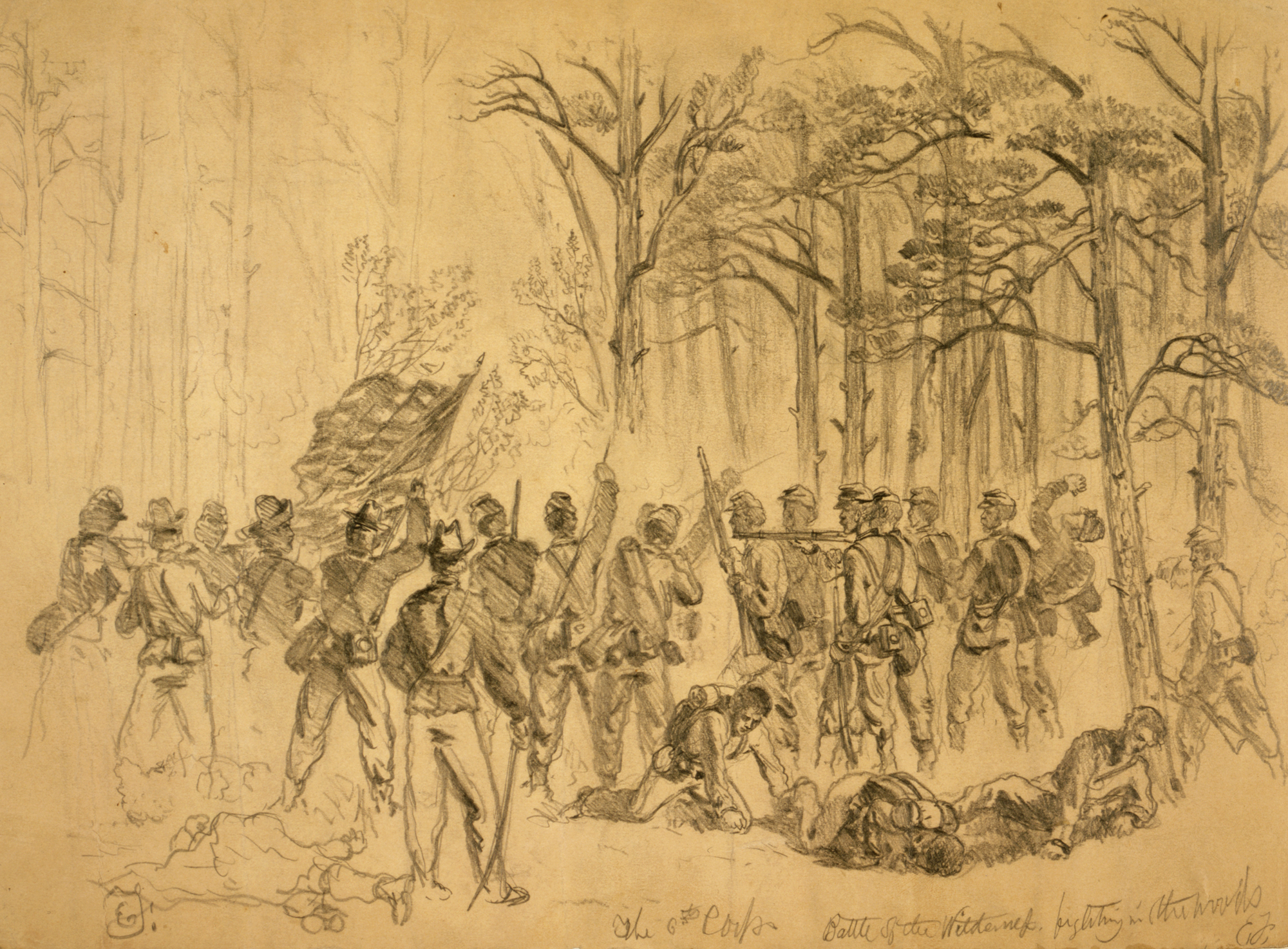
Union forces crossed the Rapidan in early May and entered a region already associated with the 1863 Chancellorsville campaign. Lee quickly moved to challenge the advance before Grant’s troops could emerge into more open ground. On May 5 and 6, fighting developed along the Orange Turnpike and Orange Plank Road, with confused engagements in dense second-growth forest.
Neither side achieved an unambiguous battlefield victory. Fires endangered wounded men, units became lost, and close-range volleys punished both armies. The important campaign decision came afterward: Grant did not withdraw north to recover as some previous Union commanders had done. He ordered his forces southeast toward Spotsylvania, signaling that one costly battle would not end the offensive.
Why did Spotsylvania Court House matter?
Spotsylvania was a road junction south of the Wilderness and a gateway to further movement toward Richmond. Lee’s soldiers used interior routes to arrive and fortify key ground ahead of the Union march. The battle began on May 8 and continued through a series of attacks and counterattacks. The armies constructed increasingly elaborate fieldworks as the fighting lengthened.
On May 12 the Union struck a projecting Confederate position called the Mule Shoe. The attack briefly penetrated the line and produced savage fighting around the Bloody Angle. Despite immense casualties, the Confederates established another line and held. Spotsylvania illustrates why the campaign cannot be judged solely by which side occupied an individual trench at the end of the day.
What happened at the North Anna River?
After Spotsylvania, Grant again shifted southeast rather than repeating attacks on the same defenses indefinitely. Lee moved to positions near the North Anna River, where the Confederate line formed a sharply angled arrangement. The terrain offered chances to concentrate forces against separated Union elements, but exploiting that opportunity was difficult.
Lee was ill during part of these operations, and the Confederate army did not launch the concentrated blow that some observers expected. Grant assessed the position and moved again rather than become trapped in the complicated river defenses. The North Anna episode is less famous than the Wilderness or Cold Harbor but essential for understanding the campaign’s repeated cycle of maneuver and entrenchment.
What was fought at Totopotomoy Creek?
Fighting near Totopotomoy Creek followed Union movements across rivers and roads northeast of Richmond at the end of May. Confederate troops occupied ridges and fortified approaches, making direct advances costly. Small battles, skirmishes and reconnaissance developed as both sides searched for a vulnerable flank or an accessible road.
This phase is often compressed into a short line on campaign timelines, yet it shows the continuous strain on formations after weeks of marching and combat. Soldiers had to dig again, repair equipment, locate food and water and identify enemy positions. The operations also prepared the way for the battle around Old Cold Harbor, where the opposing armies concentrated for another major confrontation.
Why did Cold Harbor become notorious?
At Cold Harbor, Confederate forces prepared formidable earthworks behind open approaches. Grant’s armies assembled for an attack, but delays and poor coordination helped the defenders strengthen their positions. On June 3, large numbers of Union infantry advanced against the Confederate line. The assault failed at terrible cost, becoming one of the campaign’s best-known disasters.
Discussions of Cold Harbor often repeat precise claims about thousands dying in minutes. Casualty statistics and time windows vary by source, so readers should distinguish the major June 3 attack from losses across the longer May 31–June 12 operations. What is beyond dispute is that entrenched defenders inflicted severe damage on attacking units, forcing Grant to reassess the route to Richmond.
What made trench warfare so important?
The campaign accelerated the use of field fortifications. Troops cut logs, dug shallow pits, raised earth parapets and added obstacles. Defenders behind earthworks could fire with much better protection than infantry standing in open ground. Attackers often suffered before reaching the lines, even when they possessed superior numbers.
Trenches were not an invention of 1864, and earlier wars had used extensive fortifications. The difference here was their speed, scale and near-continuous use by armies operating in close contact. Officers learned that poorly prepared assaults could be devastating. These developments foreshadowed the prolonged Petersburg campaign that preceded Lee’s final surrender.
How did soldiers experience six weeks of combat?
Repeated marches, short sleep, heat, rain and the need to dig defensive works wore down the armies. Soldiers wrote about smoke, difficult visibility and the anxiety of advancing through forests or across open approaches. Medical personnel dealt with large numbers of wounded, while transport units struggled to bring provisions forward and remove casualties.
The strain was not limited to men in the firing line. Teamsters, engineers, ambulance crews and hospital workers faced constant pressure. For African American civilians near the army routes, Union movements could open routes away from enslavement, but war also displaced households and damaged farms. A campaign history that lists only generals and battles misses these consequences for the people living along the roads.
Was Grant simply using an attrition strategy?
Grant understood that the United States possessed greater manpower and industrial capacity, but it is misleading to describe every decision as an attempt to trade lives without regard for maneuver. His repeated flanking movements sought more favorable positions, access to railroads and ways to force Lee out of strong defenses. Sometimes those plans failed or suffered from delays.
The label ‘war of attrition’ captures the cumulative pressure on the Confederacy, not a complete description of Grant’s tactics. Lee, meanwhile, continued to seek chances for counterattacks. Comparing commanders fairly requires separating their stated objectives, battlefield decisions, available resources and hindsight about how the war eventually ended.
What did the campaign cost?
Both armies suffered enormous casualties through successive battles, and totals depend on which engagements, dates and definitions an historian includes. A casualty could mean killed, wounded, captured or missing; it does not automatically mean a death. The numbers are particularly sensitive to whether Petersburg’s opening attacks are counted as part of the Overland Campaign.
Instead of comparing an isolated figure from one battle with a total for six weeks, use a consistent source and time frame. The loss of experienced officers and soldiers damaged both forces, but replacements were harder for the Confederacy to obtain. Lee’s army remained capable of defense while becoming less able to meet all the demands placed upon it.
Did Grant win the Overland Campaign?
At several individual battles Lee stopped Union assaults or fought Grant to a tactical standstill. Grant nonetheless maintained the larger offensive and brought federal armies close to vital Confederate supply corridors. There is no simple scoreboard in which every battleground must be labeled a Union victory for the campaign to have advanced Union objectives.
By mid-June Grant shifted across the James River and threatened Petersburg, the railroad hub supplying Richmond. Lee followed, preventing immediate capture but entering a prolonged defensive struggle. This was a significant strategic result for the Union even though it came after severe losses and operational disappointments. The distinction between tactical and strategic outcomes is crucial.
Why did Grant cross the James River?
After Cold Harbor, a direct drive toward Richmond offered few favorable options. Grant instead moved his main forces away from Lee’s front and crossed the James River, intending to strike the roads and rail lines associated with Petersburg. The maneuver required coordination of marching columns, river crossings and supply arrangements on a large scale.
The crossing temporarily changed the geometry of the campaign. Petersburg lay south of Richmond, so threatening it endangered the Confederate capital indirectly. Union attacks in mid-June failed to take the city quickly, and both sides dug into increasingly extensive positions. The ensuing months of warfare would culminate in the Confederate retreat of April 1865.
How should the campaign be remembered?
The Overland Campaign shows the difficulty of defeating a skilled army occupying strong defensive ground. It also reveals the importance of command coordination, roads, railroad connections and the political context of the war. Lincoln faced an approaching presidential election while casualty lists reminded voters of the cost of continuing the struggle.
It is best studied as a sequence rather than a single heroic charge. The Wilderness illustrates combat in dense woods; Spotsylvania the violent contest for fieldworks; North Anna the role of river geography; Cold Harbor the danger of frontal assault; and the James crossing the return to operational maneuver. Together they explain how the conflict entered its final year.
Overland Campaign 1864 timeline
The chronology below separates the campaign’s stages and shows why dates sometimes differ between short summaries and descriptions of the full operations.
| Date | Event |
|---|---|
| May 4 | Union troops cross the Rapidan River. |
| May 5–6 | Battle of the Wilderness. |
| May 8–21 | Spotsylvania Court House fighting. |
| May 23–26 | Operations at the North Anna River. |
| May 28–June 1 | Fighting near Totopotomoy Creek. |
| May 31–June 12 | Cold Harbor operations; major assault June 3. |
| June 12–15 | Grant disengages and crosses toward the James River. |
| June 15–18 | Union attacks begin against Petersburg. |
Frequently asked questions
When did it happen? May–June 1864.
Where did it happen? Central Virginia.
Who were the principal commanders? Grant, Meade, Lee.
What was the outcome? Union advance south. The military and political consequences are explained above rather than reduced to a single label.
How does it fit into the Civil War? It forms part of the larger sequence described in our American Civil War overview.
Historical sources and further reading
For accurate study, compare contemporary documents and battlefield records with modern National Park Service historical interpretation. Image captions identify whether a visual is a period sketch or a later representation.