
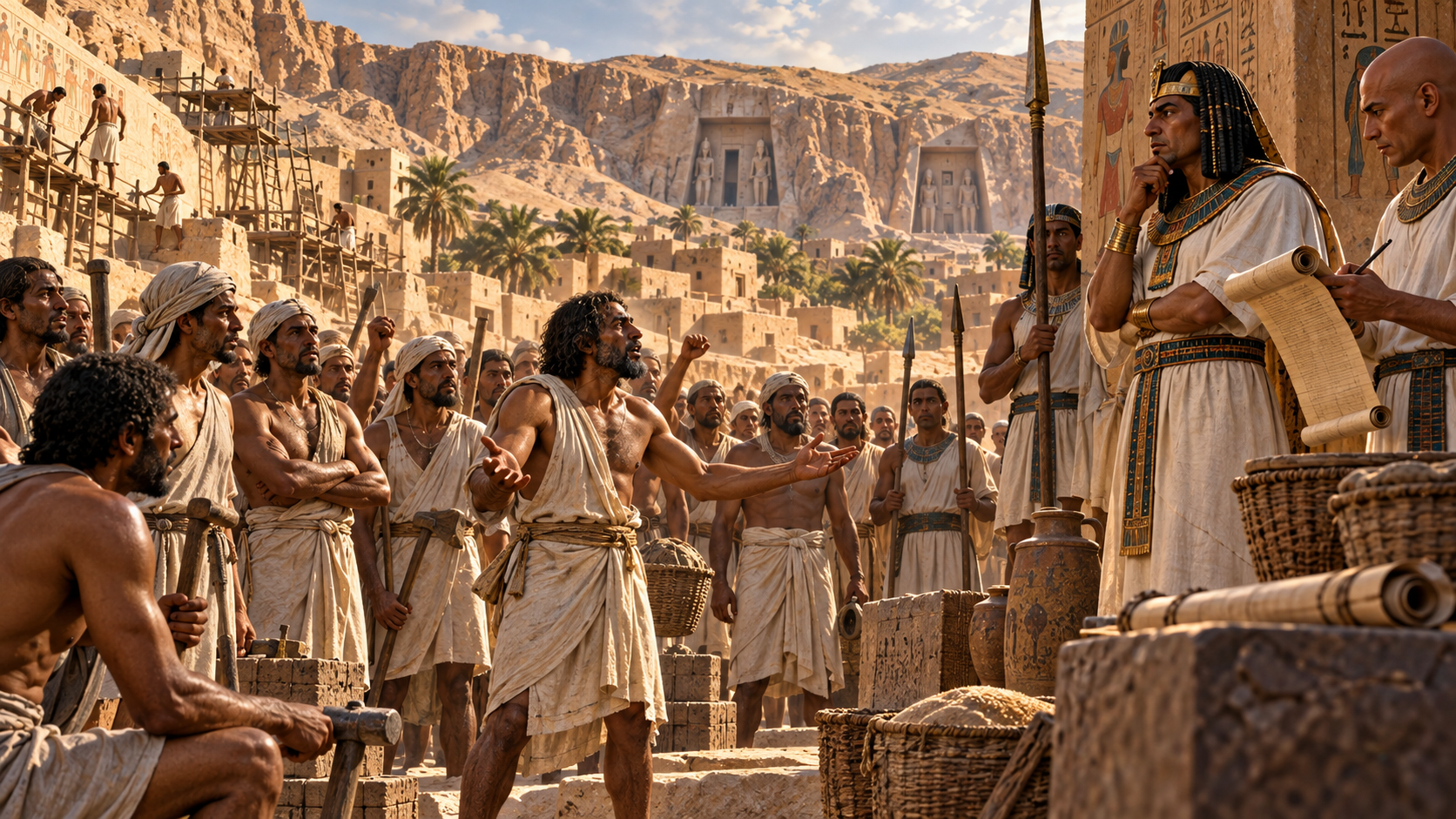
The First Recorded Labor Strike Happened in Ancient Egypt
Labor disputes are not a modern invention. More than three thousand years ago, skilled workers in ancient Egypt stopped working because they had not received the rations owed to them.
The fact
Around 1157 BCE, during the 29th year of Pharaoh Ramesses III, workers at Deir el-Medina organized what is generally regarded as the first recorded labor strike in history.
These were not anonymous agricultural laborers. Deir el-Medina was home to highly skilled artisans and craftsmen responsible for constructing and decorating royal tombs in the Valley of the Kings.
Payment in food
Workers in the royal necropolis were compensated through a ration system. Grain and other provisions were essential parts of their wages. When those payments were delayed, the problem was immediate: families depended on the deliveries for food.
The surviving document known as the Strike Papyrus, preserved at the Museo Egizio in Turin, records the workers’ complaints and their collective refusal to continue as normal.
How the protest unfolded
The workers left their assigned work areas and staged sit-ins near temples and administrative locations. They appealed to officials and demanded the provisions they were owed. The protest continued across several days as authorities attempted to resolve the shortage.
What makes the event remarkable is the level of documentation. A scribe named Amennakht recorded the dispute, giving historians an unusually direct view of a labor conflict from the New Kingdom.
Why were the rations late?
Egypt near the end of Ramesses III’s reign faced serious strains. The state had enormous expenses, and scholars have connected the disruption to broader economic and administrative difficulties. Whatever the exact combination of causes, the workers recognized that the failure to deliver their rations violated an established obligation.
A very old form of collective action
The men of Deir el-Medina did something that would be instantly recognizable today: they withheld their labor in order to pressure authorities to meet agreed conditions.
They did not use modern labor terminology, and there were no unions in the contemporary sense. Yet the basic mechanism—workers acting collectively because compensation had not been delivered—is unmistakable.
Why the record survives
Deir el-Medina is one of the best-documented communities in the ancient world. Thousands of texts survive on papyri and ostraca, preserving details about wages, family disputes, work schedules, religion and everyday life.
The strike is therefore not just an isolated curiosity. It is part of a much larger archive showing ancient Egyptians as workers, neighbors and families dealing with practical problems.