Women Airforce Service Pilots (WASP): WWII Women Pilots, 1943–1944
How the WASP program formed in 1943, which aircraft women flew, why 38 died in service and how they gained veterans recognition decades later.
Quick answer
The Women Airforce Service Pilots (WASP) program formed in 1943 from two earlier organizations, the Women’s Auxiliary Ferrying Squadron and Women’s Flying Training Detachment. More than 1,000 women completed training and performed stateside military flight duties such as ferrying aircraft, towing targets and testing planes. WASP members were classified as civilian personnel during World War II, not enlisted military service members. Thirty-eight died in connection with the wartime program. It ended in December 1944, and federal legislation in 1977 recognized eligible service for veterans’ benefits.
Key facts
On this page
- Why the Army Air Forces needed more pilots
- Nancy Harkness Love and the ferrying squadron
- Jacqueline Cochran and the training program
- The creation of WASP in 1943
- Avenger Field and the challenge of flight training
- Which aircraft did WASP members fly?
- Ferrying aircraft and towing targets
- How many women served, and how many died?
- Racial barriers and the limits of inclusion
- Why the program ended in December 1944
- The 1977 veterans’ recognition law
- The Congressional Gold Medal and historical memory
- Timeline
- FAQs
- Sources
Why the Army Air Forces needed more pilots
American entry into World War II dramatically increased demand for military aircraft and personnel. Factories produced bombers, fighters and transport planes at an unprecedented scale, and those aircraft had to be delivered from manufacturers to training bases, ports and operational commands. Experienced male pilots were also needed for combat and advanced training. Air Forces leaders considered whether qualified women could take over some domestic flying duties and thereby release more men for other work.
Women already held civilian pilot certificates and had demonstrated competence in commercial and private aviation, despite facing barriers to training and employment. The wartime problem was not whether a woman could physically operate an aircraft but whether the military would use her skills within a deeply gendered institution. The program that became WASP emerged from advocacy by established aviators and the practical demands of mobilization.
Nancy Harkness Love and the ferrying squadron
Nancy Harkness Love advocated using experienced women pilots to ferry military aircraft. In 1942 a small group of skilled aviators joined the Women’s Auxiliary Ferrying Squadron, known as WAFS. They worked within the Air Transport Command, moving aircraft between locations in the United States. Their responsibilities were demanding because the pilots needed to master varied aircraft types and handle changing weather and routes.
The ferrying operation was distinct from direct combat aviation. WAFS pilots generally flew aircraft to bases or delivery points rather than participating in bombing raids against enemy territory. That distinction does not mean the work was risk-free: mechanical failures, bad weather and training accidents remained serious hazards. Early ferrying successes helped make a broader women-pilot program more acceptable to Army Air Forces leadership.
Jacqueline Cochran and the training program
Jacqueline Cochran, an accomplished aviator, argued that the military should recruit and train women to fly aircraft in support of the war. She helped establish the Women’s Flying Training Detachment, or WFTD, in 1942. The training program sought to prepare women with prior flight experience for Army Air Forces requirements rather than rely only on the small number of already highly experienced ferry pilots.
The two early organizations developed partly through different approaches: one emphasized selected experienced pilots, while the other created a larger training pipeline. Both helped establish that women could perform useful military flight assignments. Differences in leadership and organizational structure later gave way to a combined program, although the history should not erase the roles of either Nancy Love or Jacqueline Cochran.
The creation of WASP in 1943
The WAFS and WFTD were combined in 1943 to form the Women Airforce Service Pilots. Jacqueline Cochran oversaw the broader training effort, while Love continued to play an important role in ferrying operations. The merger created a more recognizable organization for women flying military aircraft in support of the Army Air Forces. Its name became familiar through photographs, veterans’ organizations and later museum exhibits.
WASP members were government civilian employees rather than fully enlisted or commissioned military personnel. That classification shaped their pay, benefits and later recognition. The organization operated within military systems, used Army aircraft and took assignments from military authorities, but its legal status differed from that of the Women’s Army Corps. Both groups supported the war, yet they were not interchangeable institutions.
Avenger Field and the challenge of flight training
Much WASP flight training took place at Avenger Field near Sweetwater, Texas. Recruits completed ground school, navigation, instrument instruction and many hours of flying. They had to satisfy rigorous performance standards and could be dismissed for failing to meet requirements. Women who had traveled far from home entered an unfamiliar environment of military rules and technical evaluation.
Flight training demanded concentration and physical endurance, particularly in powerful aircraft unfamiliar to some civilian pilots. Weather, mechanical problems and the risk of accidents were constant concerns. The National WASP WWII Museum and National Park Service preserve information about the field, training classes and living conditions. Their records reveal an extensive educational operation, not simply a symbolic public-relations event.
Which aircraft did WASP members fly?
Depending on training and assignment, WASP pilots operated trainers, transport aircraft, fighters and bombers during stateside duties. Some ferried P-51 Mustangs and other aircraft, while experienced women delivered bombers or performed test flights. The ability to fly multiple types was important because the Army needed aircraft moved and evaluated quickly as manufacturers and maintenance depots completed their work.
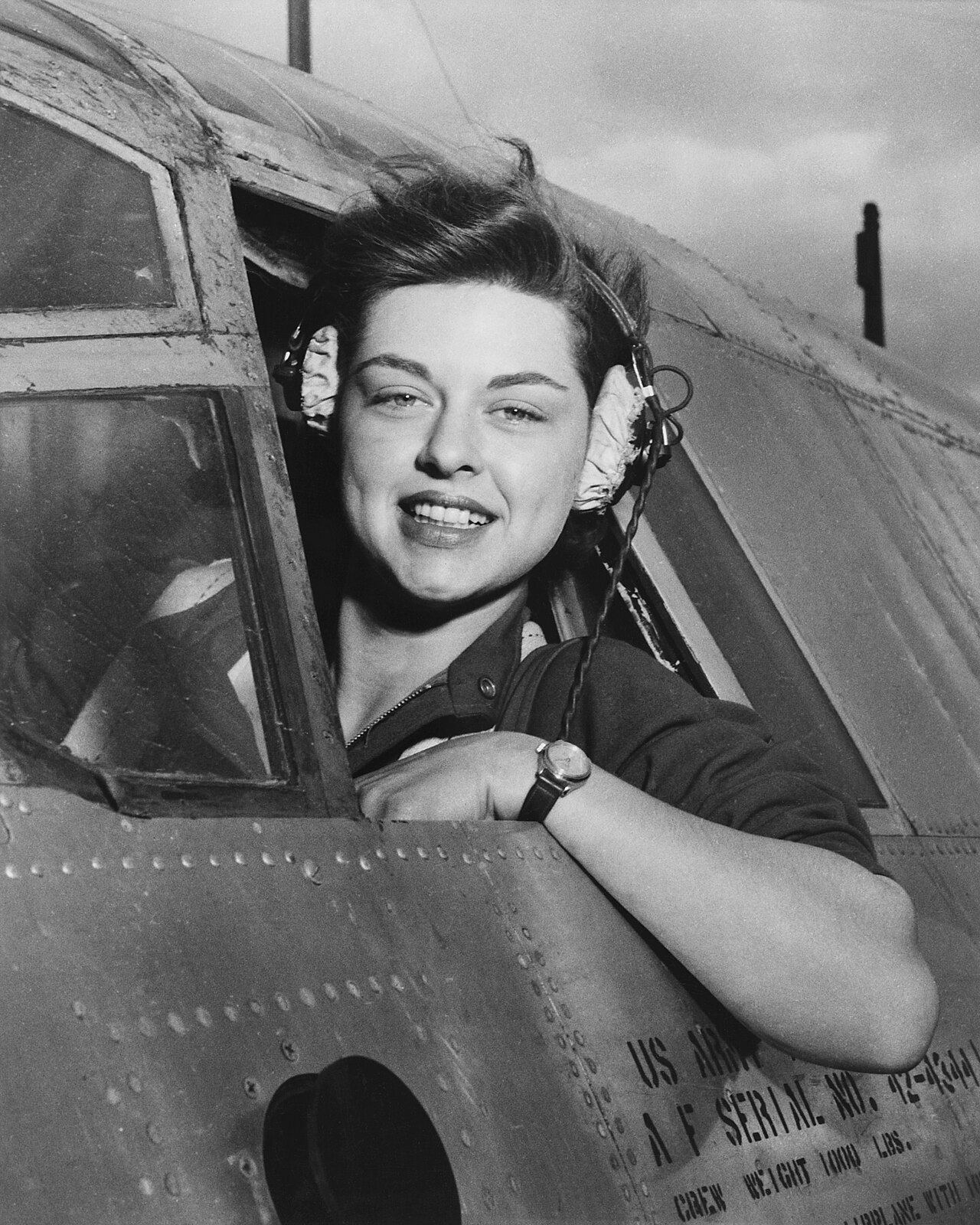
The featured National Archives photograph shows Elizabeth L. Remba Gardner in an aircraft at Harlingen Army Air Field. It documents a real pilot and period flying duty, not a modern reenactment. The image is appropriate precisely because the WASP story concerns skilled individual women working with complex aircraft. It should not be interpreted as evidence that this particular pilot participated in overseas bombing missions.
Ferrying aircraft and towing targets
Ferrying airplanes was among the most visible WASP tasks. New aircraft could be delivered from factories to training bases or embarkation points without using combat-trained pilots for every trip. Women also towed aerial targets for gunnery practice, giving soldiers and aviators opportunities to train with realistic moving targets. Some assignments involved engineering flight testing and transport duties.
Target towing and testing could be hazardous because aircraft flew near training weapons or were being evaluated after repair. Accidents were a constant risk, and pilots sometimes operated in severe weather. The work mattered to military preparedness even though it was generally conducted within U.S. territory. A reliable history of the program should not describe these duties as either harmless civilian errands or direct fighter combat against enemy aircraft.
How many women served, and how many died?
More than 1,000 women completed the training program; the Smithsonian National Air and Space Museum cites 1,074 graduates. Accounts also report that thirty-eight women died during the broader WASP program and its predecessor activities. Those deaths occurred in connection with flying and training work, not in dogfights with enemy fighters. Precise statistical descriptions should identify whether a figure counts applicants, trainees, graduates or all women who served in predecessor organizations.
The fatalities carried particular hardship because the women were civilians under federal classification. Their families did not automatically receive the same military death benefits or burial honors available to armed-service personnel. Some fellow pilots and families helped cover costs or arranged memorials. This difference in treatment became an important reason for the later campaign to recognize WASP service.
Racial barriers and the limits of inclusion
WASP recruitment opened a major opportunity for women but did not eliminate racial discrimination in military aviation. Black women pilots such as Janet Harmon Bragg and Willa Brown had worked to expand access to aviation, yet Black applicants encountered exclusion from military flying opportunities. The program did not offer all qualified women an equal chance to serve. Women of different backgrounds experienced barriers shaped by racism as well as gender.
The Tuskegee Airmen demonstrated Black military aviation skill within a segregated male program. The WASP history addresses a separate system that used women pilots but also reflected discriminatory assumptions. Reading both histories together shows how wartime demands opened some doors while leaving others closed. Neither program by itself ended segregation or gender restrictions in the armed forces.
Why the program ended in December 1944
By late 1944 the Army Air Forces had reassessed manpower requirements as more male pilots became available for domestic duties. Proposals to militarize the women pilots faced opposition in Congress and from some military and civilian groups. The program was dissolved in December 1944, and women who had trained and flown for wartime service lost the chance to continue through the same organization.
The decision did not demonstrate that women were physically incapable of flying military aircraft. Their training and mission records already contradicted that idea. Instead the ending reflected politics, staffing requirements and institutional decisions about who would hold military flying positions. Many former WASP members returned to civilian aviation or other careers, while others spent decades seeking acknowledgment of their contributions.
The 1977 veterans’ recognition law
Former WASP pilots and their supporters campaigned for recognition of their wartime military-related duties. In 1977 Congress enacted legislation enabling eligible service to be recognized for veterans’ benefits, correcting a major part of their earlier exclusion. The decision came more than three decades after the program ended and reflected sustained advocacy by women whose service had long been underappreciated.
Recognition did not change the historical fact that WASP members were classified as civilians during the war. It changed their later legal status for specified purposes. That distinction is important because descriptions such as ‘WASP pilots were commissioned military officers in 1943’ remain inaccurate. The history is one of delayed recognition for genuinely dangerous and valuable service conducted under unusual wartime arrangements.
The Congressional Gold Medal and historical memory
In 2009 Congress authorized the Congressional Gold Medal for the Women Airforce Service Pilots of World War II, with a major award ceremony in 2010. Museums, archives and veterans’ organizations have preserved photographs, oral histories and training materials that make the women’s achievements accessible. The recognition helped correct decades of limited public attention, although it arrived too late for many participants to witness it.
The strongest history of WASP service combines technical achievements, gender barriers, racial exclusion, the danger of flight assignments and the prolonged struggle for veterans’ rights. The pilots contributed to delivering and testing thousands of aircraft during wartime mobilization. Their story shows how a temporary emergency program could challenge expectations without immediately transforming the legal or cultural structures governing women’s military service.
Timeline
- 1942: WAFS and WFTD predecessor programs begin
- Early 1943: Training at Avenger Field expands
- 1943: WASP established by merger
- 1943–1944: Women ferry, test and tow targets with military aircraft
- December 1944: WASP program discontinued
- 1977: Congress provides a path to veterans recognition
- 2009–2010: Congressional Gold Medal authorized and awarded
Frequently asked questions
What does WASP stand for?
Women Airforce Service Pilots.
When did the program begin?
The combined program was created in 1943 from two initiatives begun in 1942.
Where did pilots train?
Avenger Field at Sweetwater, Texas, was the main training center.
Were WASPs in combat over Europe?
No. Their military-related flying assignments were primarily stateside ferrying, training, testing and target towing.
How many graduated?
Approximately 1,074 women completed the program.
How many died?
Thirty-eight women died during the program and its predecessor activities.
Were they military personnel in 1943?
They were classified as civilian employees during WWII; later legislation recognized eligible service for benefits.
When did the program end?
December 1944.
Sources and further reading
- Smithsonian National Air and Space Museum — WASP History
- National Park Service — Women Airforce Service Pilots
- National WASP WWII Museum — Historical Program
- Texas Woman’s University — Official WASP Archive
- National Women’s History Museum — Women Airforce Service Pilots
- U.S. Army — WASP Pilots and Legacy