Doolittle Raid (April 18, 1942): B-25 Bombers, Tokyo Attack and Aftermath
How Jimmy Doolittle launched 16 B-25 bombers from USS Hornet, why the crews landed in China and what the raid achieved and cost.
Quick answer
On April 18, 1942, Lieutenant Colonel James H. Doolittle led 80 U.S. Army Air Forces personnel in 16 B-25B Mitchell bombers launched from the aircraft carrier USS Hornet. They attacked targets in Tokyo and other Japanese cities in the first American air raid on Japan’s home islands during World War II. Japanese patrol boats forced an earlier-than-planned launch, leaving the bombers short of fuel for reaching intended Chinese airfields. All sixteen aircraft were lost after the mission; most men escaped, but some died or were captured. The raid caused limited physical damage while boosting American morale. Japan’s reprisals in China brought devastating civilian casualties.
Key facts
On this page
- Why the United States planned an attack on Japan
- Who was Jimmy Doolittle?
- Why the Army selected the B-25 Mitchell bomber
- Training and preparing sixteen aircrews
- USS Hornet and the Pacific task force
- How Japanese patrol boats forced an early launch
- The takeoffs from Hornet on April 18
- What targets were bombed in Japan?
- Why the bombers could not reach their intended Chinese airfields
- The fate of the eighty raiders
- Chinese civilians’ assistance and Japan’s reprisals
- The raid’s impact on morale and Japanese strategy
- Why the Doolittle Raid still matters
- Timeline
- FAQs
- Sources
Why the United States planned an attack on Japan
Japan’s surprise attack on Pearl Harbor on December 7, 1941, drew the United States into World War II. During the first months of the Pacific War, Japanese forces captured territory across Southeast Asia and the Pacific, while American forces struggled to respond. The United States needed to demonstrate that it could strike back against Japan’s homeland despite enormous distances and the apparent strength of Japanese defenses.
American commanders considered a bombing mission that would produce psychological and political effects even if it could not destroy a large share of Japan’s military industry. A strike on Japanese cities could show that the home islands were not beyond reach and provide a morale boost after the shock of Pearl Harbor. The plan was dangerous because ordinary land-based bombers could not operate from friendly airfields close enough to strike and return.
Who was Jimmy Doolittle?
James H. ‘Jimmy’ Doolittle was an accomplished American aviator, engineer and military officer who had previously established aviation records and contributed to instrument-flying techniques. By early 1942 he served in the U.S. Army Air Forces with the rank of lieutenant colonel. His technical experience and willingness to undertake difficult missions made him a suitable leader for a raid that required unprecedented use of a carrier deck by twin-engine bombers.
Doolittle was not the lone pilot of a single aircraft. He commanded a formation of sixteen bombers and eighty crew members, each responsible for a demanding flight over ocean, hostile territory and uncertain landing areas. Planning also depended on Navy commanders, mechanics, navigation specialists and training staff. The mission became associated with Doolittle’s name, but it was an interservice operation involving people far beyond the lead aircraft.
Why the Army selected the B-25 Mitchell bomber
The North American B-25 Mitchell was a medium bomber designed for land-based operations, not routine launches from an aircraft carrier. Its combination of range, payload and relatively short takeoff performance made it the most practical available candidate for the mission. Engineers and crews modified the airplanes to extend range, reduce weight and equip them for specialized navigation and fuel requirements.
The aircraft were not ordinary carrier fighters able to return and land aboard the ship. They lacked the characteristics and equipment necessary for a safe arrested landing on Hornet after the bombing. The plan therefore relied on taking off from the carrier, striking targets in Japan and continuing westward to suitable airfields in China. The aircraft choice shaped the entire mission’s risks: fuel, weather and navigation after the raid were as consequential as reaching the targets.
Training and preparing sixteen aircrews
Crews trained to launch their bombers from exceptionally short distances, rehearsing takeoffs and practicing the skills needed for low-level flight and navigation. Training took place in the United States, including at Eglin Field in Florida. Aircraft mechanics prepared fuel modifications and removed certain equipment where necessary. Airmen also received instructions about the expected route to targets and onward toward Chinese landing fields.
Secrecy was important because knowledge of the raid could compromise both carrier operations and the crews. The men understood that the mission was dangerous, but not every detail was revealed to every participant during the early planning stages. The operation required extraordinary trust among Army pilots, Navy personnel and commanders. A successful takeoff alone would represent a remarkable accomplishment because medium bombers had not been designed for carrier operations.
USS Hornet and the Pacific task force
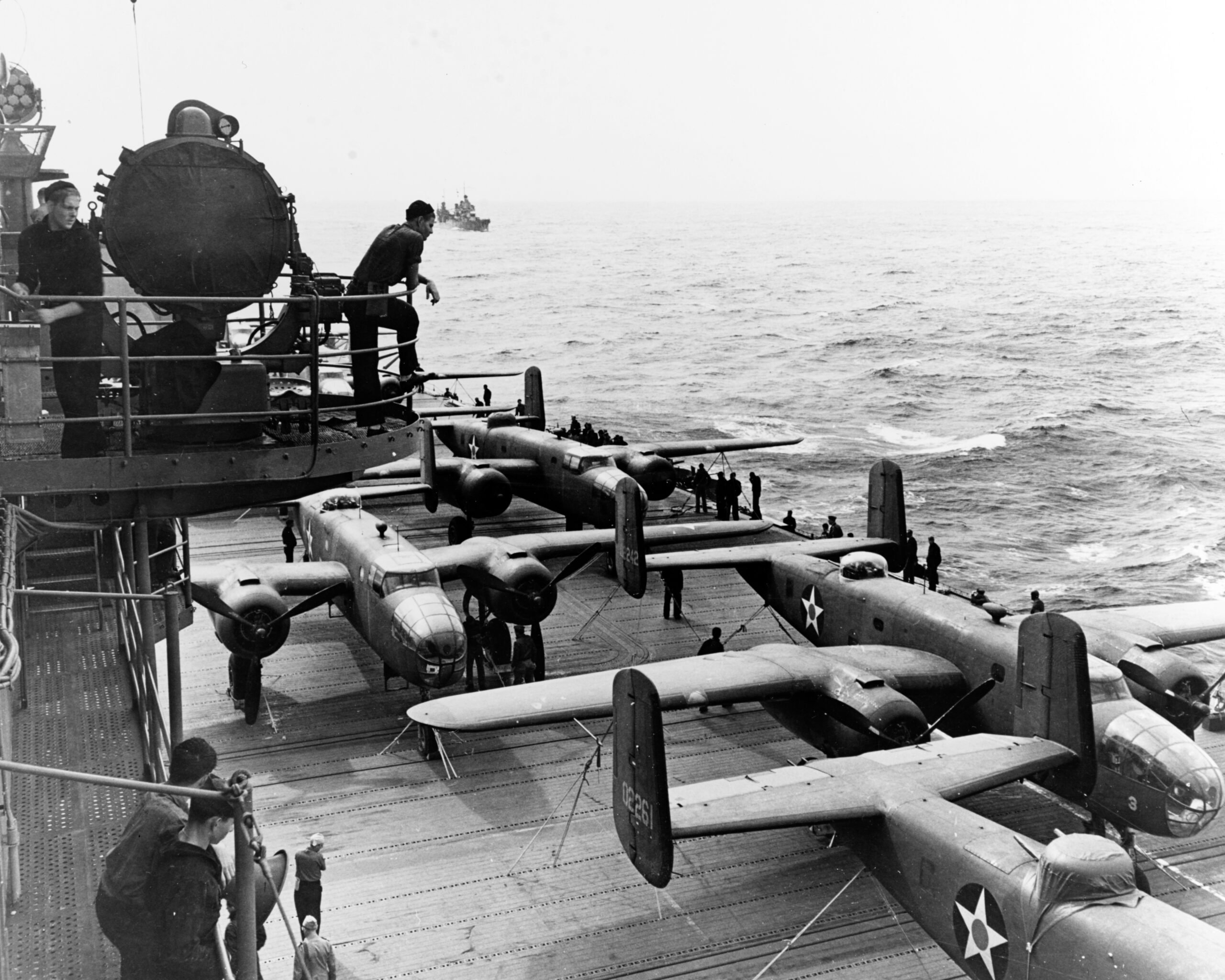
Sixteen B-25B bombers were loaded onto USS Hornet, where they occupied the flight deck and prevented ordinary carrier aircraft operations from proceeding in the usual way. The carrier sailed across the Pacific as part of a task force supported by other warships, including USS Enterprise under Vice Admiral William F. Halsey. Those escort and scouting arrangements were essential because the carriers themselves were extremely valuable and vulnerable.
The featured photograph shows the distinctive twin-engine bombers lined up on Hornet’s deck. It is an authentic U.S. Navy period image, not a later film reconstruction. The photo makes the technical challenge visible: aircraft with wide wingspans were arranged along a flight deck that offered limited room for takeoff. The planned route depended on approaching close enough to Japan to leave fuel for the journey toward China.
How Japanese patrol boats forced an early launch
On the morning of April 18, 1942, the task force encountered Japanese patrol boats earlier than expected. U.S. forces attacked one of the vessels, but there was concern that it could have transmitted a warning of the American ships’ presence. Halsey and Doolittle therefore faced a choice between retreating and launching the bombers from farther away than planned.
They chose to launch, approximately 650 miles from Japan according to the National Museum of the U.S. Air Force, rather than wait to reach the originally intended distance of roughly 400–450 miles. The extra distance increased the chances that the bombers would run out of fuel before reaching safe airfields. The decision is crucial to the mission’s history because it helps explain why the crews later had so much difficulty landing in China.
The takeoffs from Hornet on April 18
Doolittle’s aircraft took off first, followed by the other fifteen B-25s. Their crews used the carrier’s motion and sea wind to help achieve sufficient lift over a short flight deck. All sixteen aircraft successfully became airborne, a notable achievement for bombers not designed to operate from carriers. The operation then proceeded toward Japan, with individual crews navigating their routes and preparing to attack specified targets.
The launch did not guarantee the mission’s safe completion. The crews still had to cross hostile airspace, drop their bombs and attempt a long flight to China in deteriorating conditions. In accounts of the Doolittle Raid the carrier takeoff is often the most dramatic image, but it represented only the first stage of a mission that continued far beyond the Japanese coast.
What targets were bombed in Japan?
The aircraft attacked targets in Tokyo and other Japanese cities, including industrial and military facilities in the greater Tokyo region and elsewhere. The crews generally flew at low altitude on the approach, then made bombing runs before turning toward China. The raid was intended partly to demonstrate that American bombers could reach Japan despite the geographic distance and naval defenses that planners had previously considered substantial obstacles.
Physical damage from the raid was relatively limited compared with the destruction caused by later wartime bombing campaigns. Japanese civilians were also put at risk during attacks on urban areas, and the targets should not be described as isolated from nearby populations. The operation’s lasting importance lay more in military psychology and subsequent strategic decisions than in its immediate effect on Japan’s industrial capacity.
Why the bombers could not reach their intended Chinese airfields
After the attacks, fifteen crews continued toward China, where they had expected to land at prepared airfields. The earlier launch left them with reduced fuel reserves for the onward journey, and darkness, weather and uncertainty about navigation made conditions worse. Rather than reach the planned landing locations, crews were forced to bail out, crash-land or ditch their airplanes. None of the sixteen bombers returned to Hornet.
One aircraft diverted northward to Soviet territory and landed near Vladivostok. The Soviet Union was at war with Germany but not yet at war with Japan, creating diplomatic complications for that crew. It was detained rather than simply welcomed into active Allied operations. The remaining aircraft were lost on the route toward or within China. Their fate explains why a successful bombing operation and the safe recovery of its aircraft were separate outcomes.
The fate of the eighty raiders
Of the eighty airmen, most eventually escaped through assistance from Chinese people and Allied networks, but the losses were serious. Three men died during crash landings or attempts to escape their aircraft, according to Air Force historical accounts. Eight were captured by Japanese forces. Three of those prisoners were executed in October 1942; a fourth died in captivity in 1943. Four of the captured airmen survived imprisonment until the war’s end.
The Soviet-landed crew was interned and later made its way out of Soviet territory. The experiences of individual men were not identical, and some were injured during bailouts or landings. A statement that ‘all eighty returned safely’ would therefore be false. Nor should the death of a captured airman in captivity be confused with those killed during the immediate crash and bailout stage. Air Force museum resources preserve biographical information about the prisoners and survivors.
Chinese civilians’ assistance and Japan’s reprisals
Chinese villagers, soldiers and local networks helped many American airmen evade capture and move through territory threatened by Japanese forces. That assistance was dangerous because Japan’s military controlled large areas and sought to punish people associated with the raid. Afterward Japanese forces conducted a brutal campaign in parts of eastern China, destroying settlements and killing large numbers of people.
Some accounts cite approximately 250,000 Chinese civilians killed during the subsequent reprisals, but estimates and the precise scope of the campaign vary across historical studies. The figure should therefore be presented as a cited estimate rather than a mathematically verified count. The suffering of Chinese civilians was not a marginal footnote to the operation: their actions helped save American aircrew, and reprisals imposed an enormous human cost on communities already facing years of occupation and war.
The raid’s impact on morale and Japanese strategy
In the United States, the announcement of a successful strike on Japanese territory generated substantial enthusiasm. American forces had suffered major defeats in the Pacific, and the raid demonstrated that Japan’s home islands were vulnerable to attack. Doolittle received the Medal of Honor and became a national hero. The operation’s importance in contemporary public memory was therefore much greater than the amount of physical damage inflicted.
Japanese leaders also had to consider the possibility of further attacks on the homeland, and some forces were reassigned for defense. Historians debate the raid’s relationship to decisions leading toward the Battle of Midway in June 1942. A careful account should not claim that the raid directly and single-handedly caused the Midway battle or determined its outcome. The subsequent strategic consequences were indirect and involved numerous Japanese and American decisions.
Why the Doolittle Raid still matters
The Doolittle Raid combined a technically innovative carrier launch, coordinated Army-Navy operations and a high-risk attack planned for psychological effect. It succeeded in striking Japanese territory and raising morale, but all sixteen bombers were lost, several Americans died and eight were captured. Chinese civilians who assisted survivors faced devastating reprisals. The full story is therefore more complex than an uncomplicated account of a daring success.
The mission belongs within the first months after Pearl Harbor and the rapid expansion of the U.S. war effort. The War Production Board reflects the industrial side of mobilization, while the Doolittle Raid shows the operational possibilities and costs of deploying those resources. Its enduring significance lies in daring aviation, strategic symbolism, and the human consequences on both sides of the Pacific.
Timeline
- December 7, 1941: Japan attacks Pearl Harbor
- Early 1942: Doolittle mission developed and crews train
- April 2, 1942: Hornet sails carrying sixteen B-25s
- April 18, 1942: Early launch and bombing raids on Japan
- April 18–19: Aircraft lost as crews escape into China or land in Soviet territory
- October 1942: Three captured Americans executed
- 1943: Another prisoner dies in captivity
- August 1945: Remaining prisoners liberated
Frequently asked questions
When was the Doolittle Raid?
April 18, 1942.
Who led it?
U.S. Army Air Forces Lieutenant Colonel James H. Doolittle.
How many planes took part?
Sixteen B-25B Mitchell medium bombers.
How many airmen participated?
Eighty men, five per aircraft.
Which aircraft carrier launched the bombers?
USS Hornet (CV-8).
Did the planes land back on the carrier?
No. They were planned to land in China; one diverted to Soviet territory, and all sixteen aircraft were lost after the raid.
What happened to captured raiders?
Eight were captured. Three were executed, one died in captivity and four survived imprisonment.
What happened to Chinese civilians?
Japanese military reprisals killed very large numbers of Chinese civilians; some historical estimates reach about 250,000 deaths, though totals are debated.
Sources and further reading
- National Museum of the U.S. Air Force — Doolittle Raid
- U.S. Navy — Halsey–Doolittle Raid History
- National Museum of the U.S. Air Force — Captured Raiders
- U.S. Navy — Chinese Reprisals and Raider Legacy
- U.S. Air Force — Doolittle Raiders Historical Account
- National Museum of the U.S. Air Force — Raid Infographic