Kelly Act of 1925: How Air Mail Helped Build U.S. Commercial Aviation
The 1925 Contract Air Mail Act let the Post Office hire private companies to carry mail, helping create routes and income for the emerging airline industry.
Quick answer
The Contract Air Mail Act, commonly called the Kelly Act, became law on February 2, 1925. It authorized the U.S. Post Office Department to contract with private businesses to transport mail by air. Government pilots had already carried airmail since 1918; the new law began a transition toward privately operated contract routes. By September 1927 contractors handled all U.S. airmail. It helped commercial aviation develop but did not create the first airmail flight or instantly establish modern passenger airlines.
Key facts
On this page
- Why the United States already had an airmail system
- Why lawmakers wanted private contractors
- The Contract Air Mail Act of February 2, 1925
- What contract air mail routes meant
- Air mail payments and business incentives
- The Post Office’s earlier technical achievements
- From government pilots to commercial carriers
- How the act relates to Charles Lindbergh
- Later reforms and the 1930s airmail controversies
- Why the Kelly Act matters
- Timeline
- FAQs
- Sources
Why the United States already had an airmail system
Airplanes became practical enough for planned mail service during the First World War era, though flights remained difficult and risky. The U.S. Post Office began scheduled airmail operations in 1918, with cooperation from military aviators at the outset. Over the following years the Post Office developed routes and gradually built experience operating aircraft over long distances. This public system gave aviation a visible use beyond demonstration flights and military missions, but it demanded staff, aircraft, fuel and ground facilities from the federal government.
The challenge was not merely placing sacks of letters inside an aircraft. Flights needed dependable schedules, navigational aids, intermediate stops, mechanics and routes that could be used under uncertain weather conditions. The Post Office experimented with day-and-night service across the continent, including illuminated airway beacons. These investments demonstrated that air transport could become useful infrastructure. The Kelly Act arose after these earlier federal experiments, so calling it the beginning of American airmail would erase an important stage of development.
Why lawmakers wanted private contractors
Federal operation showed the possibility of faster delivery, but politicians also questioned whether the government should permanently operate its own fleet. Supporters of contracting argued that private firms could develop aircraft, train crews and improve efficiency while receiving a predictable stream of payment for carrying mail. Airmail revenue might help a company survive before the public demand for passenger travel was large enough to sustain regular services independently.
This was a policy experiment rather than an immediate guarantee that private firms would be safer or cheaper. Companies needed access to aircraft and investors, while postal officials still had to decide which routes deserved service and how to pay contractors. The government would remain the customer and regulator of postal arrangements. In exchange, private operators would undertake the actual flying on routes selected through the program. The balance between public funding and business initiative became central to commercial aviation’s early growth.
The Contract Air Mail Act of February 2, 1925
The act was associated with Pennsylvania Representative Clyde Kelly and is often described simply as the Kelly Act. It authorized the Postmaster General to contract for the carriage of mail by air, initially placing emphasis on shorter feeder routes linked to the existing network. The Smithsonian National Postal Museum dates the act to February 2, 1925, and describes the authorization as the first major legislative move away from exclusive Post Office control of airmail transportation.
Accounts sometimes describe the first contracts as though all public flying ended the day the law passed. In fact, the transition took time. Postal officials had to solicit bids, select contractors, establish performance requirements and arrange connections to government-operated trunk routes. The first contract operations followed later. The act created the authority and incentive for a market; it did not on its own build every airplane, appoint every pilot or complete all routes on February 2.
What contract air mail routes meant
A contract air mail route was a designated service for which an operator received federal payment to transport postal material. Businesses could bid for routes and attempt to supply reliable service under an agreement with the Post Office. The initial emphasis on feeder routes was strategic. Local connections could bring letters from smaller cities into a growing national network, helping test commercial operation while the federal government still supported important long-distance links.
The work was difficult because aviation lacked today’s comprehensive network of airports, navigation systems and forecasting technology. Contractors needed to handle bad weather, mechanical problems, landing fields and schedules. A company that performed reliably could develop experience and credibility, while one that failed faced financial and operational pressures. The arrangement promoted competition for contracts, but the number of capable operators remained limited and routes differed sharply in their costs and commercial prospects.
Air mail payments and business incentives
Mail contracts supplied income in a business that otherwise had relatively few sources of dependable revenue. Flying passengers was still uncommon for much of the early 1920s, and airmail demand was limited by postage prices and the size of the network. A predictable federal contract could support the purchase of aircraft, maintenance shops, employees and route improvements. The arrangement helped some aviation firms attract investment and gain the experience needed for broader commercial operations.
The subsidy-like role of mail payments is an important part of airline history. It would be misleading to suggest that the market alone immediately produced a profitable nationwide network without government involvement. The federal government selected routes and paid carriers while private businesses operated the flights. The costs and benefits were debated, and later changes to payment formulas and contracts revealed weaknesses in the original approach. Still, the 1925 legislation created an important institutional bridge between government demonstration services and a private aviation industry.
The Post Office’s earlier technical achievements
The Kelly Act built upon federal research into navigation and route planning. The Post Office had already organized scheduled flights, established intermediate stations and developed the country’s growing airway system. Transcontinental delivery was particularly challenging, because an airplane could cross great distances only with reliable fueling and landing sites. At night, pilots could follow lighted beacons that marked portions of the route. These were expensive innovations, and they reduced some risks without making early flight uniformly safe.
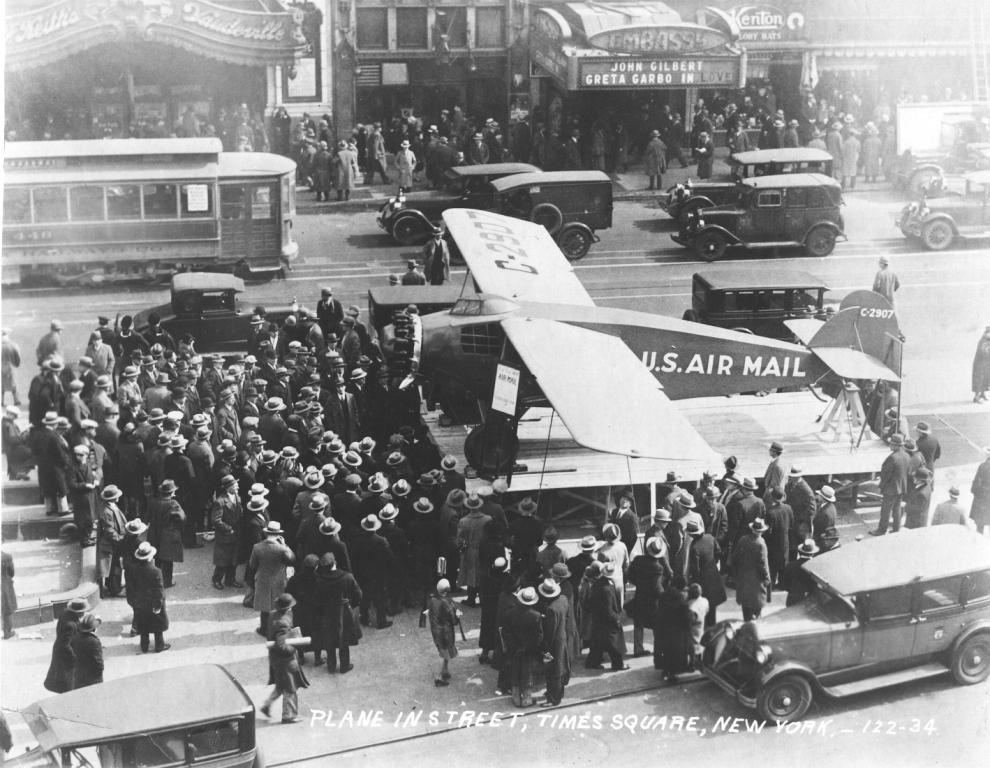
A photograph from the National Archives showing a U.S. Air Mail aircraft displayed in Times Square in 1934 accompanies this article. Its date is later than the Kelly Act, and it is used to illustrate the continuing public identity of airmail services. It should not be captioned as a picture of the first contract flight in 1925. Period sources and museum histories provide more reliable evidence for the exact chronology of the industry’s development than an undated photograph of an airplane.
From government pilots to commercial carriers
The system changed progressively after the act. Private firms began operating contract routes, eventually extending service over more of the national network. The National Postal Museum notes that by September 1927 all U.S. airmail was being flown by contract carriers. That milestone does not imply the Post Office withdrew from mail policy: it continued buying services, establishing postal rules and maintaining responsibility for delivery arrangements. Instead, the person flying an airmail airplane was increasingly employed by a private operator.
The transition was significant because it created opportunities for companies to grow outside military or demonstration flying. Aircraft manufacturers and transport firms gained access to commercial customers, and pilots could pursue careers on recurring routes. Some early firms evolved or merged into later airlines; others disappeared. It is not historically responsible to identify every airline as a direct product of one law. The relationship was wider: the contracts helped establish the conditions in which a commercial network could become viable.
How the act relates to Charles Lindbergh
Charles Lindbergh worked as an airmail pilot before his famous transatlantic flight of May 1927. That experience demonstrates how mail routes became training grounds for aviators and how the emerging industry could produce pilots skilled in navigation and long flights. His solo New York-to-Paris flight was a separate achievement, made in a specially designed aircraft rather than an ordinary contract mail route.
The Kelly Act did not directly award the Orteig Prize that Lindbergh later won, and it did not make transatlantic passenger travel routine in 1925. The connection is between the institutions supporting pilot experience and the wider public excitement that followed aviation milestones. Lindbergh’s fame strengthened enthusiasm for flying, while the practical commercial foundation had been developed through postal routes, aircraft makers, mechanics and many less famous pilots.
Later reforms and the 1930s airmail controversies
The Kelly Act was not the last airmail law. Amendments and the McNary–Watres Act of 1930 changed how contracts were awarded and compensated, giving officials greater power to shape routes and service arrangements. Disputes over preferential treatment and contract allocation contributed to the airmail controversy of 1934, when the government canceled contracts and temporarily assigned delivery to military pilots. That later episode should not be mistaken for the original 1925 decision to allow private carriers.
The policy history shows that creating a new market with government contracts requires oversight. Supporters wanted efficient transport and a strong national network, while critics worried about favoritism, the cost of public payments and safety. Later reforms developed against that experience. Studying both the successful expansion and the controversy is more informative than treating the Kelly Act as a flawless solution or assuming public contracting necessarily failed.
Why the Kelly Act matters
The Kelly Act helped establish a framework in which private firms could carry U.S. mail by airplane under federal contracts. It recognized that aviation could become an industry, not merely a government service or a collection of individual feats. The Post Office’s earlier work supplied knowledge and infrastructure, while the new contracts offered businesses customers and incentives for investment. The transition to private operation was completed over the next two years.
For understanding the commercial aviation of the 1920s, that distinction between law, implementation and later developments is essential. The act did not invent airplanes, launch the first airmail service or produce every future airline. It created a practical route toward greater private participation, connecting government postal requirements with the growth of regular air transport. The story links the history of public infrastructure with the aspirations of an emerging technology.
Timeline
- 1918: U.S. Post Office begins scheduled airmail
- 1924: Day-and-night transcontinental airmail operations developed
- February 2, 1925: Kelly Act enacted
- 1926: Early private contract routes begin operating
- September 1927: All U.S. airmail flown by contractors
- 1930: McNary–Watres Act changes airmail contracts
- 1934: Further controversy and changes to contract system
Frequently asked questions
When was the Kelly Act passed?
February 2, 1925.
What did the Kelly Act do?
It authorized the U.S. Post Office Department to contract with private companies to carry airmail.
Did it establish the first U.S. airmail service?
No. Government-operated scheduled airmail began in 1918.
What does CAM stand for?
Contract Air Mail, the designation used for routes operated by private contractors.
Did all flights become private immediately?
No. The transition was gradual, and contract carriers handled all U.S. airmail by September 1927.
Was Charles Lindbergh an airmail pilot?
Yes. He flew airmail routes before his May 1927 solo transatlantic flight.