Plessy v. Ferguson (1896): Separate but Equal and the Jim Crow Era
How a planned challenge to train segregation produced a Supreme Court decision upholding the separate-but-equal doctrine.
In Plessy v. Ferguson on May 18, 1896, the Supreme Court upheld Louisiana’s Separate Car Act requiring separate railway accommodations by race. The ruling endorsed “separate but equal” and helped sustain Jim Crow segregation. Justice John Marshall Harlan dissented.
Learn about Homer Plessy, the citizens’ committee, the Court’s legal reasoning and the path toward Brown v. Board.
On this page — 22 topics
What was Plessy v. Ferguson?
Plessy v. Ferguson was a United States Supreme Court decision issued on May 18, 1896, that upheld a Louisiana law requiring racially separate railway accommodations. The Court rejected Homer Plessy’s argument that forced separation violated the Fourteenth Amendment, allowing the state to maintain what became known as the “separate but equal” doctrine. The ruling was a major legal endorsement of segregation during the Jim Crow era. Justice Henry Billings Brown wrote the majority opinion, while John Marshall Harlan dissented. The decision did not introduce every form of segregation from nothing: discriminatory practices and laws already existed. Its importance lies in providing constitutional approval for a state policy mandating racial separation, an approach later challenged by civil-rights advocates and overturned in important contexts.
Who was Homer Plessy?
Homer Adolph Plessy was a New Orleans resident who took part in an organized challenge to Louisiana’s Separate Car Act. He worked as a shoemaker and belonged to a community of free people of color and their descendants with a long history in Louisiana. He was selected to test the law partly because his appearance did not readily reveal the ancestry the state used to classify passengers. The case was not simply a spontaneous argument between an individual traveler and a conductor; it involved planning by a citizens’ committee seeking to challenge racial segregation through the courts. Plessy’s involvement placed him at legal and personal risk, while helping create one of the most consequential constitutional cases of the nineteenth century.
What was Louisiana’s Separate Car Act?
Louisiana enacted the Separate Car Act in 1890, requiring railroads operating in the state to provide separate but purportedly equal accommodations for white and Black passengers. The statute included penalties for people who refused to use the car assigned by racial classification. It did not apply identically to every form of transportation; for example, its text contained particular exceptions and definitions that matter in legal interpretation. The law represented an attempt to formalize racial separation through state authority, despite the citizenship and equal-protection principles adopted during Reconstruction. Opponents argued that compulsory separation imposed unequal status even when officials claimed the facilities would be equivalent. The Supreme Court eventually considered whether the requirement was constitutional.
What happened on June 7, 1892?
Plessy purchased a first-class ticket for the East Louisiana Railway and took a seat in a railcar designated for white passengers. His planned refusal to move was intended to create a legal challenge. When the conductor instructed him to enter the car assigned to Black passengers, Plessy refused and was arrested. The test was coordinated by activists who sought judicial review of the state statute rather than a violent confrontation. His arrest eventually led to proceedings in Louisiana courts and then the Supreme Court of the United States. The exact June 7 date helps distinguish the original event from the 1896 Supreme Court decision. Four years of litigation separated the train incident from the national judgment.
Who organized the legal challenge?
The Comité des Citoyens, a New Orleans civil-rights organization made up of local activists, supported challenges to racial segregation and arranged the test case. Members raised funds, coordinated legal strategy and selected Plessy as a participant. Their involvement is vital because the standard retelling often isolates Plessy as one man acting alone. The committee belonged to a wider tradition of Black and Creole political organization in Louisiana following emancipation. Activists understood that the law would require judicial confrontation if it was to be overturned. Their strategy combined legal argument, publicity and the deliberate creation of a case that could travel through the courts. The organization deserves recognition alongside Plessy and his attorneys.
Who was Judge John H. Ferguson?
John Howard Ferguson was the Louisiana criminal district court judge involved in Plessy’s case, and his name became part of the Supreme Court caption. Ferguson rejected the challenge to the Separate Car Act at a stage of the proceedings. Plessy’s legal team sought review in Louisiana’s highest court and subsequently secured a path to the federal Supreme Court. The case title therefore names Plessy and the judge, not the railroad itself. A common misunderstanding is that Ferguson was a train conductor or the state law’s author. In reality, his role was judicial. The course of the litigation illustrates how a state criminal case could become a major national constitutional dispute.
What did Plessy’s attorneys argue?
The legal challenge relied especially on the Thirteenth and Fourteenth Amendments. Lawyers argued that compulsory racial separation imposed a badge of inferiority and violated constitutional promises of freedom and equality. Albion W. Tourgée, an important Reconstruction-era lawyer and writer, participated in the Supreme Court argument. The case raised questions about personal liberty, legal racial classifications and the extent to which states could use police powers to regulate public transportation. A central issue was whether separate facilities could truly be equal when the separation itself was based on racial distinctions. The lawyers’ arguments were broader than a complaint that one physical car was more comfortable than another.
When did the Supreme Court rule?
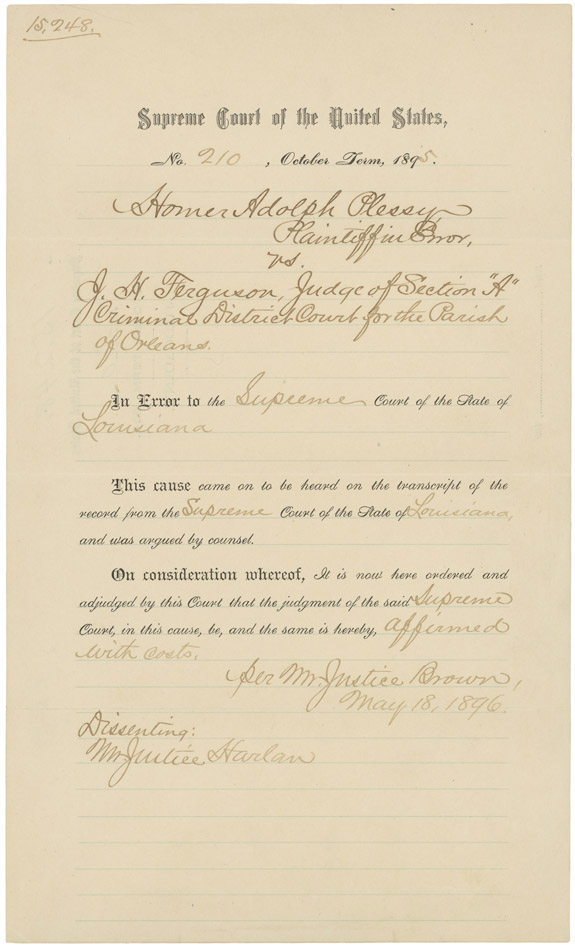
The Supreme Court announced its judgment on May 18, 1896. The ruling affirmed the Louisiana court’s decision and upheld the state’s Separate Car Act. The original judgment, preserved by the National Archives, identifies the parties and records the majority disposition and Harlan’s dissent. It is reproduced as the featured historical document for this article. The 1896 decision should not be confused with the law enacted in 1890 or the train incident of 1892. Those separate dates show how long an organized constitutional challenge could take. The Court’s ruling became influential beyond Louisiana because other states could invoke its reasoning to defend compulsory racial separation.
What did the majority decide?
Justice Henry Billings Brown wrote the majority opinion, which held that the Separate Car Act did not violate the Fourteenth Amendment’s Equal Protection Clause simply by requiring separation, so long as facilities were described as equal. The majority rejected the argument that compulsory separation necessarily imposed legal inferiority. This reasoning treated the state’s classification as compatible with constitutional equality, a conclusion challenged by civil-rights advocates then and since. The Court’s judgment supplied authority for state segregation policies even though actual facilities and opportunities were frequently unequal. An accurate account distinguishes the Court’s constitutional holding from a historical claim that segregation was fair or beneficial. The latter would not follow from the former.
What does separate but equal mean?
The phrase “separate but equal” describes the legal doctrine under which government could require racial separation while claiming to provide equivalent facilities or services. In practice, segregated institutions commonly received unequal funding and treatment, but the constitutional problem extended beyond measurable differences in quality. Compulsory racial separation communicated that citizens did not belong together in public institutions. The Plessy majority treated the arrangement as potentially consistent with equal protection, while dissenters and later civil-rights advocates argued that the separation itself was discriminatory. The phrase became associated with the legal order of Jim Crow even though the Court did not invent the social practice of segregation in 1896.
Who dissented in Plessy?
Justice John Marshall Harlan was the lone dissenter. He argued that Louisiana’s law was inconsistent with the Constitution’s principles of civil freedom and would allow governments to create a caste system based on race. His opinion included the famous expression that the Constitution is color-blind, but his full discussion reflects the assumptions and racial language of the nineteenth century. Later reformers often cited Harlan’s central objection to state-enforced separation. A dissent is not the law adopted by the Court, however, and it had no immediate power to invalidate the statute. Its historical importance lies in preserving an alternative constitutional interpretation that continued to influence arguments against segregation.
Was the ruling unanimous?
No. The commonly reported vote was seven to one, with Justice Harlan dissenting; Justice David J. Brewer did not participate in the decision. This distinction matters because it explains why the decision is not usually described as eight-to-one or unanimous. Legal histories should name the actual participating justices instead of inferring a vote from the standard number of seats on the Court. The majority included judges who approached Reconstruction-era protections narrowly, while Harlan rejected their conclusion. The decision nevertheless became binding precedent despite the dissent. Its authority and the political conditions of the period allowed state segregation laws to proliferate while Black citizens continued challenging discriminatory treatment.
How did the case relate to the Fourteenth Amendment?
Ratified in 1868, the Fourteenth Amendment guaranteed national citizenship and prohibited states from denying equal protection or due process. Plessy directly raised the question of whether a state law requiring racial separation violated those principles. Unlike the 1883 Civil Rights Cases, which involved Congress regulating private-business discrimination, Plessy concerned a state statute. The Supreme Court acknowledged the state action but interpreted equal protection in a way that permitted the segregation rule. Our Fourteenth Amendment guide examines the constitutional language. Understanding that difference prevents the mistake of describing the two decisions as addressing identical legal questions despite their related effects on civil rights.
How did Plessy relate to the 1883 Civil Rights Cases?
The Civil Rights Cases of 1883 had invalidated major portions of the 1875 federal law against private discrimination in public accommodations. Plessy later upheld a state’s affirmative requirement for separate railway facilities. The cases concerned different sources of government action and different constitutional claims. Together they reduced the legal protection available to Black Americans challenging segregation and exclusion in public life. But it is incorrect to say the same Supreme Court opinion issued both rulings or that the 1883 judgment itself required separate railcars. Their combined impact belongs to the long post-Reconstruction movement toward entrenched racial separation.
Did the ruling legalize every form of Jim Crow?
Plessy gave strong constitutional support to state-mandated segregation under the separate-but-equal rationale, but Jim Crow involved many laws and practices across distinct states and decades. Segregation extended into schools, transportation, public facilities and civic life through legislation, local custom, violence and unequal economic resources. The decision did not instantly write every restriction into a national code. It became a crucial precedent that state officials and courts used to defend separation. The history of Jim Crow also includes efforts to restrict voting rights despite the Fifteenth Amendment. A full account therefore connects Plessy to the earlier rollback of Reconstruction and later statutes without reducing the entire period to one Supreme Court case.
What changed with Brown v. Board of Education?
In 1954 the Supreme Court held in Brown v. Board of Education that racially segregated public schools were inherently unequal under the Fourteenth Amendment. The decision rejected separate-but-equal reasoning in public education and became a central milestone in the civil-rights movement. It did not instantly integrate every school or automatically settle segregation across all areas of American life. Implementation was contested, and additional federal legislation and judicial decisions followed. Our Brown v. Board guide explains the education-specific ruling and its aftermath. It is more accurate to describe Brown as repudiating Plessy’s doctrine in a major constitutional context than to imply one day in 1954 ended every Jim Crow rule.
What happened to Homer Plessy afterward?
Plessy lived after the Supreme Court defeat and continued ordinary work in New Orleans. His legal challenge did not succeed during his lifetime, yet it became an enduring part of the struggle against racial segregation. In the twenty-first century, his descendants and supporters helped advance public recognition of the case’s history, including a posthumous pardon granted in Louisiana in 2022. That modern action should not be confused with reversal of the 1896 Supreme Court precedent, which was weakened through later judicial decisions and legislation. Plessy’s story is important because a planned, peaceful act of civil disobedience created a record that later generations used to understand the legal foundations of segregation.
What does the original Supreme Court judgment show?
The original document preserved by the National Archives is a primary source naming Homer Adolph Plessy and Judge J. H. Ferguson. It records the Court’s disposition on May 18, 1896, and identifies the participating judicial opinions. The image accompanying this article shows the historic paperwork rather than an illustration of the train incident. Documents like this are valuable because they separate the legal outcome from later retellings and dramatic recreations. The National Archives provides a transcription and historical background. Readers wanting the reasoning should also consult the full majority and dissenting opinions, because the judgment sheet alone does not explain every constitutional argument.
Why is Plessy v. Ferguson a turning point?
The ruling showed how the constitutional promise of equal protection could be interpreted to permit coercive racial separation. Its influence extended through the Jim Crow period, affecting public transportation and other institutions until the law began changing through litigation and federal action. At the same time, the case reveals continued Black political organization: Plessy and the Comité des Citoyens deliberately challenged segregation even when national Reconstruction protections had weakened. Its legacy therefore includes both the legal defeat and the persistent activism that contested the doctrine. Understanding Plessy requires attention to Louisiana law, judicial reasoning, organized resistance and the later constitutional changes that reshaped American civil rights.
Plessy v. Ferguson timeline
| Date | Event |
|---|---|
| 1890 | Louisiana enacts Separate Car Act. |
| June 7, 1892 | Homer Plessy challenges train segregation and is arrested. |
| May 18, 1896 | U.S. Supreme Court upholds the Louisiana law. |
| 1954 | Brown v. Board rejects school segregation as inherently unequal. |
| 2022 | Louisiana grants a posthumous pardon to Plessy. |