Civil Rights Cases (1883): Supreme Court Ruling Against the 1875 Act
Why the Supreme Court invalidated key federal protections against discrimination in public accommodations.
In the Civil Rights Cases of October 15, 1883, the Supreme Court ruled 8–1 that Congress could not use the Fourteenth Amendment to prohibit certain private-business discrimination under the Civil Rights Act of 1875. Justice Joseph Bradley wrote the majority opinion, and Justice John Marshall Harlan dissented.
This article distinguishes private discrimination, state action, constitutional amendments and the act’s separate jury provision.
On this page — 21 topics
What were the Civil Rights Cases of 1883?
The Civil Rights Cases were a set of Supreme Court proceedings decided together on October 15, 1883. They challenged federal rules against racial discrimination in inns, transportation and other public accommodations enacted under the Civil Rights Act of 1875. By an eight-to-one vote, the Court held that Congress had exceeded its constitutional authority when regulating discrimination by private businesses under those provisions. Justice Joseph P. Bradley wrote for the majority, while Justice John Marshall Harlan dissented. The decision became a landmark in the struggle over equal treatment after Reconstruction, because it removed a major federal protection against exclusion in public places. Its legal reasoning centered on how the Thirteenth and Fourteenth Amendments limited or empowered Congress.
Why did the cases reach the Supreme Court?
After Congress adopted the Civil Rights Act of 1875, disputes arose when businesses refused Black patrons services or separate facilities were imposed. Different federal prosecutions and civil claims challenged the law’s validity. The Supreme Court considered several cases together because they raised overlapping constitutional questions about federal power. The parties came from different places and types of business, so “the Civil Rights Cases” is a collective label, not the name of one hotel or passenger. It is useful to distinguish the factual incidents from the broader legal issue: whether Congress could regulate private discrimination in the way the 1875 act attempted. The decision tested the reach of Reconstruction legislation after political support for federal intervention had weakened.
What had the Civil Rights Act of 1875 promised?
The 1875 statute sought equal enjoyment of specified public accommodations, including inns, public conveyances and theaters, without discrimination based on race or a previous condition of servitude. It also contained a separate provision concerning jury service. Supporters argued that formal citizenship meant little if people could be excluded from essential public services. Senator Charles Sumner had championed wider protections before his death in 1874. The enacted law represented a congressional effort to secure everyday equality as well as legal status in courts and contracts. Our 1875 Civil Rights Act article examines its passage. The 1883 decision is a distinct legal event because the Court then restricted Congress’s authority to enforce its public-accommodations provisions.
What did the Fourteenth Amendment say?
The Fourteenth Amendment, ratified in 1868, prohibits states from denying due process or equal protection of the laws and establishes national citizenship language. Its central wording limits the conduct of a state, not explicitly every private relationship. Supporters of federal civil-rights legislation argued that public-facing businesses and systematic discrimination undermined the rights the amendment sought to protect. The majority in 1883 adopted a narrower interpretation of congressional enforcement power against private conduct. The debate requires separating the amendment’s text from political aspirations and later Supreme Court doctrine. Even when a discriminatory practice had severe social effects, the Court asked whether the federal statute targeted conduct within Congress’s constitutional power.
What was the state-action doctrine?
The state-action doctrine distinguishes government conduct from actions by private individuals or businesses for purposes of certain constitutional protections. In the Civil Rights Cases the majority held that the Fourteenth Amendment’s prohibitions concerned state action. Congress could enforce those prohibitions against state violations, but it could not use the amendment alone to regulate all private discrimination addressed by the 1875 act. The doctrine has a long subsequent legal history, with exceptions and complexities developed by later cases. It should not be treated as a claim that private discrimination was morally acceptable. The immediate result, however, was that Black travelers and customers lost important federal recourse when excluded from private public-facing establishments.
Did the Court also interpret the Thirteenth Amendment?
Yes. The Thirteenth Amendment abolished slavery and involuntary servitude, apart from its criminal-punishment exception, and gave Congress enforcement authority. Supporters argued that racial exclusion in public accommodations perpetuated badges or incidents of slavery and could therefore be prohibited under the amendment. The 1883 majority rejected using the Thirteenth Amendment to sustain the challenged provisions. Its analysis did not mean Congress lacked all power under the amendment; rather, the Court took a narrow view of how the particular public-accommodations restrictions related to slavery. Justice Harlan strongly disagreed with the majority’s approach. Understanding both amendments is essential because the legal decision involved separate questions, not only one phrase about equal protection.
Who was Justice Joseph P. Bradley?
Joseph P. Bradley was an associate justice of the Supreme Court who wrote the majority opinion in 1883. He had also served on the Electoral Commission that helped resolve the disputed presidential election of 1876. His reasoning focused on constitutional limits on congressional power to regulate private conduct. Bradley’s opinion shaped later understanding of state action during a period when Black citizenship and political participation were under growing pressure. His connection to the 1876 commission is historically interesting, but it does not mean the judicial ruling was an electoral bargain. The opinion must be read on its own terms and compared with contemporary legal debates over the Reconstruction Amendments.
Who was Justice John Marshall Harlan?
John Marshall Harlan was the sole dissenting justice. He argued that the federal government possessed broader authority to protect equal rights in services offered to the public. His opinion treated the exclusion of Black Americans from certain public facilities as part of a continuing system of racial subordination. The dissent became influential in later discussions of civil rights, although it did not alter the Court’s judgment in 1883. Harlan’s reasoning should not be quoted as though it were the majority rule at the time. His disagreement is nevertheless important because it demonstrates that the constitutional text admitted competing interpretations and that some judges believed the 1875 law could be defended within Reconstruction’s aims.
What public accommodations were involved?
The underlying cases concerned businesses and services that nineteenth-century Americans used while traveling or seeking entertainment, including inns, railroads and theaters. These were not purely private family gatherings; many establishments advertised or supplied services to the public. Supporters of the law regarded access to such places as part of the practical meaning of free citizenship. The majority’s distinction between governmental action and private business decisions left many exclusions outside the invalidated federal protections. Regulations of common carriers and public accommodations continued to differ under state law and later legislation. A historically precise account avoids assuming that every business in every state was immediately subject to the same policy after the decision.
What was the Court’s vote?
The Supreme Court ruled eight to one, with Justice Harlan dissenting. The majority invalidated key public-accommodations provisions of the 1875 law as applied to private discrimination. The voting division matters because it was not a closely divided five-to-four judgment. However, the numerical margin should not be used to imply that the constitutional interpretation was inevitable or universally accepted outside the Court. Black leaders and civil-rights advocates sharply criticized the outcome, and the dissent preserved an alternative legal reading. The decision’s broad influence resulted from the authority of the Court’s interpretation and the absence of a comparable replacement federal statute for many decades.
Were jury rights also abolished?
No. The ruling should not be summarized as declaring every section of the 1875 act unconstitutional. The principal issue concerned public-accommodations discrimination by private parties; the separate jury provision followed a different constitutional path. The Supreme Court had already upheld federal authority to address race-based exclusion from juries in Ex parte Virginia in 1880, which involved conduct by a state official. This distinction illustrates how state action could support federal intervention even under a narrower interpretation of the Fourteenth Amendment. Treating the entire 1875 law as a single undifferentiated statute produces mistakes about what remained enforceable and why. Accurate legal history follows the specific section and the conduct it regulated.
How did the decision affect daily life?
The ruling removed an important national legal tool for challenging racial exclusion in facilities operated by private businesses. Black travelers and customers could encounter segregated seating, denial of accommodations or other unequal treatment without the protection Congress had tried to establish in 1875. State laws and local practices differed, but the decision strengthened the position of people arguing that segregation in private enterprise was beyond the reach of that federal statute. The consequences were not merely symbolic. Public transport, lodging and entertainment were basic components of movement and civic life. Restricted access could affect employment, education and the sense of belonging to a country that had formally recognized Black citizenship.
How did this relate to the end of Reconstruction?
Reconstruction’s political support had already weakened by 1883, and the withdrawal of federal backing from contested Southern Republican governments occurred in 1877. White supremacist violence and discriminatory state policies continued to undermine Black rights. The Civil Rights Cases belong to this longer retreat from some federal protections, but they did not themselves end Reconstruction on one day. The decision concerned constitutional interpretation of a particular law after Reconstruction’s conventional endpoint. Its significance was that the judicial branch rejected an important part of Congress’s earlier strategy for promoting equal public treatment. Understanding this chronology prevents confusion between the 1875 enactment, the 1877 political settlement and the 1883 Court decision.
Did the ruling create Jim Crow segregation?
It did not create all discriminatory state and local laws from nothing. Racial segregation and exclusion had developed through many practices and policies, and their expansion continued in different states over subsequent decades. The Civil Rights Cases weakened federal protection against private discrimination, contributing to an environment in which segregation could become more entrenched. Later statutes and decisions, including Plessy v. Ferguson, gave further legal support to segregation under state authority. These events were related but distinct. A complete explanation of Jim Crow should examine political power, violence, economic inequality, legislation and judicial decisions rather than attribute every development to one Supreme Court case.
How was the decision connected to Plessy v. Ferguson?
In 1896 the Court decided Plessy v. Ferguson, upholding a Louisiana law requiring separate railway accommodations by race. Unlike the 1883 Civil Rights Cases, Plessy directly challenged a state statute rather than a federal restriction on private businesses. This distinction matters because the legal issues were different, though the outcomes both weakened efforts to secure racial equality. Together the rulings became important components of the legal order associated with segregation. Plessy endorsed a “separate but equal” rationale under the Fourteenth Amendment, while the Civil Rights Cases limited congressional authority over private discrimination. Historians should not collapse the two decisions into one ruling or assume they were issued in the same decade.
Why was the dissent historically important?
Harlan’s dissent argued that public-facing businesses could be treated differently from purely private relationships when Congress sought to protect equal citizenship. Later reformers cited broader interpretations of national power and equality while challenging discriminatory practices. The dissent’s lasting interest comes from the contrast between what the majority permitted and what another contemporary justice considered constitutionally defensible. It is important not to present Harlan as a modern civil-rights advocate with opinions identical to every later movement. His arguments emerged from nineteenth-century debates, but they preserved a legal challenge to the majority’s narrow interpretation at the very moment federal protections were retreating.
How did the Civil Rights Act of 1964 differ?
The Civil Rights Act of 1964 prohibited discrimination in public accommodations through legal foundations and enforcement mechanisms developed long after the 1875 statute. Congress relied in significant part on its authority over interstate commerce, and Supreme Court decisions upheld key provisions under that framework. This was not simply a reversal of every issue decided in 1883 through an identical legal argument. Political movements, constitutional interpretation and legislation had changed over nearly a century. Our 1964 guide explains the later statute’s structure and role. Comparing it with the earlier law reveals both the continuity of the demand for equal public access and the different legal pathways used to achieve protection.
Where can readers examine the original ruling?
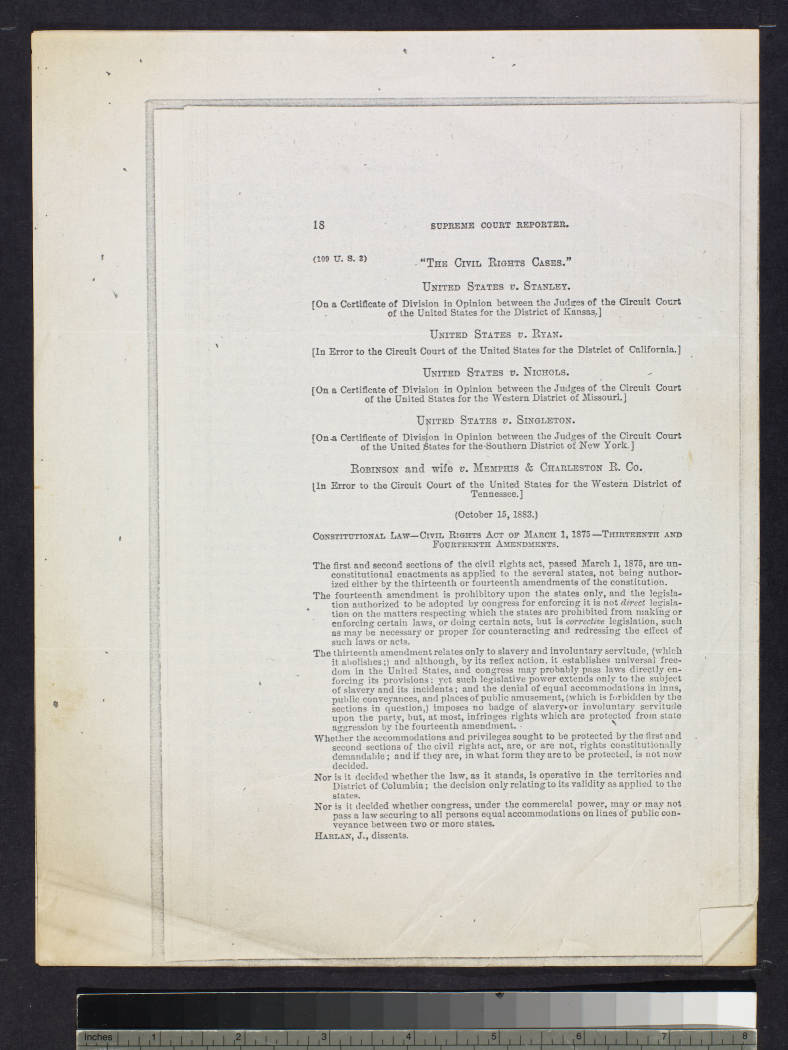
The Civil Rights Cases were reported in volume 109 of United States Reports, beginning at page 3. The decision text is available through legal archives, and a historical printed report is pictured in this article. The National Archives civil-rights timeline summarizes the key outcome, while the original opinions show the constitutional arguments in greater detail. The court report’s printed page is a primary legal source rather than a modern illustration of social conditions. Researchers should also read the 1875 statute to determine which sections were challenged. Juxtaposing the statute, the majority and Harlan’s dissent helps explain the ruling more accurately than relying on the phrase “struck down civil rights” alone.
Civil Rights Cases timeline
| Year | Event |
|---|---|
| 1875 | Congress passes public-accommodations protections. |
| 1880 | Supreme Court addresses racial jury exclusion in Ex parte Virginia. |
| October 15, 1883 | Civil Rights Cases invalidate major public-accommodations provisions. |
| 1896 | Plessy v. Ferguson upholds Louisiana segregation law. |
| 1964 | Congress creates modern federal public-accommodations protections. |