Secession (1860–1861): Eleven States, Causes and Timeline
Which states claimed independence, when they acted, and what their declarations say about slavery.
Eleven slaveholding Southern states declared secession from the United States during the 1860–1861 crisis. South Carolina was first, on December 20, 1860. Seven states left before the war, while Virginia, Arkansas, Tennessee and North Carolina joined after the attack on Fort Sumter. The central purpose of secession was protecting slavery and the political interests of slaveholders; the United States rejected unilateral separation as unlawful.
Examine the chronology, secession declarations, Southern Unionism, the border states and why the constitutional crisis became armed conflict.
On this page — 23 topics
What was the secession crisis of 1860–1861?
The secession crisis began after Abraham Lincoln’s election in November 1860 and culminated in the formation of the Confederate States of America and the outbreak of the Civil War. Eleven Southern states adopted ordinances claiming to leave the United States. Seven declared secession before the war began and four more joined after Confederate forces attacked Fort Sumter in April 1861.
Secession represented a political rebellion against the existing federal Union. The United States government rejected unilateral separation as constitutionally invalid. The dispute became an immediate military problem because national forts, armories, customs houses and other federal installations remained within territory claimed by the seceding state governments.
What was the main cause of Southern secession?
Slavery was the central political issue. Secessionists wanted to protect slaveholding and its expansion from a Republican administration that opposed extending slavery into federal territories. Official declarations from several seceding states explicitly emphasized the institution, federal fugitive-slave laws and the danger they associated with antislavery politics.
Economic differences and arguments about state sovereignty also existed, but separating them from slavery misrepresents the documentary record. When state leaders defended the right to secede, they repeatedly stated what they considered at stake: preservation of a slaveholding racial order. The National Park Service causes guide identifies slavery as the leading cause.
Why did Lincoln’s election trigger the crisis?
Lincoln won the 1860 presidential election without substantial support across the Deep South. He pledged to oppose slavery’s expansion while indicating that he had no immediate program to abolish it within existing slave states. Many slaveholding politicians nevertheless feared that a Republican government would steadily undermine their national influence.
The election shifted assumptions about political power. For decades, Southern elites had relied on compromises and national party alliances to protect slavery. A president could now be elected by a predominantly Northern coalition. Secession leaders used that development to argue that remaining in the Union threatened the institution they defended.
Which state seceded first?
South Carolina adopted its ordinance of secession on December 20, 1860. State convention delegates asserted that the compact joining South Carolina to the Union was dissolved. A declaration of causes adopted soon afterward emphasized disputes over slaveholding, fugitive slaves and antislavery hostility.
The decision was not a direct vote by all residents. The large enslaved population was excluded from political participation, and dissenting white Unionists also existed. The South Carolina declaration is important because its authors explicitly explained their rationale to contemporaries. The historical record does not support rewriting the document as a simple statement about abstract taxation.
What were the seven Deep South states?
Before Lincoln took office, South Carolina, Mississippi, Florida, Alabama, Georgia, Louisiana and Texas had declared secession. Their ordinances were adopted from December 1860 to early February 1861, although Texas’s formal effective date and referendum process differed from the others.
These states had political economies deeply connected to slavery, though regional patterns differed. The decision to secede was made by conventions and existing political elites, not by a common referendum of every inhabitant. Their action created a regional separatist coalition before the first shots at Fort Sumter.
How did the Confederacy form?
Delegates from the seceded states met in Montgomery, Alabama, in February 1861 and organized the Confederate States of America. They adopted a provisional constitution and chose Jefferson Davis as provisional president. A permanent constitution followed in March. It contained explicit protections for slavery, demonstrating the importance of that institution to the new government’s political design.
The Confederate government claimed sovereignty but was not recognized as an independent nation by the United States or by major foreign powers. Its leaders nevertheless raised troops, collected revenue and attempted diplomatic relations. Military organization began before the open battle at Fort Sumter, illustrating how far the crisis had progressed in the winter of 1860–61.
What did Mississippi’s declaration say?
Mississippi’s declaration explicitly linked its position to slavery, presenting the institution as central to the state’s economic and political identity. The language is striking because it does not require a modern historian to infer motives from distant events. The secession convention wrote its own public explanation and placed slaveholding near the center of its case.
The Mississippi declaration of causes should be read alongside other state documents. They were not all identical, but their recurring references to slavery and the grievances of slaveholders undermine accounts that treat secession as unrelated to human bondage.
Why did Texas secede?
Texas adopted an ordinance of secession on February 1, 1861, and held a referendum later that month; the ordinance took effect in March. Its declaration defended slavery and asserted racial hierarchy. The state also faced distinct frontier concerns and questions about military posts and relations with neighboring regions.
The Texas State Library’s secession documents help distinguish a convention vote, popular ratification and effective date. These legal stages can otherwise be confused in short timelines. Texas joined the Confederacy as part of the first secession wave, not as one of the states that left only after Fort Sumter.
Did all Southern people support secession?
No. Unionist communities existed across the South, including in parts of eastern Tennessee, western Virginia, mountain regions and other areas. Support for secession varied by county, social class, local politics and relationships to slavery. Enslaved people, whose freedom and families were directly endangered by the Confederacy’s founding project, were denied a vote over separation.
Some white Southerners opposed secession even while accepting slavery, believing it unwise or unlawful. Others opposed slaveholding more directly. Later wartime loyalties could change under pressure. It is misleading to describe the seceding states as unanimous political communities in which every inhabitant freely chose the same course.
What was the position of border states?
Delaware, Maryland, Kentucky and Missouri were slave states that did not formally join the Confederacy. Their politics were deeply divided, and Union authorities took different measures to retain control. Kentucky initially declared neutrality, while Missouri experienced competing governments and extensive fighting.
The border states show that slaveholding did not automatically produce secession. Military geography, trade links, political institutions and different local beliefs influenced outcomes. West Virginia later formed from part of Virginia after the region’s Unionist political movement rejected the Richmond government’s separation.
How did President Buchanan respond?
James Buchanan remained president until March 4, 1861. He argued that secession was unconstitutional but also questioned the federal government’s power to force a state to remain. Federal authorities therefore confronted a rapidly changing situation without a clear agreed political remedy.
Southern state governments seized forts, arsenals and other property, while loyal federal officers tried to maintain remaining positions. The administration’s uncertainty was important, but the primary decisions to withdraw were made by secessionist conventions and political leaders defending slavery.
What compromise proposals were considered?
During the secession winter, politicians proposed constitutional amendments and political arrangements intended to prevent war. The Crittenden Compromise sought new protections for slavery in federal territories along geographic lines. Supporters believed concessions could preserve the Union, while many Republicans viewed them as surrendering their central commitment to preventing slavery’s expansion.
No proposal achieved a national agreement. The disagreement was more fundamental than one disputed tariff or one misunderstanding between leaders. The future of slavery, territorial settlement and federal authority remained unresolved, and increasing numbers of Southern politicians rejected compromise that did not guarantee the institution’s security.
What happened at Fort Sumter?
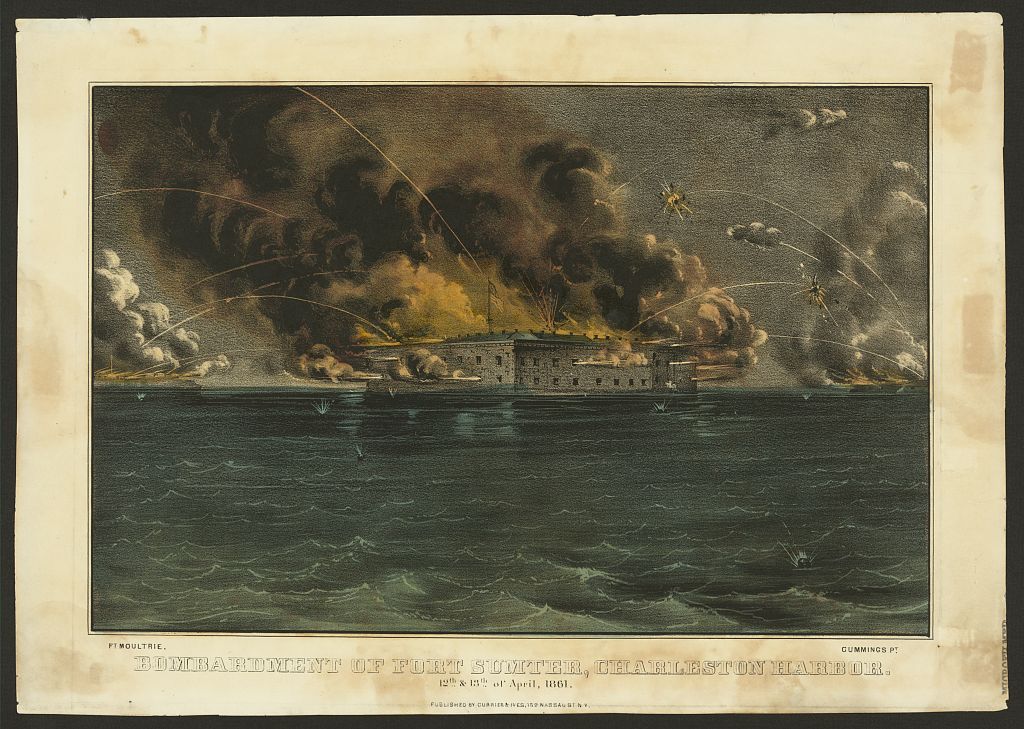
Union soldiers occupied Fort Sumter in Charleston Harbor after South Carolina claimed independence. Confederate authorities demanded its surrender, while Lincoln planned to deliver supplies without conceding federal ownership. Confederate batteries opened fire on April 12, 1861, beginning the military conflict.
Major Robert Anderson’s garrison eventually surrendered. The episode gave a concrete form to competing sovereignty claims: which government owned and could defend federal property inside territory claimed by South Carolina? Our Fort Sumter guide explains the chronology and the misconceptions about the first deaths.
Which states seceded after Fort Sumter?
After Lincoln called for volunteers, Virginia, Arkansas, Tennessee and North Carolina joined the Confederacy, although their local political procedures and dates differed. These states had substantial Unionist communities and did not all follow the Deep South before hostilities began.
The timing demonstrates that the beginning of war changed calculations for political leaders and populations. For many white Southerners, the question of whether their state should provide troops to the federal government or oppose it became more urgent than earlier abstract debates. The state-by-state variation is essential to an accurate timeline.
How did West Virginia enter the Union?
Unionist leaders in northwestern Virginia rejected their state’s secession and organized alternative political institutions. With federal support and a contested constitutional process, the new state of West Virginia was admitted to the Union in June 1863.
Its creation demonstrates the depth of political divisions within seceding states. It was not simply a case of one state peacefully splitting by universal agreement. The process occurred amid war, disputed legitimacy and regional disagreements over slavery and political representation.
Did states have a constitutional right to leave?
Secessionists argued that states were sovereign parties to a federal compact and could withdraw. Unionists argued that the Constitution established a continuing nation and that unilateral secession was not lawful. The Constitution did not contain an explicit secession procedure, and the competing interpretations were not resolved through negotiation.
Lincoln rejected secession in his First Inaugural Address and insisted that federal laws and property would be maintained. The war ultimately defeated the Confederacy’s attempt to establish independence. The Supreme Court later characterized the Union as indestructible in Texas v. White (1869), a postwar decision that should not be projected backward as if it had settled the 1861 dispute before conflict began.
What did secession mean for enslaved people?
Secession was undertaken to preserve an economic and racial system that treated enslaved people as property. Enslaved men, women and children did not consent to the formation of the Confederacy. Their labor and lives were central to the institutions the seceding governments sought to protect.
During the war, enslaved people acted to secure freedom by escaping, aiding Union armies, seeking family reunification and participating in emerging freedpeople’s communities. The secession crisis is therefore not merely a constitutional dispute among white politicians. It directly concerned the lives and futures of millions whose voices were excluded from the conventions.
Secession timeline, 1860–1861
The chronology distinguishes the first seven states from the four that left after fighting began. It also separates electoral and constitutional milestones.
| Date | Event |
|---|---|
| Nov 6, 1860 | Lincoln elected president. |
| Dec 20 | South Carolina secedes. |
| Jan–Feb 1861 | Six other Deep South states secede. |
| Feb 1861 | Confederate government formed. |
| Mar 4 | Lincoln inaugurated. |
| Apr 12–13 | Confederate attack on Fort Sumter. |
| Apr–June | Virginia, Arkansas, Tennessee and North Carolina join Confederacy. |
Why does secession remain historically important?
The crisis tested whether the United States would continue as one constitutional government and whether slavery would remain protected within an independent Southern republic. It divided families and regions, forced soldiers and civilians to choose allegiances and turned disagreements about citizenship into a devastating war.
It also exposes the danger of confusing political rhetoric with historical evidence. The conventions did not all use identical words, but their official documents repeatedly defended slaveholding. An honest account can examine constitutional theories and economic arguments while recognizing slavery’s decisive position in the secessionists’ own explanations.
Frequently asked questions about secession
Which state left first? South Carolina on December 20, 1860.
How many states joined the Confederacy? Eleven.
Why did they leave? Principally to protect slavery and the slaveholding political order.
When was the Confederate government formed? February 1861.
Did all states secede before the war? No, four followed the Fort Sumter attack.
Did every Southerner support secession? No.
Where should students examine primary documents?
Read the South Carolina declaration, Mississippi declaration and Texas secession records rather than relying only on later summaries. Compare how officials described the threats they perceived, especially the expansion of slavery and obligations under federal fugitive-slave laws.
Then use the U.S. Army Civil War chronology to check dates and the NPS analysis to distinguish central causes from secondary factors. These different sources provide direct statements of political purpose and a reliable sequence of the crisis.