Battle of Bennington (1777): John Stark, Walloomsac and Saratoga
How a failed British supply expedition near Vermont strengthened the American position in the northern campaign.
The Battle of Bennington was fought on August 16, 1777, near Walloomsac, New York—not within Bennington, Vermont. American militia commanded by John Stark, with additional help from Seth Warner, defeated a British-allied expedition under Friedrich Baum and reinforcements led by Heinrich von Breymann. Burgoyne’s army lost nearly 900 men and failed to obtain needed supplies, weakening its campaign before Saratoga.
Explore the location, commanders, separate attacks on Baum and Breymann, role of militia, and logistical effects on Burgoyne before Saratoga.

On this page — 23 topics
What happened at the Battle of Bennington?
The Battle of Bennington was fought on August 16, 1777, near Walloomsac in present-day New York. American forces led by John Stark and supported by militia from several New England areas attacked a detachment from General John Burgoyne’s army. The detachment, which included German troops and Loyalist and other allies, had been sent to obtain desperately needed supplies and horses.
The Americans won a decisive victory, defeating the original force and then helping drive off reinforcements. The defeat cost Burgoyne men, equipment, and confidence at a time when his advance from Canada was already strained by the difficulty of transporting supplies through the Hudson Valley. Bennington was an important precursor to the larger American success at Saratoga.
Where did the battle take place?
Although named after Bennington, Vermont, the principal fighting occurred across the state line near Walloomsac, New York. The American militia’s supply base and the detachment’s intended target were associated with Bennington, but the battlefield itself was west of town. This distinction is important for maps, historical markers, and students trying to locate the actual terrain.
Hills, farms, narrow roads and wooded approaches shaped the fight. Both sides had to contend with travel difficulties and changing weather. The name of an eighteenth-century battle often identifies a nearby settlement rather than the precise ground where soldiers fought, and Bennington is a clear example of that pattern.
Why was Burgoyne marching south from Canada?
In 1777 British General John Burgoyne attempted to push south from Canada toward Albany, New York, hoping to control the Hudson corridor and isolate New England from other rebellious colonies. British regulars, German troops in British service, Loyalists, and Indigenous allies participated in the campaign. The route presented significant problems of transport, navigation, supplies and maintaining communications.
Burgoyne captured Fort Ticonderoga in July, but advancing farther into the interior did not become easier. Roads had to be improved, wagons and animals were needed, and American forces could threaten scattered parties. The army’s vulnerability increased as its supply chain grew longer. The failure at Bennington exposed the costs of those problems before the battles near Saratoga decided the campaign.
Why did Burgoyne send soldiers toward Bennington?
Burgoyne believed supplies, draft animals, horses and equipment could be seized in the region around Bennington. He sent a detachment commanded by Lieutenant Colonel Friedrich Baum to raid the area. The aim was to strengthen the army’s mobility and provisioning rather than launch a separate war of conquest against Vermont.
The expedition was based partly on expectations that local Loyalists would provide support. Those expectations proved unreliable, and the detachment found stronger organized resistance than anticipated. The episode demonstrates how decisions made under logistical pressure can expose an army to new dangers: a force seeking supplies must travel away from its main support while guarding its own movement and communications.
Who was John Stark?
John Stark was an experienced New Hampshire officer who commanded a large body of American militia. He had fought earlier in the war, including in the Boston campaign, and had complicated relations with military authorities over rank and command. At Bennington he led troops whose familiarity with the region and commitment to resisting Burgoyne proved important.
Stark’s success should not be reduced to one famous speech. He brought together units from several communities, planned attacks against separate defensive positions, and organized his men to approach from multiple directions. The militia’s victory also depended on information, terrain and the arrival of additional support. Stark became closely identified with the battle in later public memory.
Who commanded Burgoyne’s detachment?
Lieutenant Colonel Friedrich Baum led the first detachment, which included German soldiers as well as British-aligned Loyalists and other participants. Baum’s troops occupied defensive positions and attempted to secure the approaches while awaiting help. His command was not a simple single-nationality unit: the range of forces reflected the political and military alliances of the British war effort.
Lieutenant Colonel Heinrich von Breymann led the reinforcement column sent to aid Baum. The arrival of those troops changed the fighting after the initial American success and created a second phase of the engagement. The two detachments are often combined in summaries, but distinguishing them clarifies why the battle unfolded over several hours.
What role did Loyalists play?
Loyalists were inhabitants of the American colonies who supported continued British rule, though their motives and degrees of commitment varied. Burgoyne’s commanders expected local Loyalist recruits and guides to help locate supplies and provide intelligence. In practice the region contained strong Patriot mobilization and the assumptions made by British officers did not match the support available.
Loyalist participation also illustrates the civil-war character of the Revolution. Neighbors might fight on different sides, and military operations could bring retaliation, property loss and lasting community conflict. It is inaccurate to portray every American-born participant at Bennington as a supporter of independence or every defender as a British professional soldier.
Were Indigenous warriors involved?
Indigenous warriors participated in Burgoyne’s larger campaign under their own leaders and with their own concerns about territorial power, trade and relationships with imperial authorities. Some Native participants were associated with the expedition toward Bennington. Their actions cannot be understood simply as an extension of British orders, because Indigenous nations were not politically uniform and communities faced different pressures.
The 1777 campaign also included Indigenous support for American positions elsewhere, notably Oneida participation in the Battle of Oriskany. Reading both events together shows that regional alliances did not map neatly onto a two-sided national story. Sources should identify nations and individuals where the record permits and avoid treating Native participants as anonymous auxiliaries.
Why was the fighting delayed by rain?
Wet weather complicated roads and the movement of troops and equipment before the main battle. Baum’s detachment paused and occupied positions while Stark gathered militia and planned the attack. Delays could be dangerous for an isolated column because they allowed local opponents time to assemble.
Rain also illustrates the practical limits of eighteenth-century campaigning. A commander could not move artillery, wagons and animals at a modern fixed speed. The local surface, bridges, narrow tracks and visibility influenced decisions. Weather did not cause the battle by itself, but it affected when the opposing forces met and how prepared they were to fight.
How did Stark organize the attack?
Stark planned an assault using several American elements to strike Baum’s positions from different directions. This approach sought to overwhelm defensive outposts and make it difficult for the detachment to reinforce each threatened sector. The American militia included men familiar with woods and local routes, which helped them maneuver toward the positions.
The operation required timing and recognition of friendly units, problems that often limited militia forces in large battles. Stark’s ability to coordinate the attacks was therefore important. The success should not be explained as a crowd simply rushing a stationary enemy: separate movements and assaults broke down the defenses in stages.
What happened to Baum’s force?
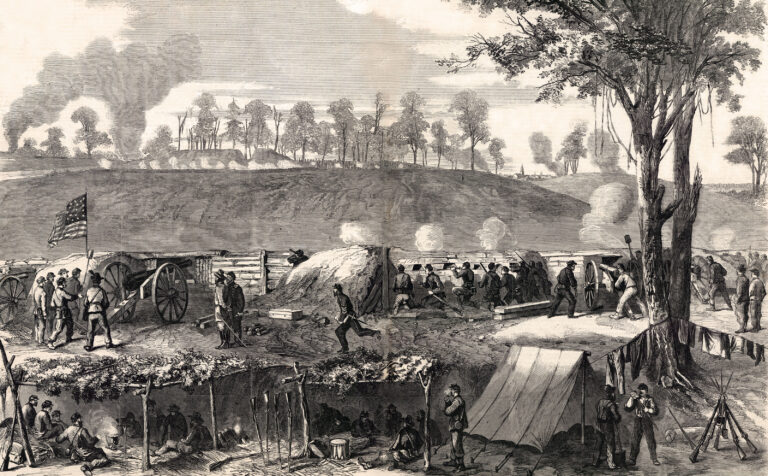
The first American attacks overwhelmed various defensive positions and increasingly isolated Baum’s remaining troops. Fighting was intense, and many soldiers in the German-led detachment were killed, wounded or captured. Baum himself was mortally wounded. His force could no longer carry out the supply mission and was defeated before Breymann could intervene effectively.
The result deprived Burgoyne of manpower he could not easily replace. The loss also demonstrated that militia could defeat an isolated portion of a larger professional army when commanders used terrain, local intelligence and concentrated force effectively. It did not mean that Burgoyne’s whole army had surrendered at Bennington; the main northern campaign continued.
Why did Breymann’s reinforcements arrive late?
Breymann’s detachment marched to assist Baum, but difficult roads and the challenge of moving artillery and supplies slowed its progress. When the reinforcements reached the vicinity, Baum’s force had already suffered a decisive defeat. This created a new problem for the British-aligned troops: they had to fight American units that were regrouping after an initial success.
The timing is essential to the outcome. If the columns had united earlier, the balance of forces might have differed. Historians cannot know exactly how a hypothetical alternative battle would have unfolded, but the separation of the detachments helps explain how American troops were able to deal with them in succession.
What was Seth Warner’s role?
Colonel Seth Warner commanded the Green Mountain Boys and related Vermont troops who arrived during the later phase of the fighting. Their contribution helped resist Breymann’s reinforcements and maintain American pressure when Stark’s men had already fought hard. Warner was therefore an important participant, not simply a minor figure following Stark.
The exact distribution of credit among Stark, Warner and other commanders varies in popular accounts. A careful history recognizes multiple leaders and the militia units they directed. The American victory resulted from coordinated and overlapping actions over several hours rather than one leader’s isolated maneuver.
What were the casualties and prisoners?
The Saratoga National Historical Park timeline estimates that Burgoyne lost nearly 900 men in the Bennington operation, including those killed, wounded and captured. The number is significant relative to his overall army and cannot be treated as an insignificant raid that went wrong. American losses were considerably smaller, though the battle still brought death and injury to local militia communities.
Casualty figures differ depending on whether historians combine Baum’s first force with Breymann’s reinforcements and how prisoners are classified. Students should check the categories used in their sources before repeating an exact total. The scale of the British loss and the failure to obtain supplies are more securely established than every detail of individual returns.
Did the Americans capture supplies?
The main British mission was to secure horses, equipment and provisions. Instead it suffered defeat and lost much of its detachment. American forces captured prisoners and some useful military equipment, though accounts of particular quantities vary. The more important logistical result was negative for Burgoyne: his army had sought help for an increasingly difficult supply situation and gained none of the hoped-for relief.
The episode illustrates how campaigns can be won through the destruction of an enemy’s mobility and logistical options as well as through set-piece battles. Burgoyne’s remaining army had to continue without a large number of men and without the additional horses or supplies he had hoped to obtain.
How did Bennington affect Saratoga?
Bennington weakened Burgoyne’s army weeks before it confronted American forces near Saratoga. It reduced available manpower, damaged morale and demonstrated the strength of regional Patriot mobilization. Around the same period, the failure of the British operation against Fort Stanwix denied Burgoyne support from another direction.
These problems contributed to the isolation of the British army that eventually surrendered in October 1777. Bennington was not itself the surrender at Saratoga, but it forms an essential part of the campaign’s cumulative story. The National Park Service’s Saratoga timeline shows how these separate events combined before the major battles of September and October.
Why was the location important to Vermont?
Bennington was an important Patriot community and a supply center in the region that would later become Vermont. Although the fighting happened in New York, its political and military significance became central to Vermont’s historical identity. The battle is commemorated as Bennington Battle Day and has influenced regional public history.
The distinction between battlefield location and the town name matters for accurate geography. Travelers interested in the battlefield should look for the Walloomsac site in New York, while Vermont contains other major commemorative landmarks. Neither place should be described as the only location associated with the historical event.
Battle of Bennington timeline
The operation occurred during Burgoyne’s broader 1777 advance. These dates help link the failed supply expedition to other problems in the northern campaign.
| Date | Event |
|---|---|
| July 1777 | Burgoyne advances south after taking Ticonderoga. |
| Early August | Baum sent toward suspected supplies near Bennington. |
| August 14–15 | Militia assemble; weather affects movement. |
| August 16 | Stark attacks Baum’s force near Walloomsac. |
| August 16 later | Breymann arrives; American troops including Warner’s fight his column. |
| September–October | British forces are defeated in the Saratoga campaign. |
What myths and oversimplifications should be avoided?
One frequent mistake is placing the main battlefield within the town of Bennington rather than at Walloomsac, New York. Another is claiming that Bennington alone defeated Burgoyne’s entire army. The detachment’s defeat was serious but formed only one part of the campaign.
It is also misleading to portray all troops as either native-born Americans or British redcoats. The forces included German soldiers, colonial Loyalists and Indigenous participants whose motives differed. Accurate history requires specifying who fought, where, and under what command instead of relying on a simplified two-color battlefield diagram.
Frequently asked questions about Bennington
When was the battle? August 16, 1777.
Where was it fought? Near Walloomsac, New York, west of Bennington, Vermont.
Who commanded the Americans? John Stark, supported by officers including Seth Warner.
Who led the British-aligned detachment? Friedrich Baum, with reinforcements under Heinrich von Breymann.
Who won? American militia forces.
Why was it important? It deprived Burgoyne of men and supplies before Saratoga.
How should Bennington be researched?
Begin with the Saratoga National Historical Park campaign chronology, which places the battle in the northern campaign and estimates Burgoyne’s losses. The Vermont State Historic Sites guide provides the local commemorative context and helps identify the battlefield’s location. Compare these accounts with maps, military orders and the record of Burgoyne’s supply problems.
An official battle summary can state who won and when, but explaining why requires the situation before the attack. Look at the distance from Burgoyne’s main army, the role of roads and horses, and the timing of Baum’s and Breymann’s detachments. This approach connects a localized engagement to the strategic collapse of the British advance.