Valley Forge (1777–1778): Winter Encampment, Hardship and Army Training
Why Washington’s army spent six months near Philadelphia, what soldiers endured, and how the Continental Army changed.
Valley Forge was the Continental Army’s winter encampment in Pennsylvania from December 19, 1777, to June 19, 1778. General George Washington’s soldiers faced supply shortages, illness, and difficult living conditions, while improving military training and organization. Nearly 2,000 people died of disease, and Baron von Steuben helped standardize drills. There was no major battle at Valley Forge; the army left in June to pursue the British after they evacuated Philadelphia.
What really happened at Valley Forge? This guide explains the camp’s location, dates, food and shelter problems, the people who kept it operating, the training reforms, and how later patriotic stories differ from the historical evidence.
On this page — 27 topics
What happened at Valley Forge?
From December 19, 1777, to June 19, 1778, General George Washington’s Continental Army occupied a vast winter camp at Valley Forge, Pennsylvania. The soldiers built temporary housing, guarded the approaches to British-held Philadelphia, dealt with inadequate supplies, and prepared for another campaign. Valley Forge was not the site of a major battle. Its historical significance rests in how the army survived and reorganized during a dangerous stage of the American Revolutionary War.
The encampment is often described simply as a story of courage in the snow. There certainly was hardship. Yet the National Park Service emphasizes a more complicated picture: soldiers entered camp after a difficult campaign, experienced illness and logistical failures, and also worked to improve military discipline and administration. Not every soldier was barefoot, not every week was without food, and the winter was not uniquely cold by Revolutionary War standards.
When the army left Valley Forge in June 1778, it was capable of pursuing the British across New Jersey. Understanding why means looking beyond the famous images of suffering to the camp’s geography, leadership, labor, changing supply arrangements, and training.
Why did George Washington choose Valley Forge?
Washington needed a defensible location near Philadelphia after the British had occupied the city in September 1777. A winter camp directly inside the city was impossible, and a camp too far away would have surrendered strategic influence. Valley Forge, roughly twenty miles northwest of Philadelphia, offered elevated terrain, wooded areas, access to water, and routes that could support communication and foraging.
The site lay near the Schuylkill River. Its position made a surprise British attack difficult while allowing Washington to monitor movements around Philadelphia. Engineers and officers could plan defenses on the surrounding heights. Placing the army in one large encampment also helped keep units together for training instead of dispersing them among distant towns and farms.
This was a military decision, not simply an accident of bad weather. It had costs: thousands of people concentrated in a temporary camp created enormous demand for shelter, food, clothing, fuel, and sanitation. The same concentration that protected the army also increased the danger of disease. The National Park Service’s study of the Valley Forge landscape explains the location’s strategic advantages.
What happened before the army arrived?
The autumn of 1777 had produced contrasting fortunes for the American cause. In Pennsylvania, British forces under Sir William Howe had defeated Washington’s army at Brandywine and entered Philadelphia. Washington subsequently fought at Germantown but failed to dislodge the British. His army remained in the field, yet the loss of the political capital created pressure on its commander.
Farther north, the Americans won a major victory at the Battles of Saratoga, capturing the army of British General John Burgoyne. That achievement helped persuade France to enter a formal alliance with the United States in 1778. Valley Forge therefore came at a moment of both serious danger and genuine strategic opportunity.
The Continental Army needed to preserve itself until the next campaigning season. Washington also faced an awkward political problem: critics could point to the loss of Philadelphia even while other American forces celebrated victory in New York. A successful encampment required military discipline and a workable relationship with Congress, not merely the endurance of individual soldiers.
When did the Continental Army arrive and leave?
Washington’s troops marched into Valley Forge on December 19, 1777. They began constructing winter quarters and defensive works shortly after arrival. Units stayed in the area through the winter and spring, and Washington’s army departed on June 19, 1778, following the British withdrawal from Philadelphia.
Those two dates provide useful boundaries for the episode. The encampment lasted about six months, rather than one especially harsh week or a single battle. Conditions changed within that period. Early arrivals focused on building shelter; a serious shortage of meat was recorded in February; major drill reforms gathered pace in the spring; and the army later received news of the alliance with France.
The departure was also part of a larger campaign. British troops were moving across New Jersey toward New York, and Washington’s army followed them. A few days later, the opposing armies fought at Monmouth. The story of Valley Forge belongs to that sequence of continuous military operations.
Valley Forge timeline: December 1777 to June 1778
The essential sequence is easier to understand when the military and political events are read together. Dates marking the camp’s opening and closing are firm; many developments, including illness, foraging, and changes in discipline, unfolded gradually.
| Date | What happened | Why it mattered |
|---|---|---|
| December 19, 1777 | The Continental Army entered Valley Forge. | Washington concentrated his force near British-held Philadelphia. |
| Late December–January | Soldiers built huts and field defenses. | Temporary housing and fortified lines supported a prolonged stay. |
| February 1778 | Food shortages worsened; Baron von Steuben arrived on February 23. | Supply failure threatened readiness while professional training began. |
| Spring 1778 | Training and administrative reforms continued. | Units practiced more standardized drills and camp procedures. |
| May 1778 | News of the formal French alliance was celebrated. | International support improved the prospects of American independence. |
| June 19, 1778 | Washington’s army left Valley Forge. | The army pursued British forces departing Philadelphia. |
For classroom use, compare the chronology with events outside the camp. The February 1778 French alliance grew out of earlier American diplomacy and battlefield developments; it was not created at Valley Forge. Likewise, the June departure was made possible partly by British strategic decisions elsewhere in the war.
How many soldiers were at Valley Forge?
Approximately 12,000 or more Continental soldiers entered the winter quarters, according to National Park Service accounts, though strength figures vary depending on the date and whether a tally counts soldiers present, fit for duty, absent, or attached to particular units. Hundreds of civilians also lived and worked around the camp. It was effectively a large temporary settlement rather than a small group of men around a campfire.
The camp included soldiers from different states and backgrounds. Men served in infantry, artillery, cavalry, headquarters, engineering, and support functions. Officers and enlisted men had different responsibilities and different access to accommodations. Women, children, civilian workers, Indigenous allies, and free and enslaved Black people were also part of the encampment’s complex population.
Numbers reported in popular accounts should therefore be treated as approximations tied to a date and definition. A soldier listed as unable to serve because he lacked shoes was not necessarily dead or permanently absent. The park’s encampment history distinguishes those categories and avoids treating one figure as a complete census.
What were the soldiers’ living conditions?
Soldiers faced cramped housing, damp ground, worn clothing, repeated exposure to freezing and thawing weather, and frequent shortages of fresh food. Many had marched and fought through the preceding campaign and arrived fatigued. Mud could make roads difficult to use, delaying carts just when thousands of people needed regular delivery of flour, meat, forage, and other necessities.
Living standards differed across the army. Some units were reasonably clothed; others struggled to obtain footwear and serviceable garments. Officers could have more space and household support than enlisted men. A soldier’s daily experience also changed over the six months as huts were completed, supply shipments fluctuated, and winter gave way to spring.
The hardship was real without needing every familiar dramatic image to be literally true. For example, the park reports that at the worst point in early March, 2,898 men were unfit for duty because of clothing shortages. This is evidence of severe difficulty, but it does not mean the entire force lacked uniforms at every moment.
Was the winter of 1777–1778 the coldest of the war?
No. The winter at Valley Forge was difficult, but historians do not identify it as the coldest or snowiest winter of the Revolutionary War. The better-known image of an army buried beneath constant deep snow misrepresents the range of conditions recorded at camp. Rain, thawing ground, slush, and muddy roads created persistent problems alongside periods of freezing temperatures.
Exposure remained dangerous, especially for soldiers with inadequate clothing or shelter. Cold weather also complicated deliveries and made routine work exhausting. Nevertheless, an explanation that relies only on extraordinary temperatures misses the food distribution, transport, sanitation, and administrative failures that made the encampment so dangerous.
The National Park Service explicitly cautions against turning the episode into a simplified scene of helpless soldiers waiting for rescue. Troops constructed shelters, collected materials, maintained guard posts, cooked their meals, and took practical measures to survive. The historical lesson is stronger when those efforts appear alongside the hardships.
What kind of huts did soldiers build?
Thousands of men helped construct a temporary military town made largely of log huts. These buildings were intended to provide more durable shelter than exposed tents during a winter encampment. Soldiers cut timber, shaped logs, assembled roofs, and attempted to make interiors usable with fireplaces and other improvised features. Building materials and quality could differ from one part of camp to another.
The park describes roughly 1,500 huts and a system of protective works. Housing did not appear overnight: construction required tools, fuel, labor, and coordination at the same time that units still had guard and military duties. Within each hut, the number of occupants and the available furnishings influenced comfort and hygiene.
Modern visitors can see reconstructed cabins at Valley Forge National Historical Park. Those structures help explain the scale and arrangement of the encampment, but a reconstruction should not be mistaken for an untouched 1777 building. Archaeology, contemporary plans, documents, and modern interpretation all contribute to the picture historians present.
Why did soldiers sometimes go hungry?
The problem was not simply that no food existed anywhere in Pennsylvania. The Continental Army had to acquire supplies, pay or requisition them, transport them over damaged and muddy roads, and distribute them to the correct units. Weak finances, competing state responsibilities, inefficient procurement, and the difficulty of keeping enough draft animals all complicated those tasks.
Conditions varied by month. The park reports that shipment records indicate a January 1778 average of about half a pound of beef per man per day. February brought a more serious meat shortage, with soldiers at times going several days without meat. Some units were better supplied than others, and local foraging or purchases could relieve specific shortages without solving the system-wide problem.
Washington pressed political authorities to address military needs. The crisis illustrates why logistics mattered as much as battlefield courage: troops who cannot be fed, clothed, or moved cannot remain an effective army indefinitely. The Smithsonian’s Valley Forge correspondence exhibit presents contemporary letters that reveal practical supply concerns.
How did disease become the deadliest threat?
Disease was more deadly than enemy fire during the encampment because no major battle occurred at Valley Forge. People lived close together, sanitation was difficult, and the population included many who were exhausted, poorly nourished, or already ill. The camp experienced illnesses commonly described in the historical record as influenza, typhoid, dysentery, and other fevers.
The National Park Service estimates that nearly 2,000 people died from disease during the six months. Historical counts are imperfect, and different studies sometimes use somewhat different totals. The crucial point is not the precision of a single rounded number but the scale of preventable suffering in a densely occupied military camp.
Sickness also affected the army well beyond the number of deaths. Men who survived an illness might be unavailable for weeks, disrupting patrols, drills, hauling, and defense. Camp cleanliness, food delivery, fresh water, and the organization of medical care were consequently questions of military strength, not merely personal comfort.
What did Baron von Steuben change?
Friedrich Wilhelm von Steuben, a Prussian-born officer known as Baron von Steuben, arrived at Valley Forge on February 23, 1778. His task was to help turn units using different local drill traditions into a more consistently trained force. He first examined the army’s practices and then developed a standardized approach to marching, formations, weapons handling, and field discipline.
Von Steuben did not personally train every American soldier from the beginning. He worked with a model company and with officers who could carry the lessons into other regiments. His instructions, first written in French, were translated for American officers and circulated through the chain of command. This method allowed the training program to spread widely.
He also pressed for improvements in inspection and sanitation. His influence should not erase the contributions of Washington, existing American officers, or the soldiers who learned and practiced the new procedures. The National Park Service biography of von Steuben describes the training process and its organizational impact.
Did von Steuben write the Continental Army’s training manual?
Yes, but the well-known printed manual appeared after the Valley Forge encampment. Von Steuben’s daily instructions and drills developed during 1778 helped form the basis of Regulations for the Order and Discipline of the Troops of the United States, published in 1779. Soldiers and historians often call it the Blue Book.
This distinction matters because it prevents an easy chronological mistake. The 1779 publication did not arrive at Valley Forge as a finished manual in February 1778. Instead, instructors tested and circulated drill procedures in the camp, and the written system was later organized into a formal printed reference.
Standardization improved the likelihood that soldiers from different states could maneuver together under common commands. It was not a magical transformation achieved in a single afternoon. The changes required repeated practice and continued leadership after June. See the park’s history of Steuben’s Regulations for the manual’s development and publication.
Who was Nathanael Greene, and how did supplies improve?
Nathanael Greene, one of Washington’s senior generals, became quartermaster general in March 1778. The quartermaster’s office helped organize transport, equipment, camp needs, and the complex work of moving an army. It was a difficult responsibility in a military system where Congress, states, contractors, officers, and local communities all influenced access to materials.
Supply improvement required more than appointing one capable officer. Washington sought assistance from Congress and worked to change the structure and supervision of army support. Foraging and procurement continued. Better arrangements helped the force prepare for movement when the British eventually left Philadelphia, though deficiencies did not disappear permanently.
The correspondence highlighted by the Smithsonian’s National Postal Museum includes a spring 1778 letter from Greene about the practical challenge of keeping the army mobile. Such documents are valuable because they show leaders dealing with mundane but essential questions about wagons, provisions, and equipment rather than only issuing stirring battlefield statements.
What did George Washington do during the encampment?
Washington’s responsibilities were political and organizational as well as military. He had to protect the army, maintain morale, work with senior officers, communicate with Congress, and respond to criticism of his command. He oversaw preparations for renewed campaigning while keeping watch on British-occupied Philadelphia. The commander could not solve every problem himself, but his headquarters was central to coordinating the response.
The winter coincided with criticism from figures later associated with the so-called Conway Cabal. Some officers and politicians contrasted Washington’s defeats around Philadelphia with the American success at Saratoga. The term can suggest a more coherent secret plot than the surviving evidence always supports, but dissatisfaction and questions about leadership were genuine.
Washington retained command. His advocates defended him, and congressional discussions brought greater attention to the army’s situation. George Washington’s Mount Vernon’s Valley Forge history highlights the command challenges, while the park’s account traces the encampment’s importance for Washington’s authority and the army’s reorganization.
What roles did women play at Valley Forge?
Women were part of the encampment, not merely occasional visitors. The National Park Service estimates that roughly 250 to 400 women were present. Some accompanied enlisted relatives and children, while others worked as nurses, laundresses, cooks, vendors, and household employees. Their work helped sustain soldiers in ways that military summaries often overlook.
Service could be paid or unpaid, voluntary or constrained by circumstance. Regulations limited where women could go and what they could do, and different women encountered very different conditions. The park records women such as Mary Geyer, who laundered and repaired clothing, and Jane Norton, who received rations for nursing work. The labor of washing, repairing, cooking, and nursing was essential in an enormous camp.
Martha Washington arrived in February 1778 and managed aspects of life at Washington’s headquarters, including hospitality and household organization. She did not represent every camp woman’s experience. The National Park Service’s account of women at Valley Forge offers a more varied and evidence-based view.
Were Black soldiers and civilians at Valley Forge?
Yes. The Continental Army and its support community included free and enslaved Black people, and their experiences cannot be reduced to one uniform story. Some fought as enlisted soldiers; others worked around headquarters and in labor roles. State laws, military policies, the legal status of individuals, and individual circumstances affected how and why people served.
The National Park Service documents Black soldiers in several units and notes that the encampment included at least 115 Black soldiers from Rhode Island. A 1778 Rhode Island measure offered emancipation through military service to certain enslaved recruits, but legal and practical realities were complicated. Enlistment did not mean the wider Revolutionary struggle had ended slavery.
Individual biographies make this history more concrete. They also remind readers of gaps in the record: muster rolls often omit racial identity, and many people who sustained the encampment left fewer surviving documents than senior officers. The park’s Patriots of Color at Valley Forge project gathers evidence for soldiers whose contributions have not always been prominent in older narratives.
How did Indigenous allies contribute?
The American Revolution involved Indigenous nations and communities with their own interests, diplomatic relationships, and difficult choices. Some sided with Britain, others supported the American cause, and allegiances could differ within and among communities. It would be inaccurate to describe Indigenous participants as simply joining one national movement without their own aims.
In spring 1778, delegations of Oneida and Tuscarora warriors worked with the Continental Army, providing military support that included scouting and countering British activity. Oneida assistance also appears in traditions about food and care. Polly Cooper, an Oneida woman, is remembered for helping soldiers use white corn safely and for assisting the camp.
Some parts of these accounts are grounded in surviving records; others are preserved through oral tradition. Both deserve careful identification rather than being merged into a single unquestioned anecdote. For further context, the National Park Service provides a detailed guide to American Indian allies at Valley Forge.
Was Valley Forge a battlefield?
No major battle took place at Valley Forge during the winter encampment. Soldiers built defenses and remained alert to possible British attacks, but the site is historically important as a military camp and training center. Calling it a battlefield without qualification can confuse readers about what the Continental Army accomplished there.
Military activities nevertheless continued. Patrols guarded approaches, parties sought supplies, soldiers drilled, and officers evaluated their opponents’ movements. A camp so close to Philadelphia could not simply become a place of rest with no concern for the war. Remaining ready for a potential attack was one reason its strategic position and defenses mattered.
The distinction also explains why accounts of Valley Forge focus on illness and logistical strain rather than combat casualty lists. When Washington’s army eventually left the site, it engaged British troops at Monmouth in New Jersey later that month. The transformation at Valley Forge was tested during subsequent operations, not in a battle fought inside the camp itself.
What happened when France joined the American war effort?
American diplomacy and the victory at Saratoga helped make a formal alliance with France possible. Agreements signed in February 1778 brought French recognition and crucial international assistance. News of the alliance was celebrated by the Continental Army in May, giving soldiers a powerful reminder that the rebellion was becoming a broader international conflict.
The alliance promised more than moral support. French military forces, money, supplies, and particularly naval power eventually became important to the American war effort. Yet France did not immediately solve every supply problem in Pennsylvania. The Continental Army still faced months and years of fighting after the announcement.
The connection becomes especially clear when readers continue to the Siege of Yorktown in 1781, where cooperation between American and French forces was decisive. Valley Forge should therefore be understood as one stage in a larger sequence: American survival, international diplomacy, professional reform, and later combined operations.
Why did the army leave Valley Forge in June 1778?
The British decided to evacuate Philadelphia and concentrate their forces toward New York. This decision reflected changing British strategic priorities as France entered the conflict. A shift in British deployment created an opportunity for Washington to move his army rather than remain in winter quarters indefinitely.
On June 19, 1778, the Continental Army marched out of Valley Forge in pursuit. Its ability to move and operate as an organized force was an important test of the winter’s work. The army soon met the British at the Battle of Monmouth, on June 28. That battle involved intense heat and complicated battlefield decisions rather than the snowy conditions usually associated with Valley Forge.
Leaving camp did not end the Revolution, and it did not mean the army was suddenly free of logistical difficulties. It did mark a transition from a vulnerable, stationary encampment to active summer campaigning. The park’s encampment overview places the June march within this broader change in strategy.
Did Valley Forge win American independence?
Valley Forge did not win independence by itself. The American Revolution continued until the major British surrender at Yorktown in 1781 and the peace settlement of 1783. It would be misleading to claim that one winter made the final outcome inevitable. The war depended on diplomacy, finances, regional campaigns, popular support, military leadership, and events beyond Washington’s Pennsylvania camp.
What Valley Forge did was help preserve a Continental Army capable of remaining in the field. The soldiers survived an extended period of hardship, senior leaders worked toward administrative improvements, and more consistent training helped units act together. The armed force that departed in June 1778 had more unified procedures than the one that arrived six months earlier.
Its significance is both practical and symbolic. Practically, it supported the army’s future campaigns. Symbolically, it became a national story about perseverance. Both meanings matter, but the symbolic version must be checked against the details of actual life in the encampment.
Which popular Valley Forge stories are myths or oversimplifications?
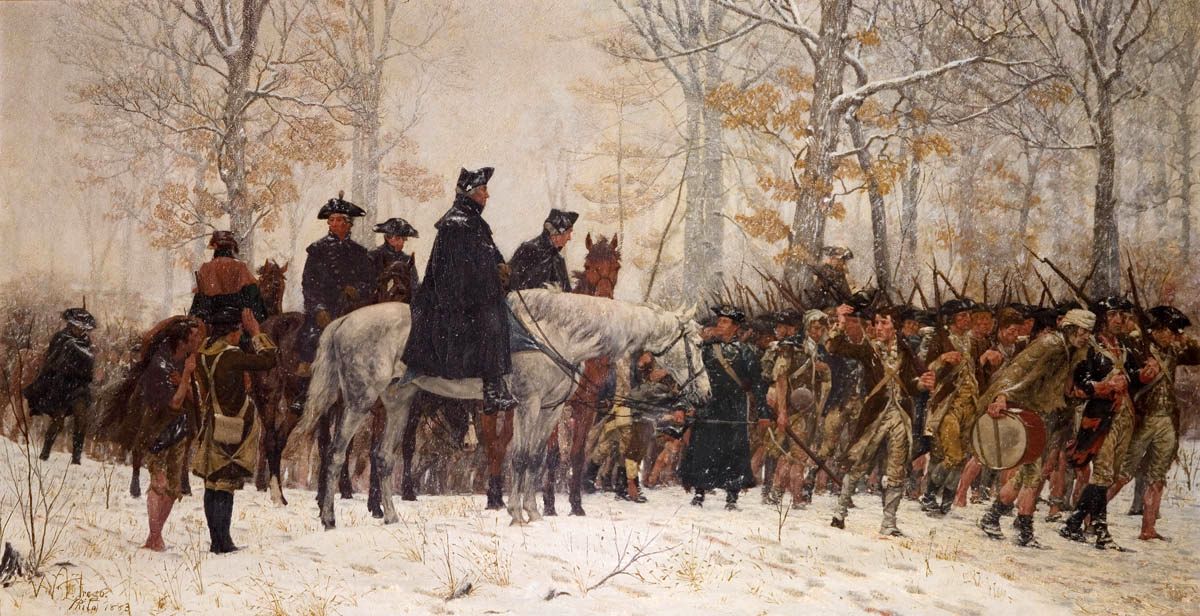
The most familiar image shows nearly every Continental soldier barefoot, collapsing in unusually deep snow, until extraordinary courage alone saves the army. Some men did lack shoes or coats, and many people suffered terribly. However, the National Park Service warns that this single scene does not accurately describe every unit or the entire six-month encampment.
A second oversimplification is that the soldiers arrived as an undisciplined mob and were instantly transformed by one European officer. Von Steuben made important reforms, but the army already included veterans and experienced officers. Training required organization and repeated work, and continued after the spring of 1778.
A third is to treat famous later artwork and patriotic storytelling as direct photographs of events. The painting accompanying this article was created in 1883, more than a century after the march. It is valuable for understanding public memory and commemoration but cannot by itself prove what individual soldiers wore on December 19, 1777.
What can historians learn from the surviving evidence?
Different kinds of evidence answer different questions. Army returns help estimate troop strength and readiness; supply accounts help reconstruct food distribution; letters reveal the concerns of officers and ordinary participants; maps and archaeology help establish where units camped and how their temporary structures were arranged.
Every source has limitations. A commander writing to Congress might emphasize urgent shortages to secure assistance. A retrospective memoir might dramatize the experience. A modern painting might focus on sacrifice and heroism rather than logistical detail. A count of men absent from duty might include several causes and should not automatically be treated as a death toll.
Students can improve their interpretation by comparing the National Park Service’s historical overview, the Smithsonian’s original correspondence exhibit, and George Washington’s Mount Vernon’s military and political account. The strongest conclusions emerge when independent types of evidence support the same point.
Frequently asked questions about Valley Forge
When was Valley Forge? The Continental Army camped there from December 19, 1777, to June 19, 1778.
Where is Valley Forge? In southeastern Pennsylvania, near the Schuylkill River and northwest of Philadelphia.
Who commanded the army? General George Washington led the Continental Army.
How many people died? The National Park Service estimates nearly 2,000 deaths from disease during the encampment; exact historical totals vary.
Why were supplies short? Difficulties acquiring, financing, transporting, and distributing provisions combined with hard road conditions and an enormous camp population.
Who was Baron von Steuben? A Prussian-born officer who helped standardize Continental Army drills and inspection.
Was there a battle at Valley Forge? No major battle occurred there during the encampment.
Did the French alliance happen at Valley Forge? The alliance was signed through diplomacy in February 1778; the camp celebrated news of it in May.
Why is Valley Forge remembered? It symbolizes endurance and is associated with reforms that improved Continental Army organization and training.
Historical sources and further reading
These institutional histories and documentary collections provide the evidence used to distinguish the encampment’s military history from later patriotic imagery. Some counts and interpretations differ by source because surviving Revolutionary War records are incomplete.
- National Park Service — What Happened at Valley Forge
- National Park Service — Valley Forge Cultural Landscapes
- National Park Service — General von Steuben
- National Park Service — Women Present at Valley Forge
- National Park Service — Patriots of Color at Valley Forge
- National Park Service — American Indian Allies at Valley Forge
- Smithsonian National Postal Museum — Revolutionary: Valley Forge, 1778
- George Washington’s Mount Vernon — Valley Forge
Related American Revolution guides
Follow the events before and after the winter to understand why Valley Forge was important to the wider war.
- American Revolution: causes, battles, and independence
- Battles of Saratoga (1777): why they mattered
- Siege of Yorktown (1781): French alliance and surrender
- Lexington and Concord (1775): the opening battles
- Declaration of Independence (1776): meaning and signing
- Articles of Confederation: wartime government and weaknesses