Home / Medieval History / Vikings
Vikings: Daily Life, Warriors, Women and Religion
Who were the Vikings beyond the raids? Explore Viking daily life, longhouses, farming, ships, trade, warriors, women, slavery, Norse gods, settlements and the myths modern culture gets wrong.
Published 29 September 2026
The Vikings are often remembered as raiders arriving from the sea with swords and axes. Raiding was important, but it was only one part of Viking Age society.
Most people in Scandinavia were farmers. Others were craftsmen, traders, sailors, enslaved people, landowners, political leaders or warriors. Viking ships connected Scandinavia with Britain, Ireland, continental Europe, the Baltic, Russia, Byzantium, the Islamic world, Iceland, Greenland and eventually North America.
The Viking Age was therefore not simply an age of violence. It was a period of migration, trade, political change, colonization, religious transformation and extraordinary maritime mobility. This guide looks at the people behind the stereotype and separates archaeological evidence from later legend.
For wider medieval context, browse our Medieval History hub.
Who were the Vikings?
The word “Viking” does not neatly describe one ethnic group or every person living in Scandinavia.
In the Viking Age, most inhabitants of what are now Denmark, Norway and Sweden lived ordinary local lives. Some people took part in overseas expeditions for raiding, trade, warfare, exploration or settlement.
Modern historians therefore often distinguish between the broader Scandinavian populations of the Viking Age and the activity of “going Viking.”
The exact origin of the word itself is debated. It may be connected with seaborne raiding or with Scandinavian geographical terms.
When was the Viking Age?
There is no universally fixed starting and ending date.
In British history, the raid on the monastery of Lindisfarne in 793 is often used as a symbolic beginning.
In Scandinavia, historians may define the Viking Age somewhat differently. The National Museum of Denmark places the Danish Viking Age roughly between 800 and 1050 CE.
The end was gradual as Scandinavian kingdoms consolidated, Christianity spread and the political world that had supported Viking raiding and migration changed.
Where did the Vikings come from?
Viking Age Scandinavia included the regions that later became Denmark, Norway and Sweden.
People from different areas often traveled in different directions, although the patterns were never absolute.
- Danish groups were heavily involved in England, Francia and the North Sea.
- Norwegian groups traveled toward Ireland, Scotland, the North Atlantic islands, Iceland and Greenland.
- Swedish groups were especially important in Baltic and eastern routes toward present-day Russia, Ukraine and Byzantium.
These networks overlapped, and Viking identity could change as people settled in new regions.
Most Scandinavians were farmers
The enduring image of every Viking as a professional raider is wrong.
Most Viking Age Scandinavians depended on agriculture.
Families grew crops, raised livestock, produced food and maintained farms. Fishing, hunting and gathering also contributed to local economies.
The National Museum of Denmark notes that most people lived as farmers in small rural communities rather than in towns.
What did Viking farms look like?
A typical farm might include a main dwelling, barns, storage buildings, animal shelters and workshops.
Farms could be grouped into small villages.
Fields and grazing land surrounded the settlement, while livestock might include cattle, sheep, goats, pigs and horses.
The farm was both a household and a center of economic production.
Viking longhouses
The main dwelling was often a longhouse built primarily from timber and other local materials.
Longhouses could contain living, working and sleeping areas under one roof.
A central hearth provided heat, light and a place to cook.
Smoke ventilation was imperfect, so indoor air could be smoky.
The size and quality of a longhouse varied according to wealth and status.
What did Vikings eat?
Viking diets depended on season and location.
Common foods included:
- barley, rye and oats;
- bread and porridge;
- milk, butter and cheese;
- fish;
- beef, pork, mutton and game;
- peas and other vegetables;
- berries, nuts and fruit;
- beer and ale.
Coastal communities had particularly strong access to fish and marine resources.
The wealthy could eat more meat and host feasts that reinforced political status and social alliances.
What did Vikings wear?
Viking clothing was mainly made from wool and linen.
Textile production required enormous labor: sheep had to be raised, wool prepared and spun, fabric woven, clothing cut and sewn.
Both men and women wore jewelry, including brooches, arm rings, necklaces and beads.
Clothing and ornament could indicate wealth, identity and social position.
Viking towns
Although most people lived in the countryside, Viking Age Scandinavia developed important trading towns.
Sites such as Hedeby, Ribe, Birka and Kaupang connected regional economies with long-distance trade routes.
Craftsmen in these centers worked metal, bone, antler, leather, glass and textiles.
Merchants used scales and weights to value silver and other goods.
Viking trade networks
Vikings were not only raiders. They were deeply involved in commerce.
Scandinavian traders moved goods across enormous distances.
Exports could include furs, walrus ivory, iron, amber, slaves and other commodities.
Imports included silver, silk, wine, glassware, jewelry and luxury objects.
Islamic silver coins discovered in Scandinavia show the reach of eastern trade networks.
Did Vikings use money?
Coinage existed, but Viking commerce did not always depend on fixed coin values.
Silver could be weighed rather than counted by face value.
Cut pieces of jewelry and silver objects—often described as hack-silver—could function in transactions.
Scales and standardized weights were therefore important tools for merchants.
Viking ships
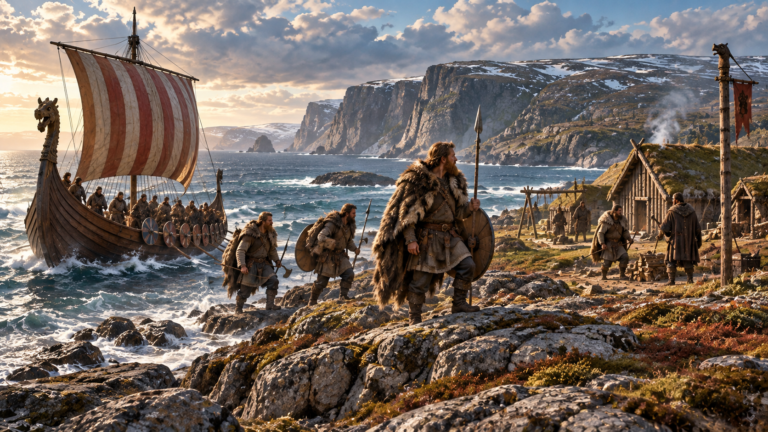
Ships were the technology that made the Viking Age possible.
Scandinavian shipbuilders produced vessels that could cross open seas, navigate coastal waters and move along rivers.
They used overlapping planks in a construction technique known as clinker building.
Lightweight hulls, shallow drafts and sails made Viking ships exceptionally flexible.
Were all Viking ships longships?
No.
The longship is the most famous Viking vessel because it was suited to warfare and rapid troop movement.
But cargo ships were equally important.
Trading vessels were broader and had much greater carrying capacity than narrow warships.
The National Museum of Denmark notes that some large ocean-going cargo ships could carry many tens of tons of goods.
Why were Viking longships effective?
Longships were fast, relatively shallow and highly maneuverable.
They could operate under sail or oar.
Their shallow draft allowed them to approach beaches and enter rivers where heavier vessels had difficulty following.
This gave raiders strategic surprise and allowed armies to move quickly between coastal and inland targets.
How did Vikings navigate?
Viking sailors did not have magnetic compasses in the modern sense.
They navigated using practical knowledge of coastlines, stars, the sun, winds, currents, birds and other environmental clues.
Exact navigational techniques are difficult to reconstruct because much knowledge was practical rather than recorded in detailed Viking Age manuals.
Why did Vikings raid?
No single explanation accounts for Viking raiding.
Possible motives included:
- portable wealth;
- political competition;
- status and prestige;
- slaves;
- land;
- tribute payments;
- opportunities created by improved ships and weakly defended targets.
Raiding could also evolve into longer-term warfare, taxation or settlement.
The raid on Lindisfarne
In 793, raiders attacked the monastery of Lindisfarne off the coast of Northumbria.
The event became famous because Christian writers recorded it as a shocking assault on a sacred place.
It was not the first Scandinavian contact with Britain, but it became a powerful symbol of the beginning of Viking raiding.
Why monasteries were attractive targets
Monasteries could contain valuable portable objects while having relatively limited military defenses.
Church treasures included precious metal vessels and ornaments.
Many surviving written sources were produced by Christian clergy, which helped shape the enduring image of Vikings as exceptionally violent enemies of religion.
Archaeology shows a broader world in which farming, trade and craft production were equally central to daily life.
Viking warriors
Not every Viking man was a warrior, and not every warrior fought full-time.
War bands could form around kings, chieftains and wealthy leaders.
Some fighters joined expeditions temporarily, while elite retainers could have more permanent military roles.
Successful warfare produced wealth, followers and political power.
What weapons did Vikings use?
Weapons varied according to wealth and role.
Common types included:
- spears;
- axes;
- swords;
- bows;
- round wooden shields.
Swords were expensive and could function as prestige objects as well as weapons.
The British Museum describes the double-edged sword as among the most prestigious weapons available to high-status warriors.
Did Vikings wear horned helmets?
No evidence shows that Viking warriors routinely wore horned helmets in battle.
The famous horned-helmet image developed much later, especially through nineteenth-century art, costume and romantic nationalism.
Actual Viking Age helmets were practical protective equipment.
Complete Viking helmets are archaeologically rare.
What were berserkers?
Old Norse literature describes warriors known as berserkir, associated with exceptional ferocity and sometimes with Odin.
Later stories portray them fighting in trance-like states or without normal armor.
Because much of this literature was written down generations after the Viking Age, it is difficult to separate historical warrior practices from literary exaggeration.
Claims that berserkers achieved their state through hallucinogenic mushrooms are speculative and not established fact.
Viking women
Women played essential economic, household and social roles.
They managed farms and households, produced textiles, raised children and could exercise authority when male relatives were away.
Some women traveled long distances as settlers, traders and members of migrating families.
Grave goods, inscriptions and later texts show that elite women could hold substantial wealth and status.
Could Viking women own property?
Women’s legal rights differed by region and period.
Later Scandinavian law codes suggest women could possess property and have inheritance rights under certain circumstances.
Widows could have especially important economic authority.
It would be misleading, however, to describe Viking society as modern gender equality. Political and military institutions were still heavily male-dominated.
Were there female Viking warriors?
This question remains debated.
Most evidence indicates that warfare was primarily male, but archaeology has complicated the old assumption that every weapon burial belonged to a man.
The famous Birka grave Bj.581 in Sweden contained an individual buried with an extensive set of weapons and military equipment. Ancient-DNA analysis confirmed that the individual was biologically female.
The researchers argue that the burial is best understood as a high-status warrior grave. Other scholars have debated how directly grave goods reveal a person’s occupation.
The evidence therefore supports the possibility that some women held warrior roles, but it does not demonstrate that large numbers of women routinely served in Viking armies.
Marriage and family
Marriage connected households, property and political alliances.
Families were fundamental to social identity.
Kinship influenced inheritance, legal disputes, revenge obligations and access to resources.
Households could include relatives, servants, laborers and enslaved people.
Children in Viking society
Children contributed to household work as they grew older.
They learned farming, craft and domestic skills from family and community members.
Childhood mortality was high by modern standards.
Elite children could also become part of political alliances through fosterage or marriage arrangements.
Slavery in Viking society
Slavery was a major and often overlooked part of Viking Age life.
Enslaved people were commonly called thralls in Old Norse contexts.
People could be captured during raids, purchased through trade or born into unfree status.
Slaves worked in households, agriculture and other forms of labor.
The slave trade connected Viking networks with markets across Europe and beyond.
Viking law and the Thing
Viking societies did not operate without law.
Free men gathered at political and legal assemblies known as things.
Assemblies dealt with disputes, inheritance, accusations, political decisions and agreements.
Law was initially transmitted largely through oral tradition before later being written down in medieval law codes.
Were Vikings ruled by kings?
Political organization changed significantly during the Viking Age.
Local chieftains and regional rulers competed for followers and territory.
Over time, larger kingdoms became more stable in Denmark, Norway and Sweden.
Royal power depended on military followers, taxation, trade, religious patronage and control of strategic places.
Viking religion
Early Viking Age Scandinavians practiced forms of pre-Christian Norse religion.
There was no single standardized doctrine comparable to a modern centralized church.
Religious practice varied locally and included sacrifices, feasts, burial rituals, sacred places and devotion to different gods.
Who were the main Norse gods?
Among the best-known gods were:
- Odin: associated with rulership, poetry, magic and the slain.
- Thor: associated with thunder, strength and protection.
- Freyja: associated with fertility, desire, magic and aspects of warfare and death.
- Freyr: associated with fertility and prosperity.
- Tyr: associated in surviving tradition with law and martial courage.
- Frigg: associated with Odin and high-status divine motherhood.
Our knowledge comes from archaeology, place names, inscriptions and medieval texts written mostly after Christianization, so reconstruction requires caution.
What was Valhalla?
In later Old Norse literary tradition, Valhalla was Odin’s hall where selected fallen warriors prepared for the final battle of Ragnarök.
It was not necessarily believed that every Viking who died went to Valhalla.
Norse ideas about death and the afterlife were varied, and burial practices differed greatly across regions and social groups.
Valkyries
Valkyries appear in Old Norse poetry and later prose as supernatural female figures connected with battle and the selection of the slain.
Small Viking Age images may depict female figures associated with this tradition.
Valkyries belong to religion and mythology and should not automatically be treated as proof that ordinary Viking women served as organized warrior units.
Viking burials
Burial practices varied enormously.
Some people were cremated. Others were buried in graves with objects.
Elite burials could include weapons, jewelry, animals, vehicles and ships.
The famous Oseberg ship burial in Norway contained two women and an exceptionally rich collection of objects.
Grave goods can reveal beliefs and social status, but interpreting the exact identity or occupation of a buried person is not always straightforward.
Did Vikings burn their dead in ships?
Ship burials existed, but the popular image of every Viking corpse placed on a burning ship and pushed out to sea is misleading.
Some people were buried inside ships or boats on land.
Other burials had no vessel at all.
Funerary practices depended on region, status and period.
How important were runes?
Vikings used runic writing for short inscriptions.
Runes appear on stones, wood, metal objects, jewelry and other materials.
They could record names, memorials, ownership, messages and magical or symbolic formulas.
Runes did not function as a full substitute for the large manuscript culture found in Christian Europe. Most Viking Age Scandinavian history was not recorded in books by Vikings themselves.
Why written sources must be used carefully
Many written descriptions of Vikings came from outsiders—especially Christian clerics who experienced or heard about raids.
The Vikings themselves left shorter runic inscriptions rather than large historical chronicles.
Later Icelandic sagas preserve valuable traditions, but they were written down generations after many of the events they describe.
Archaeology is therefore essential for reconstructing Viking daily life.
Viking settlement in England
Raids on Britain developed into conquest and settlement.
In the ninth century, a large Scandinavian army—often called the Great Heathen Army in later English sources—campaigned across Anglo-Saxon kingdoms.
Large areas of northern and eastern England came under Scandinavian control and influence.
The region later known as the Danelaw contained communities where Scandinavian law, language and settlement had a major impact.
Alfred the Great and the Vikings
King Alfred of Wessex resisted Viking armies in the late ninth century.
His victory over Guthrum at Edington in 878 helped preserve Wessex as an independent kingdom.
Peace agreements and conversion followed, but warfare between English and Scandinavian rulers continued for generations.
Viking York
York became one of the most important Scandinavian centers in England.
Known as Jórvík in Norse contexts, the city was connected with long-distance trade and craft production.
Archaeological excavations in York have revealed houses, workshops, tools, textiles and organic remains that provide unusually detailed evidence of urban Viking Age life.
Vikings in Ireland
Viking raiders began attacking Ireland in the late eighth century.
Over time, Scandinavian groups established permanent bases and settlements.
Dublin developed into a major commercial center connected to Atlantic and European trade networks.
Irish and Norse populations fought, traded, intermarried and influenced one another.
Normandy
In the early tenth century, the Frankish king granted territory around the lower Seine to the Scandinavian leader Rollo and his followers.
The region became known as Normandy—the land of the Northmen.
The descendants of Scandinavian settlers gradually adopted Christianity, French language and local political culture.
The Normans who conquered England in 1066 were therefore descendants of earlier Viking settlers, but by then they had developed a distinct identity.
Iceland
Norse settlers began colonizing Iceland during the late ninth century.
Iceland developed a farming society with an assembly known as the Althing.
Its later medieval literature became one of the richest sources for Old Norse myth, poetry and saga tradition.
Greenland
Norse settlers led by Erik the Red established communities in Greenland around the end of the tenth century.
These settlements depended on farming, hunting and trade.
They survived for centuries before disappearing in the later medieval period.
Vikings in North America
Norse voyagers crossed from Greenland to North America around the year 1000.
Archaeology at L’Anse aux Meadows in Newfoundland confirmed a Norse presence in the Americas centuries before Columbus.
Research using tree rings and a known atmospheric radiocarbon event established that Norse people were cutting wood at the site in exactly 1021 CE.
Read the full evidence in our guide: Vikings Were in North America in the Year 1021.
Vikings traveling east
Scandinavian travelers also moved east through the Baltic and river systems of eastern Europe.
They participated in trade routes connecting the Baltic with the Black Sea, Caspian Sea, Byzantium and the Islamic world.
Groups described as Varangians became involved in the politics and trade of the emerging Rus’ states.
The Varangian Guard
Scandinavian warriors became famous as mercenaries in Byzantine service.
The Varangian Guard developed into an elite unit associated with the Byzantine emperor.
Over time it included not only Scandinavians but also Anglo-Saxons and other northern Europeans.
Did Vikings reach the Islamic world?
Yes.
Trade networks connected Scandinavia with the Islamic world through eastern European river routes.
Large numbers of Arabic silver dirhams have been found in Scandinavia and the Baltic.
These coins show the scale and reach of Viking Age commerce.
Christianity and the Vikings
Christian conversion was gradual.
Some Scandinavians encountered Christianity through trade, slavery, diplomacy, migration and missionary activity long before rulers officially converted.
For generations, Christian and traditional Norse practices could exist side by side.
Harald Bluetooth
The Danish king Harald Bluetooth is closely associated with the Christianization and political consolidation of Denmark.
The famous Jelling stone states that Harald won Denmark and Norway and made the Danes Christian.
The inscription is a political claim, not proof that every inhabitant immediately abandoned older beliefs.
Conversion was a long social process.
Why did Vikings convert to Christianity?
Religious belief mattered, but conversion also had political and economic dimensions.
Christian rulers could form alliances and participate more easily in the diplomatic world of Christian Europe.
Merchants operating in Christian regions also had incentives to accommodate Christian practices.
Kings could use the church to strengthen centralized government and royal legitimacy.
When did the Viking Age end?
The Viking Age did not stop on one day.
In England, the defeat of Norwegian king Harald Hardrada at Stamford Bridge in 1066 is often used symbolically.
But Scandinavian expansion, trade and warfare continued afterward.
More important long-term changes included Christianization, stronger kingdoms, new military structures and deeper integration into medieval European politics.
Viking myths and reality
Myth: every Viking was a raider
Most Scandinavians were farmers, craftspeople and local householders. Only a portion took part in overseas raiding.
Myth: Vikings wore horned helmets
There is no evidence that Viking warriors routinely wore horned helmets in battle.
Myth: Vikings were uniquely dirty
Archaeology has recovered combs, grooming tools and personal-care objects. Cleanliness varied, but the stereotype of universally filthy Vikings is not supported.
Myth: Vikings only destroyed
Viking networks also created towns, trade routes, settlements and political states.
Myth: Vikings were one unified nation
There was no single Viking country. Scandinavia contained competing communities, chieftains and kingdoms.
Myth: female warriors definitely never existed
The Birka Bj.581 burial shows why categorical statements are risky. The buried individual was biologically female and was interred with a remarkable set of military objects, although the broader prevalence of female warriors remains debated.
Viking Age timeline
- 793: raid on Lindisfarne becomes a symbolic beginning of the Viking Age in Britain.
- 9th century: Scandinavian raiding and settlement expand across Britain, Ireland and continental Europe.
- c. 865: the Great Heathen Army begins major campaigns in England.
- 878: Alfred defeats Guthrum at Edington.
- late 9th century: Norse settlement of Iceland accelerates.
- 911: Rollo receives territory that develops into Normandy.
- 10th century: Scandinavian kingdoms consolidate and Christian conversion expands.
- c. 965: Harald Bluetooth’s Jelling stone proclaims Denmark Christian.
- late 10th century: Norse settlements established in Greenland.
- 1021: Norse people are demonstrably active at L’Anse aux Meadows in Newfoundland.
- 1016–1035: Cnut rules England and a wider North Sea empire for part of this period.
- 1066: Harald Hardrada is defeated at Stamford Bridge, a common symbolic endpoint for the Viking Age in England.
Vikings FAQ
Where did Vikings come from?
They came primarily from Viking Age Scandinavia: the regions that became Denmark, Norway and Sweden.
What did Vikings do for a living?
Most were farmers. Others were craftsmen, traders, sailors, warriors, political leaders or enslaved laborers.
Did Vikings have women warriors?
Most warfare appears to have been male, but the female burial Bj.581 at Birka has reopened debate over whether some women held warrior roles. Evidence does not support a large, routine female warrior class.
What religion did Vikings follow?
Early Viking communities practiced diverse forms of Norse pagan religion involving gods such as Odin and Thor. Christianity spread gradually and became dominant as Scandinavian kingdoms converted.
Did Vikings discover America?
Norse people reached North America centuries before Columbus. Archaeology confirms their presence at L’Anse aux Meadows, Newfoundland.
Did Vikings wear horned helmets?
No archaeological evidence shows routine horned battle helmets among Viking warriors.
Why were Viking ships so important?
The ships combined speed, shallow draft, sails and seaworthiness, allowing Scandinavians to raid, trade, migrate and explore across extraordinary distances.
Sources and further reading
- National Museum of Denmark — The Viking Age
- National Museum of Denmark — The People of the Viking Age
- National Museum of Denmark — Viking Travel and Ships
- British Museum — Vikings: Life and Legend
- Antiquity — Viking Warrior Women? Reassessing Birka Grave Bj.581
- Neil Price, Children of Ash and Elm: A History of the Vikings.
- Else Roesdahl, The Vikings.
CONTINUE EXPLORING
More Viking & Medieval History
Stories, people and events that shaped our world. Explore history with context, clarity and curiosity.
© 2026 Passion for History. All rights reserved.
Some content is created with AI assistance and may contain errors. We aim to review, verify and improve our articles over time.