In 897, a Dead Pope Was Put on Trial
The history behind the Cadaver Synod: the trial of Pope Formosus’s body, its political causes and what the sources actually say.
In 897, Pope Stephen VI had his predecessor Formosus, dead since 896, exhumed and tried at a Roman church council now called the Cadaver Synod. Formosus was condemned and his ordinations declared invalid, but later popes reversed the judgment amid continuing factional conflict.
The history behind the Cadaver Synod: the trial of Pope Formosus’s body, its political causes and what the sources actually say. The discussion below separates documented events from uncertain details and later interpretations.
On this page — 20 topics
Medieval politics could be vicious, but the events of Rome in 897 went beyond ordinary rivalry. A pope’s enemies brought him to trial even though he had already been dead for months.
The fact
In 897, the body of Pope Formosus was exhumed and placed on trial in an episode now known as the Cadaver Synod.
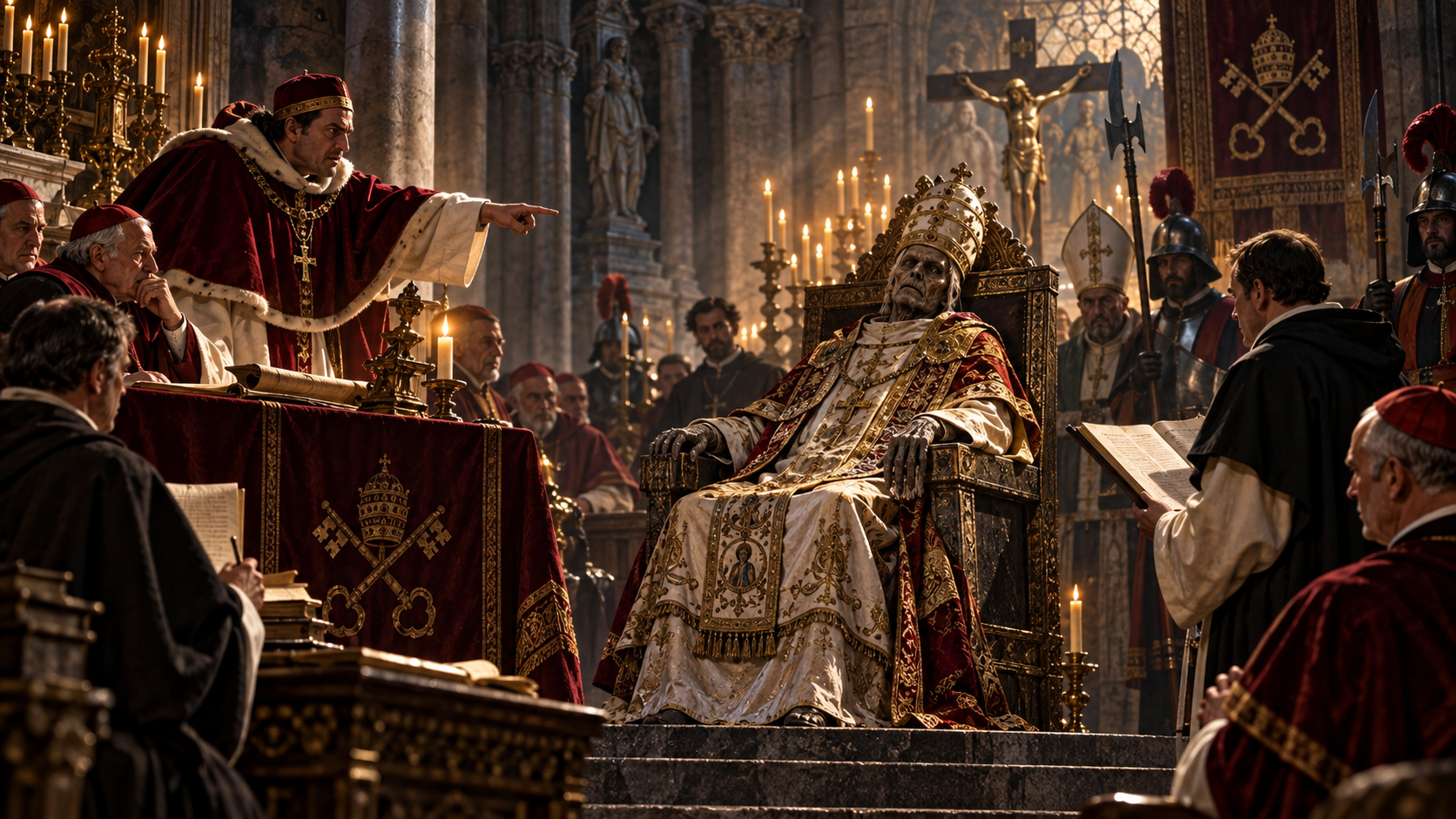
The corpse was dressed in papal vestments and seated in the Basilica of St. John Lateran. A deacon was assigned to respond on behalf of the dead man while Pope Stephen VI presided over the proceedings.
Who was Pope Formosus before the trial?
Formosus was a senior church official who became pope in 891 and died in 896. His career included diplomatic missions and disputes within the church, giving him allies and enemies before he took the papal throne.
The late ninth-century papacy did not operate independently of Italian rulers. Roman aristocratic factions and rival political leaders competed for influence, including claims connected to imperial titles and territory.
These conflicts explain why his successor’s government could treat past papal decisions as politically dangerous. The historical entry on Formosus describes the factional context, but as an older reference it should be read together with modern scholarship rather than taken as a neutral account of every motive.
Why put a corpse on trial?
The spectacle was rooted in fierce political struggles over control of Italy and the papacy. Formosus had become entangled in rival claims involving powerful Italian families and rulers competing for imperial influence.
After his death in 896, his enemies wanted not merely to criticize him but to invalidate his authority and many of the acts he had performed as pope.
Who ordered the Cadaver Synod?
Stephen, the reigning pope in 897, arranged the council that judged Formosus. Modern lists usually call him Stephen VI, while some older sources call him Stephen VII because of a historical difference in how another short-lived Stephen was counted.
The numbering issue is a useful example of how names in reference works can change without referring to different people. The pope who presided over the Cadaver Synod is the same individual in both conventions.
His political position was connected with forces that opposed Formosus’s earlier alliances. Historians can identify the factions involved, but the inner motives of each participant cannot always be determined from narratives written after the event.
The charges
The court accused Formosus of violating church rules, including improperly moving from one episcopal see to another and obtaining the papacy illegitimately.
The outcome was unsurprising. The dead pope was declared guilty. His papal acts were annulled, his vestments were removed and the fingers associated with giving blessings were cut from the corpse.
What happened when the corpse was brought into the church?
According to the historical accounts, Formosus’s body was removed from its grave, dressed in papal garments and placed before the assembled clergy. A deacon was assigned to answer the charges in the dead man’s name.
The sight is extraordinary to modern readers, but the event was more than a bizarre piece of theatre. The council was attempting to attach a legal and religious judgment to the dead pope’s actions and office.
Secondary accounts should be distinguished from eyewitness transcripts: no modern courtroom-style record of every speech survives. The 2016 historical review of the Cadaver Synod summarises the episode and its consequences, and the older Formosus biography preserves the traditional description.
What happened to the body?
Accounts describe the body being buried and later thrown into the Tiber. It was subsequently recovered and eventually returned to a proper burial.
The treatment of Formosus shocked even a city accustomed to violent political changes.
What charges were made against Formosus?
Accusations centred on whether Formosus had properly occupied the papacy after serving as bishop of another see, Porto, and whether his earlier conduct or decisions violated church law. Rules about transferring from one episcopal office to another were central to the controversy.
These charges were not the same as an ordinary criminal trial for theft or violence. The council sought to invalidate ecclesiastical acts, appointments and ordinations, making the outcome important to clergy who had received office under Formosus.
The arguments were embedded in political rivalries. Treating the charges merely as an absurd reaction to a corpse misses the practical stakes: a judgment against a deceased pope could be used to challenge living bishops and the legitimacy of political or religious decisions.
The backlash
The Cadaver Synod damaged Pope Stephen’s position. Public anger and political upheaval followed, and Stephen was deposed, imprisoned and later killed.
Subsequent church councils reversed the judgment against Formosus and restored the validity of his pontificate. The episode became a symbol of how deeply secular political rivalries had penetrated the papacy in the late ninth century.
Why were fingers removed from the dead pope?
Traditional accounts describe the removal of three fingers from Formosus’s right hand, associated with blessings and ordinations. The body was stripped of papal vestments and treated as that of a man condemned by the council.
The act communicated the attempt to strip Formosus of legitimacy even after death. It also created a memorable image that later writers used to condemn the perpetrators and illustrate the instability of Roman church politics.
Historians should avoid adding invented dialogue or extra physical details. The published historical article and the Stephen VI reference biography recount the key acts, but surviving sources do not give us a detailed visual record of every moment.
A note on Stephen’s numbering
You may see the presiding pope called either Stephen VI or Stephen VII in older and modern sources. The difference comes from historical changes in how an earlier short-lived Stephen was counted in the official sequence of popes.
Was Formosus really thrown into the River Tiber?
Sources report that after condemnation the corpse was buried in a common grave and later thrown into the Tiber. It was subsequently recovered and returned to burial with honours after political circumstances changed.
The broad sequence is recorded in historical accounts, but descriptions of precise timing and participants differ. A brief narrative can be reliable about the public result without preserving every step of the corpse’s movement.
The recovery was politically meaningful because rehabilitating the dead pope also challenged Stephen’s judgment. How Formosus was buried mattered to the public presentation of papal authority as much as to the treatment of a particular body.
Why the Cadaver Synod still fascinates historians
The image of a corpse seated for trial is unforgettable, but the episode is more than medieval grotesquerie. It reveals a period when the papacy was vulnerable to competing aristocratic and imperial factions, and when control of religious office carried enormous political consequences.
It is one of history’s clearest examples of political vengeance continuing beyond the grave.
Who reversed the Cadaver Synod’s ruling?
Stephen’s position collapsed during upheaval in Rome; he was imprisoned and died in 897. Later popes and synods restored Formosus’s standing and recognised the validity of ordinations he had conferred.
Pope John IX confirmed reversals of the cadaver trial at councils in the late 890s. The dispute nevertheless did not vanish: factions continued to contest its outcome, and later arguments over Formosus returned in the tenth century.
The Formosus reference entry describes both the annulment and later controversy under Sergius III. This sequence prevents a misleading statement that the matter was permanently settled within weeks of Stephen’s downfall.
Sources and further reading
What did the trial reveal about Rome in 897?
The event illustrates how papal office was entangled with alliances among Roman aristocrats and regional rulers. An outgoing pope’s appointments, support for rulers and political contacts could be challenged by successors with different patrons.
Rome’s church leadership had spiritual authority, but the ability to exercise it depended partly on political circumstances. The violent deposition of one pope and vindication of another demonstrated the instability of those arrangements.
The lesson is not that medieval people were uniformly irrational. Institutions were being used in a power struggle in ways that later observers found scandalous. By explaining the legal claims and rival factions, historians can understand the event without excusing its cruelty.
How reliable are the stories of the Cadaver Synod?
Accounts of dramatic events often survive because they became useful symbols in later political or moral arguments. The Cadaver Synod was remembered for its shocking treatment of Formosus, but historians still examine when particular descriptions were recorded and which side the writer favoured.
A modern research method checks dates of papal reigns, records of councils and contemporary or near-contemporary commentaries. It also separates the core events from dialogue and emotional reactions supplied by later retellings.
The 2016 article indexed by PubMed is a modern historical overview, not an eyewitness source. Older ecclesiastical reference works supply detailed narratives but must likewise be examined critically.
Cadaver Synod timeline: 891–904
| Year | Event |
|---|---|
| 891 | Formosus becomes pope |
| 896 | Formosus dies; Stephen later succeeds |
| 897 | Cadaver Synod; Stephen’s eventual downfall |
| 897–898 | Formosus’s status restored in later church decisions |
| 904 onward | Renewed controversy under Sergius III |
Events are listed by year because not every source agrees on the exact chronology of each action. A timeline is useful for seeing why the verdict changed with political leadership. It should not suggest a single stable authority controlled Rome throughout the conflict.
Five misconceptions about the dead pope’s trial
Myth: the accused was a living pope. Formosus had been dead for months when his body was exhumed.
Myth: the trial was a normal medieval criminal case. It concerned church office and ecclesiastical acts within a political conflict.
Myth: Stephen VI and Stephen VII were different judges. Both numbers have been used for the same pope due to historical numbering practices.
Myth: the corpse answered the questions. A deacon was assigned to respond on its behalf.
Myth: the condemnation stayed in force permanently. Later councils reversed it, although factional disputes continued.
Why the Cadaver Synod remains important
The event shows how religious legitimacy could be treated as a political resource. Challenging the status of a dead pope affected living bishops, allies and the authority of later officeholders.
It also reveals the limits of a purely sensational approach to history. The corpse’s treatment was extraordinary, but the more important question is why rival groups fought to reinterpret previous appointments and acts.
Useful further reading includes the Formosus biographical account and the modern historical review. The surviving evidence supports a strong narrative without the need for invented quotations or exaggerated details.